×
Request Free Sample ×

Kindly complete the form below to receive a free sample of this Report

* Please use a valid business email

Leading companies partner with us for data-driven Insights

clients tt-cursor
Hero Background

Italy Electronic Data Interchange Software Market

ID: MRFR/ICT/57963-HCR
200 Pages
Aarti Dhapte
February 2026

Italy Electronic Data Interchange EDI Software Market Size, Share and Research Report: By Component (Solution, Services), By Type (Direct EDI, EDI via AS2, EDI via VAN, Mobile EDI, Web EDI, EDI Outsourcing, Others) and By Industry (Retail and Consumer Goods, BFSI, Healthcare, IT and Telecommunication, Transportation and Logistics, Others)-Forecast to 2035

Share:
Download PDF ×

We do not share your information with anyone. However, we may send you emails based on your report interest from time to time. You may contact us at any time to opt-out.

Italy Electronic Data Interchange Software Market Infographic
Purchase Options

Italy Electronic Data Interchange Software Market Summary

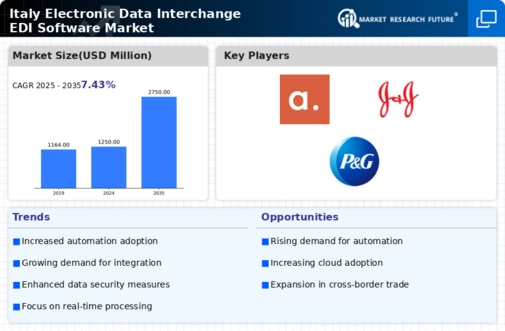
As per analysis, The Italy electronic data interchange software market is projected to grow from USD 63.7 Million in 2024 to USD 169.75 Million by 2035, exhibiting a compound annual growth rate (CAGR) of 9.32% during the forecast period (2025 - 2035).

Key Market Trends & Highlights

The Italy electronic data interchange software market is experiencing a robust shift towards cloud-based solutions and advanced technologies.

  • The Order Processing segment remains the largest contributor to the market, driven by the need for efficient transaction management.
  • Healthcare is identified as the fastest-growing segment, reflecting an increasing demand for streamlined data exchange in medical environments.
  • Retail continues to dominate the market, showcasing a strong reliance on electronic data interchange for inventory and sales management.
  • Key market drivers include the growing demand for automation and rising e-commerce activities, which are reshaping operational efficiencies.

Market Size & Forecast

2024 Market Size 63.7 (USD Million)
2035 Market Size 169.75 (USD Million)
CAGR (2025 - 2035) 9.32%

Major Players

SAP (DE), IBM (US), Sage (GB), Oracle (US), Integromat (CZ), Cegedim (FR), Systech (IT), Kewill (GB), TrueCommerce (US)

Our Impact
Enabled $4.3B Revenue Impact for Fortune 500 and Leading Multinationals
Partnering with 2000+ Global Organizations Each Year
30K+ Citations by Top-Tier Firms in the Industry

Italy Electronic Data Interchange Software Market Trends

The Italy electronic data interchange software market is currently experiencing a notable evolution, driven by the increasing demand for streamlined business processes and enhanced operational efficiency. Organizations across various sectors are recognizing the value of electronic data interchange (EDI) solutions in facilitating seamless communication and data exchange. This trend is particularly evident in industries such as retail, logistics, and manufacturing, where timely and accurate information flow is crucial for maintaining competitiveness. Furthermore, the Italian government has been actively promoting digital transformation initiatives, which further supports the adoption of EDI technologies. As businesses seek to optimize their supply chains and improve collaboration with partners, the relevance of EDI software continues to grow. In addition to operational benefits, The Italy electronic data interchange software market is also influenced by regulatory requirements that encourage electronic transactions. Compliance with standards set by authorities is becoming increasingly important for businesses aiming to avoid penalties and ensure smooth operations. Moreover, the rise of cloud-based EDI solutions is transforming the landscape, offering flexibility and scalability to organizations of all sizes. As the market evolves, it appears that the integration of advanced technologies, such as artificial intelligence and machine learning, may further enhance the capabilities of EDI systems, providing even greater value to users. Overall, the future of the Italy electronic data interchange software market seems promising, with ongoing advancements likely to shape its trajectory.

Increased Adoption of Cloud-Based Solutions

The shift towards cloud-based electronic data interchange solutions is becoming more pronounced in the Italy electronic data interchange software market. Organizations are increasingly favoring these solutions due to their scalability, cost-effectiveness, and ease of integration with existing systems. This trend allows businesses to enhance their operational efficiency while minimizing the need for extensive IT infrastructure.

Focus on Regulatory Compliance

Regulatory compliance is emerging as a critical driver in the Italy electronic data interchange software market. Businesses are recognizing the necessity of adhering to local and international standards to avoid potential penalties. This focus on compliance is prompting organizations to invest in EDI solutions that ensure secure and efficient data exchange, thereby fostering trust among trading partners.

Integration of Advanced Technologies

The incorporation of advanced technologies, such as artificial intelligence and machine learning, is beginning to influence the Italy electronic data interchange software market. These technologies have the potential to enhance data processing capabilities, improve decision-making, and streamline operations. As organizations seek to leverage these innovations, the demand for sophisticated EDI solutions is likely to increase.

Italy Electronic Data Interchange Software Market Drivers

Rising E-commerce Activities

The surge in e-commerce activities in Italy is significantly influencing the electronic data interchange software market. With the increasing number of online transactions, businesses are compelled to adopt EDI solutions to manage orders, invoices, and shipping documents efficiently. The Italian e-commerce market has experienced a growth rate of over 15% annually, leading to a heightened need for effective data management systems. EDI software facilitates real-time data exchange, which is essential for maintaining customer satisfaction and operational efficiency in the fast-paced e-commerce environment. As more retailers and wholesalers embrace digital platforms, the reliance on EDI systems is likely to intensify, thereby driving market growth. This trend suggests that the integration of EDI solutions will become a standard practice for businesses aiming to thrive in the competitive e-commerce landscape.

Growing Demand for Automation

The increasing demand for automation in business processes is a pivotal driver for The Italy electronic data interchange software market. Companies are seeking to streamline operations, reduce manual errors, and enhance efficiency. Automation through EDI solutions allows for seamless data exchange between trading partners, which is crucial in sectors such as manufacturing and retail. According to recent statistics, the adoption of EDI solutions in Italy has risen by approximately 25% over the past two years, indicating a robust trend towards automated processes. This shift not only improves operational efficiency but also fosters better relationships with suppliers and customers, as timely and accurate data exchange becomes the norm. As businesses continue to recognize the benefits of automation, the demand for EDI software is expected to grow, further propelling the market forward.

Increased Focus on Data Security

The heightened focus on data security is emerging as a critical driver for the Italy electronic data interchange software market. With the rise in cyber threats and data breaches, businesses are prioritizing secure data exchange methods. EDI solutions offer enhanced security features, such as encryption and secure access controls, which are essential for protecting sensitive information. In Italy, regulatory frameworks like the General Data Protection Regulation (GDPR) have further emphasized the importance of data security in business operations. Companies are increasingly adopting EDI systems to ensure compliance with these regulations while safeguarding their data. This growing awareness of data security risks is likely to propel the demand for electronic data interchange software, as organizations seek reliable solutions to mitigate potential threats.

Supportive Government Initiatives

Government initiatives aimed at promoting digital transformation are playing a crucial role in the growth of the Italy electronic data interchange software market. The Italian government has implemented various policies to encourage businesses to adopt digital solutions, including EDI systems. Programs that provide financial incentives for technology adoption and training are becoming increasingly common. For instance, the 'Industry 4.0' initiative aims to enhance the competitiveness of Italian companies through digitalization. Such supportive measures not only facilitate the transition to EDI but also create a favorable environment for software vendors. As businesses respond to these initiatives, the market for electronic data interchange software is likely to expand, reflecting the government's commitment to fostering innovation and efficiency in the economy.

Need for Enhanced Supply Chain Management

The necessity for improved supply chain management is a significant driver for the Italy electronic data interchange software market. Companies are increasingly recognizing that efficient supply chain operations are vital for maintaining competitiveness. EDI solutions enable real-time visibility and tracking of goods, which is essential for effective inventory management and order fulfillment. In Italy, industries such as automotive and food processing are particularly reliant on robust supply chain systems. The integration of EDI software allows for better coordination among suppliers, manufacturers, and distributors, thereby reducing lead times and costs. As businesses strive to optimize their supply chains, the demand for electronic data interchange solutions is expected to rise, indicating a strong growth trajectory for the market.


Market Segment Insights

By Application: Order Processing (Largest) vs. Supply Chain Management (Fastest-Growing)

In The Italy electronic data interchange software market, the Order Processing segment holds the largest share, benefiting from the increasing demand for streamlined transaction processes in various sectors such as retail and e-commerce. This dominance is attributed to the growing necessity for businesses to automate order management systems to enhance efficiency and reduce manual errors, thus providing a significant competitive edge in the marketplace. On the other hand, the Supply Chain Management segment is identified as the fastest-growing part of this market. Driven by the rising need for integrated and optimized supply chain solutions, companies are rapidly adopting technologies that facilitate real-time inventory tracking and better demand forecasting. This upward trend is further fueled by challenges such as global supply disruptions, making efficient supply chain management crucial for operational success in today’s economic climate.

Order Processing (Dominant) vs. Inventory Management (Emerging)

Order Processing serves as the dominant application within the Italy electronic data interchange software market due to its essential role in facilitating seamless transactions and ensuring customer satisfaction. This segment focuses on automating and managing the various stages involved in order placement, confirmation, and fulfillment, which is invaluable in sectors where speed and accuracy are paramount. In contrast, Inventory Management is rapidly emerging as a vital application as businesses strive to optimize their inventory levels and minimize holding costs. Its increasing adoption reflects a broader market trend toward integrating advanced data analytics and AI tools to enhance operational efficiency and responsiveness to market demands.

By End Use: Retail (Largest) vs. Healthcare (Fastest-Growing)

In The Italy electronic data interchange software market, the retail sector commands a substantial share, driven by the rapid digitization of processes and the increasing demand for efficient supply chain management. Retailers are increasingly adopting EDI solutions to streamline operations, improve inventory management, and enhance customer service, resulting in significant market participation. On the other hand, the healthcare sector is emerging as the fastest-growing segment as organizations strive for interoperability and compliance with regulatory standards. The ongoing shift toward digital health solutions is fostering a burgeoning demand for EDI in this industry.

Retail: Dominant vs. Healthcare: Emerging

The retail sector remains the dominant player in the Italy electronic data interchange software market, characterized by its focus on operational efficiency, cost-effectiveness, and improved customer engagement. Retailers utilize EDI to automate transactions and manage supply chains seamlessly, facilitating timely communication with suppliers and customers. Conversely, the healthcare segment is identified as emerging, with a notable acceleration in technology adoption to meet industry-specific needs such as patient data exchange, insurance claim processing, and regulatory compliance. As hospitals and healthcare providers increasingly embrace digital transformation, the demand for tailored EDI solutions is expected to surge, enhancing patient care and operational workflows.

By Deployment Type: Cloud-Based (Largest) vs. Hybrid (Fastest-Growing)

In The Italy electronic data interchange software market, the distribution of deployment types reveals that cloud-based solutions dominate the landscape. This segment has captured a significant portion of the market due to their scalability, cost-effectiveness, and ease of integration. On-premises solutions, while still relevant, have seen a decline as organizations migrate towards more flexible models. Hybrid deployments are gaining traction, offering the benefits of both cloud and on-premises while ensuring data security and compliance. The growth trends indicate a strong shift towards cloud-based deployments driven by the increasing need for remote access and real-time collaboration. Organizations are investing in digital transformation initiatives, and cloud-based EDI solutions provide the agility needed to meet evolving business demands. Concurrently, the hybrid model is emerging rapidly, appealing to businesses looking to combine legacy systems with modern capabilities, making it the fastest-growing segment in Italy's EDI landscape.

Cloud-Based (Dominant) vs. Hybrid (Emerging)

Cloud-based electronic data interchange solutions are positioned as the dominant force in the Italy market due to their adaptability and user-friendly interfaces. Companies are adopting these solutions to enhance operational efficiency and reduce overhead costs. Meanwhile, hybrid solutions are emerging as a preferred choice for organizations that require a customized approach. They allow businesses to maintain their on-premises systems while leveraging the advantages of cloud technology. The flexibility offered by hybrid deployments caters to various operational needs, enabling firms to transition gradually to cloud-based environments. As a result, both deployment types play crucial roles in shaping the future of EDI software, with cloud-based solutions leading and hybrid models rapidly gaining popularity.

By Integration Type: API Integration (Largest) vs. EDI Integration (Fastest-Growing)

In The Italy electronic data interchange software market, the API Integration segment holds the largest share, reflecting its widespread adoption among businesses looking for real-time data exchange capabilities. EDI Integration continues to play a significant role, catering to industries with established electronic trading relationships, but API is increasingly preferred for its flexibility and ease of integration with modern systems. As companies embrace digitization, these approaches are becoming essential for efficient operations. The growth of the API Integration segment is driven by the increasing demand for real-time data and seamless connectivity between different software applications. Meanwhile, EDI Integration is witnessing rapid growth due to the necessity of standardization in transactions, particularly in manufacturing and retail sectors. As companies adapt to changing market dynamics, the emphasis on innovative integration solutions is set to intensify, ensuring a competitive edge in the digital landscape.

API Integration (Dominant) vs. Web Services Integration (Emerging)

API Integration is clearly established as the dominant integration method within the Italy electronic data interchange software market, allowing businesses to connect disparate software systems and facilitate real-time data exchange efficiently. This integration type is favored for its scalability and ability to bridge legacy systems with modern applications. On the other hand, Web Services Integration is emerging as a viable alternative, providing a set of standards for interoperability among applications over the internet. As organizations pursue digital transformations, Web Services Integration is increasingly recognized for enhancing collaboration and operational efficiency, although it still trails behind API Integration in overall market traction. Both segments are crucial as businesses adapt to evolving technology landscapes and strive for operational excellence.

By Business Size: Small Enterprises (Largest) vs. Large Enterprises (Fastest-Growing)

In The Italy electronic data interchange software market, small enterprises currently hold the largest market share. Their dominance is attributed to the growing digitalization of business processes and the increasing necessity for efficient communication solutions. Meanwhile, large enterprises are emerging as the fastest-growing segment, driven by the need for robust and integrated solutions that facilitate seamless interoperability across various platforms and locations. Growth in the segment is largely fueled by the increasing adoption of cloud-based solutions by medium and large enterprises, which enhance operational efficiency and data accuracy. Additionally, regulatory pressures and the demand for compliance have prompted these businesses to invest more in electronic data interchange systems. As digital transformation accelerates, the prospects for both small and large enterprises in this market are expected to thrive in the coming years.

Small Enterprises (Dominant) vs. Large Enterprises (Emerging)

Small enterprises play a dominant role in the Italy electronic data interchange software market, prioritizing affordable and user-friendly solutions that offer quick deployment and ease of use. They typically seek scalable options that can grow with their business needs. In contrast, large enterprises, while currently an emerging segment, are increasingly adopting sophisticated EDI solutions that enable complex integrations and data management across extensive operations. Their investment is driven by the necessity for enhanced operational efficiencies and compliance with industry standards. Large enterprises often require customization and advanced features, making them a critical audience for EDI vendors aiming to capture this segment.

Get more detailed insights about Italy Electronic Data Interchange Software Market

Key Players and Competitive Insights

The electronic data interchange software market in Italy is characterized by a dynamic competitive landscape, driven by the increasing demand for streamlined business processes and enhanced operational efficiency. Key players such as SAP (DE), IBM (US), and Oracle (US) are at the forefront, leveraging their extensive technological capabilities and market presence. SAP (DE) focuses on innovation through continuous software enhancements, while IBM (US) emphasizes partnerships and cloud-based solutions to cater to diverse client needs. Oracle (US) is strategically positioned with its comprehensive suite of applications, which integrates EDI functionalities, thereby enhancing its competitive edge. Collectively, these strategies foster a robust environment where technological advancement and customer-centric solutions are paramount.

In terms of business tactics, companies are increasingly localizing their operations to better serve the Italian market, optimizing supply chains to enhance efficiency. The competitive structure appears moderately fragmented, with several players vying for market share. However, the influence of major companies remains substantial, as they set industry standards and drive innovation. This competitive interplay suggests a landscape where agility and responsiveness to market demands are critical for success.

In December 2025, SAP (DE) announced a strategic partnership with a leading Italian logistics firm to enhance its EDI capabilities, aiming to streamline supply chain processes for local businesses. This collaboration is likely to bolster SAP's market position by providing tailored solutions that address specific regional challenges, thereby enhancing customer satisfaction and loyalty. The move underscores the importance of localized strategies in a competitive market.

In November 2025, IBM (US) launched a new AI-driven EDI solution designed to automate data exchange processes for small and medium-sized enterprises (SMEs) in Italy. This initiative reflects IBM's commitment to digital transformation and its recognition of the growing need for SMEs to adopt advanced technologies. By simplifying EDI integration, IBM may significantly expand its customer base and enhance operational efficiencies for its clients.

In October 2025, Oracle (US) unveiled an updated version of its EDI software, incorporating advanced analytics features that allow businesses to gain insights from their data exchanges. This enhancement is indicative of Oracle's focus on innovation and its strategy to provide clients with tools that not only facilitate transactions but also drive strategic decision-making. Such developments are likely to strengthen Oracle's competitive position in the market.

As of January 2026, current trends in the electronic data interchange software market include a pronounced shift towards digitalization, sustainability, and AI integration. Strategic alliances are increasingly shaping the competitive landscape, enabling companies to pool resources and expertise. The evolution of competitive differentiation appears to be moving away from price-based competition towards a focus on innovation, technology, and supply chain reliability. This shift suggests that companies that prioritize these elements will likely emerge as leaders in the market.

Key Companies in the Italy Electronic Data Interchange Software Market include

Future Outlook

Italy Electronic Data Interchange Software Market Future Outlook

The Italy electronic data interchange software market is projected to grow at a 9.32% CAGR from 2025 to 2035, driven by digital transformation and regulatory compliance.

New opportunities lie in:

  • Integration of AI-driven analytics for enhanced decision-making.
  • Development of industry-specific EDI solutions for niche markets.
  • Expansion of cloud-based EDI platforms to improve accessibility.

By 2035, the market is expected to be robust, reflecting substantial growth and innovation.

Market Segmentation

Italy Electronic Data Interchange Software Market End Use Outlook

  • Retail
  • Manufacturing
  • Healthcare
  • Finance
  • Telecommunications

Italy Electronic Data Interchange Software Market Application Outlook

  • Supply Chain Management
  • Order Processing
  • Inventory Management
  • Invoicing
  • Shipping and Logistics

Italy Electronic Data Interchange Software Market Business Size Outlook

  • Small Enterprises
  • Medium Enterprises
  • Large Enterprises

Italy Electronic Data Interchange Software Market Deployment Type Outlook

  • On-Premises
  • Cloud-Based
  • Hybrid

Italy Electronic Data Interchange Software Market Integration Type Outlook

  • API Integration
  • EDI Integration
  • Web Services Integration
  • File Transfer Protocol Integration

Report Scope

MARKET SIZE 202463.7(USD Million)
MARKET SIZE 202570.25(USD Million)
MARKET SIZE 2035169.75(USD Million)
COMPOUND ANNUAL GROWTH RATE (CAGR)9.32% (2024 - 2035)
REPORT COVERAGERevenue Forecast, Competitive Landscape, Growth Factors, and Trends
BASE YEAR2024
Market Forecast Period2025 - 2035
Historical Data2019 - 2024
Market Forecast UnitsUSD Million
Key Companies ProfiledSAP (DE), IBM (US), Sage (GB), Oracle (US), Integromat (CZ), Cegedim (FR), Systech (IT), Kewill (GB), TrueCommerce (US)
Segments CoveredApplication, End Use, Deployment Type, Integration Type, Business Size
Key Market OpportunitiesIntegration of artificial intelligence in the italy electronic data interchange software market enhances efficiency and decision-making.
Key Market DynamicsRising demand for seamless integration drives competition among electronic data interchange software providers in Italy.
Countries CoveredItaly
Leave a Comment

FAQs

What is the current valuation of the Italy electronic data interchange software market?

The market valuation was 63.7 USD Million in 2024.

What is the projected market size for the Italy electronic data interchange software market by 2035?

The projected valuation for 2035 is 169.75 USD Million.

What is the expected CAGR for the Italy electronic data interchange software market during the forecast period?

The expected CAGR for the market from 2025 to 2035 is 9.32%.

Which companies are considered key players in the Italy electronic data interchange software market?

Key players include SAP, IBM, Sage, Oracle, Integromat, Cegedim, Systech, Kewill, and TrueCommerce.

What are the primary applications of electronic data interchange software in Italy?

Primary applications include Supply Chain Management, Order Processing, Inventory Management, Invoicing, and Shipping and Logistics.

How does the market segment by end use in the Italy electronic data interchange software market?

The market segments by end use include Retail, Manufacturing, Healthcare, Finance, and Telecommunications.

What are the deployment types available in the Italy electronic data interchange software market?

Deployment types include On-Premises, Cloud-Based, and Hybrid solutions.

What integration types are utilized in the Italy electronic data interchange software market?

Integration types include API Integration, EDI Integration, Web Services Integration, and File Transfer Protocol Integration.

How does the market segment by business size in the Italy electronic data interchange software market?

The market segments by business size into Small Enterprises, Medium Enterprises, and Large Enterprises.

What was the valuation of the Shipping and Logistics segment in the Italy electronic data interchange software market?

The Shipping and Logistics segment was valued at 18.7 USD Million in 2024.

Download Free Sample

Kindly complete the form below to receive a free sample of this Report

Compare Licence

×
Features License Type
Single User Multiuser License Enterprise User
Price $4,950 $5,950 $7,250
Maximum User Access Limit 1 User Upto 10 Users Unrestricted Access Throughout the Organization
Free Customization
Direct Access to Analyst
Deliverable Format
Platform Access
Discount on Next Purchase 10% 15% 15%
Printable Versions