×
Request Free Sample ×

Kindly complete the form below to receive a free sample of this Report

* Please use a valid business email

Leading companies partner with us for data-driven Insights

clients tt-cursor
Hero Background

Isosafrole Market

ID: MRFR/CnM/34531-HCR
111 Pages
Chitranshi Jaiswal
February 2026

Isosafrole Market Research Report: By Application (Fragrance, Flavoring Agent, Pharmaceuticals, Agrochemicals), By Type (Synthetic Isosafrole, Natural Isosafrole), By End Use Industry (Food and Beverage, Cosmetics and Personal Care, Healthcare, Agriculture), By Form (Liquid, Solid) and By Regional (North America, Europe, South America, Asia Pacific, Middle East and Africa) - Forecast to 2035

Share:
Download PDF ×

We do not share your information with anyone. However, we may send you emails based on your report interest from time to time. You may contact us at any time to opt-out.

Isosafrole Market Infographic
Purchase Options

Isosafrole Market Summary

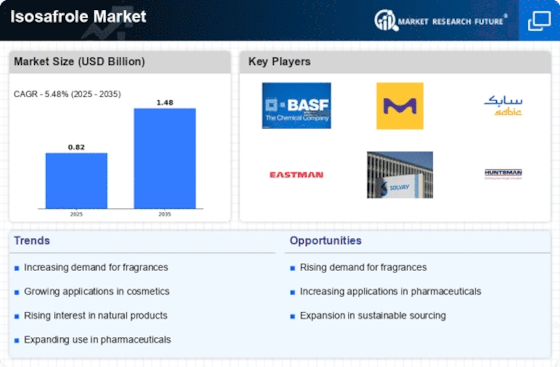
As per Market Research Future analysis, the Isosafrole Market Size was estimated at 0.8215 USD Billion in 2024. The Isosafrole industry is projected to grow from USD 0.8666 Billion in 2025 to USD 1.478 Billion by 2035, exhibiting a compound annual growth rate (CAGR) of 5.48% during the forecast period 2025 - 2035

Key Market Trends & Highlights

The Isosafrole Market is currently experiencing a shift towards sustainability and natural ingredients.

  • North America remains the largest market for Isosafrole Market, driven by a robust demand for natural fragrances.
  • The Asia-Pacific region is emerging as the fastest-growing market, fueled by increasing consumer awareness of natural products.
  • The fragrance segment dominates the market, while the pharmaceuticals segment is witnessing rapid growth due to rising health consciousness.
  • Key market drivers include the rising demand for natural fragrances and regulatory support for natural ingredients.

Market Size & Forecast

2024 Market Size 0.8215 (USD Billion)
2035 Market Size 1.478 (USD Billion)
CAGR (2025 - 2035) 5.48%

Major Players

BASF SE (DE), Merck KGaA (DE), SABIC (SA), Eastman Chemical Company (US), Solvay S.A. (BE), Huntsman Corporation (US), Aromsyn (FR), Givaudan (CH), Symrise AG (DE)

Our Impact
Enabled $4.3B Revenue Impact for Fortune 500 and Leading Multinationals
Partnering with 2000+ Global Organizations Each Year
30K+ Citations by Top-Tier Firms in the Industry

Isosafrole Market Trends

The Isosafrole Market is currently experiencing a notable evolution, driven by various factors that influence its dynamics. This compound, primarily derived from natural sources, is utilized in the fragrance and flavor industries, as well as in the synthesis of other chemical compounds. The growing demand for natural and organic products appears to be a significant driver, as consumers increasingly favor ingredients perceived as safe and environmentally friendly. Furthermore, the regulatory landscape surrounding chemical substances is evolving, which may impact production practices and sourcing strategies within the market. As manufacturers adapt to these changes, innovation in extraction and processing methods is likely to emerge, potentially enhancing product quality and sustainability. In addition to these factors, the Isosafrole Market is witnessing shifts in consumer preferences, with a marked inclination towards sustainable and ethically sourced materials. This trend suggests that companies may need to reassess their supply chains and production methodologies to align with consumer expectations. Moreover, the rise of e-commerce platforms is facilitating broader access to Isosafrole Market products, enabling smaller players to enter the market and compete with established entities. Overall, the Isosafrole Market appears poised for growth, with opportunities for innovation and adaptation in response to changing consumer demands and regulatory frameworks.

Sustainability Focus

The Isosafrole Market is increasingly influenced by a growing emphasis on sustainability. Consumers are becoming more aware of the environmental impact of their purchases, leading to a preference for products that are sourced and produced in an eco-friendly manner. This trend may compel manufacturers to adopt greener practices, such as utilizing renewable resources and minimizing waste during production.

Regulatory Changes

The evolving regulatory landscape surrounding chemical substances is likely to have a profound effect on the Isosafrole Market. Stricter regulations may necessitate changes in production processes and sourcing strategies, pushing companies to ensure compliance while maintaining product quality. This could lead to increased investment in research and development to meet new standards.

E-commerce Expansion

The rise of e-commerce platforms is transforming the distribution channels within the Isosafrole Market. This shift allows for greater accessibility to a wider range of products, enabling smaller companies to reach consumers directly. As online shopping continues to grow, it may reshape competitive dynamics and encourage innovation in marketing strategies.

Isosafrole Market Drivers

Expansion of the Aromatherapy Sector

The Isosafrole Market is poised to benefit from the expansion of the aromatherapy sector, which has gained traction as consumers increasingly seek holistic wellness solutions. Aromatherapy utilizes essential oils and natural compounds, including isosafrole, for therapeutic benefits. The Isosafrole Market is anticipated to reach a valuation of over 4 billion USD by 2026, indicating a robust growth trajectory. This expansion is likely to create new opportunities for isosafrole, as it is often used for its calming and soothing properties in various aromatherapy products. As more individuals turn to natural remedies for stress relief and overall well-being, the demand for isosafrole in this context may significantly enhance its market dynamics.

Rising Demand for Natural Fragrances

The Isosafrole Market is experiencing a notable increase in demand for natural fragrances, driven by consumer preferences shifting towards organic and sustainable products. This trend is particularly evident in the cosmetics and personal care sectors, where brands are increasingly formulating products with natural ingredients. According to recent data, the market for natural fragrances is projected to grow at a compound annual growth rate of approximately 8% over the next five years. This growth is likely to bolster the Isosafrole Market, as isosafrole is a key component in many natural fragrance formulations. As consumers become more aware of the environmental impact of synthetic fragrances, the demand for isosafrole, derived from natural sources, is expected to rise, thereby enhancing its market presence.

Regulatory Support for Natural Ingredients

The Isosafrole Market is benefiting from increasing regulatory support for natural ingredients, as governments and regulatory bodies worldwide promote the use of safe and sustainable substances in consumer products. This regulatory environment is encouraging manufacturers to adopt isosafrole as a preferred ingredient in various applications, including cosmetics, food, and pharmaceuticals. Recent regulations have emphasized the importance of transparency in ingredient sourcing and the safety of natural compounds, which aligns with the properties of isosafrole. As a result, the Isosafrole Market is likely to experience growth as companies seek to comply with these regulations while meeting consumer demand for natural and safe products.

Technological Advancements in Extraction Methods

Technological advancements in extraction methods are transforming the Isosafrole Market by improving the efficiency and sustainability of isosafrole production. Innovations such as supercritical fluid extraction and cold pressing are enabling manufacturers to obtain isosafrole with higher purity and yield while minimizing environmental impact. These advancements not only enhance product quality but also reduce production costs, making isosafrole more accessible to various industries, including food and beverage, cosmetics, and pharmaceuticals. As the market for isosafrole continues to evolve, these technological improvements are likely to play a crucial role in meeting the growing demand for high-quality natural ingredients, thereby strengthening the overall market position of isosafrole.

Increasing Applications in the Food and Beverage Industry

The Isosafrole Market is witnessing a surge in applications within the food and beverage sector, where isosafrole is utilized for its flavoring properties. As consumer preferences shift towards unique and natural flavors, food manufacturers are increasingly incorporating isosafrole into their products. The flavoring agents market is projected to grow significantly, with estimates suggesting a compound annual growth rate of around 5% over the next few years. This growth is likely to drive demand for isosafrole, as it is recognized for its distinctive taste profile. Consequently, the integration of isosafrole in food and beverage formulations may enhance its market presence and contribute to the overall expansion of the Isosafrole Market.


Market Segment Insights

By Application: Fragrance (Largest) vs. Pharmaceuticals (Fastest-Growing)

The Isosafrole Market displays a diverse application landscape, with the fragrance segment commanding the largest share. This segment leverages the fresh and floral notes of isosafrole, making it a popular choice in perfumes, soaps, and cosmetics. Following closely, the pharmaceuticals and agrochemicals are also substantial contributors, although they represent a smaller portion of the market. The flavoring agent application is significant too, primarily catering to the food industry, which seeks natural flavoring alternatives. Market growth trends highlight an energizing demand within the pharmaceuticals sector, attributed to an increasing focus on natural ingredients in drug formulations. The fragrance industry continues to thrive driven by consumer preferences leaning towards organic and environmentally friendly products. Agrochemicals also show potential due to the rise in sustainable farming practices, while the flavoring industry navigates the evolving tastes of consumers towards authenticity and naturalism.

Fragrance (Dominant) vs. Pharmaceuticals (Emerging)

The fragrance application of isosafrole is dominant due to its appealing scent profile, which is central to numerous personal care and cosmetic products. Brands are increasingly focusing on formulations that incorporate natural ingredients, further solidifying isosafrole's position in high-end and niche fragrances. On the other hand, the pharmaceuticals segment is emerging, driven by the growing trend of using plant-derived compounds in medications and health products. This shift is further propelled by regulatory frameworks encouraging natural alternatives over synthetic chemicals. As consumer awareness increases, both segments are adapting to changing market demands, with fragrances emphasizing sustainability and pharmaceuticals innovating blending traditional practices with modern healthcare.

By Type: Synthetic Isosafrole Market (Largest) vs. Natural Isosafrole Market (Fastest-Growing)

The Isosafrole Market is characterized by a significant division between two main types: Synthetic Isosafrole Market and Natural Isosafrole Market. Synthetic Isosafrole Market currently holds the largest share of the market due to its widespread application in the fragrance industry and its cost-effectiveness. Natural Isosafrole Market, while being a smaller segment, has gained traction among consumers looking for sustainable and eco-friendly options, reflecting a shift in market demands. As a result, both segments are poised for distinctive trajectories in the market.

Isosafrole Market Type: Synthetic (Dominant) vs. Natural (Emerging)

Synthetic Isosafrole Market remains the dominant player in the Isosafrole Market, primarily utilized in the production of various fragrances and flavoring agents. Its production process is more efficient and cost-effective, allowing it to meet bulk demands in industries like cosmetics and food. On the other hand, Natural Isosafrole Market is emerging as a preferred choice among consumers who prioritize natural ingredients. Its growing popularity in the niche markets of organic personal care and natural fragrances is indicative of a broader trend towards sustainability. This segment not only appeals to eco-conscious consumers but also taps into the increasing regulatory pressures on synthetic compounds, thereby positioning itself for potential rapid growth in the coming years.

By End Use Industry: Food and Beverage (Largest) vs. Cosmetics and Personal Care (Fastest-Growing)

The Isosafrole Market is significantly influenced by its end-use industries, with the Food and Beverage segment currently holding the largest market share. This sector leverages Isosafrole Market primarily for its flavoring and aroma-enhancing properties, making it a staple in food production. In contrast, the Cosmetics and Personal Care segment is rapidly gaining traction, driven by the increasing demand for natural ingredients and organic formulations in beauty products. This segment is expected to witness robust expansion in the coming years, as consumer preferences shift toward cleaner, more sustainable options.

Food and Beverage (Dominant) vs. Healthcare (Emerging)

The Food and Beverage industry remains a dominant force in the Isosafrole Market, primarily due to its applications in flavoring agents and fragrances. This segment benefits from a stable demand for food products while also adapting to evolving culinary trends that increasingly favor natural and organic ingredients. On the other hand, the Healthcare industry is emerging, showing potential for increased usage of Isosafrole Market in pharmaceuticals and wellness products. This growth is spurred by a rising awareness of the benefits of natural compounds in health applications, thus fostering research and development efforts that incorporate Isosafrole Market into various therapeutic formulations.

By Form: Liquid (Largest) vs. Solid (Fastest-Growing)

In the Isosafrole Market, the liquid form currently holds the largest market share, predominantly favored for its versatility and ease of use in various applications. Liquid is widely utilized in the fragrance and personal care sectors, where its solubility characteristics deliver enhanced formulation advantages. Conversely, the solid form, while having a smaller current share, is rapidly emerging and gaining traction due to its stability and convenience in handling and storage. This growing preference indicates potential shifts in consumer demands and application trends favoring solid formulations.

Liquid (Dominant) vs. Solid (Emerging)

The liquid form of isosafrole has established itself as the dominant player in the market, attributed to its wide usage in the creation of fragrances, flavorings, and personal care products. It is favored for its high solubility, which allows for seamless integration into complex formulations. On the other hand, the solid form is gaining momentum as an emerging segment, particularly driven by the growing trend for eco-friendly and easy-to-handle products. Solid isosafrole is preferred for its longer shelf life and diminished risks associated with transportation and storage, making it appealing for manufacturers looking to streamline processes and reduce costs.

Get more detailed insights about Isosafrole Market

Regional Insights

North America : Innovation and Demand Surge

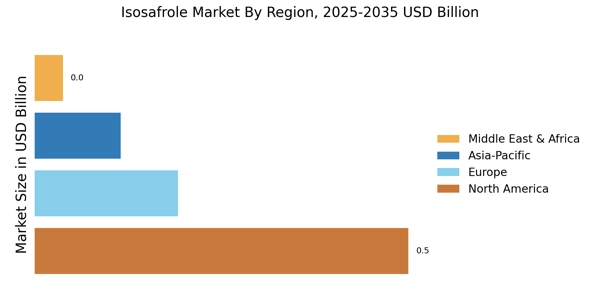
The North American isosafrole market is driven by increasing demand in the fragrance and flavor industries, alongside stringent regulations promoting sustainable sourcing. The U.S. holds the largest market share at approximately 65%, followed by Canada at 20%. Regulatory frameworks, such as the Toxic Substances Control Act, are catalyzing growth by ensuring safety and environmental compliance. Leading players like Eastman Chemical Company and BASF SE dominate the competitive landscape, leveraging advanced technologies and sustainable practices. The presence of major companies fosters innovation, while collaborations with local suppliers enhance market reach. The region's focus on R&D and sustainability positions it as a key player in The Isosafrole Market.

Europe : Regulatory Frameworks Drive Growth

Europe is witnessing significant growth in the isosafrole market, driven by increasing consumer demand for natural and organic products. The region holds a market share of approximately 25%, with Germany and France being the largest contributors. Regulatory bodies, such as the European Chemicals Agency, are implementing stringent regulations that promote the use of safe and sustainable chemicals, further boosting market growth. Germany leads the market, supported by key players like Merck KGaA and Symrise AG, who are investing in innovative production methods. France and the UK also play crucial roles, with a growing emphasis on eco-friendly products. The competitive landscape is characterized by collaborations and partnerships aimed at enhancing product offerings and meeting regulatory standards, ensuring a robust market presence.

Asia-Pacific : Emerging Markets and Opportunities

The Asia-Pacific region is emerging as a significant player in the isosafrole market, driven by rapid industrialization and increasing demand for fragrances in personal care products. The region holds a market share of around 15%, with China and India being the largest markets. The growing middle class and rising disposable incomes are key factors fueling demand, alongside supportive government policies promoting local manufacturing. China is at the forefront, with major companies like SABIC and Huntsman Corporation expanding their operations. India is also witnessing growth, with local manufacturers increasing production capacities. The competitive landscape is marked by a mix of established players and new entrants, fostering innovation and enhancing product availability in the region.

Middle East and Africa : Resource-Rich and Growing Demand

The Middle East and Africa region is experiencing growth in the isosafrole market, driven by increasing demand for natural ingredients in cosmetics and food industries. The region holds a market share of approximately 5%, with South Africa and Saudi Arabia leading the way. The growth is supported by favorable climatic conditions for sourcing raw materials and government initiatives promoting local production. South Africa is emerging as a key player, with local companies focusing on sustainable practices and innovation. Saudi Arabia is also investing in chemical manufacturing, enhancing its market presence. The competitive landscape is characterized by a mix of local and international players, creating opportunities for collaboration and growth in the isosafrole market.

Isosafrole Market Regional Image

Key Players and Competitive Insights

The Isosafrole Market is currently characterized by a dynamic competitive landscape, driven by increasing demand for natural flavoring agents and fragrances. Key players such as BASF SE (DE), Merck KGaA (DE), and Givaudan (CH) are strategically positioned to leverage their extensive research and development capabilities, focusing on innovation and sustainability. These companies are actively pursuing partnerships and collaborations to enhance their product offerings and expand their market reach, thereby shaping a competitive environment that emphasizes quality and differentiation over mere price competition.In terms of business tactics, companies are increasingly localizing manufacturing to reduce lead times and optimize supply chains. The market structure appears moderately fragmented, with several players vying for market share. However, the collective influence of major companies like Eastman Chemical Company (US) and Solvay S.A. (BE) is notable, as they implement strategies that enhance operational efficiencies and foster innovation.

In August BASF SE (DE) announced a significant investment in a new production facility aimed at increasing its Isosafrole Market output. This strategic move is expected to bolster the company's position in the market by enhancing its capacity to meet growing demand, particularly in the fragrance and flavor sectors. The investment underscores BASF's commitment to sustainability, as the new facility will utilize advanced technologies to minimize environmental impact.

In September Merck KGaA (DE) launched a new line of Isosafrole Market derivatives designed for use in high-performance applications. This initiative reflects the company's focus on innovation and its intent to cater to niche markets that require specialized products. By diversifying its product portfolio, Merck KGaA aims to strengthen its competitive edge and respond to evolving customer needs in the chemical industry.

In July Givaudan (CH) entered into a strategic partnership with a leading biotechnology firm to develop sustainable sourcing methods for Isosafrole Market. This collaboration is indicative of the growing trend towards sustainability in the market, as Givaudan seeks to enhance its supply chain resilience while addressing consumer demand for environmentally friendly products. Such partnerships are likely to play a crucial role in shaping the future of the Isosafrole Market.

As of October current competitive trends indicate a strong emphasis on digitalization, sustainability, and the integration of artificial intelligence in production processes. Strategic alliances are increasingly shaping the landscape, allowing companies to pool resources and expertise. Looking ahead, it appears that competitive differentiation will evolve, with a shift from price-based competition to a focus on innovation, technological advancements, and supply chain reliability. This transition may redefine market dynamics, compelling companies to adapt swiftly to maintain their competitive positions.

Key Companies in the Isosafrole Market include

Industry Developments

Recent developments in the Isosafrole Market have showcased notable trends and activities among key players. Companies like Galactic and BASF have been expanding their production capacities to meet the rising global demand for isosafrole, driven by its applications in the fragrance and chemical industries.

Meanwhile, Gujarat Alkalies and Chemicals Limited and LyondellBasell Industries are focusing on sustainable practices in their production processes. Current affairs indicate a growing shift towards eco-friendly solutions, impacting market dynamics significantly.

Additionally, Kraton Corporation has been exploring strategic partnerships to enhance market penetration. In terms of mergers and acquisitions, there has been increased activity, particularly with companies like Merck and Givaudan considering collaborations to diversify their product lines and optimize supply chains.

Nanjing Jinlong Chemical and Eastman Chemical Company are reportedly evaluating market entry strategies, further intensifying competition within the sector. Overall, a surge in market valuation among these companies reflects the ongoing evolution and robustness of the Isosafrole Market, influenced by technological advancements and shifting consumer preferences.

Future Outlook

Isosafrole Market Future Outlook

The Isosafrole Market is projected to grow at a 5.48% CAGR from 2025 to 2035, driven by increasing demand in fragrance and pharmaceutical applications.

New opportunities lie in:

  • Expansion into emerging markets with tailored product offerings.
  • Development of sustainable sourcing strategies for raw materials.
  • Investment in advanced manufacturing technologies to enhance production efficiency.

By 2035, the Isosafrole Market is expected to achieve robust growth, solidifying its position in key industries.

Market Segmentation

Isosafrole Market Form Outlook

  • Liquid
  • Solid

Isosafrole Market Type Outlook

  • Synthetic Isosafrole
  • Natural Isosafrole

Isosafrole Market Application Outlook

  • Fragrance
  • Flavoring Agent
  • Pharmaceuticals
  • Agrochemicals

Isosafrole Market End Use Industry Outlook

  • Food and Beverage
  • Cosmetics and Personal Care
  • Healthcare
  • Agriculture

Report Scope

MARKET SIZE 20240.8215(USD Billion)
MARKET SIZE 20250.8666(USD Billion)
MARKET SIZE 20351.478(USD Billion)
COMPOUND ANNUAL GROWTH RATE (CAGR)5.48% (2025 - 2035)
REPORT COVERAGERevenue Forecast, Competitive Landscape, Growth Factors, and Trends
BASE YEAR2024
Market Forecast Period2025 - 2035
Historical Data2019 - 2024
Market Forecast UnitsUSD Billion
Key Companies ProfiledBASF SE (DE), Merck KGaA (DE), SABIC (SA), Eastman Chemical Company (US), Solvay S.A. (BE), Huntsman Corporation (US), Aromsyn (FR), Givaudan (CH), Symrise AG (DE)
Segments CoveredApplication, Type, End Use Industry, Form, Regional
Key Market OpportunitiesGrowing demand for natural fragrances and flavors enhances opportunities in the Isosafrole Market.

Key Market DynamicsRising demand for natural fragrances drives innovation and competition in the Isosafrole market.
Countries CoveredNorth America, Europe, APAC, South America, MEA
Leave a Comment

FAQs

What is the projected market valuation of the Isosafrole Market by 2035?

The Isosafrole Market is projected to reach a valuation of 1.478 USD Billion by 2035.

What was the market valuation of Isosafrole in 2024?

In 2024, the Isosafrole Market was valued at 0.8215 USD Billion.

What is the expected CAGR for the Isosafrole Market during the forecast period 2025 - 2035?

The expected CAGR for the Isosafrole Market during the forecast period 2025 - 2035 is 5.48%.

Which companies are considered key players in the Isosafrole Market?

Key players in the Isosafrole Market include BASF SE, Merck KGaA, SABIC, Eastman Chemical Company, and Solvay S.A.

What are the main applications of Isosafrole in the market?

The main applications of Isosafrole include Fragrance, Flavoring Agent, Pharmaceuticals, and Agrochemicals.

How does the market for Synthetic Isosafrole compare to Natural Isosafrole?

The market for Synthetic Isosafrole was valued at 0.4929 USD Billion in 2024, while Natural Isosafrole was valued at 0.3286 USD Billion.

What end-use industries are driving the demand for Isosafrole?

The end-use industries driving demand for Isosafrole include Food and Beverage, Cosmetics and Personal Care, Healthcare, and Agriculture.

What forms of Isosafrole are available in the market?

Isosafrole is available in two forms: Liquid and Solid, with Liquid valued at 0.4925 USD Billion in 2024.

What was the valuation of the Fragrance segment in the Isosafrole Market in 2024?

The Fragrance segment in the Isosafrole Market was valued at 0.30075 USD Billion in 2024.

Download Free Sample

Kindly complete the form below to receive a free sample of this Report

Compare Licence

×
Features License Type
Single User Multiuser License Enterprise User
Price $4,950 $5,950 $7,250
Maximum User Access Limit 1 User Upto 10 Users Unrestricted Access Throughout the Organization
Free Customization
Direct Access to Analyst
Deliverable Format
Platform Access
Discount on Next Purchase 10% 15% 15%
Printable Versions