×
Request Free Sample ×

Kindly complete the form below to receive a free sample of this Report

* Please use a valid business email

Leading companies partner with us for data-driven Insights

clients tt-cursor
Hero Background

Industrial Personal Protective Equipment Market

ID: MRFR/CnM/37991-HCR
111 Pages
Garvit Vyas
February 2026

Industrial Personal Protective Equipment PPE MarketIndustrial Personal Protective Equipment (PPE) Market Research Report: By Product Type (Head Protection, Eye and Face Protection, Hearing Protection, Respiratory Protection, Fall Protection), By End User (Construction, Manufacturing, Oil and Gas, Healthcare, Mining), By Distribution Channel (Direct Sales, Online Retail, Distributors, Wholesale, Retail Stores), By Material Type (Metal, Plastic, Textiles, Rubber, Composite) and By Regional (North America, Europe, South America, Asia Asia-Pacific, Middle East and Africa) - Forecast to 2035

Share:
Download PDF ×

We do not share your information with anyone. However, we may send you emails based on your report interest from time to time. You may contact us at any time to opt-out.

Industrial Personal Protective Equipment Market Infographic
Purchase Options

Industrial Personal Protective Equipment Market Summary

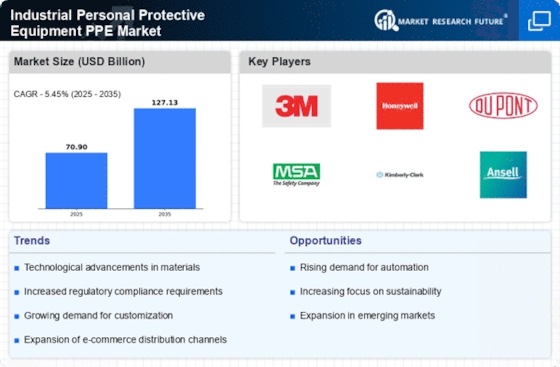
As per Market Research Future analysis, the Industrial Personal Protective Equipment Market was estimated at 70.9 USD Billion in 2024. The PPE industry is projected to grow from 74.76 USD Billion in 2025 to 127.13 USD Billion by 2035, exhibiting a compound annual growth rate (CAGR) of 5.45% during the forecast period 2025 - 2035

Key Market Trends & Highlights

The Industrial Personal Protective Equipment Market (PPE) Market is poised for substantial growth driven by technological advancements and heightened safety awareness.

  • Technological integration in PPE is enhancing user experience and safety features across various industries.
  • A growing emphasis on sustainability is influencing manufacturers to develop eco-friendly protective equipment.
  • North America remains the largest market for PPE, while the Asia-Pacific region is emerging as the fastest-growing market.
  • Increased workplace safety awareness and stringent regulatory frameworks are key drivers propelling the demand for head protection and respiratory protection in the construction and healthcare sectors.

Market Size & Forecast

2024 Market Size 70.9 (USD Billion)
2035 Market Size 127.13 (USD Billion)
CAGR (2025 - 2035) 5.45%

Major Players

3M (US), Honeywell (US), DuPont (US), MSA Safety (US), Kimberly-Clark (US), Ansell (AU), Lakeland Industries (US), Radians (US), Bullard (US), Sioen Industries (BE)

Our Impact
Enabled $4.3B Revenue Impact for Fortune 500 and Leading Multinationals
Partnering with 2000+ Global Organizations Each Year
30K+ Citations by Top-Tier Firms in the Industry

Industrial Personal Protective Equipment Market Trends

The Industrial Personal Protective Equipment Market PPE Market is currently experiencing a dynamic evolution, driven by a heightened awareness of workplace safety and regulatory compliance. Organizations across various sectors are increasingly prioritizing the health and safety of their workforce, leading to a surge in demand for advanced protective gear. This market encompasses a wide range of products, including helmets, gloves, eye protection, and respiratory equipment, all designed to mitigate risks associated with hazardous environments. As industries adapt to changing safety standards, manufacturers are innovating to provide solutions that not only meet regulatory requirements but also enhance user comfort and functionality. In addition to regulatory influences, technological advancements are reshaping the landscape of the Industrial Personal Protective Equipment Market PPE Market. The integration of smart technologies, such as IoT and wearable devices, is becoming more prevalent, offering real-time monitoring and data collection capabilities. This trend suggests a shift towards more personalized and responsive safety equipment, which could potentially improve overall workplace safety outcomes. Furthermore, the growing emphasis on sustainability is prompting manufacturers to explore eco-friendly materials and production processes, indicating a broader commitment to environmental responsibility within the industry. As these trends unfold, the market is poised for continued growth and transformation.

Technological Integration

The incorporation of smart technologies into personal protective equipment is gaining traction. Wearable devices equipped with sensors can monitor environmental conditions and worker health, providing real-time data that enhances safety protocols. This trend indicates a move towards more intelligent and responsive safety solutions.

Sustainability Focus

There is a noticeable shift towards sustainable practices within the Industrial Personal Protective Equipment Market PPE Market. Manufacturers are increasingly exploring eco-friendly materials and production methods, reflecting a commitment to reducing environmental impact while maintaining product efficacy.

Regulatory Compliance and Safety Standards

The evolving landscape of workplace safety regulations is driving demand for compliant protective gear. Organizations are prioritizing adherence to safety standards, which is influencing product development and innovation in the Industrial Personal Protective Equipment Market PPE Market.

Industrial Personal Protective Equipment Market Drivers

Stringent Regulatory Frameworks

The Industrial Personal Protective Equipment Market PPE Market is significantly influenced by stringent regulatory frameworks that mandate the use of protective gear across various sectors. Governments and regulatory bodies are implementing comprehensive safety regulations to protect workers from occupational hazards. Compliance with these regulations is not only a legal requirement but also a critical aspect of corporate responsibility. As a result, companies are compelled to invest in high-quality PPE to ensure compliance and avoid penalties. The increasing number of regulations, such as those set forth by occupational safety administrations, is driving the demand for PPE. This regulatory environment is expected to bolster market growth, as organizations prioritize compliance and safety in their operational strategies. The emphasis on adhering to safety standards is likely to create a robust market for industrial PPE in the coming years.

Technological Advancements in PPE

Technological advancements are playing a pivotal role in shaping the Industrial Personal Protective Equipment Market PPE Market. Innovations such as smart helmets, wearable sensors, and advanced materials are enhancing the functionality and effectiveness of protective gear. These technologies not only improve safety but also increase comfort and usability for workers. For instance, the integration of IoT devices in PPE allows for real-time monitoring of environmental conditions, thereby enabling proactive safety measures. The market is witnessing a shift towards more sophisticated products that cater to the specific needs of various industries. As a result, manufacturers are investing heavily in research and development to create cutting-edge solutions that meet evolving safety standards. This trend is expected to drive significant growth in the PPE market, as companies seek to leverage technology to enhance worker safety.

Rising Focus on Employee Well-being

The Industrial Personal Protective Equipment Market PPE Market is witnessing a rising focus on employee well-being, which is driving the demand for protective equipment. Organizations are increasingly acknowledging that the health and safety of their workforce are integral to overall productivity and morale. This shift in perspective is leading to enhanced investment in PPE as companies strive to create safer work environments. The emphasis on employee well-being is not only a response to regulatory pressures but also a strategic approach to improve retention and reduce absenteeism. As businesses recognize the correlation between safety and performance, the demand for high-quality PPE is expected to rise. This trend reflects a broader commitment to fostering a culture of safety and well-being within organizations, thereby contributing to the growth of the industrial PPE market.

Increased Workplace Safety Awareness

The Industrial Personal Protective Equipment Market PPE Market is experiencing a surge in demand due to heightened awareness regarding workplace safety. Organizations are increasingly prioritizing the health and safety of their employees, leading to a greater emphasis on protective gear. This trend is reflected in the rising investments in safety training programs and the implementation of stringent safety protocols. According to recent data, the market for industrial PPE is projected to grow at a compound annual growth rate of approximately 7.5% over the next few years. This growth is indicative of a broader cultural shift towards prioritizing safety in various industries, including construction, manufacturing, and healthcare. As companies recognize the financial and ethical implications of workplace injuries, the demand for high-quality PPE is likely to continue its upward trajectory.

Growing Industrialization and Construction Activities

The Industrial Personal Protective Equipment Market PPE Market is benefiting from the rapid industrialization and construction activities observed in various regions. As economies expand, the demand for skilled labor in construction, manufacturing, and other industrial sectors is increasing. This growth necessitates the use of protective equipment to safeguard workers from potential hazards associated with these environments. The construction sector, in particular, is a major contributor to the PPE market, with a projected growth rate of around 8% annually. As new projects emerge, the need for reliable and effective PPE becomes paramount. Companies are increasingly recognizing the importance of equipping their workforce with appropriate protective gear to mitigate risks and enhance productivity. This trend is likely to continue, further propelling the demand for industrial PPE.


Market Segment Insights

By Product Type: Head Protection (Largest) vs. Respiratory Protection (Fastest-Growing)

The Industrial Personal Protective Equipment Market (PPE) market is predominantly driven by the head protection segment, which captures a significant share due to its essential role in ensuring worker safety in various industrial applications. This segment's strong presence reflects the growing awareness of safety protocols and regulatory requirements focused on head injuries in workplaces. Conversely, respiratory protection is emerging as a fast-growing segment, particularly as concerns over air quality and airborne contaminants in industrial settings continue to rise, spurring investment in innovation and new product lines.

Head Protection (Dominant) vs. Respiratory Protection (Emerging)

Head protection is characterized by a diverse range of products including helmets, hard hats, and bump caps, all designed to safeguard workers from head injuries in hazardous environments. This segment dominates the PPE market due to strict regulatory standards and a strong focus on workplace safety. On the other hand, respiratory protection, which includes masks, respirators, and breathing apparatuses, is rapidly gaining ground in the market. This growth is fueled by the increasing frequency of health-related issues arising from exposure to harmful particles and gases. As industries face tighter regulations on air quality and personal safety, the demand for respiratory protection solutions is expected to rise considerably, positioning it as a key focus area for manufacturers.

By End User: Construction (Largest) vs. Healthcare (Fastest-Growing)

In the Industrial Personal Protective Equipment Market (PPE) market, the 'End User' segment showcases a diversified landscape, prominently featuring construction as the largest contributor. Historically, construction has relied heavily on PPE due to the physical hazards present on job sites. Healthcare, on the other hand, is increasingly gaining momentum as workers demand specialized protective gear for infections and safety standards. The manufacturing and mining sectors also play substantial roles; however, they are overshadowed by the persistent growth in construction and healthcare.

Construction (Dominant) vs. Healthcare (Emerging)

The construction sector stands out as the dominant end user of industrial PPE, driven by stringent safety regulations and the inherent risks associated with construction activities. Workers are exposed to various hazards, including falls, machinery accidents, and environmental factors. Consequently, there is a sustained demand for helmets, gloves, and other protective gear. Conversely, the healthcare sector is emerging rapidly, prompted by the COVID-19 pandemic and a growing emphasis on worker safety in medical environments. The need for isolation gowns, masks, and eye protection is skyrocketing, making healthcare a dynamic and evolving market for PPE.

By Distribution Channel: Direct Sales (Largest) vs. Online Retail (Fastest-Growing)

In the Industrial Personal Protective Equipment Market (PPE) Market, Direct Sales emerges as the most significant distribution channel, capturing a solid portion of the overall market share. This traditional approach enables manufacturers to deliver tailored solutions directly to customers, enhancing relationships and brand loyalty. In contrast, Online Retail has witnessed substantial growth, catering to the rising demand for convenience and accessibility in purchasing PPE products, particularly post-pandemic.

Direct Sales (Dominant) vs. Online Retail (Emerging)

Direct Sales remains a dominant force in the Industrial PPE market, primarily due to its ability to provide personalized service and customized solutions to businesses. This method fosters direct communication between manufacturers and end-users, allowing for a better understanding of specific safety needs. Conversely, Online Retail is marked as an emerging channel, thriving on digital marketing and e-commerce strategies. It appeals to younger, tech-savvy buyers seeking efficiency, a broad range of product options, and competitive pricing, thus reshaping consumer behaviors and preferences in the Industrial PPE landscape.

By Material Type: Textiles (Largest) vs. Composite (Fastest-Growing)

In the Industrial Personal Protective Equipment Market (PPE) Market, the material type segment is characterized by a diverse distribution of market shares among various materials, namely metal, plastic, textiles, rubber, and composite. Textiles dominate this segment due to their versatility, comfort, and widespread use in clothing and gear that require flexibility and breathability. In contrast, composite materials are gaining traction, appealing to industries that prioritize both durability and lightweight characteristics in their protective equipment.

Textiles (Dominant) vs. Composite (Emerging)

Textiles serve as the dominant material in the industrial PPE sector owing to their adaptability in various applications. This includes garments, gloves, and protective covers that require not only protection but also comfort for users who wear them for extended periods. With advancements in textile technology, manufacturers are creating specialized fabrics that enhance safety features, including flame resistance and chemical protection. On the other hand, composite materials represent an emerging segment, increasingly favored for applications where strength combined with minimal weight is critical. As industries evolve to embrace innovative solutions, composites, made from a blend of materials, are revolutionizing the design of PPE, offering enhanced performance characteristics and hence capturing new market segments.

Get more detailed insights about Industrial Personal Protective Equipment Market

Regional Insights

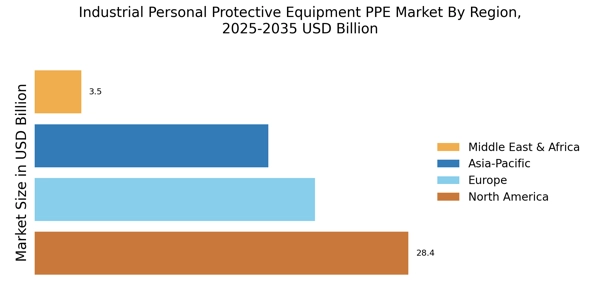
The Industrial Personal Protective Equipment Market PPE Market is poised for substantial growth across its regional segments, driven by increasing awareness of workplace safety. In 2023, North America emerges emerged as the dominant region with a valuation of 22.5 USD Billion, reflecting its stringent safety regulations and robust industrial sector. Europe follows closely, valued at 18.0 USD Billion, supported by its strong focus on worker protection and compliance standards.

The Asia-Pacific (APAC) region, valued at 15.0 USD Billion, showcases significant growth potential due to rapid industrialization and an increasing labor force, making it a key player in the Industrial Personal Protective Equipment Market PPE Market revenue.South America, with a valuation of 5.0 USD Billion, and the Middle East and Africa (MEA), at 3.25 USD Billion, together represent smaller yet crucial markets, where rising investments in safety standards are beginning to take root.

As the market continues to expand, North America’s America's majority holding will likely remain significant, while APAC's growth trajectory positions it as a vital area for future opportunities in PPE industry advancements. Each region reflects unique growth drivers and challenges that contribute to the overall dynamics of Industrial Personal Protective Equipment Market PPE Market segmentation and statistics.

Industrial Personal Protective Equipment Market Regional Image

Key Players and Competitive Insights

The Industrial Personal Protective Equipment (PPE) Market is currently characterized by a dynamic competitive landscape, driven by increasing safety regulations and a heightened awareness of workplace safety. Key players such as 3M (US), Honeywell (US), and DuPont (US) are strategically positioned to leverage innovation and technological advancements to enhance their product offerings. 3M (US) focuses on integrating advanced materials into its PPE solutions, while Honeywell (US) emphasizes digital transformation through smart PPE technologies. DuPont (US) continues to invest in sustainable materials, reflecting a growing trend towards eco-friendly products. Collectively, these strategies not only enhance their competitive edge but also shape the market's trajectory towards more sophisticated and sustainable safety solutions.In terms of business tactics, companies are increasingly localizing manufacturing to reduce lead times and optimize supply chains. This approach appears to be particularly effective in a moderately fragmented market, where the collective influence of major players like MSA Safety (US) and Ansell (AU) is significant. MSA Safety (US) has been focusing on enhancing its distribution networks, while Ansell (AU) is investing in regional partnerships to strengthen its market presence. Such tactics are crucial in navigating the complexities of global supply chains and meeting localized demand effectively.

In August 3M (US) announced a partnership with a leading technology firm to develop smart helmets equipped with augmented reality features. This strategic move is likely to position 3M (US) at the forefront of innovation in the PPE sector, catering to industries that require enhanced situational awareness and safety monitoring. The integration of AR technology into PPE could redefine user experience and operational efficiency, potentially setting new industry standards.

In September Honeywell (US) launched a new line of connected safety products designed to improve worker safety through real-time data analytics. This initiative underscores Honeywell's commitment to digital transformation and reflects a broader trend towards data-driven decision-making in workplace safety. By harnessing the power of IoT and AI, Honeywell (US) is likely to enhance its competitive positioning and offer more value to its customers.

In July DuPont (US) unveiled a new range of sustainable PPE made from recycled materials, aligning with the growing demand for environmentally responsible products. This strategic initiative not only addresses consumer preferences but also positions DuPont (US) as a leader in sustainability within the PPE market. The emphasis on eco-friendly solutions may resonate well with companies looking to enhance their corporate social responsibility profiles.

As of October the competitive trends in the Industrial PPE Market are increasingly defined by digitalization, sustainability, and the integration of artificial intelligence. Strategic alliances among key players are shaping the landscape, fostering innovation and enhancing product offerings. The shift from price-based competition to a focus on technological advancement and supply chain reliability is evident. Moving forward, companies that prioritize innovation and sustainability are likely to differentiate themselves in a crowded marketplace, ultimately reshaping the competitive dynamics of the industry.

Key Companies in the Industrial Personal Protective Equipment Market include

Industry Developments

  • Q2 2024: Honeywell to acquire safety gear maker Norcross for $1.2 billion Honeywell announced the acquisition of Norcross Safety Products, a leading manufacturer of industrial personal protective equipment, for $1.2 billion to expand its safety and productivity solutions portfolio.
  • Q2 2024: 3M appoints new President of Personal Safety Division 3M announced the appointment of Jane Smith as President of its Personal Safety Division, overseeing the company's global industrial PPE business.
  • Q3 2024: DuPont opens new PPE manufacturing facility in Vietnam DuPont inaugurated a new manufacturing facility in Vietnam dedicated to producing industrial protective clothing and equipment, aiming to meet rising demand in Asia-Pacific.
  • Q2 2024: Ansell launches next-generation cut-resistant gloves for industrial workers Ansell introduced a new line of cut-resistant gloves designed for industrial applications, featuring advanced materials for improved safety and comfort.
  • Q1 2025: MSA Safety acquires UK-based helmet maker Centurion Safety Products MSA Safety completed the acquisition of Centurion Safety Products, a UK manufacturer of industrial head protection, to strengthen its European PPE portfolio.
  • Q2 2024: Honeywell and Microsoft announce partnership to develop connected PPE solutions Honeywell and Microsoft entered a strategic partnership to co-develop smart personal protective equipment integrating IoT and cloud analytics for industrial safety monitoring.
  • Q3 2024: Lakeland Industries secures $30 million contract to supply protective clothing to Middle East oil & gas sector Lakeland Industries won a $30 million contract to provide industrial protective clothing to a major oil and gas operator in the Middle East.
  • Q2 2025: DuPont launches Tyvek 500 Xpert Plus for enhanced chemical protection DuPont launched Tyvek 500 Xpert Plus, a new protective coverall designed for industrial workers requiring advanced chemical and particle protection.
  • Q1 2025: Protective Industrial Products acquires Italian glove manufacturer ARCO Protective Industrial Products (PIP) acquired ARCO, an Italian manufacturer of industrial gloves, to expand its European market presence.
  • Q2 2024: MSA Safety introduces V-Gard 950 Class 2 industrial safety helmet MSA Safety launched the V-Gard 950 Class 2 helmet, a new industrial safety helmet designed for electrical and construction workers.
  • Q3 2024: Uvex Safety Group opens new R&D center for industrial PPE innovation in Germany Uvex Safety Group opened a new research and development center in Germany focused on developing next-generation industrial personal protective equipment.
  • Q1 2025: Kimberly-Clark Professional launches sustainable industrial gloves made from recycled materials Kimberly-Clark Professional introduced a new line of industrial gloves manufactured from recycled materials, targeting sustainability-conscious industrial clients.

Future Outlook

Industrial Personal Protective Equipment Market Future Outlook

The Industrial Personal Protective Equipment Market PPE Market is projected to grow at a 5.45% CAGR from 2025 to 2035, driven by regulatory compliance, technological advancements, and increasing workplace safety awareness.

New opportunities lie in:

  • Integration of smart wearable technology for real-time monitoring
  • Expansion of e-commerce platforms for PPE distribution
  • Development of customized PPE solutions for niche industries

By 2035, the market is expected to be robust, reflecting substantial growth and innovation.

Market Segmentation

Industrial Personal Protective Equipment Market End User Outlook

  • Construction
  • Manufacturing
  • Oil and Gas
  • Healthcare
  • Mining

Industrial Personal Protective Equipment Market Product Type Outlook

  • Head Protection
  • Eye and Face Protection
  • Hearing Protection
  • Respiratory Protection
  • Fall Protection

Industrial Personal Protective Equipment Market Material Type Outlook

  • Metal
  • Plastic
  • Textiles
  • Rubber
  • Composite

Industrial Personal Protective Equipment Market Distribution Channel Outlook

  • Direct Sales
  • Online Retail
  • Distributors
  • Wholesale
  • Retail Stores

Report Scope

MARKET SIZE 202470.9(USD Billion)
MARKET SIZE 202574.76(USD Billion)
MARKET SIZE 2035127.13(USD Billion)
COMPOUND ANNUAL GROWTH RATE (CAGR)5.45% (2025 - 2035)
REPORT COVERAGERevenue Forecast, Competitive Landscape, Growth Factors, and Trends
BASE YEAR2024
Market Forecast Period2025 - 2035
Historical Data2019 - 2024
Market Forecast UnitsUSD Billion
Key Companies Profiled3M (US), Honeywell (US), DuPont (US), MSA Safety (US), Kimberly-Clark (US), Ansell (AU), Lakeland Industries (US), Radians (US), Bullard (US), Sioen Industries (BE)
Segments CoveredProduct Type, End User, Distribution Channel, Material Type, Regional
Key Market OpportunitiesIntegration of smart technologies enhances safety and efficiency in the Industrial Personal Protective Equipment PPE Market.
Key Market DynamicsRising regulatory standards and technological advancements drive innovation and competition in the Industrial Personal Protective Equipment market.
Countries CoveredNorth America, Europe, APAC, South America, MEA
Leave a Comment

FAQs

What is the projected market valuation of the Industrial Personal Protective Equipment PPE Market by 2035?

The market is projected to reach a valuation of 127.13 USD Billion by 2035.

What was the overall market valuation of the Industrial Personal Protective Equipment PPE Market in 2024?

In 2024, the overall market valuation was 70.9 USD Billion.

What is the expected CAGR for the Industrial Personal Protective Equipment PPE Market during the forecast period 2025 - 2035?

The expected CAGR for the market during the forecast period is 5.45%.

Which product type segment is projected to have the highest valuation by 2035?

The Fall Protection segment is projected to reach approximately 47.13 USD Billion by 2035.

How does the Eye and Face Protection segment's valuation change from 2024 to 2035?

The Eye and Face Protection segment's valuation is expected to increase from 12.0 USD Billion in 2024 to 22.0 USD Billion by 2035.

Which end-user segment is anticipated to grow the most by 2035?

The Manufacturing segment is anticipated to grow from 20.0 USD Billion in 2024 to 35.0 USD Billion by 2035.

What distribution channel is expected to dominate the Industrial Personal Protective Equipment PPE Market by 2035?

The Distributors channel is expected to dominate, growing from 20.0 USD Billion in 2024 to 35.0 USD Billion by 2035.

Which material type segment is projected to see the largest increase in valuation by 2035?

The Textiles segment is projected to see the largest increase, from 20.0 USD Billion in 2024 to 35.0 USD Billion by 2035.

Who are the key players in the Industrial Personal Protective Equipment PPE Market?

Key players include 3M, Honeywell, DuPont, MSA Safety, and Kimberly-Clark, among others.

Download Free Sample

Kindly complete the form below to receive a free sample of this Report

Compare Licence

×
Features License Type
Single User Multiuser License Enterprise User
Price $4,950 $ $7,250
Maximum User Access Limit 1 User Upto 10 Users Unrestricted Access Throughout the Organization
Free Customization
Direct Access to Analyst
Deliverable Format
Platform Access
Discount on Next Purchase 10% 15% 15%
Printable Versions