×
Request Free Sample ×

Kindly complete the form below to receive a free sample of this Report

* Please use a valid business email

Leading companies partner with us for data-driven Insights

clients tt-cursor
Hero Background

Indonesia Semiconductor IP Market

ID: MRFR/SEM/55939-HCR
200 Pages
Aarti Dhapte
February 2026

Indonesia Semiconductor IP Market Size, Share and Research Report By Application (Automotive, Consumer Electronics, Networking, Industrial Automation) and By Type (Microprocessor, Digital Signal Processors)-Forecast to 2035

Share:
Download PDF ×

We do not share your information with anyone. However, we may send you emails based on your report interest from time to time. You may contact us at any time to opt-out.

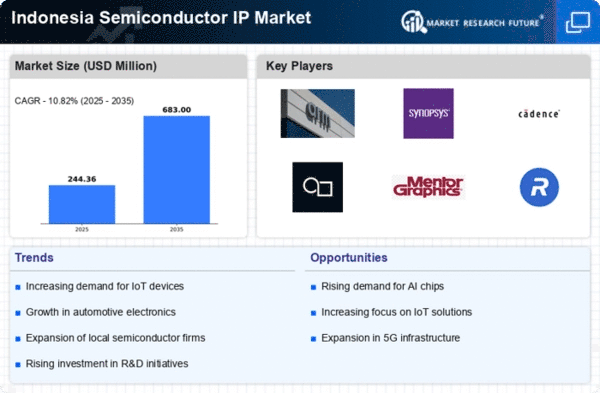
Indonesia Semiconductor IP Market Infographic
Purchase Options

Indonesia Semiconductor IP Market Summary

As per Market Research Future analysis, the Indonesia semiconductor ip market Size was estimated at 220.5 USD Million in 2024. The Indonesia semiconductor ip market is projected to grow from 244.36 USD Million in 2025 to 683.0 USD Million by 2035, exhibiting a compound annual growth rate (CAGR) of 10.8% during the forecast period 2025 - 2035

Key Market Trends & Highlights

The Indonesia semiconductor IP market is poised for growth driven by local investments and technological advancements.

  • Investment in local capabilities is enhancing the semiconductor IP landscape in Indonesia.
  • The rise of electric vehicles is creating new opportunities within the automotive electronics segment.
  • Collaboration with educational institutions is fostering innovation and skill development in the semiconductor sector.
  • Growing demand for consumer electronics and government initiatives are key drivers propelling market expansion.

Market Size & Forecast

2024 Market Size 220.5 (USD Million)
2035 Market Size 683.0 (USD Million)
CAGR (2025 - 2035) 10.82%

Major Players

Arm Holdings (GB), Synopsys (US), Cadence Design Systems (US), Imagination Technologies (GB), Mentor Graphics (US), Rambus (US), Silicon Labs (US), Dialog Semiconductor (GB), STMicroelectronics (FR)

Our Impact
Enabled $4.3B Revenue Impact for Fortune 500 and Leading Multinationals
Partnering with 2000+ Global Organizations Each Year
30K+ Citations by Top-Tier Firms in the Industry

Indonesia Semiconductor IP Market Trends

The semiconductor ip market in Indonesia is currently experiencing a notable evolution, driven by the increasing demand for advanced technologies across various sectors. The nation is witnessing a surge in investments aimed at enhancing local capabilities in semiconductor design and manufacturing. This trend is likely influenced by the growing emphasis on digital transformation, which necessitates sophisticated semiconductor solutions. Furthermore, the government's initiatives to foster innovation and support local startups are contributing to a more vibrant ecosystem. As a result, the semiconductor ip market appears poised for substantial growth, with potential opportunities for both domestic and international players. In addition, the rising interest in electric vehicles and smart devices is propelling the need for specialized semiconductor solutions. This shift indicates a broader trend towards integrating advanced technologies into everyday applications. The collaboration between educational institutions and industry stakeholders is also noteworthy, as it aims to cultivate a skilled workforce capable of meeting the demands of this evolving market. Overall, the semiconductor ip market in Indonesia seems to be on a promising trajectory, reflecting the country's commitment to becoming a key player in the semiconductor landscape.

Investment in Local Capabilities

There is a growing trend of investment in local semiconductor design and manufacturing capabilities. This focus aims to reduce reliance on imports and enhance self-sufficiency in technology development. The government is actively promoting initiatives to attract both domestic and foreign investments, which could lead to the establishment of new facilities and innovation hubs.

Rise of Electric Vehicles

The increasing adoption of electric vehicles is driving demand for specialized semiconductor solutions. This trend reflects a broader shift towards sustainable technologies and smart mobility solutions. As the automotive sector evolves, the semiconductor ip market is likely to adapt to meet the unique requirements of electric vehicle applications.

Collaboration with Educational Institutions

There is a notable trend of collaboration between semiconductor companies and educational institutions. This partnership aims to develop a skilled workforce equipped with the necessary expertise in semiconductor design and engineering. Such initiatives are essential for fostering innovation and ensuring that the local industry can compete effectively in the semiconductor ip market.

Indonesia Semiconductor IP Market Drivers

Rise of IoT Applications

The proliferation of Internet of Things (IoT) applications in Indonesia is emerging as a key driver for the semiconductor ip market. With the increasing adoption of smart devices across various sectors, including agriculture, healthcare, and manufacturing, the demand for efficient semiconductor solutions is on the rise. The IoT market in Indonesia is projected to grow at a compound annual growth rate (CAGR) of 20% over the next five years, which will likely necessitate advanced semiconductor ip to support the connectivity and processing needs of these devices. As industries seek to leverage IoT for improved efficiency and data analytics, the semiconductor ip market is poised to benefit significantly from this trend. The integration of IoT technologies into everyday applications underscores the critical role of semiconductor ip in driving innovation.

Focus on Sustainable Technologies

The increasing emphasis on sustainability and energy efficiency in Indonesia is influencing the semiconductor ip market. As industries and consumers alike become more environmentally conscious, there is a growing demand for semiconductor solutions that minimize energy consumption and reduce carbon footprints. The market for green technologies is expected to expand by approximately 12% annually, prompting semiconductor ip providers to innovate in this area. Companies are likely to invest in developing energy-efficient semiconductor ip that aligns with sustainability goals. This focus on sustainable technologies not only addresses environmental concerns but also opens new avenues for growth within the semiconductor ip market. As a result, the drive towards sustainability is shaping the future landscape of the semiconductor ip market in Indonesia.

Government Initiatives and Support

The Indonesian government has been actively promoting the development of the semiconductor industry, which serves as a crucial driver for the semiconductor ip market. Initiatives aimed at enhancing local manufacturing capabilities and reducing dependency on imports are gaining momentum. The government has allocated approximately $500 million for research and development in semiconductor technologies, which is expected to bolster the semiconductor ip market. Additionally, policies that encourage foreign investment in local semiconductor firms are likely to create a more competitive landscape. This support not only fosters innovation but also attracts global players to collaborate with local companies, thereby enhancing the overall ecosystem. As a result, government initiatives are instrumental in shaping the future of the semiconductor ip market in Indonesia.

Expansion of Automotive Electronics

The automotive sector in Indonesia is undergoing a transformation, with a notable shift towards electric and connected vehicles. This transition is a significant driver for the semiconductor ip market, as modern vehicles increasingly rely on advanced semiconductor technologies for functionalities such as infotainment systems, safety features, and autonomous driving capabilities. The automotive electronics market is expected to grow by around 15% annually, creating substantial opportunities for semiconductor ip providers. As manufacturers seek to integrate more sophisticated technologies into vehicles, the demand for specialized semiconductor ip will likely rise. This trend indicates a promising future for the semiconductor ip market, as automotive companies look for innovative solutions to enhance vehicle performance and safety.

Growing Demand for Consumer Electronics

The increasing demand for consumer electronics in Indonesia is a pivotal driver for the semiconductor ip market. As the population becomes more tech-savvy, the need for smartphones, tablets, and smart home devices surges. In 2025, the consumer electronics sector is projected to grow by approximately 10%, which directly influences the semiconductor ip market. This growth necessitates advanced semiconductor solutions to enhance device performance and energy efficiency. Companies are likely to invest in developing innovative semiconductor ip solutions to meet the evolving needs of consumers. Furthermore, the proliferation of 5G technology is expected to further accelerate this demand, as it requires sophisticated semiconductor ip for optimal performance. Thus, the consumer electronics trend is a significant catalyst for the semiconductor ip market in Indonesia.


Market Segment Insights

By Application: Automotive (Largest) vs. Consumer Electronics (Fastest-Growing)

In the Indonesia semiconductor ip market, the application segment showcases diverse distribution with automotive leading significantly in market share. This sector commands the largest portion due to the robust automotive industry, characterized by increasing vehicle electrification and smart technologies. Consumer electronics follows closely, gaining momentum through the rising demand for smart devices and smart home technologies that are becoming ubiquitous in consumer households. Growth trends reveal that automotive is bolstering its position driven by advancements in autonomous driving and electric vehicles, which are reshaping industry dynamics. Conversely, consumer electronics is the fastest-growing segment, fueled by innovation in mobile devices, IoT applications, and connected home systems. This rapid rise signifies changing consumer preferences and a more connected lifestyle, which are anticipated to accelerate development and investment in these technologies.

Automotive: Dominant vs. Consumer Electronics: Emerging

The automotive sector stands as the dominant application in the Indonesia semiconductor ip market, characterized by its adoption of cutting-edge technologies such as ADAS (Advanced Driver-Assistance Systems) and electric powertrains that significantly enhance vehicle performance and safety. This segment's growth is also driven by stringent regulations promoting vehicle safety and efficiency. On the other hand, consumer electronics is emerging rapidly, spurred by technological advancements in smart devices and the widespread use of gadgets in everyday life. This segment thrives on innovations like AI and machine learning integration into personal devices, illustrating a shift in consumer behavior towards smarter and more efficient products. Both sectors are expected to contribute substantially to the market's evolution, with interconnected trends between them.

By Type: Microprocessor (Largest) vs. Digital Signal Processors (Fastest-Growing)

In the Indonesia semiconductor ip market, the microprocessor segment possesses the largest market share, dominating the landscape with a significant lead over digital signal processors. As the primary component in computing devices, microprocessors are essential for various applications, including personal computers, servers, and mobile devices. Their established presence ensures a robust market performance, maintaining stability in share distribution. The digital signal processors are noted for their rapid growth, driven by increasing demand for high-performance computing and advanced multimedia applications. Their expansion is fueled by trends such as the Internet of Things (IoT) and artificial intelligence (AI), where efficient signal processing is crucial. As technology evolves, the digital signal processor segment is poised for significant advancement, attracting investments and innovation.

Microprocessor (Dominant) vs. Digital Signal Processors (Emerging)

The microprocessor segment stands as the dominant force within the Indonesia semiconductor ip market, characterized by its extensive application range and scalability across various technologies. This segment benefits from established manufacturers and a strong supply chain, ensuring the availability of cutting-edge microprocessors that cater to increasing consumer needs. In contrast, digital signal processors represent an emerging value, focusing on optimizing multi-media applications, telecommunications, and real-time signal processing. Their adaptability to evolving tech, such as embedded systems and smart devices, positions them for rapid growth. The rising need for efficient processing capabilities in innovative tech solutions drives interest and investment in digital signal processors, making them essential for future developments.

Get more detailed insights about Indonesia Semiconductor IP Market

Key Players and Competitive Insights

The semiconductor IP market in Indonesia is characterized by a dynamic competitive landscape, driven by rapid technological advancements and increasing demand for integrated circuits across various sectors. Key players such as Arm Holdings (GB), Synopsys (US), and STMicroelectronics (FR) are at the forefront, each adopting distinct strategies to enhance their market presence. Arm Holdings (GB) focuses on innovation in processor designs, particularly in the realm of mobile and IoT applications, while Synopsys (US) emphasizes software-driven solutions that streamline the design process for semiconductor manufacturers. STMicroelectronics (FR) is strategically positioned with a strong emphasis on regional partnerships and local manufacturing capabilities, which collectively shape a competitive environment that is increasingly collaborative yet fiercely competitive.The market structure appears moderately fragmented, with a blend of established players and emerging firms vying for market share. Key business tactics include localizing manufacturing to reduce costs and enhance supply chain resilience, as well as optimizing logistics to meet the growing demand for semiconductor products. The collective influence of these major players fosters a competitive atmosphere where innovation and operational efficiency are paramount.
In October Synopsys (US) announced a strategic partnership with a leading Indonesian technology firm to enhance local semiconductor design capabilities. This collaboration is expected to bolster the local ecosystem by providing advanced design tools and training, thereby fostering innovation within the region. Such initiatives not only strengthen Synopsys's market position but also contribute to the overall growth of the semiconductor IP landscape in Indonesia.
In September Arm Holdings (GB) unveiled a new suite of IP solutions tailored for automotive applications, reflecting the growing demand for smart vehicle technologies. This strategic move is significant as it positions Arm at the intersection of two rapidly evolving markets: automotive and semiconductor IP. By addressing the specific needs of automotive manufacturers, Arm is likely to capture a larger share of this niche market, enhancing its competitive edge.
In August STMicroelectronics (FR) expanded its manufacturing footprint in Indonesia by investing in a new facility aimed at producing advanced semiconductor components. This investment underscores STMicroelectronics's commitment to local production and supply chain optimization, which is crucial in meeting the increasing demand for semiconductors in various applications, including consumer electronics and industrial automation. Such expansions are indicative of a broader trend towards localized production in the semiconductor industry.
As of November current competitive trends in the semiconductor IP market are heavily influenced by digitalization, sustainability, and the integration of AI technologies. Strategic alliances are becoming increasingly vital, as companies seek to leverage complementary strengths to enhance their offerings. The competitive differentiation is likely to evolve from traditional price-based competition towards a focus on innovation, technological advancements, and supply chain reliability. This shift suggests that companies that prioritize R&D and strategic partnerships will be better positioned to thrive in the future.

Key Companies in the Indonesia Semiconductor IP Market include

Industry Developments

The Indonesia Semiconductor IP Market has recently seen significant developments, particularly with major global players such as Texas Instruments, STMicroelectronics, Arm, and Qualcomm increasing their engagement in the region.

As of October 2023, Indonesia's government has established initiatives to enhance local semiconductor manufacturing capabilities, aiming to boost self-sufficiency and reduce imports.

This initiative aligns with the global chip shortage challenges faced in 2021 and continuing supply chain disruptions. In terms of market valuations, companies like NXP Semiconductors and MediaTek have reported substantial growth due to rising demand for integrated circuits in automotive and consumer electronics.

Furthermore, notable mergers and acquisitions are shaping the competitive landscape; for instance, in June 2023, Broadcom acquired certain assets from Rohm Semiconductor to strengthen its R&D and production footprint in Indonesia.

Over the past few years, notable advancements include the establishment of local R&D centers by Dialog Semiconductor and Analog Devices to support regional innovation.

This strategic focus is designed to leverage Indonesia's young workforce and growing tech ecosystem to foster local semiconductor innovations and meet both domestic and global market demands effectively.

Future Outlook

Indonesia Semiconductor IP Market Future Outlook

The semiconductor IP market in Indonesia is poised for growth at a 10.82% CAGR from 2025 to 2035, driven by technological advancements and increasing demand for integrated circuits.

New opportunities lie in:

  • Development of custom semiconductor IP for AI applications Expansion of licensing models for emerging tech startups Investment in R&D for next-gen semiconductor technologies

By 2035, the semiconductor IP market is expected to achieve substantial growth and innovation.

Market Segmentation

Indonesia Semiconductor IP Market Type Outlook

  • Microprocessor
  • Digital Signal Processors

Indonesia Semiconductor IP Market Application Outlook

  • Automotive
  • Consumer Electronics
  • Networking
  • Industrial Automation

Report Scope

MARKET SIZE 2024 220.5(USD Million)
MARKET SIZE 2025 244.36(USD Million)
MARKET SIZE 2035 683.0(USD Million)
COMPOUND ANNUAL GROWTH RATE (CAGR) 10.82% (2025 - 2035)
REPORT COVERAGE Revenue Forecast, Competitive Landscape, Growth Factors, and Trends
BASE YEAR 2024
Market Forecast Period 2025 - 2035
Historical Data 2019 - 2024
Market Forecast Units USD Million
Key Companies Profiled Arm Holdings (GB), Synopsys (US), Cadence Design Systems (US), Imagination Technologies (GB), Mentor Graphics (US), Rambus (US), Silicon Labs (US), Dialog Semiconductor (GB), STMicroelectronics (FR)
Segments Covered Application, Type
Key Market Opportunities Growing demand for advanced semiconductor IP in emerging technologies like AI and IoT presents substantial opportunities.
Key Market Dynamics Rising demand for advanced semiconductor intellectual property drives innovation and competition in Indonesia's technology sector.
Countries Covered Indonesia
Leave a Comment

FAQs

What is the projected market size of the Indonesia Semiconductor IP Market in 2024?

The projected market size of the Indonesia Semiconductor IP Market in 2024 is expected to be valued at 240.0 million USD.

What market size is anticipated for the Indonesia Semiconductor IP Market by 2035?

By 2035, the Indonesia Semiconductor IP Market is anticipated to be valued at 720.0 million USD.

What is the expected CAGR for the Indonesia Semiconductor IP Market from 2025 to 2035?

The expected CAGR for the Indonesia Semiconductor IP Market from 2025 to 2035 is 10.503 percent.

Which application is estimated to have the highest market value in 2035?

In 2035, the Consumer Electronics application is estimated to have the highest market value at 270.0 million USD.

How much is the Automotive application projected to be worth in 2035?

The Automotive application is projected to be worth 180.0 million USD in 2035.

What is the market size for the Networking application in 2024?

The market size for the Networking application in 2024 is valued at 50.0 million USD.

Who are the key players in the Indonesia Semiconductor IP Market?

Key players in the Indonesia Semiconductor IP Market include Texas Instruments, STMicroelectronics, Arm, and Qualcomm.

What is the market value for the Industrial Automation application by 2035?

The market value for the Industrial Automation application is expected to reach 120.0 million USD by 2035.

What growth opportunities exist in the Indonesia Semiconductor IP Market?

Growth opportunities in the Indonesia Semiconductor IP Market include increasing demand in consumer electronics and automotive applications.

What impact does the growth of technology sectors have on the Semiconductor IP Market?

The growth of technology sectors significantly drives demand for semiconductor IP solutions, thereby boosting market expansion.

Download Free Sample

Kindly complete the form below to receive a free sample of this Report

Compare Licence

×
Features License Type
Single User Multiuser License Enterprise User
Price $4,950 $5,950 $7,250
Maximum User Access Limit 1 User Upto 10 Users Unrestricted Access Throughout the Organization
Free Customization
Direct Access to Analyst
Deliverable Format
Platform Access
Discount on Next Purchase 10% 15% 15%
Printable Versions