×
Request Free Sample ×

Kindly complete the form below to receive a free sample of this Report

* Please use a valid business email

Leading companies partner with us for data-driven Insights

clients tt-cursor
Hero Background

Indonesia Helpdesk Automation Market

ID: MRFR/ICT/60783-HCR
200 Pages
Aarti Dhapte
February 2026

Indonesia Helpdesk Automation Market Size, Share and Trends Analysis Report By Software Type (Web Help Desk, On-Premise Help Desk, Enterprise Help Desk, Open Source Help Desk), By Solution (Ticket Sortation, Ticket Scheduling, Alert Management, Others), By Organization Size (Large Enterprises, Small and Medium Enterprises) and By End-User (BFSI, Retail, Healthcare, Automotive, Telecom, Education, Government)- Forecast to 2035

Share:
Download PDF ×

We do not share your information with anyone. However, we may send you emails based on your report interest from time to time. You may contact us at any time to opt-out.

Indonesia Helpdesk Automation Market Infographic
Purchase Options

Indonesia Helpdesk Automation Market Summary

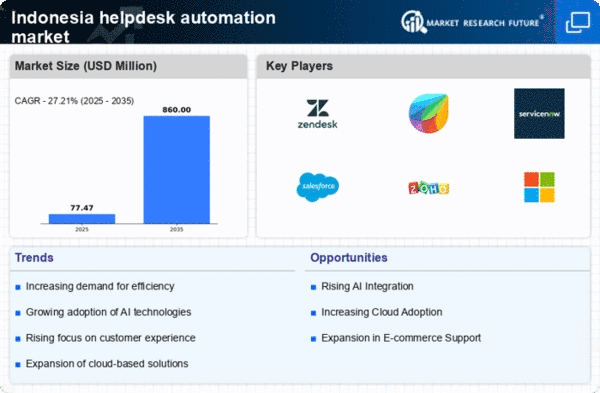
As per Market Research Future analysis, the Indonesia Helpdesk Automation Market size was estimated at 60.9 USD Million in 2024. The Helpdesk Automation market is projected to grow from 77.47 USD Million in 2025 to 860.0 USD Million by 2035, exhibiting a compound annual growth rate (CAGR) of 27.2% during the forecast period 2025 - 2035

Key Market Trends & Highlights

The Indonesia helpdesk automation market is experiencing robust growth driven by technological advancements and evolving customer expectations.

  • The integration of AI technologies is transforming helpdesk operations, enhancing efficiency and customer satisfaction.
  • Omnichannel support is becoming increasingly vital as businesses strive to provide seamless customer experiences across various platforms.
  • There is a rising demand for self-service options, allowing customers to resolve issues independently and efficiently.
  • Key market drivers include growing digital transformation initiatives and increased customer expectations, which are shaping the future of helpdesk automation.

Market Size & Forecast

2024 Market Size 60.9 (USD Million)
2035 Market Size 860.0 (USD Million)
CAGR (2025 - 2035) 27.21%

Major Players

Zendesk (US), Freshworks (IN), ServiceNow (US), Salesforce (US), Zoho (IN), Microsoft (US), Oracle (US), Atlassian (AU), HappyFox (US)

Our Impact
Enabled $4.3B Revenue Impact for Fortune 500 and Leading Multinationals
Partnering with 2000+ Global Organizations Each Year
30K+ Citations by Top-Tier Firms in the Industry

Indonesia Helpdesk Automation Market Trends

The Indonesia Helpdesk Automation Market is experiencing notable growth, driven by the increasing demand for efficient customer service solutions. Organizations are increasingly adopting automation technologies to streamline their operations, reduce response times, and enhance customer satisfaction. This trend is particularly evident in Indonesia, where businesses are recognizing the importance of integrating advanced tools to manage customer inquiries effectively. The rise of digital transformation initiatives across various sectors is further propelling the adoption of helpdesk automation solutions. As companies seek to improve their service delivery, the focus on automation is likely to intensify, leading to a more competitive landscape. Moreover, the growing reliance on artificial intelligence (AI) and machine learning (ML) technologies is reshaping the helpdesk automation market. These innovations enable organizations to provide personalized support and predictive analytics, which can significantly enhance the customer experience. In Indonesia, the increasing internet penetration and smartphone usage are facilitating the shift towards automated solutions. As businesses continue to invest in technology, the helpdesk automation market is poised for substantial advancements, potentially transforming how customer service is delivered in the region.

Integration of AI Technologies

The incorporation of artificial intelligence in helpdesk automation is becoming increasingly prevalent. AI-driven chatbots and virtual assistants are being utilized to handle routine inquiries, allowing human agents to focus on more complex issues. This trend is particularly relevant in Indonesia, where businesses are leveraging AI to enhance operational efficiency and customer engagement.

Focus on Omnichannel Support

There is a growing emphasis on providing seamless support across multiple channels. Organizations are recognizing the need to integrate various communication platforms, such as social media, email, and live chat, into their helpdesk systems. This trend is evident in Indonesia, where customers expect consistent service regardless of the channel they choose.

Rising Demand for Self-Service Options

The demand for self-service solutions is on the rise, as customers increasingly prefer to resolve issues independently. Helpdesk automation tools that offer knowledge bases, FAQs, and community forums are gaining traction. In Indonesia, this trend reflects a shift towards empowering users to find solutions quickly and efficiently.

Indonesia Helpdesk Automation Market Drivers

Increased Customer Expectations

In Indonesia, customer expectations are evolving rapidly, with consumers demanding faster and more efficient service. This shift is significantly impacting the helpdesk automation market, as businesses strive to meet these heightened expectations. A recent survey indicated that 70% of Indonesian consumers prefer immediate responses to their inquiries, which has led organizations to adopt automated solutions to enhance customer service. The ability to provide 24/7 support through chatbots and automated ticketing systems is becoming essential for businesses aiming to retain customer loyalty. As competition intensifies, companies are likely to invest in helpdesk automation technologies to ensure they can deliver timely and effective support. This trend suggests that the helpdesk automation market will continue to expand as organizations prioritize customer satisfaction and seek innovative ways to engage with their clientele.

Regulatory Compliance and Data Security

In Indonesia, regulatory compliance and data security concerns are becoming increasingly important for businesses, influencing the helpdesk automation market. Organizations are required to adhere to various regulations regarding data protection and privacy, which necessitates the implementation of secure automated systems. The rise in cyber threats has heightened the focus on data security, prompting companies to invest in helpdesk automation solutions that offer robust security features. According to industry reports, businesses that prioritize data security are more likely to gain customer trust and loyalty. As a result, the demand for helpdesk automation tools that comply with regulatory standards is expected to grow. This trend indicates that the helpdesk automation market will not only expand due to operational efficiencies but also as a response to the increasing need for secure and compliant customer support solutions.

Cost Efficiency and Resource Optimization

The pursuit of cost efficiency is a primary driver for the helpdesk automation market in Indonesia. Businesses are increasingly recognizing the financial benefits of automating customer support processes. By implementing automated helpdesk solutions, organizations can reduce operational costs associated with staffing and training. Data indicates that companies can save up to 30% on customer service costs by utilizing automation technologies. This financial incentive is particularly appealing to small and medium-sized enterprises (SMEs) in Indonesia, which often operate with limited resources. As these businesses seek to optimize their operations, the adoption of helpdesk automation tools is likely to increase. Moreover, the ability to allocate human resources to more complex tasks while automating routine inquiries enhances overall productivity. Thus, the drive for cost efficiency is expected to significantly influence the growth trajectory of the helpdesk automation market.

Growing Digital Transformation Initiatives

The ongoing digital transformation initiatives across various sectors in Indonesia are propelling the helpdesk automation market. Organizations are increasingly adopting digital tools to enhance operational efficiency and customer engagement. According to recent data, the digital economy in Indonesia is projected to reach $124 billion by 2025, indicating a robust shift towards technology-driven solutions. This transformation necessitates the integration of automated helpdesk systems to streamline customer support processes. As businesses seek to improve response times and service quality, the demand for helpdesk automation solutions is likely to rise. Furthermore, the Indonesian government has been promoting digital literacy and technology adoption, which further supports the growth of the helpdesk automation market. Consequently, companies are investing in automation technologies to remain competitive in a rapidly evolving digital landscape.

Technological Advancements in Automation Tools

Technological advancements are playing a crucial role in shaping the helpdesk automation market in Indonesia. Innovations in artificial intelligence, machine learning, and natural language processing are enhancing the capabilities of helpdesk automation tools. These advancements enable businesses to provide more personalized and efficient customer support. For instance, AI-driven chatbots can now understand and respond to customer inquiries with greater accuracy, leading to improved customer satisfaction. The market for AI in customer service is projected to grow substantially, indicating a strong trend towards automation. As Indonesian companies increasingly adopt these advanced technologies, the helpdesk automation market is likely to experience significant growth. The continuous evolution of automation tools suggests that businesses will have access to increasingly sophisticated solutions, further driving the demand for helpdesk automation.


Market Segment Insights

By Software Type: Web Help Desk (Largest) vs. Open Source Help Desk (Fastest-Growing)

The software type segment in the Indonesia helpdesk automation market showcases significant diversity. Web Help Desk holds the largest market share, driven by its user-friendly interface and cloud-based capabilities that cater to a wide range of businesses. On the other hand, the On-Premise Help Desk is favored by organizations seeking more control over their data, though it lags in market share compared to cloud solutions. Emerging trends indicate that Open Source Help Desk solutions are gaining traction rapidly, being recognized for their adaptability and cost-effectiveness. As businesses in Indonesia increasingly prioritize digital transformation, the demand for innovative and flexible helpdesk solutions is expected to rise. Enterprise Help Desk solutions remain popular among larger organizations, offering comprehensive features tailored to complex needs, but may face stiff competition from emerging software types.

Web Help Desk (Dominant) vs. Open Source Help Desk (Emerging)

Web Help Desk is a dominant player, offering a comprehensive platform that simplifies ticket management and enhances user experience. Its integration capabilities and cloud-based nature make it ideal for businesses looking to streamline operations. Conversely, Open Source Help Desk solutions are emerging as a threat to traditional models, providing customizable features that can be adapted to specific business needs. These solutions allow companies to modify the software without incurring significant licensing fees, making them an attractive option for startups and budget-conscious organizations. The flexibility and community support further enhance their appeal, driving adoption in sectors looking for tailored helpdesk solutions.

By Solution: Ticket Sortation (Largest) vs. Ticket Scheduling (Fastest-Growing)

In the Indonesia helpdesk automation market, Ticket Sortation currently holds the largest market share among the solution segments, driven by its ability to efficiently categorize and route tickets to appropriate departments. Ticket Scheduling and Alert Management are also notable, but their shares remain smaller. The demand for streamlined ticket management processes has significantly contributed to the dominance of Ticket Sortation in this competitive landscape. As businesses are increasingly focusing on enhancing customer experience, Ticket Scheduling emerges as the fastest-growing segment. Factors such as remote work trends and the need for timely responses are bolstering its growth. Alert Management, while crucial, tends to trail behind in revenue generation and adoption rates, highlighting the dynamic nature of solution preferences within the Indonesia helpdesk automation market.

Ticket Sortation: Dominant vs. Ticket Scheduling: Emerging

Ticket Sortation has solidified its position as the dominant solution in the Indonesia helpdesk automation market, enabling organizations to efficiently manage and streamline customer queries. Its effectiveness in sorting and prioritizing tickets enhances operational efficiency, allowing quicker resolutions. In contrast, Ticket Scheduling is recognized as an emerging solution, capturing attention for its rapid growth. This segment appeals to businesses aiming to optimize their workload and ensure prompt service delivery. Both segments exhibit unique characteristics that drive their relevance, with Ticket Sortation focusing on established processes while Ticket Scheduling adapts to new operational demands, catering to the evolving nature of customer support.

By Organization Size: Large Enterprises (Largest) vs. Small and Medium Enterprises (Fastest-Growing)

In the Indonesia helpdesk automation market, Large Enterprises hold a significant market share, benefiting from their extensive resources and established infrastructures. Their ability to invest in advanced automation technologies positions them as leaders in adopting helpdesk solutions, ensuring they meet diverse customer demands effectively. Conversely, Small and Medium Enterprises are rapidly catching up, tapping into innovative solutions that provide them with competitive advantages while catering to their unique operational needs. The growth trends for these segments reveal a dynamic landscape, where Small and Medium Enterprises are increasingly adopting helpdesk automation as digital transformation becomes crucial for efficiency. The move towards cloud-based solutions and the need for cost-effective support systems drive their adoption rates upward. Additionally, the increasing complexity of customer interactions encourages these enterprises to seek automated solutions to enhance service quality and responsiveness, marking them as the fastest-growing segment in the market.

Large Enterprises (Dominant) vs. Small and Medium Enterprises (Emerging)

Large Enterprises in the Indonesia helpdesk automation market demonstrate a robust presence, leveraging their substantial budgets and resources to implement comprehensive automation solutions. They focus on integrating systems across multiple platforms, enhancing user experience and operational efficiency. In contrast, Small and Medium Enterprises represent an emerging force, becoming more prevalent as they adapt to market demands with agile, tailored helpdesk solutions. These enterprises prioritize flexibility and customer-centric approaches, enabling them to respond swiftly to changes in consumer behavior. With advancements in technology and supportive government policies, SMEs are positioned for rapid growth, promising a competitive edge as they incorporate automation into their operational frameworks.

By End-User: BFSI (Largest) vs. Retail (Fastest-Growing)

In the Indonesia helpdesk automation market, the BFSI segment commands a significant share, driven by the necessity for efficient customer service and streamlined operations. The Retail segment, while smaller currently, is experiencing rapid expansion as businesses increasingly adopt automation technologies to enhance the customer experience and manage inquiries more effectively. The growth trends in this space are propelled by advancements in AI and machine learning technologies, which enable more personalized and efficient service solutions. The education sector is showing renewed interest in automation, particularly as online learning becomes prevalent. Meanwhile, the automotive and telecom industries are also leveraging these systems to improve customer support, indicating a broadening market appeal across diverse sectors.

BFSI: Dominant vs. Retail: Emerging

The BFSI sector is a dominant force in the Indonesia helpdesk automation market, characterized by its robust demand for secure, efficient customer support solutions. Institutions like banks and insurance companies leverage helpdesk automation to streamline operations and improve customer satisfaction. In contrast, the Retail segment is rapidly emerging, fueled by growing e-commerce adoption and the need for immediate customer service responses. Retailers are utilizing automation tools to handle high volumes of inquiries during peak seasons, thus enhancing operational efficiency and customer engagement. Both sectors are critical to the evolving landscape, with BFSI leading in stability and Retail gaining traction as a key player in the advancement of automated helpdesk solutions.

Get more detailed insights about Indonesia Helpdesk Automation Market

Key Players and Competitive Insights

The helpdesk automation market in Indonesia is characterized by a dynamic competitive landscape, driven by the increasing demand for efficient customer service solutions and the rapid adoption of digital technologies. Major players such as Zendesk (US), Freshworks (IN), and ServiceNow (US) are strategically positioned to leverage innovation and regional expansion to enhance their market presence. Zendesk (US) focuses on integrating AI capabilities into its platform, aiming to streamline customer interactions and improve service efficiency. Freshworks (IN) emphasizes user-friendly interfaces and affordability, appealing to small and medium-sized enterprises (SMEs) in Indonesia. ServiceNow (US) is concentrating on enterprise-level solutions, enhancing its offerings through strategic partnerships and acquisitions, thereby shaping a competitive environment that prioritizes technological advancement and customer-centric solutions.The market structure appears moderately fragmented, with a mix of established players and emerging startups. Key business tactics include localizing services to meet regional needs and optimizing supply chains to ensure timely delivery of solutions. This competitive structure allows for diverse offerings, catering to various customer segments, from SMEs to large enterprises. The collective influence of these key players fosters an environment where innovation and customer satisfaction are paramount, driving continuous improvement in service delivery.

In October Zendesk (US) announced a significant partnership with a leading Indonesian telecommunications provider to enhance its service offerings in the region. This collaboration is expected to facilitate the integration of advanced analytics and AI-driven insights into customer service operations, thereby improving response times and customer satisfaction. Such strategic moves indicate Zendesk's commitment to expanding its footprint in Indonesia and adapting to local market demands.

In September Freshworks (IN) launched a localized version of its helpdesk automation software tailored specifically for Indonesian businesses. This initiative aims to address the unique challenges faced by local companies, such as language barriers and cultural nuances. By customizing its offerings, Freshworks (IN) positions itself as a more accessible option for Indonesian SMEs, potentially increasing its market share in this competitive landscape.

In August ServiceNow (US) acquired a local tech startup specializing in AI-driven customer service solutions. This acquisition is likely to enhance ServiceNow's capabilities in delivering tailored solutions to Indonesian enterprises, further solidifying its position in the market. The integration of local expertise with ServiceNow's robust platform may lead to innovative service offerings that cater specifically to the needs of Indonesian customers.

As of November current trends in the helpdesk automation market include a strong emphasis on digitalization, AI integration, and sustainability. Companies are increasingly forming strategic alliances to enhance their technological capabilities and expand their service offerings. The competitive differentiation is shifting from price-based competition to a focus on innovation, technology, and supply chain reliability. This evolution suggests that companies that prioritize these aspects will likely gain a competitive edge in the increasingly complex market landscape.

Key Companies in the Indonesia Helpdesk Automation Market include

Industry Developments

The Indonesia Helpdesk Automation Market has recently experienced significant developments with notable growth among key players. Companies like Zendesk, Freshworks, and Salesforce have been investing heavily in technology innovations to cater to the increasing demand for efficient customer service solutions. 

In September 2023, Zendesk announced enhancements to its platform to streamline support processes for Indonesian businesses, capitalizing on the country’s rapid digital transformation. Meanwhile, HubSpot launched a new Customer Relationship Management (CRM) tool that integrates with existing helpdesk solutions, thereby aiming to improve user experience and operational efficiency.

Moreover, Freshworks has expanded its operations in Indonesia, recognizing the market's potential as businesses increasingly seek to automate customer interactions. In August 2023, Microsoft introduced advanced analytics features to its helpdesk solutions targeting Indonesian SMEs, thereby enhancing decision-making capabilities. 

Recently, there have been no significant merger or acquisition activities reported among the key players like Kayako, Gorgias, and Intercom in Indonesia, signaling a focus on organic growth strategies. Overall, the growing adaptation of digital tools in Indonesia highlights a market eager for innovative helpdesk automation solutions that can enhance customer satisfaction and drive efficiency.

Future Outlook

Indonesia Helpdesk Automation Market Future Outlook

The Helpdesk Automation Market in Indonesia is projected to grow at a 27.21% CAGR from 2025 to 2035, driven by technological advancements and increasing demand for efficiency.

New opportunities lie in:

  • Integration of AI-driven chatbots for 24/7 customer support.
  • Development of customizable helpdesk software for niche industries.
  • Expansion of cloud-based solutions to enhance scalability and accessibility.

By 2035, the market is expected to achieve substantial growth, positioning itself as a leader in automation solutions.

Market Segmentation

Indonesia Helpdesk Automation Market End-User Outlook

  • BFSI
  • Retail
  • Healthcare
  • Automotive
  • Telecom
  • Education
  • Government

Indonesia Helpdesk Automation Market Solution Outlook

  • Ticket Sortation
  • Ticket Scheduling
  • Alert Management
  • Others

Indonesia Helpdesk Automation Market Software Type Outlook

  • Web Help Desk
  • On-Premise Help Desk
  • Enterprise Help Desk
  • Open Source Help Desk

Indonesia Helpdesk Automation Market Organization Size Outlook

  • Large Enterprises
  • Small and Medium Enterprises

Report Scope

MARKET SIZE 2024 60.9(USD Million)
MARKET SIZE 2025 77.47(USD Million)
MARKET SIZE 2035 860.0(USD Million)
COMPOUND ANNUAL GROWTH RATE (CAGR) 27.21% (2025 - 2035)
REPORT COVERAGE Revenue Forecast, Competitive Landscape, Growth Factors, and Trends
BASE YEAR 2024
Market Forecast Period 2025 - 2035
Historical Data 2019 - 2024
Market Forecast Units USD Million
Key Companies Profiled Zendesk (US), Freshworks (IN), ServiceNow (US), Salesforce (US), Zoho (IN), Microsoft (US), Oracle (US), Atlassian (AU), HappyFox (US)
Segments Covered Software Type, Solution, Organization Size, End-User
Key Market Opportunities Integration of artificial intelligence enhances efficiency in the helpdesk automation market.
Key Market Dynamics Rising demand for efficient customer support drives innovation in helpdesk automation solutions across Indonesia.
Countries Covered Indonesia
Leave a Comment

FAQs

What is the expected market size of the Indonesia Helpdesk Automation Market in 2024?

The Indonesia Helpdesk Automation Market is expected to be valued at 50.0 USD Million in 2024.

How fast is the Indonesia Helpdesk Automation Market projected to grow between 2025 and 2035?

The market is anticipated to grow at a CAGR of 31.303% between 2025 and 2035.

What will the market size of the Indonesia Helpdesk Automation Market reach by 2035?

By 2035, the Indonesia Helpdesk Automation Market is expected to reach a valuation of 1000.0 USD Million.

Which segment of the software type will have the highest market value in 2035?

The Web Help Desk segment is projected to have the highest market value at 300.0 USD Million in 2035.

What is the expected market size for the Enterprise Help Desk by 2035?

The Enterprise Help Desk segment is anticipated to have a market size of 400.0 USD Million by 2035.

Who are the major players in the Indonesia Helpdesk Automation Market?

Key players include Kayako, HubSpot, Freshworks, HappyFox, and Salesforce, among others.

What will the market size for the Open Source Help Desk be in 2024?

The Open Source Help Desk segment is valued at 5.0 USD Million in 2024.

What is the growth potential of the On-Premise Help Desk segment by 2035?

The On-Premise Help Desk segment is expected to grow to 200.0 USD Million by 2035.

What are the key trends driving the growth in the Indonesia Helpdesk Automation Market?

Key trends include increased automation, the growth of e-commerce, and the need for efficient customer support.

Is there a significant impact of the current global economic scenario on the Indonesia Helpdesk Automation Market?

The market is expected to be influenced by global economic changes, yet it remains on a growth trajectory.

Download Free Sample

Kindly complete the form below to receive a free sample of this Report

Compare Licence

×
Features License Type
Single User Multiuser License Enterprise User
Price $4,950 $5,950 $7,250
Maximum User Access Limit 1 User Upto 10 Users Unrestricted Access Throughout the Organization
Free Customization
Direct Access to Analyst
Deliverable Format
Platform Access
Discount on Next Purchase 10% 15% 15%
Printable Versions