×
Request Free Sample ×

Kindly complete the form below to receive a free sample of this Report

* Please use a valid business email

Leading companies partner with us for data-driven Insights

clients tt-cursor
Hero Background

India Wlan Market

ID: MRFR/ICT/60940-HCR
200 Pages
Aarti Dhapte
February 2026

India WLAN Market Research Report By Application (Residential, Commercial, Industrial, Public Sector, Education), By Product Type (Access Points, Controllers, Hotspots, Repeaters, Antennas), By Connectivity Technology (Wi-Fi 5, Wi-Fi 6, Wi-Fi 6E, Wi-Fi 7, Mesh Networking) and By End Use (Small and Medium Enterprises, Large Enterprises, Home Users, Government, Hospitality)- Forecast to 2035

Share:
Download PDF ×

We do not share your information with anyone. However, we may send you emails based on your report interest from time to time. You may contact us at any time to opt-out.

India Wlan Market Infographic
Purchase Options

India Wlan Market Summary

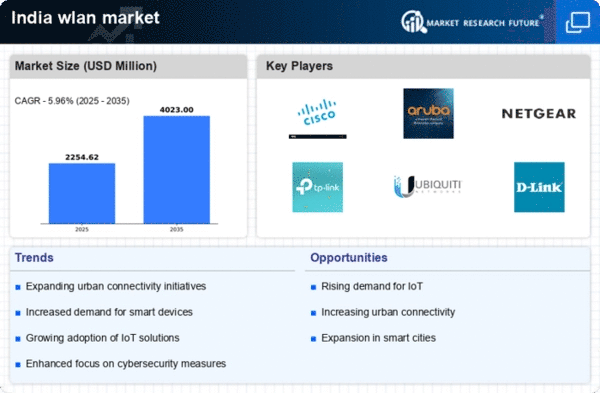
As per Market Research Future analysis, the India wlan market Size was estimated at 2127.8 USD Million in 2024. The Wlan market is projected to grow from 2254.62 USD Million in 2025 to 4023.0 USD Million by 2035, exhibiting a compound annual growth rate (CAGR) of 5.9% during the forecast period 2025 - 2035

Key Market Trends & Highlights

The India WLAN market is experiencing robust growth driven by technological advancements and increasing demand for connectivity.

  • The adoption of Wi-Fi 6 technology is gaining momentum, enhancing network performance and efficiency.
  • Smart home devices are becoming increasingly prevalent, driving demand for reliable wireless connectivity solutions.
  • Cybersecurity is receiving heightened attention as organizations prioritize the protection of their networks and data.
  • The expansion of internet infrastructure and the rise in mobile device usage are key drivers propelling market growth.

Market Size & Forecast

2024 Market Size 2127.8 (USD Million)
2035 Market Size 4023.0 (USD Million)
CAGR (2025 - 2035) 5.96%

Major Players

Cisco Systems (US), Aruba Networks (US), Netgear (US), TP-Link (CN), Ubiquiti Networks (US), D-Link (TW), Huawei Technologies (CN), Extreme Networks (US)

Our Impact
Enabled $4.3B Revenue Impact for Fortune 500 and Leading Multinationals
Partnering with 2000+ Global Organizations Each Year
30K+ Citations by Top-Tier Firms in the Industry

India Wlan Market Trends

The wlan market in India is currently experiencing a dynamic evolution, driven by the increasing demand for high-speed internet connectivity and the proliferation of smart devices. As urbanization accelerates, more households and businesses are seeking reliable wireless solutions to support their digital activities. This trend is further fueled by government initiatives aimed at enhancing digital infrastructure, which appear to be creating a conducive environment for growth. The rise of remote work and online education has also contributed to the heightened need for robust wlan solutions, as users require seamless connectivity for various applications. Moreover, the competitive landscape of the wlan market is intensifying, with numerous players striving to innovate and differentiate their offerings. Companies are investing in advanced technologies such as Wi-Fi 6 and mesh networking to meet the evolving needs of consumers. This focus on innovation suggests a shift towards more efficient and user-friendly wireless solutions. Additionally, the growing awareness of cybersecurity issues is prompting users to seek secure wlan options, indicating a potential shift in consumer preferences towards brands that prioritize safety and reliability. Overall, the wlan market in India is poised for substantial growth, driven by technological advancements and changing consumer behaviors.

Adoption of Wi-Fi 6 Technology

The wlan market is witnessing a notable shift towards the adoption of Wi-Fi 6 technology. This advancement offers enhanced speed, capacity, and efficiency, catering to the increasing number of connected devices in homes and businesses. As users demand higher performance, the transition to this next-generation standard appears to be a key focus for manufacturers and service providers.

Growth of Smart Home Devices

The proliferation of smart home devices is significantly influencing the wlan market. As consumers increasingly integrate smart technologies into their living spaces, the demand for reliable and high-speed wireless connectivity is rising. This trend suggests that wlan solutions must evolve to support the seamless operation of various smart devices.

Emphasis on Cybersecurity

With the growing reliance on wireless networks, there is an increasing emphasis on cybersecurity within the wlan market. Consumers are becoming more aware of potential threats, leading to a demand for secure wlan solutions. This trend indicates that companies may need to prioritize security features in their offerings to meet consumer expectations.

India Wlan Market Drivers

Rise in Mobile Device Usage

The rise in mobile device usage in India significantly impacts the wlan market. As of November 2025, mobile devices account for approximately 70% of internet traffic in the country. This trend indicates a growing reliance on wireless connectivity for both personal and professional use. The increasing adoption of smartphones, tablets, and laptops necessitates the deployment of advanced wlan technologies to ensure seamless connectivity. Moreover, the proliferation of mobile applications and services further drives the demand for high-performance wlan solutions. Businesses are increasingly investing in wlan infrastructure to accommodate the growing number of connected devices, thereby enhancing user experience. This shift towards mobile-centric connectivity solutions is likely to propel the wlan market forward, as organizations strive to meet the evolving needs of their customers.

Emergence of IoT Applications

The emergence of Internet of Things (IoT) applications is a key driver of the wlan market in India. With the increasing integration of IoT devices across various sectors, including agriculture, manufacturing, and smart cities, the demand for robust wlan solutions is on the rise. As of November 2025, it is estimated that there will be over 1 billion connected IoT devices in India, necessitating the deployment of efficient wireless networks to support their operation. This proliferation of IoT devices requires advanced wlan technologies that can handle high data traffic and provide reliable connectivity. Consequently, businesses are likely to invest in wlan infrastructure to ensure seamless integration of IoT applications. The growth of the IoT ecosystem is expected to significantly contribute to the expansion of the wlan market, as organizations seek to leverage wireless connectivity for enhanced operational efficiency.

Expansion of Internet Infrastructure

The ongoing expansion of internet infrastructure in India plays a crucial role in driving the wlan market. With the government's initiatives to enhance digital connectivity, the number of internet users is projected to reach over 900 million by 2025. This surge in connectivity necessitates robust wlan solutions to support the increasing demand for high-speed internet access. The wlan market is likely to benefit from investments in fiber optic networks and 5G technology, which are expected to complement existing wireless networks. As urban areas become more densely populated, the need for reliable and efficient wlan systems becomes paramount. Consequently, this expansion is anticipated to create a favorable environment for wlan market growth, as businesses and consumers alike seek improved connectivity solutions.

Increased Demand for Remote Work Solutions

The increased demand for remote work solutions is reshaping the wlan market landscape in India. As organizations adapt to flexible work arrangements, the need for reliable and secure wireless networks has become paramount. Companies are investing in wlan technologies to facilitate seamless communication and collaboration among remote teams. This trend is expected to drive the growth of the wlan market, as businesses seek to enhance their digital infrastructure to support remote work. Furthermore, the rise of hybrid work models necessitates the implementation of advanced wlan solutions that can accommodate fluctuating user demands. As organizations prioritize employee productivity and connectivity, the wlan market is likely to experience sustained growth in response to these evolving workplace dynamics.

Government Initiatives for Digital Transformation

Government initiatives aimed at digital transformation are significantly influencing the wlan market in India. Programs such as Digital India and Smart Cities Mission are designed to enhance digital infrastructure and promote the adoption of advanced technologies. These initiatives encourage investments in wlan technologies to support various sectors, including education, healthcare, and transportation. As a result, the demand for reliable and high-speed wireless networks is expected to increase. The government is also focusing on improving internet accessibility in rural areas, which could further expand the wlan market. By fostering an environment conducive to technological advancement, these initiatives are likely to stimulate growth in the wlan market, as more organizations seek to leverage wireless connectivity for improved service delivery.


Market Segment Insights

By Application: Residential (Largest) vs. Education (Fastest-Growing)

In the India wlan market, the application segment is characterized by a diverse distribution among various sectors. The residential sector holds the largest share, driven by the increasing demand for home networking solutions and remote work culture. Following this, the commercial sector also shows significant market presence due to the emergence of smart office solutions and sustained digital transformation initiatives. The growth trends reveal that the education sector is emerging as the fastest-growing segment within the India wlan market. This growth is fueled by the rising adoption of e-learning and digital classrooms, necessitating robust wireless communication infrastructure. Additionally, the industrial sector is witnessing enhanced deployment driven by automation and IoT advancements, further contributing to the market dynamics.

Residential (Dominant) vs. Education (Emerging)

The residential segment of the India wlan market stands out as a dominant force, characterized by an increasing number of households investing in high-speed internet and smart home technologies. This segment benefits from the growing trend of remote working and online entertainment, prompting consumers to seek reliable and efficient wireless solutions. On the other hand, the education segment is emerging rapidly, primarily due to the integration of technology in learning environments. Schools and institutions are increasingly prioritizing wireless solutions to support online education, collaborative learning, and enhanced connectivity for students and educators. This dual dynamic between the dominant residential segment and the fast-emerging education sector highlights the transformative changes within the market.

By Product Type: Access Points (Largest) vs. Hotspots (Fastest-Growing)

In the India wlan market, Access Points hold the largest market share among the product types, driven by the increasing demand for reliable wireless connectivity in both residential and commercial settings. Controllers, Repeaters, and Antennas follow as integral components of the network ecosystem, albeit with smaller portions of the overall market share. Hotspots have shown distinctive growth, catering to the rising need for mobile internet access and public Wi-Fi solutions. The growth trends in this segment are fueled by several factors, including the surging adoption of smart devices and the need for robust network infrastructure. Emerging trends such as IoT integration and 5G technology are additionally stimulating demand, especially for Hotspots, which are becoming essential in urban areas. The competitive landscape is characterized by innovation, with new product features enhancing user experience and network performance.

Access Points (Dominant) vs. Repeaters (Emerging)

Access Points represent the dominant product type in the India wlan market, known for their crucial role in establishing wireless networks. They are designed to manage multiple connections efficiently, ensuring robust network coverage. The demand for high-capacity Access Points has surged, influenced by the rise in high-bandwidth applications. On the other hand, Repeaters are emerging as essential tools for extending the range of wireless networks. They are particularly valued in large spaces where signal strength diminishes. As consumers and businesses seek to optimize their connectivity experience, the integration of advanced multipoint technology in Repeaters is enhancing their positioning in the market and addressing the challenges of coverage in expansive environments.

By Connectivity Technology: Wi-Fi 6 (Largest) vs. Wi-Fi 7 (Fastest-Growing)

In the India wlan market, the connectivity technology segment is primarily dominated by Wi-Fi 6, which holds a significant market share due to its advanced features and superior performance compared to previous generations. Wi-Fi 5 has shown steady demand; however, its market share is declining as consumers increasingly prefer the efficiency and speed offered by newer technologies. On the other hand, Wi-Fi 7 is emerging as a strong competitor in the segment, characterized by its ability to support higher capacity and speed, making it the fastest-growing technology. Factors driving this growth include the proliferation of IoT devices and increasing demand for high-speed internet connections in urban areas, leading to an overall positive outlook for the connectivity technology segment.

Wi-Fi 6 (Dominant) vs. Wi-Fi 7 (Emerging)

Wi-Fi 6 is characterized by its support for more simultaneous connections, improved battery life, and enhanced data rates, making it a preferred choice for both residential and commercial users in the India wlan market. As a dominant player, it caters to the increasing demand for reliable connectivity solutions in an era where remote work and online streaming are prevalent. In contrast, Wi-Fi 7 is an emerging technology designed to meet the future needs of high-capacity environments, offering even greater speeds and lower latency. Its architecture is primed to handle the anticipated surge in connected devices, positioning it well for rapid adoption as users seek to upgrade their networks to support next-generation applications.

By End Use: Small and Medium Enterprises (Largest) vs. Home Users (Fastest-Growing)

In the India wlan market, the segmentation by end use reveals that Small and Medium Enterprises (SMEs) hold the largest share, as they adopt wireless technology for efficient operations and connectivity. The increasing need for robust network solutions has led to a significant market presence for SMEs, solidifying their position as the dominant end-user segment. In contrast, Home Users represent the fastest-growing segment, driven by the rising trend of remote work and online learning, which has heightened the demand for reliable home internet connectivity. The growth trends within these segments indicate that SMEs are investing more in advanced wlan solutions to boost productivity and support remote operational capabilities. Conversely, Home Users are being compelled to upgrade their internet services due to increasing digital content consumption, further driven by the proliferation of smart devices. Overall, the competition between these segments illustrates a dynamic market landscape with varying needs and growth potentials.

SMEs (Dominant) vs. Home Users (Emerging)

Small and Medium Enterprises (SMEs) are characterized by their need for affordable yet efficient wireless network solutions in the India wlan market. They leverage wlan technology to enhance productivity, streamline communications, and support a growing remote workforce. The focus on secure and scalable solutions suitable for multiple users positions SMEs as a substantial segment. On the other hand, Home Users are an emerging segment, increasingly prioritizing high-speed internet access to support activities like streaming and online education. As smart home devices proliferate, the demand for reliable wlan connections among Home Users is expected to rise, making them crucial for market growth. This competition between the segments creates unique opportunities for product innovation and service offerings.

Get more detailed insights about India Wlan Market

Key Players and Competitive Insights

The wlan market in India is characterized by a dynamic competitive landscape, driven by rapid technological advancements and increasing demand for high-speed connectivity. Major players such as Cisco Systems (US), Aruba Networks (US), and TP-Link (CN) are actively shaping the market through strategic initiatives focused on innovation and regional expansion. Cisco Systems (US) emphasizes its commitment to enhancing network security and performance, while Aruba Networks (US) leverages its expertise in AI-driven solutions to optimize wireless networks. TP-Link (CN), on the other hand, focuses on cost-effective solutions, catering to both residential and commercial segments, thereby diversifying its market reach. Collectively, these strategies contribute to a moderately fragmented market structure, where competition is intensifying as companies seek to differentiate themselves through technological advancements and customer-centric solutions.Key business tactics employed by these companies include localizing manufacturing and optimizing supply chains to enhance operational efficiency. The competitive structure of the wlan market appears to be moderately fragmented, with several key players vying for market share. This fragmentation allows for a diverse range of products and services, catering to various customer needs. The influence of major players is significant, as they set industry standards and drive innovation, thereby shaping the overall market dynamics.

In October Cisco Systems (US) announced the launch of its new AI-driven wireless access point, designed to enhance network performance and security. This strategic move underscores Cisco's focus on integrating advanced technologies into its product offerings, positioning the company as a leader in the evolving wlan landscape. The introduction of this product is likely to attract enterprise customers seeking robust and secure wireless solutions, further solidifying Cisco's market presence.

In September Aruba Networks (US) unveiled its partnership with a leading telecommunications provider to expand its service offerings in India. This collaboration aims to enhance the deployment of next-generation wireless solutions across urban and rural areas. The strategic importance of this partnership lies in its potential to increase Aruba's market penetration and address the growing demand for reliable connectivity in underserved regions, thereby fostering digital inclusion.

In August TP-Link (CN) launched a new line of affordable wireless routers aimed at small and medium-sized enterprises (SMEs). This initiative reflects TP-Link's strategy to capture a larger share of the SME market, which is increasingly reliant on robust wireless solutions. By offering cost-effective products tailored to the needs of SMEs, TP-Link is likely to enhance its competitive positioning and drive revenue growth in this segment.

As of November current trends in the wlan market indicate a strong emphasis on digitalization, sustainability, and AI integration. Companies are increasingly forming strategic alliances to enhance their technological capabilities and expand their market reach. The competitive differentiation is expected to evolve, shifting from price-based competition to a focus on innovation, technology, and supply chain reliability. This transition suggests that companies that prioritize advanced technological solutions and sustainable practices will likely emerge as leaders in the wlan market.

Key Companies in the India Wlan Market include

Industry Developments

Recent developments in the India WLAN Market have shown a significant focus on enhancing connectivity solutions across various sectors. Companies such as Hewlett Packard Enterprise and Cisco Systems are increasingly investing in innovative technologies to meet the demand for robust wireless networks. In September 2023, Cisco Systems announced an upgrade in its WLAN services targeted at educational institutions, aiming to streamline wireless access for students, reflecting the growing need for reliable connectivity in India’s education sector. 

Similarly, in August 2023, Aruba Networks showcased its advancements in security features for WLAN solutions, responding to the heightened concerns regarding cybersecurity threats in India. The Indian Government's push for digitization is accelerating market growth, with 5G technology set to further transform WLAN infrastructures. 

Furthermore, TPLink Technologies is looking to expand its manufacturing capabilities in India by 2024 to fulfill the increasing demand for consumer-grade wireless solutions. Merger and acquisition activity has also been minimal recently, with no major deals reported among key players like Juniper Networks or Extreme Networks in the past few months. The WLAN market valuation continues to grow, driven by increasing internet penetration and the rise of IoT devices in the region.

Future Outlook

India Wlan Market Future Outlook

The WLAN Market in India is projected to grow at a 5.96% CAGR from 2025 to 2035, driven by increasing demand for high-speed internet and smart devices.

New opportunities lie in:

  • Expansion of Wi-Fi 6 infrastructure in urban areas
  • Development of customized enterprise WLAN solutions
  • Integration of AI-driven network management tools

By 2035, the wlan market is expected to achieve substantial growth and innovation.

Market Segmentation

India Wlan Market End Use Outlook

  • Small and Medium Enterprises
  • Large Enterprises
  • Home Users
  • Government
  • Hospitality

India Wlan Market Application Outlook

  • Residential
  • Commercial
  • Industrial
  • Public Sector
  • Education

India Wlan Market Product Type Outlook

  • Access Points
  • Controllers
  • Hotspots
  • Repeaters
  • Antennas

India Wlan Market Connectivity Technology Outlook

  • Wi-Fi 5
  • Wi-Fi 6
  • Wi-Fi 6E
  • Wi-Fi 7
  • Mesh Networking

Report Scope

MARKET SIZE 2024 2127.8(USD Million)
MARKET SIZE 2025 2254.62(USD Million)
MARKET SIZE 2035 4023.0(USD Million)
COMPOUND ANNUAL GROWTH RATE (CAGR) 5.96% (2025 - 2035)
REPORT COVERAGE Revenue Forecast, Competitive Landscape, Growth Factors, and Trends
BASE YEAR 2024
Market Forecast Period 2025 - 2035
Historical Data 2019 - 2024
Market Forecast Units USD Million
Key Companies Profiled Cisco Systems (US), Aruba Networks (US), Netgear (US), TP-Link (CN), Ubiquiti Networks (US), D-Link (TW), Huawei Technologies (CN), Extreme Networks (US)
Segments Covered Application, Product Type, Connectivity Technology, End Use
Key Market Opportunities Integration of advanced security protocols in wlan market to address rising cybersecurity concerns.
Key Market Dynamics Rising demand for high-speed connectivity drives innovation and competition in the WLAN market.
Countries Covered India
Leave a Comment

FAQs

What is the expected market size of the India WLAN Market in 2024?

The India WLAN Market is expected to be valued at 2.5 USD Billion in 2024.

What is the projected market size of the India WLAN Market by 2035?

By 2035, the India WLAN Market is anticipated to reach a value of 6.5 USD Billion.

What is the expected compound annual growth rate (CAGR) for the India WLAN Market from 2025 to 2035?

The expected CAGR for the India WLAN Market from 2025 to 2035 is 9.075%.

What are the market size projections for the Residential application in the India WLAN Market?

The Residential application is projected to grow from 1.0 USD Billion in 2024 to 2.5 USD Billion in 2035.

How much is the Commercial application in the India WLAN Market expected to be valued in 2035?

The Commercial application is expected to reach a valuation of 1.8 USD Billion by 2035.

What market size is projected for the Industrial application in 2024?

The Industrial application is projected to be valued at 0.4 USD Billion in 2024.

Which companies are the major players in the India WLAN Market?

Major players in the India WLAN Market include Hewlett Packard Enterprise, Cisco Systems, and Aruba Networks among others.

What is the market value projected for the Public Sector application by 2035?

The Public Sector application is expected to reach a valuation of 0.5 USD Billion by 2035.

What growth opportunities exist in the India WLAN Market?

Significant growth opportunities in the India WLAN Market are expected due to increasing connectivity needs across various sectors.

What challenges does the India WLAN Market face in its growth?

The India WLAN Market faces challenges such as technological advancements and intense competition among existing players.

Download Free Sample

Kindly complete the form below to receive a free sample of this Report

Compare Licence

×
Features License Type
Single User Multiuser License Enterprise User
Price $4,950 $5,950 $7,250
Maximum User Access Limit 1 User Upto 10 Users Unrestricted Access Throughout the Organization
Free Customization
Direct Access to Analyst
Deliverable Format
Platform Access
Discount on Next Purchase 10% 15% 15%
Printable Versions