×
Request Free Sample ×

Kindly complete the form below to receive a free sample of this Report

* Please use a valid business email

Leading companies partner with us for data-driven Insights

clients tt-cursor
Hero Background

India Welded Pipes Market

ID: MRFR/PCM/44405-HCR
111 Pages
Snehal Singh
February 2026

India Welded Pipes Market Research Report: By Material (Carbon Steel, Stainless Steel, Alloy Steel), By Type (Process Pipes, Mechanical Tubes, Heat Exchanger Tubes, Structural Tubes, Hydraulic Instrumentation Tubes), andBy Application (Oil and Gas, Power Generation, Infrastructure and Construction, Automotive, MechanicalEngineering)- Forecast to 2035.

Share:
Download PDF ×

We do not share your information with anyone. However, we may send you emails based on your report interest from time to time. You may contact us at any time to opt-out.

India Welded Pipes Market Infographic
Purchase Options

India Welded Pipes Market Summary

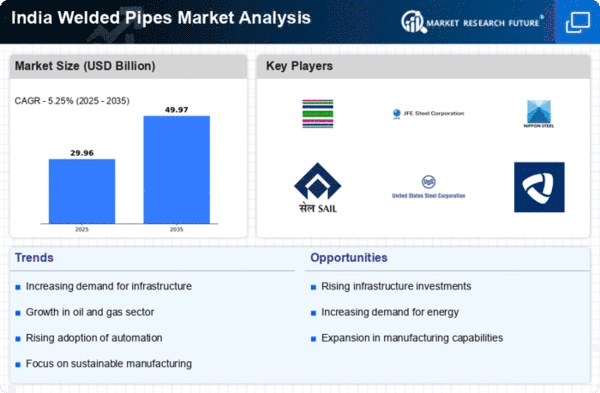
As per Market Research Future analysis, the India Welded Pipes Market size was estimated at 28.47 USD Billion in 2024. The India welded pipes market is projected to grow from 29.96 USD Billion in 2025 to 49.97 USD Billion by 2035, exhibiting a compound annual growth rate (CAGR) of 5.2% during the forecast period 2025 - 2035

Key Market Trends & Highlights

The India The market is experiencing robust growth driven by various sectoral demands and technological advancements. is experiencing robust growth driven by various sectoral demands and technological advancements.

  • The construction sector is the largest segment, significantly driving the demand for welded pipes.
  • Technological advancements in manufacturing processes are enhancing production efficiency and product quality.
  • Sustainability and eco-friendly practices are becoming increasingly important in the welded pipes market.
  • Infrastructure development initiatives and urbanization are key drivers propelling market growth.

Market Size & Forecast

2024 Market Size 28.47 (USD Billion)
2035 Market Size 49.97 (USD Billion)
CAGR (2025 - 2035) 5.25%

Major Players

Tenaris (AR), JFE Steel Corporation (JP), Nippon Steel Corporation (JP), Steel Authority of India Limited (IN), United States Steel Corporation (US), Severstal (RU), Valmont Industries (US), Zekelman Industries (US)

Our Impact
Enabled $4.3B Revenue Impact for Fortune 500 and Leading Multinationals
Partnering with 2000+ Global Organizations Each Year
30K+ Citations by Top-Tier Firms in the Industry

India Welded Pipes Market Trends

The India Welded Pipes Market is currently experiencing a dynamic phase characterized by evolving demand and technological advancements. is currently experiencing a dynamic phase characterized by evolving demand and technological advancements. The construction and infrastructure sectors are driving the need for high-quality welded pipes, as these products are essential for various applications, including water supply, gas distribution, and structural support. The increasing urbanization in India appears to be a significant factor influencing this growth, as cities expand and require robust piping solutions. Furthermore, the government's initiatives to enhance infrastructure development may further stimulate the market, suggesting a positive outlook for manufacturers and suppliers in this sector. In addition to infrastructure projects, the welded pipes market is also witnessing a shift towards sustainability and eco-friendly practices. Manufacturers are increasingly adopting innovative techniques to produce pipes that minimize environmental impact. This trend aligns with the global push for sustainable development, indicating that the market is not only responding to local demands but also to broader environmental concerns. As the industry evolves, it seems likely that advancements in technology and materials will continue to shape the future of welded pipes, making them more efficient and durable for various applications.

Rising Demand from Construction Sector

The construction sector is a primary driver of the welded pipes market, as infrastructure projects require reliable piping solutions. The ongoing urbanization in India is likely to increase the demand for welded pipes, particularly in residential and commercial buildings.

Technological Advancements in Manufacturing

Innovations in manufacturing processes are enhancing the quality and efficiency of welded pipes. New technologies may lead to the production of lighter, stronger, and more corrosion-resistant pipes, which could meet the evolving needs of various industries.

Focus on Sustainability and Eco-Friendly Practices

There is a growing emphasis on sustainability within the welded pipes market. Manufacturers are exploring eco-friendly materials and production methods, which may align with global environmental goals and cater to the increasing demand for sustainable construction solutions.

India Welded Pipes Market Drivers

Growing Energy Sector

The expansion of the energy sector in India is poised to be a major driver for the The expansion of the energy sector in India is poised to be a major driver for the market.. With the government's commitment to increasing renewable energy capacity, particularly in solar and wind energy, the need for efficient piping systems is becoming more pronounced. The energy sector's growth is projected to attract investments exceeding $20 billion by 2025, which could lead to heightened demand for welded pipes used in energy transmission and distribution. Additionally, the oil and gas industry continues to thrive, with significant investments in pipeline infrastructure. This sector's reliance on durable and high-quality welded pipes for transporting hydrocarbons suggests a sustained demand, thereby positively impacting the welded pipes market. The interplay between energy expansion and welded pipe requirements indicates a promising outlook for the industry.

Regulatory Support and Standards

Regulatory support and the establishment of standards in India are expected to bolster the Regulatory support and the establishment of standards in India are expected to bolster the market.. The Bureau of Indian Standards (BIS) has implemented various guidelines to ensure the quality and safety of welded pipes, which could enhance consumer confidence and drive market growth. Compliance with these standards is crucial for manufacturers, as it ensures that products meet the necessary safety and performance criteria. Furthermore, government policies promoting the use of high-quality materials in construction and infrastructure projects may lead to increased demand for welded pipes. As industries adapt to these regulations, the welded pipes market is likely to experience growth, driven by the need for compliance and the assurance of quality in construction materials.

Urbanization and Population Growth

Urbanization and population growth in India are likely to significantly influence the Urbanization and population growth in India are likely to significantly influence the market.. As more individuals migrate to urban areas, the demand for housing, sanitation, and infrastructure services is expected to rise. The urban population is projected to reach 600 million by 2031, necessitating extensive development in water supply and sewage systems. This surge in urbanization will likely require a substantial quantity of welded pipes for various applications, including plumbing and drainage systems. Moreover, the government's initiatives to improve urban infrastructure, such as the Atal Mission for Rejuvenation and Urban Transformation (AMRUT), further emphasize the need for welded pipes. Consequently, the welded pipes market appears to be well-positioned to benefit from these demographic trends and urban development efforts.

Infrastructure Development Initiatives

The Indian government's ongoing infrastructure development initiatives are likely to drive the The Indian government's ongoing infrastructure development initiatives are likely to drive the market.. With substantial investments in projects such as smart cities, highways, and urban transport systems, the demand for welded pipes is expected to surge. The National Infrastructure Pipeline (NIP) aims to invest over $1.4 trillion by 2025, which could significantly boost the construction and utility sectors. This increase in infrastructure projects necessitates the use of welded pipes for water supply, sewage systems, and gas distribution, thereby enhancing the market's growth prospects. Furthermore, the government's push for housing and urban development is anticipated to create a robust demand for welded pipes, as they are essential components in various construction applications. Overall, these initiatives appear to be a key driver for the welded pipes market in India.

Technological Innovations in Production

Technological innovations in the production of welded pipes are anticipated to be a significant driver for the market. Advances in manufacturing processes, such as automated welding techniques and improved quality control measures, are likely to enhance the efficiency and quality of welded pipes. These innovations can lead to reduced production costs and increased output, making welded pipes more accessible to various industries. Additionally, the integration of smart technologies in manufacturing could facilitate real-time monitoring and optimization of production processes. As manufacturers adopt these technologies, the Technological innovations in the production of welded pipes are anticipated to be a significant driver for the market. may witness a transformation, characterized by higher quality products and improved competitiveness. This technological evolution appears to be a crucial factor in shaping the future landscape of the welded pipes market.


Market Segment Insights

By Material: Carbon Steel (Largest) vs. Stainless Steel (Fastest-Growing)

In the India welded pipes market, Carbon Steel holds a significant share, established as the most prevalent material due to its cost-effectiveness and sufficient strength for various applications. Stainless Steel, while smaller in overall market share, is rapidly gaining traction owing to its superior resistance to corrosion and high durability, appealing to industries demanding longevity and quality in their piping solutions. The growth trends within this segment indicate a noteworthy shift towards Stainless Steel, driven by increasing demand in sectors like construction, oil & gas, and chemical processing where corrosion resistance is paramount. Simultaneously, Carbon Steel remains resilient due to its widespread usage in infrastructure projects. This divergence highlights a market in transition, balancing traditional materials with emerging preferences for advanced alloys.

Carbon Steel (Dominant) vs. Stainless Steel (Emerging)

Carbon Steel remains the dominant material in the India welded pipes market, celebrated for its balance of strength and affordability. It is widely used across diverse industries, including construction and water transport, owing to its excellent load-bearing capacity. In contrast, Stainless Steel is emerging as a key player, driven by its resistance to oxidation and corrosion, making it highly suitable for applications in food processing, pharmaceuticals, and environments prone to moisture. The shift towards environmentally sustainable practices also favors Stainless Steel as it is often recyclable, aligning with modern industrial standards. This contrast reflects a dynamic market landscape where the established strengths of Carbon Steel are being challenged by the advancements offered by Stainless Steel.

By Type: Process Pipes (Largest) vs. Mechanical Tubes (Fastest-Growing)

The India welded pipes market showcases a diverse distribution among different segment values, with process pipes holding the largest share. They are widely used across various industries such as oil and gas and chemicals due to their reliability and strength. Mechanical tubes follow as a significant segment, benefiting from a growing demand for high-performance tubes in automotive and engineering applications. The growth trends in this segment are pivotal, driven by industrial expansion and infrastructure developments across the nation. Emerging sectors such as renewable energy and construction are increasingly utilizing specialized tubes like heat exchanger tubes and hydraulic instrumentation tubes, indicating a shift towards advanced applications and materials. This trend signifies evolving industry needs that are propelling the market forward.

Process Pipes (Dominant) vs. Heat Exchanger Tubes (Emerging)

Process pipes are characterized by their robustness and versatility, making them dominant in various industrial applications. They are essential for transporting fluids in processes that require durability and resistance to chemicals. On the other hand, heat exchanger tubes represent an emerging segment, as they are increasingly adopted in sectors focused on energy efficiency and thermal management. These tubes are engineered for superior heat transfer, making them vital in power generation and HVAC systems. The contrasting characteristics between the established dominance of process pipes and the growth potential of heat exchanger tubes highlight the evolving dynamics within the India welded pipes market.

By Application: Infrastructure & Construction (Largest) vs. Oil & Gas (Fastest-Growing)

The India welded pipes market exhibits a diverse distribution among various applications, with the dominant segment being Infrastructure & Construction, which holds a significant share owing to the country's ongoing urbanization and industrial expansion. In contrast, the Oil & Gas segment, while smaller, is rapidly gaining traction as investments in energy and exploration increase, emphasizing the critical role of welded pipes in these sectors. Growth trends within the segment are primarily driven by the rising demand for robust piping solutions in Infrastructure & Construction, as government initiatives and infrastructure projects prompt sustained usage. Furthermore, the Oil & Gas sector is experiencing heightened activity fueled by increasing energy needs and evolving exploration technologies. These dynamics create an environment conducive to innovation and expansion in the welded pipes market, particularly in emerging applications.

Oil & Gas (Dominant) vs. Automotive (Emerging)

The Oil & Gas segment is characterized by its reliable demand for high-quality welded pipes, essential for transporting hydrocarbons efficiently over long distances. This segment has established a solid footing in the India welded pipes market due to the sector's foundational need for durable piping solutions amid fluctuating oil prices and regulatory challenges. Conversely, the Automotive segment is emerging, driven by the increasing production of vehicles and a shift towards more efficient transport systems. As manufacturers seek lightweight yet strong materials, welded pipes are becoming integral in automotive applications, particularly in exhaust systems and structural components. The growth potential in the Automotive segment presents unique opportunities for innovation and enhanced performance within the India welded pipes market.

Get more detailed insights about India Welded Pipes Market

Key Players and Competitive Insights

The welded pipes market in India is characterized by a competitive landscape that is increasingly shaped by innovation, strategic partnerships, and regional expansion. Key players such as Steel Authority of India Limited (India), Tenaris (Argentina), and Nippon Steel Corporation (Japan) are actively pursuing strategies that enhance their market positioning. Steel Authority of India Limited (India) focuses on expanding its production capabilities and enhancing product quality, which appears to be a response to the growing demand for high-grade welded pipes in various sectors, including construction and infrastructure. Meanwhile, Tenaris (Argentina) emphasizes technological advancements and sustainability in its operations, indicating a shift towards environmentally friendly manufacturing processes. Nippon Steel Corporation (Japan) is also investing in digital transformation initiatives, which suggests a broader trend among competitors to leverage technology for operational efficiency and customer engagement.The business tactics employed by these companies reflect a concerted effort to localize manufacturing and optimize supply chains. The market structure is moderately fragmented, with several players vying for market share, yet the influence of major companies is palpable. This competitive dynamic fosters an environment where innovation and operational excellence are paramount, as companies seek to differentiate themselves in a crowded marketplace.

In September Steel Authority of India Limited (India) announced a strategic partnership with a leading technology firm to enhance its manufacturing processes through automation. This move is likely to improve production efficiency and reduce operational costs, positioning the company favorably against its competitors. The partnership underscores the importance of technological integration in maintaining competitiveness within the welded pipes market.

In August Tenaris (Argentina) launched a new line of eco-friendly welded pipes designed for the renewable energy sector. This initiative not only aligns with global sustainability trends but also caters to the increasing demand for environmentally responsible products. The introduction of this product line may enhance Tenaris's market share and appeal to a broader customer base focused on sustainability.

In October Nippon Steel Corporation (Japan) unveiled a digital platform aimed at streamlining customer interactions and improving service delivery. This platform is expected to enhance customer satisfaction and loyalty, reflecting a growing trend towards digitalization in the industry. By investing in customer-centric technologies, Nippon Steel Corporation is likely to strengthen its competitive position in the market.

As of November the welded pipes market is witnessing trends that emphasize digitalization, sustainability, and technological integration. Strategic alliances are increasingly shaping the competitive landscape, enabling companies to pool resources and expertise. The shift from price-based competition to a focus on innovation and supply chain reliability is evident, suggesting that future competitive differentiation will hinge on the ability to adapt to these evolving trends.

Key Companies in the India Welded Pipes Market include

Industry Developments

The India Welded Pipes Market has witnessed notable developments recently, with companies like Tata Metaliks and Jindal Steel and Power investing in capacity expansion to meet the rising demand for API-grade pipes, particularly in the oil and gas sector.

In January 2023, Welspun Corp announced the successful completion of several projects, enhancing its market position significantly. ISMT Limited has also focused on improving product offerings to cater to infrastructure projects, indicating a shift towards higher-quality manufacturing.

The market valuation for companies such as Essar Steel and Bhushan Steel has seen upward trends, with the sector benefiting from increased government infrastructure spending and the National Infrastructure Plan initiatives.

Regarding mergers and acquisitions, in early 2023, Madhav KRG Group completed the acquisition of certain assets from Kothari Products, aimed at enhancing their product portfolio in the welded pipe segment.

Notably, in the past two years, major players like Steel Authority of India Limited launched new products and technologies to bolster their competitiveness, contributing to the robust growth of the sector amid rising domestic and export demands.

Future Outlook

India Welded Pipes Market Future Outlook

The welded pipes market in India is projected to grow at a 5.25% CAGR from 2025 to 2035, driven by infrastructure development, energy sector expansion, and increasing demand for durable materials.

New opportunities lie in:

  • Investment in advanced welding technologies to enhance production efficiency.
  • Development of eco-friendly welded pipes to meet sustainability standards.
  • Expansion into emerging markets through strategic partnerships and local manufacturing.

By 2035, the welded pipes market is expected to achieve robust growth, driven by innovation and strategic investments.

Market Segmentation

India Welded Pipes Market Type Outlook

  • Process Pipes
  • Mechanical Tubes
  • Heat Exchanger Tubes
  • Structural Tubes
  • Hydraulic Instrumentation Tubes

India Welded Pipes Market Material Outlook

  • Carbon Steel
  • Stainless Steel
  • Alloy Steel

India Welded Pipes Market Application Outlook

  • Oil & Gas
  • Power Generation
  • Infrastructure & Construction
  • Automotive
  • Mechanical & Engineering

Report Scope

MARKET SIZE 2024 28.47(USD Billion)
MARKET SIZE 2025 29.96(USD Billion)
MARKET SIZE 2035 49.97(USD Billion)
COMPOUND ANNUAL GROWTH RATE (CAGR) 5.25% (2025 - 2035)
REPORT COVERAGE Revenue Forecast, Competitive Landscape, Growth Factors, and Trends
BASE YEAR 2024
Market Forecast Period 2025 - 2035
Historical Data 2019 - 2024
Market Forecast Units USD Billion
Key Companies Profiled Tenaris (AR), JFE Steel Corporation (JP), Nippon Steel Corporation (JP), Steel Authority of India Limited (IN), United States Steel Corporation (US), Severstal (RU), Valmont Industries (US), Zekelman Industries (US)
Segments Covered Material, Type, Application
Key Market Opportunities Adoption of advanced welding technologies enhances efficiency and quality in the welded pipes market.

Key Market Dynamics Rising demand for welded pipes driven by infrastructure development and regulatory support for sustainable construction practices.
Countries Covered India
Leave a Comment

FAQs

What is the expected market size of the India Welded Pipes Market by 2024?

The India Welded Pipes Market is expected to be valued at approximately 22.15 USD Billion by the year 2024.

What is the projected market size of the India Welded Pipes Market by 2035?

By the year 2035, the India Welded Pipes Market is anticipated to reach a valuation of around 39.5 USD Billion.

What is the expected compound annual growth rate (CAGR) for the India Welded Pipes Market from 2025 to 2035?

The market is expected to grow at a CAGR of 5.401 percent from 2025 to 2035.

Which material segment holds the highest value in the India Welded Pipes Market by 2024?

The Carbon Steel segment holds the highest value in the India Welded Pipes Market, projected at 8.84 USD Billion by 2024.

What is the expected value of the Alloy Steel segment in the India Welded Pipes Market by 2035?

The Alloy Steel segment is expected to reach a value of 12.89 USD Billion by the year 2035.

What are some of the key players in the India Welded Pipes Market?

Key players in the India Welded Pipes Market include Essar Steel, Tata Metaliks, Welspun Corp, and Steel Authority of India Limited.

What growth opportunities exist for the India Welded Pipes Market?

The market presents opportunities driven by infrastructure development and increased demand in various industries.

How does the projected growth of the Stainless Steel segment look by 2035?

The Stainless Steel segment is projected to reach a valuation of approximately 10.78 USD Billion by 2035.

What challenges does the India Welded Pipes Market face?

Challenges include fluctuating raw material prices and competition from alternative materials.

What is the impact of regional trends on the India Welded Pipes Market?

Regional trends in manufacturing and construction significantly influence the growth and demand in the India Welded Pipes Market.

Download Free Sample

Kindly complete the form below to receive a free sample of this Report

Compare Licence

×
Features License Type
Single User Multiuser License Enterprise User
Price $4,950 $5,950 $7,250
Maximum User Access Limit 1 User Upto 10 Users Unrestricted Access Throughout the Organization
Free Customization
Direct Access to Analyst
Deliverable Format
Platform Access
Discount on Next Purchase 10% 15% 15%
Printable Versions