×
Request Free Sample ×

Kindly complete the form below to receive a free sample of this Report

* Please use a valid business email

Leading companies partner with us for data-driven Insights

clients tt-cursor
Hero Background

India Vitamins Market

ID: MRFR/FnB/46272-HCR
128 Pages
Snehal Singh
February 2026

India Vitamins Market Size, Share, Industry Trend & Analysis Research Report By Type (Vitamin B, Vitamin C, Vitamin E, Others), By Source (Synthetic, Natural) and By Application (Food & Beverages, Pharmaceutical & Nutraceutical, Animal Feed, Personal Care) - Forecast to 2035.

Share:
Download PDF ×

We do not share your information with anyone. However, we may send you emails based on your report interest from time to time. You may contact us at any time to opt-out.

India Vitamins Market Infographic
Purchase Options

India Vitamins Market Summary

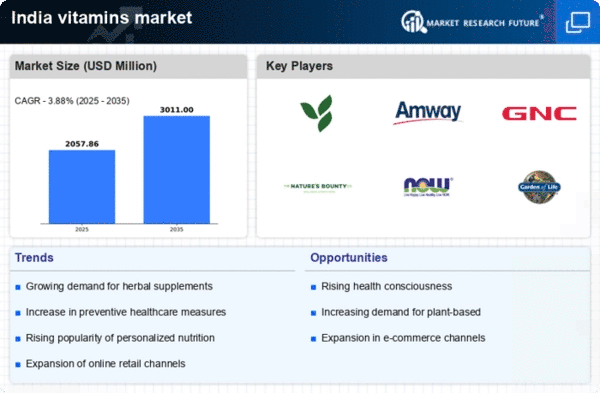
As per Market Research Future analysis, the India vitamins market Size was estimated at 1981.0 $ Million in 2024. The India vitamins market is projected to grow from 2057.86 $ Million in 2025 to 3011.0 $ Million by 2035, exhibiting a compound annual growth rate (CAGR) of 3.8% during the forecast period 2025 - 2035

Key Market Trends & Highlights

The India vitamins market is experiencing robust growth driven by health consciousness and digital trends.

  • The largest segment in the India vitamins market is dietary supplements, while the fastest-growing segment is herbal vitamins.
  • Rising health consciousness among consumers is propelling demand for vitamins across various demographics.
  • E-commerce is rapidly transforming the distribution landscape, making vitamins more accessible to consumers.
  • Key market drivers include increasing nutritional awareness and the influence of social media and digital marketing.

Market Size & Forecast

2024 Market Size 1981.0 (USD Million)
2035 Market Size 3011.0 (USD Million)
CAGR (2025 - 2035) 3.88%

Major Players

Herbalife (US), Amway (US), GNC Holdings (US), Nature's Bounty (US), NOW Foods (US), Garden of Life (US), Solgar (US), Swanson Health Products (US), NutraBlast (US)

Our Impact
Enabled $4.3B Revenue Impact for Fortune 500 and Leading Multinationals
Partnering with 2000+ Global Organizations Each Year
30K+ Citations by Top-Tier Firms in the Industry

India Vitamins Market Trends

The vitamins market in India is currently experiencing notable growth, driven by increasing health awareness among consumers. This heightened consciousness regarding nutrition and wellness has led to a surge in demand for dietary supplements, particularly vitamins. Consumers are becoming more proactive about their health, seeking products that can enhance their well-being and prevent deficiencies. Additionally, the rise of e-commerce platforms has facilitated easier access to a variety of vitamin products, further propelling market expansion. The trend towards preventive healthcare is likely to continue influencing purchasing behaviors, as individuals prioritize maintaining optimal health through supplementation. Moreover, the vitamins market is witnessing a shift towards natural and organic products. As consumers become more discerning, there is a growing preference for vitamins derived from natural sources rather than synthetic alternatives. This inclination aligns with broader trends in the food and beverage sector, where clean labels and transparency are increasingly valued. Manufacturers are responding to this demand by innovating and reformulating their offerings to include plant-based and organic ingredients. This evolution in consumer preferences suggests that the market will continue to adapt, focusing on quality and sustainability in product development.

Rising Health Consciousness

There is a marked increase in health awareness among consumers, leading to a greater demand for vitamins. Individuals are actively seeking supplements to enhance their overall well-being and prevent nutritional deficiencies.

Shift Towards Natural Products

Consumers are increasingly favoring vitamins derived from natural sources over synthetic options. This trend reflects a broader movement towards organic and clean-label products, prompting manufacturers to innovate accordingly.

E-commerce Growth

The expansion of e-commerce platforms is significantly impacting the vitamins market. Consumers now have easier access to a wide range of vitamin products, which is likely to drive sales and market penetration.

India Vitamins Market Drivers

Aging Population

India's demographic shift towards an aging population is influencing the vitamins market in notable ways. As the elderly population grows, there is an increasing demand for vitamins that cater to age-related health concerns, such as bone health and cognitive function. This demographic is more likely to seek out supplements to maintain their health and vitality. Consequently, the vitamins market is expected to expand as manufacturers develop products specifically targeting the needs of older adults. This trend suggests a potential growth trajectory for the market, as companies innovate to meet the demands of this demographic.

Rising Disposable Incomes

The increase in disposable incomes among the Indian population is a significant driver for the vitamins market. As more individuals attain higher income levels, they are more likely to invest in health and wellness products, including vitamins and dietary supplements. This trend is particularly evident in metropolitan areas, where consumers are willing to spend on premium products that promise enhanced health benefits. Market data indicates that the vitamins market could see a revenue increase of up to 15% in the next few years, largely attributed to this rise in disposable income and changing consumer spending habits.

Increasing Nutritional Awareness

The growing awareness regarding nutrition and its impact on health is a pivotal driver for the vitamins market in India. Consumers are increasingly educated about the benefits of vitamins, leading to a surge in demand for dietary supplements. According to recent data, the vitamins market is projected to grow at a CAGR of approximately 8% over the next five years. This trend is particularly pronounced among urban populations, where lifestyle diseases are prevalent. As individuals seek to enhance their overall well-being, the vitamins market is likely to witness a significant uptick in sales, driven by a focus on preventive healthcare and nutritional supplementation.

Government Initiatives and Regulations

Government initiatives aimed at promoting health and wellness play a crucial role in shaping the vitamins market in India. Various programs and policies are being implemented to encourage the consumption of vitamins and supplements, particularly among vulnerable populations. For instance, the government has launched campaigns to educate citizens about the importance of micronutrients. Additionally, regulatory frameworks are being established to ensure product safety and efficacy, which enhances consumer trust. This regulatory environment is expected to bolster the vitamins market, as consumers feel more confident in the quality of products available to them.

Influence of Social Media and Digital Marketing

The impact of social media and digital marketing on consumer behavior is a driving force in the vitamins market. With the rise of influencers and health advocates promoting various vitamin products online, consumers are increasingly exposed to information about the benefits of supplementation. This digital engagement is reshaping purchasing decisions, particularly among younger demographics who rely on social media for health advice. As a result, brands are investing in targeted online marketing strategies to capture this audience, which is likely to propel the vitamins market forward as more consumers turn to online platforms for their health needs.


Market Segment Insights

By Type: Vitamins D (Largest) vs. Vitamins C (Fastest-Growing)

In the India vitamins market, Vitamins D holds the largest share, reflecting its essential role in bone health and immune support. This segment is predominantly consumed in various forms, including capsules and fortified foods, catering to the growing health consciousness among consumers in India. Vitamins A, B, and E also have significant shares, but they fall behind in comparison, showing a more stable demand without the explosive growth seen in other segments. The growth trends in this segment are heavily influenced by increasing awareness about vitamins' health benefits, especially in the wake of health concerns surrounding deficiencies. Vitamins C, in particular, is experiencing rapid growth due to its perceived immune-boosting properties, further accelerated by the pandemic's impact. Consumer preference is shifting towards holistic wellness, driving the demand for vitamin supplements, particularly in the urban population.

Vitamins D (Dominant) vs. Vitamins C (Emerging)

Vitamins D is positioned as the dominant segment in the India vitamins market due to its critical role in maintaining health and preventing deficiencies, particularly among aging populations and those with limited sun exposure. This segment benefits from a strong base of regular consumers and a growing market for fortified products. Conversely, Vitamins C is emerging rapidly, reflecting trends towards preventive health and immune support. Its appeal is bolstered by increasing consumer education related to seasonal illnesses and overall well-being, making it a hotbed for innovation in product offerings. Together, these vitamins illustrate the diverse needs and preferences within the market, each targeting specific health outcomes and demographics.

By Form: Tablets (Largest) vs. Capsules (Fastest-Growing)

In the India vitamins market, the form segment shows a diverse distribution of market share across tablets, capsules, powders, and liquids. Tablets dominate the segment, capturing the largest share due to their convenience and cost-effectiveness, appealing to a wide consumer base. Capsules follow, accounting for a smaller yet significant portion of the market. Powders and liquids, while important, hold niche positions that cater to specialized consumer needs and preferences. Growth trends in this segment are being driven by increasing health consciousness among consumers, the rise of e-commerce, and innovations in product formulations. Capsules are emerging as the fastest-growing form, particularly among younger demographics who prefer their ease of consumption and enhanced absorption rates. The shift toward personalized health solutions is also fostering innovation, thus boosting the market for various forms of vitamins.

Tablets: Dominant vs. Capsules: Emerging

Tablets have established their position as the dominant form in the vitamins market, attributed to their affordability and well-accepted format among consumers of all ages. They are widely available and often preferred for their longer shelf life and ease of production. On the other hand, capsules are emerging as a popular choice, particularly among younger consumers seeking convenience and faster absorption of nutrients. Capsules typically offer a more palatable alternative compared to tablets, which can be rough on the taste buds. As health awareness increases, the demand for capsules is likely to surge, prompting manufacturers to innovate further in this segment and offer a wider variety of options.

By End Use: Dietary Supplements (Largest) vs. Pharmaceuticals (Fastest-Growing)

In the India vitamins market, the distribution of market share among the end use segments prominently favors dietary supplements, which have established themselves as the largest segment. This dominance is driven by rising health awareness and a growing preference for preventive healthcare solutions. In contrast, the pharmaceuticals segment is rapidly gaining traction, with innovative vitamin formulations being integrated into various therapeutic practices, thus enhancing its appeal and market share. The growth trends in this segment indicate a robust increase in demand for dietary supplements fueled by changing lifestyles and dietary choices among consumers. Furthermore, the pharmaceutical segment is being propelled by advancements in research and development, leading to effective products that meet specific health needs. This synergy between preventive health and therapeutic applications is set to drive market dynamics significantly in the coming years.

Dietary Supplements: Dominant vs. Pharmaceuticals: Emerging

Dietary supplements have solidified their position as the dominant player in the end use segment of the India vitamins market, characterized by a diverse range of products that cater to various health needs, such as immunity enhancement and nutritional support. This segment offers a vast array of vitamins, minerals, and herbal supplements that are widely accepted by consumers. On the other hand, pharmaceuticals represent an emerging segment, marked by innovative vitamin-based drugs aimed at treating specific medical conditions. This segment's growth is fueled by increasing investment in pharmaceutical R&D and a greater focus on personalized medicine, making it an attractive area for both existing and new market players.

By Distribution Channel: Online Retail (Largest) vs. Pharmacies (Fastest-Growing)

The distribution of the India vitamins market reveals online retail to be the largest channel, capturing a significant portion of sales, driven by increasing digital adoption among consumers. Pharmacies, while holding a smaller share, are rapidly expanding their presence in the vitamins sector, indicating a shift in purchasing behaviors where convenience and accessibility are prioritized. Growth trends in this segment indicate that online retail is benefiting from a surge in e-commerce, with consumers favoring the ability to shop from home. On the other hand, pharmacies are positioning themselves as trusted sources for health products, enhancing their growth potential. Overall, both channels exhibit unique strengths that cater to evolving consumer preferences and market dynamics.

Online Retail (Dominant) vs. Pharmacies (Emerging)

Online retail is increasingly recognized as the dominant distribution channel in the India vitamins market, driven largely by the convenience of shopping from home, a wide range of product offerings, and easy access to information. This channel appeals to tech-savvy consumers who value time efficiency and personalized shopping experiences. In contrast, pharmacies, categorized as an emerging channel, are gaining traction due to their established trust and personal interaction capabilities. They are focusing on increasing product availability and consumer education to compete effectively. Pharmacies cater to consumers seeking expert advice and immediate product access, which enhances their position in the market despite facing stiff competition from online retailers.

Get more detailed insights about India Vitamins Market

Key Players and Competitive Insights

The vitamins market in India is characterized by a dynamic competitive landscape, driven by increasing health consciousness among consumers and a growing preference for dietary supplements. Major players such as Herbalife (US), Amway (US), and GNC Holdings (US) are actively shaping the market through strategic initiatives focused on innovation and regional expansion. Herbalife (US) emphasizes product diversification and has recently launched a new line of plant-based vitamins, catering to the rising demand for vegan options. Meanwhile, Amway (US) continues to strengthen its market presence through localized manufacturing, which not only enhances supply chain efficiency but also aligns with the growing trend of supporting local economies. GNC Holdings (US) is leveraging digital transformation to enhance customer engagement, indicating a shift towards e-commerce as a primary sales channel.The business tactics employed by these companies reflect a moderately fragmented market structure, where localized strategies and supply chain optimization play crucial roles. The collective influence of these key players fosters a competitive environment that encourages innovation and responsiveness to consumer needs. As companies localize their manufacturing processes, they not only reduce operational costs but also improve their ability to respond swiftly to market changes, thereby enhancing their competitive edge.
In October Herbalife (US) announced a partnership with a leading Indian health tech startup to develop a personalized nutrition app. This strategic move is significant as it aligns with the growing trend of digital health solutions, allowing Herbalife (US) to offer tailored vitamin recommendations based on individual health data. Such initiatives are likely to enhance customer loyalty and engagement, positioning the company favorably in a competitive market.
In September Amway (US) unveiled a new range of organic vitamins, reflecting its commitment to sustainability and consumer preferences for clean-label products. This launch not only strengthens Amway's product portfolio but also addresses the increasing demand for environmentally friendly options, potentially attracting a broader customer base. The strategic focus on organic offerings may also enhance brand reputation and consumer trust.
In August GNC Holdings (US) expanded its e-commerce platform by integrating AI-driven analytics to personalize shopping experiences. This development is crucial as it signifies a shift towards data-driven decision-making, enabling GNC Holdings (US) to better understand consumer behavior and preferences. The integration of AI technology is likely to enhance operational efficiency and customer satisfaction, further solidifying GNC's position in the market.
As of November current competitive trends in the vitamins market are increasingly defined by digitalization, sustainability, and the integration of advanced technologies such as AI. Strategic alliances are becoming more prevalent, as companies seek to enhance their capabilities and market reach. The competitive landscape is evolving, with a noticeable shift from price-based competition to a focus on innovation, technology, and supply chain reliability. This evolution suggests that companies that prioritize these aspects will likely achieve a sustainable competitive advantage in the future.

Key Companies in the India Vitamins Market include

Industry Developments

The India Vitamins Market has seen notable developments recently, particularly in the areas of product innovation and consumer awareness regarding health supplements. Companies like Amway and Nestle are actively expanding their product lines to include vitamins targeting specific health needs, such as immunity and wellness, reflecting the growing demand among consumers post-pandemic. As of September 2023, Zydus Cadila announced a strategic partnership to enhance its vitamin product distribution, aiming at broadening its market reach within India. In terms of mergers and acquisitions, there have been no significant announcements involving the specified companies within this sector in recent months.

However, previous activities include Dabur acquiring a health supplement brand in early 2022, which indicated a trend of consolidation in this competitive market. The growth in market valuation is evident as major companies like Herbalife and Pfizer report an increase in their revenues from dietary supplements, driven primarily by rising health consciousness among Indian consumers. Additionally, the Indian government's initiatives to promote nutritional awareness have indirectly fueled growth within the vitamins sector over the last few years, with significant policy developments in 2022 focusing on the fortification of foods and dietary supplements.

Future Outlook

India Vitamins Market Future Outlook

The Vitamins Market in India is projected to grow at a 3.88% CAGR from 2025 to 2035, driven by increasing health awareness, rising disposable incomes, and a growing aging population.

New opportunities lie in:

  • Development of personalized vitamin subscription services Expansion of e-commerce platforms for vitamin sales Investment in innovative delivery formats like gummies and effervescent tablets

By 2035, the vitamins market is expected to achieve substantial growth, reflecting evolving consumer preferences and market dynamics.

Market Segmentation

India Vitamins Market Form Outlook

  • Tablets
  • Capsules
  • Powders
  • Liquids

India Vitamins Market Type Outlook

  • Vitamins A
  • Vitamins B
  • Vitamins C
  • Vitamins D
  • Vitamins E

India Vitamins Market End Use Outlook

  • Dietary Supplements
  • Pharmaceuticals
  • Food Beverage

India Vitamins Market Distribution Channel Outlook

  • Online Retail
  • Pharmacies
  • Supermarkets
  • Health Stores

Report Scope

MARKET SIZE 2024 1981.0(USD Million)
MARKET SIZE 2025 2057.86(USD Million)
MARKET SIZE 2035 3011.0(USD Million)
COMPOUND ANNUAL GROWTH RATE (CAGR) 3.88% (2025 - 2035)
REPORT COVERAGE Revenue Forecast, Competitive Landscape, Growth Factors, and Trends
BASE YEAR 2024
Market Forecast Period 2025 - 2035
Historical Data 2019 - 2024
Market Forecast Units USD Million
Key Companies Profiled Herbalife (US), Amway (US), GNC Holdings (US), Nature's Bounty (US), NOW Foods (US), Garden of Life (US), Solgar (US), Swanson Health Products (US), NutraBlast (US)
Segments Covered Type, Form, End Use, Distribution Channel
Key Market Opportunities Growing consumer demand for personalized vitamins and supplements tailored to individual health needs.
Key Market Dynamics Rising consumer awareness drives demand for natural vitamins, influencing market dynamics and competitive strategies.
Countries Covered India
Leave a Comment

FAQs

What is the expected market size of the India Vitamins Market by 2024?

The India Vitamins Market is expected to be valued at 450.0 USD Million by 2024.

What is the projected market size of the India Vitamins Market by 2035?

By 2035, the market is projected to reach a value of 1100.0 USD Million.

What is the expected compound annual growth rate (CAGR) for the India Vitamins Market from 2025 to 2035?

The expected CAGR for the India Vitamins Market from 2025 to 2035 is 8.465 %.

Which sub-segment of the India Vitamins Market is expected to have the highest value in 2024?

In 2024, the Vitamin C sub-segment is expected to have the highest value at 150.0 USD Million.

What is the estimated value of the Vitamin B sub-segment in the India Vitamins Market by 2035?

The Vitamin B sub-segment is estimated to be valued at 310.0 USD Million by 2035.

Who are the major players in the India Vitamins Market?

Key players in the India Vitamins Market include Amway, Dabur, Herbalife, and Nestle.

What is the value of the Vitamin E sub-segment in the India Vitamins Market by 2035?

The Vitamin E sub-segment is expected to be valued at 220.0 USD Million by 2035.

What are the expected growth drivers for the India Vitamins Market?

The growth of the India Vitamins Market is driven by increasing health awareness and rising demand for dietary supplements.

What opportunities are present in the India Vitamins Market?

Opportunities in the India Vitamins Market include the introduction of innovative vitamin formulations and expanding distribution channels.

What challenges does the India Vitamins Market face in the coming years?

The India Vitamins Market faces challenges such as regulatory hurdles and competition from unorganized players.

Download Free Sample

Kindly complete the form below to receive a free sample of this Report

Compare Licence

×
Features License Type
Single User Multiuser License Enterprise User
Price $4,950 $5,950 $7,250
Maximum User Access Limit 1 User Upto 10 Users Unrestricted Access Throughout the Organization
Free Customization
Direct Access to Analyst
Deliverable Format
Platform Access
Discount on Next Purchase 10% 15% 15%
Printable Versions