×
Request Free Sample ×

Kindly complete the form below to receive a free sample of this Report

* Please use a valid business email

Leading companies partner with us for data-driven Insights

clients tt-cursor
Hero Background

India Transfer Membrane Market

ID: MRFR/HC/52337-HCR
200 Pages
Rahul Gotadki
February 2026

India Transfer Membrane Market Research Report: Size, Share, Trend Analysis By Types (Nitrocellulose Transfer Membranes, PVDF Transfer Membranes, Nylon Transfer Membranes), By Transfer Method (Semi-Dry Electrotransfer, Dry Electrotransfer, Tank Electrotransfer, Others), By Applications (Western Blotting, Southern Blotting, Northern Blotting, Protein Sequencing and Amino Acid Analysis, Others) and By End Users (Pharmaceutical and Biotechnology Companies, Diagnostic Laboratories, Academic and Research Institutes, Others) - Growth Outlook & Industry Forecast 2025 To 2035

Share:
Download PDF ×

We do not share your information with anyone. However, we may send you emails based on your report interest from time to time. You may contact us at any time to opt-out.

India Transfer Membrane Market Infographic
Purchase Options

India Transfer Membrane Market Summary

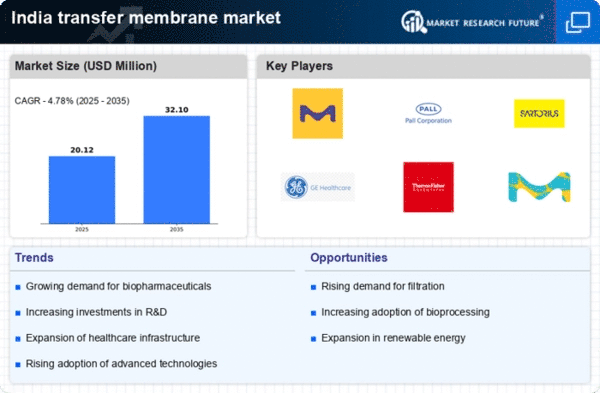
As per Market Research Future analysis, the India transfer membrane market size was estimated at 19.2 USD Million in 2024. The India transfer membrane market is projected to grow from 20.12 USD Million in 2025 to 32.1 USD Million by 2035, exhibiting a compound annual growth rate (CAGR) of 4.7% during the forecast period 2025 - 2035

Key Market Trends & Highlights

The India transfer membrane market is poised for growth driven by technological advancements and increasing demand across various sectors.

  • Technological advancements are enhancing the efficiency and performance of transfer membranes in various applications.
  • The healthcare sector emerges as the largest segment, reflecting a growing need for advanced filtration solutions.
  • Sustainability focus is driving innovations in membrane production, aligning with global environmental goals.
  • Rising demand in the healthcare sector and growth in water treatment initiatives are key drivers propelling market expansion.

Market Size & Forecast

2024 Market Size 19.2 (USD Million)
2035 Market Size 32.1 (USD Million)
CAGR (2025 - 2035) 4.78%

Major Players

Merck KGaA (DE), Pall Corporation (US), Sartorius AG (DE), GE Healthcare (US), Thermo Fisher Scientific Inc. (US), MilliporeSigma (US), 3M Company (US), Danaher Corporation (US), Asahi Kasei Corporation (JP)

Our Impact
Enabled $4.3B Revenue Impact for Fortune 500 and Leading Multinationals
Partnering with 2000+ Global Organizations Each Year
30K+ Citations by Top-Tier Firms in the Industry

India Transfer Membrane Market Trends

The transfer membrane market is currently experiencing notable growth, driven by advancements in technology and increasing applications across various sectors. The demand for high-performance membranes is rising, particularly in industries such as biotechnology, pharmaceuticals, and environmental applications. This growth is likely influenced by the need for efficient separation processes and the rising focus on sustainable practices. Furthermore, the regulatory landscape in India appears to be evolving, encouraging innovation and investment in membrane technologies. As a result, manufacturers are increasingly focusing on developing membranes that offer enhanced performance and durability, which may lead to a more competitive market environment. In addition, the transfer membrane market is witnessing a shift towards the adoption of novel materials and manufacturing techniques. This trend suggests that companies are exploring alternatives to traditional materials, aiming to improve the efficiency and effectiveness of their products. The emphasis on research and development is likely to play a crucial role in shaping the future of this market. Overall, the transfer membrane market is poised for continued expansion, with various factors contributing to its dynamic landscape.

Technological Advancements

Recent innovations in membrane technology are enhancing the performance and efficiency of transfer membranes. These advancements are likely to improve separation processes, making them more effective for various applications.

Sustainability Focus

There is a growing emphasis on sustainable practices within the transfer membrane market. Companies are increasingly developing eco-friendly membranes that reduce environmental impact while maintaining high performance.

Regulatory Support

The evolving regulatory framework in India appears to support the growth of the transfer membrane market. This support may encourage investment and innovation, leading to the development of advanced membrane technologies.

India Transfer Membrane Market Drivers

Rising Demand in Healthcare Sector

The healthcare sector in India is experiencing a notable surge in demand for advanced diagnostic and therapeutic solutions. This trend is likely to drive the transfer membrane market, as these membranes are essential in various applications, including filtration and separation processes in laboratories and hospitals. The increasing prevalence of chronic diseases and the need for efficient diagnostic tools are contributing to this growth. According to recent estimates, the healthcare expenditure in India is projected to reach $372 B by 2022, indicating a robust market for medical technologies. As healthcare facilities expand and modernize, the transfer membrane market is expected to benefit significantly from this rising demand.

Growth in Water Treatment Initiatives

India's water scarcity issues have prompted the government and private sectors to invest heavily in water treatment technologies. The transfer membrane market is poised to gain from this focus, as membranes play a crucial role in desalination, wastewater treatment, and purification processes. With the Indian government aiming to provide clean drinking water to all citizens, the demand for efficient filtration systems is likely to increase. Reports suggest that the water treatment market in India could reach $2.5 B by 2025, highlighting the potential for growth in the transfer membrane market as industries seek sustainable solutions to address water quality challenges.

Expansion of Food and Beverage Industry

The food and beverage industry in India is witnessing rapid expansion, driven by changing consumer preferences and increasing disposable incomes. This growth is likely to impact the transfer membrane market positively, as these membranes are utilized in various applications, including food processing, beverage filtration, and dairy production. The demand for high-quality, safe, and preservative-free products is pushing manufacturers to adopt advanced filtration technologies. The food processing sector is expected to grow at a CAGR of 11% from 2020 to 2025, suggesting a substantial opportunity for the transfer membrane market to cater to the evolving needs of this industry.

Increased Investment in Research and Development

Investment in research and development (R&D) within the Indian transfer membrane market is on the rise, driven by both public and private sectors. This focus on R&D is likely to foster innovation and improve the quality and efficiency of membrane technologies. Government initiatives aimed at promoting scientific research and collaboration with academic institutions are expected to yield advancements in membrane applications. As companies strive to develop cutting-edge solutions to meet market demands, the transfer membrane market stands to benefit from these investments. The emphasis on R&D could lead to breakthroughs that enhance the competitive landscape and drive market growth.

Technological Innovations in Membrane Production

Innovations in membrane technology are transforming the transfer membrane market, particularly in India. Advances in materials science and engineering are leading to the development of more efficient and durable membranes. These innovations are likely to enhance the performance of membranes in various applications, including biotechnology and pharmaceuticals. The introduction of nanotechnology and smart membranes could further revolutionize the market, offering improved selectivity and permeability. As industries seek to optimize their processes and reduce costs, the demand for advanced membrane solutions is expected to rise, indicating a promising future for the transfer membrane market.


Market Segment Insights

By Type: Nitrocellulose Transfer Membranes (Largest) vs. PVDF Transfer Membranes (Fastest-Growing)

The India transfer membrane market demonstrates a clear market share distribution among various types of membranes. Nitrocellulose transfer membranes hold the largest share, favored for their efficiency in protein transfer applications. In contrast, PVDF transfer membranes show a promising rise in demand, driven by their versatility and enhanced performance in various settings. Nylon transfer membranes maintain a steady presence, popular in specific niches, but lag behind the larger segments. Growth trends indicate a strong trajectory for both Nitrocellulose and PVDF transfer membranes, with the latter expected to accelerate due to advancements in membrane technology and broadening applications in biochemistry and research. Market drivers include increasing research activities and demand for protein detection technologies, prompting investments in these membrane technologies to meet evolving laboratory needs.

Nitrocellulose Transfer Membranes (Dominant) vs. PVDF Transfer Membranes (Emerging)

Nitrocellulose transfer membranes are characterized by their high binding affinity and efficiency for proteins, making them the dominant type in the market. They are extensively used in Western blotting and other critical assays. On the other hand, PVDF transfer membranes are rapidly emerging as a key player, appreciated for their robustness and chemical compatibility, which supports a wider array of applications beyond traditional uses. The flexibility in their use combined with ongoing developments enhances their appeal, driving their growth in various sectors, including pharmaceutical and diagnostic applications. As the demand for innovative solutions in protein transfer and analysis grows, both types are positioned uniquely to cater to specific market needs.

By Transfer Method: Semi-Dry Electrotransfer (Largest) vs. Dry Electrotransfer (Fastest-Growing)

In the India transfer membrane market, Semi-Dry Electrotransfer holds a significant market share, leading among the various transfer methods due to its efficiency and reliability. Following closely is Dry Electrotransfer, which is rapidly gaining traction, capturing the interest of manufacturers and users for its ability to provide high-quality results with minimal resource consumption. Growth trends indicate a strong demand for innovative transfer methods that optimize performance. The rise of automation and increased focus on environmentally sustainable practices are driving changes in the market. Both Semi-Dry and Dry Electrotransfer are benefitting from these shifts, with Dry Electrotransfer emerging as the fastest-growing method propelled by technological advancements and market diversification.

Semi-Dry Electrotransfer (Dominant) vs. Dry Electrotransfer (Emerging)

Semi-Dry Electrotransfer is characterized by its ability to maintain high performance with reduced operational costs, making it the preferred choice for many manufacturers in the sector. Its dominance in the market is backed by a well-established presence and proven results in various applications. Conversely, Dry Electrotransfer, while emerging, showcases a growing popularity due to its innovative features that include lower energy consumption and ease of use. As technology continues to evolve, Dry Electrotransfer is capturing market attention and is expected to further escalate its position, becoming a formidable competitor against established methods.

By Application: Western Blotting (Largest) vs. Others (Fastest-Growing)

In the India transfer membrane market, Western Blotting holds the largest market share, dominating the application segment due to its extensive use in research and diagnostic laboratories. Following closely are Other applications, which encompass a range of newer and innovative methods that are quickly gaining traction among researchers, indicating a dynamic shift in preferences towards more diverse applications of transfer membranes. The growth trends within this segment are influenced by various factors, including the increasing focus on proteomics and advancements in biotechnology. Additionally, the rising demand for diagnostic procedures and enhanced research capabilities supported by innovations in transfer membrane technology are propelling the market forward, particularly for Emerging applications that utilize novel methodologies in the field.

Western Blotting (Dominant) vs. Others (Emerging)

Western Blotting is recognized as the dominant application in the India transfer membrane market, primarily employed for detecting specific proteins in a sample. Its reliability and effectiveness make it a staple in molecular biology laboratories, contributing to a significant portion of market share. On the other hand, Other applications represent an emerging segment that includes techniques like Southern and Northern Blotting and novel methodologies gaining popularity. This growth reflects a shift towards a wider array of applications, driven by technological advancements and increased investment in research, positioning these methods as essential to evolving scientific inquiry and applications in the life sciences.

By End User: Pharmaceutical and Biotechnology Companies (Largest) vs. Diagnostic Laboratories (Fastest-Growing)

In the India transfer membrane market, the end user segment is primarily dominated by pharmaceutical and biotechnology companies, which leverage advanced membrane technologies for drug development and production. Their significant market share highlights the importance of transfer membranes in ensuring efficient and safe biopharmaceutical processes. Diagnostic laboratories also hold a substantial position in the market, playing a crucial role in utilizing membranes for various diagnostic assays and procedures, contributing to their overall market presence. The growth of the transfer membrane market in this segment is propelled by increasing investments in pharmaceuticals and biotechnology, along with rising demand for sophisticated diagnostic solutions. The expansion of healthcare infrastructure and the growing focus on research and development in academic and research institutes further fuel market dynamics. The emphasis on innovation is steering diagnostic laboratories to adopt advanced membrane technologies, enhancing their efficiency and capabilities, thereby making them the fastest-growing segment.

Pharmaceutical and Biotechnology Companies (Dominant) vs. Diagnostic Laboratories (Emerging)

Pharmaceutical and biotechnology companies serve as the dominant players within the end user segment due to their extensive dependency on membrane technologies for various applications, including separation and purification processes essential for drug development. These companies invest heavily in R&D to innovate and improve the efficiency of their processes. On the other hand, diagnostic laboratories are an emerging segment that is rapidly adopting transfer membranes as part of their workflows, significantly benefiting from advancements in membrane technology. Their agility in integrating these technologies to enhance diagnostic accuracy and speed makes them a crucial segment in the shifting landscape of the market, thus indicating their potential for growth in the future.

Get more detailed insights about India Transfer Membrane Market

Key Players and Competitive Insights

The transfer membrane market in India is characterized by a dynamic competitive landscape, driven by increasing demand for biopharmaceuticals and advancements in filtration technologies. Key players such as Merck KGaA (Germany), Pall Corporation (US), and Sartorius AG (Germany) are strategically positioned to leverage these growth drivers. Merck KGaA (Germany) focuses on innovation and product development, particularly in the area of membrane technology, which enhances their competitive edge. Pall Corporation (US) emphasizes regional expansion and partnerships, aiming to strengthen its market presence in India. Sartorius AG (Germany) is heavily investing in digital transformation, which appears to be a critical factor in optimizing their operational efficiency and customer engagement. Collectively, these strategies contribute to a competitive environment that is increasingly focused on technological advancement and customer-centric solutions.In terms of business tactics, companies are localizing manufacturing to reduce costs and improve supply chain efficiency. This approach is particularly relevant in a moderately fragmented market where several players vie for market share. The collective influence of these key players shapes the market structure, as they adopt strategies that not only enhance their operational capabilities but also respond to the unique demands of the Indian market.

In October Merck KGaA (Germany) announced the launch of a new line of high-performance membranes designed specifically for biopharmaceutical applications. This strategic move is significant as it aligns with the growing trend towards bioprocessing, potentially positioning the company as a leader in this niche segment. The introduction of these membranes could enhance their product portfolio and attract new customers seeking advanced filtration solutions.

In September Pall Corporation (US) entered into a strategic partnership with a local Indian biotechnology firm to co-develop filtration solutions tailored for the Indian market. This collaboration is likely to enhance Pall's market penetration and foster innovation by leveraging local expertise. Such partnerships may also facilitate quicker responses to market needs, thereby strengthening Pall's competitive position.

In August Sartorius AG (Germany) expanded its manufacturing capabilities in India by investing in a new facility dedicated to membrane production. This expansion is indicative of Sartorius's commitment to meeting the increasing demand for high-quality filtration products in the region. By enhancing local production, Sartorius may improve its supply chain reliability and reduce lead times, which are critical factors in maintaining customer satisfaction.

As of November current trends in the transfer membrane market include a strong emphasis on digitalization, sustainability, and the integration of AI technologies. These trends are reshaping the competitive landscape, as companies seek to differentiate themselves through innovative solutions rather than solely competing on price. Strategic alliances are becoming increasingly important, enabling firms to pool resources and expertise to address complex market challenges. Looking ahead, it is likely that competitive differentiation will evolve, with a greater focus on technological advancements and supply chain resilience, ultimately leading to a more sustainable and efficient market environment.

Key Companies in the India Transfer Membrane Market include

Industry Developments

Recent developments in the India Transfer Membrane Market include an increased focus on sustainable water treatment solutions, driven by the growing water scarcity issues faced by several regions in the country. Companies such as Xylem and SUEZ have been actively participating in initiatives aimed at upgrading wastewater treatment facilities. In July 2023, Koch Separation Solutions announced its plans to expand its membrane manufacturing capabilities in India, responding to the surge in demand for efficient water filtration systems.

In terms of mergers and acquisitions, in August 2023, DuPont Water Solutions announced its acquisition of a regional membrane technology firm, enhancing its portfolio in the water purification sector. Additionally, the growth in market valuation for companies like Pall Corporation and Hydranautics has been attributed to their innovative technologies in membrane filtration, which cater to diverse industrial sectors, ultimately impacting the overall market positively.

In the last two years, significant investments have been made in Research and Development, enhancing the operational efficiency of membrane technologies across various applications, including drinking water and industrial wastewater treatment, aligning with India's commitment to sustainable development goals.

Future Outlook

India Transfer Membrane Market Future Outlook

The Transfer Membrane Market in India is projected to grow at a 4.78% CAGR from 2025 to 2035, driven by technological advancements and increasing demand in various sectors.

New opportunities lie in:

  • Development of high-performance membranes for water treatment applications.
  • Expansion into emerging markets with tailored membrane solutions.
  • Investment in R&D for innovative membrane technologies to enhance efficiency.

By 2035, the transfer membrane market is expected to achieve substantial growth and innovation.

Market Segmentation

India Transfer Membrane Market Type Outlook

  • Nitrocellulose Transfer Membranes
  • PVDF Transfer Membranes
  • Nylon Transfer Membranes

India Transfer Membrane Market End User Outlook

  • Pharmaceutical and Biotechnology Companies
  • Diagnostic Laboratories
  • Academic and Research Institutes
  • Others

India Transfer Membrane Market Application Outlook

  • Western Blotting
  • Southern Blotting
  • Northern Blotting
  • Protein Sequencing and Amino Acid Analysis
  • Others

India Transfer Membrane Market Transfer Method Outlook

  • Semi-Dry Electrotransfer
  • Dry Electrotransfer
  • Tank Electrotransfer
  • Others

Report Scope

MARKET SIZE 2024 19.2(USD Million)
MARKET SIZE 2025 20.12(USD Million)
MARKET SIZE 2035 32.1(USD Million)
COMPOUND ANNUAL GROWTH RATE (CAGR) 4.78% (2025 - 2035)
REPORT COVERAGE Revenue Forecast, Competitive Landscape, Growth Factors, and Trends
BASE YEAR 2024
Market Forecast Period 2025 - 2035
Historical Data 2019 - 2024
Market Forecast Units USD Million
Key Companies Profiled Merck KGaA (DE), Pall Corporation (US), Sartorius AG (DE), GE Healthcare (US), Thermo Fisher Scientific Inc. (US), MilliporeSigma (US), 3M Company (US), Danaher Corporation (US), Asahi Kasei Corporation (JP)
Segments Covered Type, Transfer Method, Application, End User
Key Market Opportunities Growing demand for advanced filtration solutions drives innovation in the transfer membrane market.

Key Market Dynamics Rising demand for advanced filtration technologies drives innovation in the transfer membrane market.
Countries Covered India
Leave a Comment

FAQs

What is the expected market size of the India Transfer Membrane Market in 2024?

The India Transfer Membrane Market is expected to be valued at 19.2 USD Million in 2024.

How much is the India Transfer Membrane Market projected to grow by 2035?

By 2035, the India Transfer Membrane Market is anticipated to reach a value of 35.0 USD Million.

What is the expected compound annual growth rate (CAGR) for the India Transfer Membrane Market from 2025 to 2035?

The expected CAGR for the India Transfer Membrane Market from 2025 to 2035 is 5.61%.

What are the projected values for Nitrocellulose Transfer Membranes in 2024 and 2035?

Nitrocellulose Transfer Membranes are valued at 6.0 USD Million in 2024 and projected at 11.0 USD Million in 2035.

How much is the PVDF Transfer Membrane segment expected to be valued by 2035?

The PVDF Transfer Membrane segment is projected to reach a value of 13.5 USD Million by 2035.

Which key players dominate the India Transfer Membrane Market?

Major players in the India Transfer Membrane Market include Xylem, SUEZ, and Pall Corporation.

What is the market value of Nylon Transfer Membranes in 2024?

Nylon Transfer Membranes are valued at 5.7 USD Million in the year 2024.

What are the growth drivers for the India Transfer Membrane Market?

Key growth drivers include increasing demand for water treatment and industrial processes.

What challenges does the India Transfer Membrane Market currently face?

The market faces challenges such as fluctuating raw material costs and technological advancements.

What is the projected market value for all transfer membrane types combined by 2035?

The projected market value for all transfer membrane types combined is expected to be 35.0 USD Million by 2035.

Download Free Sample

Kindly complete the form below to receive a free sample of this Report

Compare Licence

×
Features License Type
Single User Multiuser License Enterprise User
Price $4,950 $5,950 $7,250
Maximum User Access Limit 1 User Upto 10 Users Unrestricted Access Throughout the Organization
Free Customization
Direct Access to Analyst
Deliverable Format
Platform Access
Discount on Next Purchase 10% 15% 15%
Printable Versions