×
Request Free Sample ×

Kindly complete the form below to receive a free sample of this Report

* Please use a valid business email

Leading companies partner with us for data-driven Insights

clients tt-cursor
Hero Background

India Transarterial Chemoembolization Market

ID: MRFR/HC/49764-HCR
200 Pages
Rahul Gotadki
February 2026

India Transarterial Chemoembolization Market Research Report By Procedure Type (Conventional TACE, DEB-TACE), By Indication (Unresectable HCC, Early-Stage HCC), By Product Type (Chemotherapeutic Agents, Radiotherapeutic Agents, Drug-eluting Particles, Others) and By End User (Hospitals & Clinics, Cancer Research Centers, Others) - Growth & Industry Forecast 2025 To 2035

Share:
Download PDF ×

We do not share your information with anyone. However, we may send you emails based on your report interest from time to time. You may contact us at any time to opt-out.

India Transarterial Chemoembolization Market Infographic
Purchase Options

India Transarterial Chemoembolization Market Summary

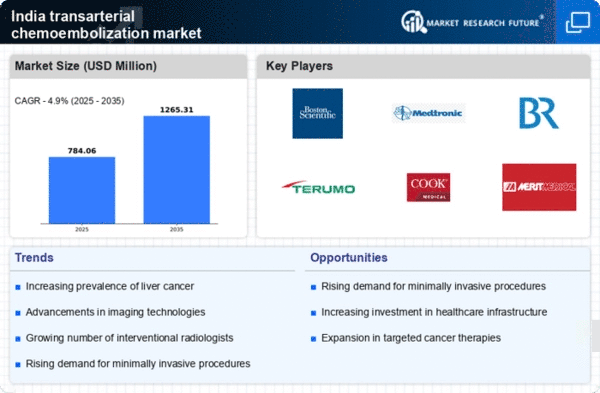
As per Market Research Future analysis, the India transarterial chemoembolization market size was estimated at 747.44 USD Million in 2024. The India transarterial chemoembolization market is projected to grow from 784.06 USD Million in 2025 to 1265.31 USD Million by 2035, exhibiting a compound annual growth rate (CAGR) of 4% during the forecast period 2025 - 2035

Key Market Trends & Highlights

The India transarterial chemoembolization market is poised for growth driven by technological advancements and rising cancer incidence.

  • Technological advancements in medical devices are enhancing the efficacy of transarterial chemoembolization procedures.
  • The rising incidence of liver cancer is contributing to an increased demand for targeted treatment options.
  • The largest segment in this market is the liver cancer treatment segment, while the fastest-growing segment is expected to be personalized medicine applications.
  • Key market drivers include increasing healthcare expenditure and rising awareness of minimally invasive procedures.

Market Size & Forecast

2024 Market Size 747.44 (USD Million)
2035 Market Size 1265.31 (USD Million)
CAGR (2025 - 2035) 4.9%

Major Players

Boston Scientific (US), Medtronic (US), Bayer (DE), Terumo Corporation (JP), Cook Medical (US), Merit Medical Systems (US), AngioDynamics (US), Halyard Health (US), Stryker Corporation (US)

Our Impact
Enabled $4.3B Revenue Impact for Fortune 500 and Leading Multinationals
Partnering with 2000+ Global Organizations Each Year
30K+ Citations by Top-Tier Firms in the Industry

India Transarterial Chemoembolization Market Trends

The transarterial chemoembolization market is experiencing notable growth, driven by advancements in medical technology and increasing awareness of minimally invasive treatment options. This procedure, which combines chemotherapy and embolization, is primarily utilized for treating liver tumors, particularly hepatocellular carcinoma. The rising incidence of liver cancer in India has led to a greater demand for effective treatment modalities. Furthermore, the integration of imaging techniques with transarterial chemoembolization enhances precision, thereby improving patient outcomes. As healthcare infrastructure continues to develop, access to these innovative therapies is expected to expand, potentially benefiting a larger patient population. In addition, the transarterial chemoembolization market is influenced by the growing emphasis on personalized medicine. Tailoring treatment plans to individual patient profiles may lead to improved efficacy and reduced side effects. The collaboration between healthcare providers and technology firms is likely to foster the development of advanced embolic agents and delivery systems. This synergy could enhance the overall effectiveness of the procedure, making it a preferred choice among oncologists. As the market evolves, ongoing research and clinical trials will play a crucial role in establishing new protocols and refining existing techniques, ultimately shaping the future landscape of cancer treatment in India.

Technological Advancements

The transarterial chemoembolization market is witnessing rapid technological advancements that enhance treatment efficacy. Innovations in imaging techniques, such as MRI and CT scans, allow for better visualization of tumors, leading to more precise targeting during procedures. Additionally, the development of novel embolic agents is likely to improve the effectiveness of drug delivery, potentially increasing patient survival rates.

Rising Cancer Incidence

The increasing incidence of liver cancer in India is a significant driver for the transarterial chemoembolization market. As awareness of liver health grows, more patients are seeking treatment options. This trend is likely to result in a higher demand for minimally invasive procedures, as patients and healthcare providers look for effective alternatives to traditional surgical methods.

Focus on Personalized Medicine

There is a growing focus on personalized medicine within the transarterial chemoembolization market. Tailoring treatment approaches to individual patient characteristics may enhance therapeutic outcomes. This trend suggests a shift towards more customized treatment plans, which could lead to improved patient satisfaction and better management of side effects.

India Transarterial Chemoembolization Market Drivers

Growing Incidence of Liver Cancer

The increasing incidence of liver cancer in India is a significant driver for the transarterial chemoembolization market. According to recent statistics, liver cancer cases have been on the rise, with an estimated 50,000 new cases reported annually. This alarming trend necessitates the need for effective treatment options, and transarterial chemoembolization has emerged as a viable solution. The procedure is particularly beneficial for patients with localized tumors, offering a targeted approach that can improve survival rates. As the prevalence of liver cancer continues to escalate, the demand for transarterial chemoembolization is expected to grow, thereby propelling the market forward.

Increasing Healthcare Expenditure

The rising healthcare expenditure in India is a crucial driver for the transarterial chemoembolization market. As the government and private sectors allocate more funds towards healthcare, the availability of advanced treatment options increases. In 2025, healthcare spending in India is projected to reach approximately $370 billion, reflecting a growth rate of around 12% annually. This financial commitment enables hospitals and clinics to invest in cutting-edge technologies and therapies, including transarterial chemoembolization. Enhanced funding also facilitates better training for healthcare professionals, ensuring that they are equipped to deliver these complex procedures effectively. Consequently, the transarterial chemoembolization market benefits from improved access to treatment and a growing patient base seeking innovative cancer therapies.

Government Initiatives for Cancer Treatment

Government initiatives aimed at improving cancer treatment accessibility are significantly influencing the transarterial chemoembolization market. The Indian government has launched various programs to enhance cancer care infrastructure, including the establishment of specialized cancer treatment centers. These initiatives are designed to provide affordable and effective treatment options to a larger segment of the population. For instance, the National Health Mission has allocated substantial funds to improve cancer care services, which includes the promotion of advanced therapies like transarterial chemoembolization. As a result, the market is expected to expand as more patients gain access to these innovative treatment modalities, thereby increasing the overall demand for transarterial chemoembolization.

Technological Innovations in Medical Devices

Technological innovations in medical devices are playing a pivotal role in shaping the transarterial chemoembolization market. The introduction of advanced imaging techniques and catheter technologies has enhanced the precision and effectiveness of the procedure. In India, the adoption of state-of-the-art imaging modalities, such as MRI and CT scans, has improved the ability to target tumors accurately. This advancement not only increases the success rates of transarterial chemoembolization but also minimizes potential complications. As hospitals invest in these innovative technologies, the market is likely to witness a surge in the number of procedures performed, thereby driving growth in the transarterial chemoembolization market.

Rising Awareness of Minimally Invasive Procedures

There is a growing awareness among patients and healthcare providers regarding the benefits of minimally invasive procedures, which significantly impacts the transarterial chemoembolization market. Patients are increasingly seeking alternatives to traditional surgical methods due to shorter recovery times and reduced hospital stays. In India, the awareness campaigns led by healthcare organizations have resulted in a notable increase in the number of patients opting for transarterial chemoembolization. This shift in patient preference is supported by data indicating that minimally invasive techniques can lead to a 30% reduction in recovery time compared to conventional surgeries. As more patients become informed about the advantages of such procedures, the demand for transarterial chemoembolization is likely to rise, further propelling market growth.


Market Segment Insights

By Procedure Type: DEB-TACE (Largest) vs. Conventional TACE (Fastest-Growing)

In the India transarterial chemoembolization market, DEB-TACE is a dominant procedure type, capturing a significant share of the market. On the other hand, Conventional TACE holds a strong position but is seeing increasing competition as healthcare providers and patients become more aware of the advancements in technology and methodologies in transarterial chemoembolization. This shift in preference is reflected in the growing adoption rate for DEB-TACE, which is becoming the preferred choice among many practitioners. The growth trends in this segment indicate a robust interest in minimally invasive procedures, with DEB-TACE leading the way due to its targeted approach and reduced side effects. The emergence of innovative drug-eluting beads enhances efficacy, propelling DEB-TACE's position as a frontrunner. Conversely, Conventional TACE is still valuable for specific cases but faces stagnation as newer techniques prove to be more effective, thus driving the shift in market dynamics.

Procedure Type: DEB-TACE (Dominant) vs. Conventional TACE (Emerging)

DEB-TACE stands out as the dominant choice within the India transarterial chemoembolization market, offering substantial advantages such as targeted drug delivery and reduced systemic exposure. This procedure leverages specialized drug-eluting beads that release chemotherapy agents directly to the tumor, enhancing treatment efficacy while minimizing adverse effects. In contrast, Conventional TACE has traditionally been employed for a broader range of cases, but its reliance on standard embolic agents may limit its effectiveness. As awareness of DEB-TACE continues to grow, coupled with ongoing advancements in clinical techniques and the backing of clinical evidence, its market share is poised to expand significantly, positioning it as the preferred option in an evolving landscape.

By Indication: Unresectable HCC (Largest) vs. Early-Stage HCC (Fastest-Growing)

In the India transarterial chemoembolization market, Unresectable HCC represents the largest segment, commanding a significant share due to the high prevalence of liver cancer and the limited treatment options available for this condition. Conversely, Early-Stage HCC is emerging as a fast-growing segment, as advancements in diagnostic technologies and increased awareness contribute to earlier detection and treatment opportunities. The growth trends within this segment are largely driven by the rising incidence of liver cancer cases, coupled with the expansion of healthcare facilities and the increasing adoption of minimally invasive therapies. Furthermore, the integration of innovative techniques in transarterial chemoembolization and heightened investment in cancer research and treatment methodologies are expected to propel the market for both Unresectable and Early-Stage HCC treatments in the coming years.

Unresectable HCC (Dominant) vs. Early-Stage HCC (Emerging)

Unresectable HCC has established itself as the dominant segment in the India transarterial chemoembolization market due to its critical necessity in treating patients who cannot undergo surgical resection. This segment benefits from a higher volume of procedures performed annually, attributed to the advanced stages of liver cancer often diagnosed at treatment initiation. In contrast, Early-Stage HCC is gaining traction as an emerging segment, fueled by improved awareness and educational initiatives aimed at promoting early diagnosis. It offers a promising opportunity for healthcare providers and patients seeking less invasive treatment alternatives, potentially resulting in better clinical outcomes and quality of life.

By Product Type: Chemotherapeutic Agents (Largest) vs. Drug-eluting Particles (Fastest-Growing)

In the India transarterial chemoembolization market, the distribution of market share among product types indicates that chemotherapeutic agents hold the largest segment. These agents are widely used due to their effectiveness in targeting tumors and their established protocols within clinical settings, contributing significantly to overall treatment strategies. Conversely, drug-eluting particles are rapidly gaining traction, supported by advancements in technology that enhance their efficacy and safety, which is leading to growing adoption in clinical practices. The growth trends in this segment are significantly influenced by the rise in cancer incidences and the increasing preference for minimally invasive procedures. Chemotherapeutic agents continue to dominate the market due to their proven results, while drug-eluting particles are positioned as the fastest-growing option, driven by novel formulations and the demand for targeted therapies. This shift indicates a transformative change in treatment approaches, reflecting both patient and healthcare provider preferences for innovative treatment alternatives.

Chemotherapeutic Agents (Dominant) vs. Drug-eluting Particles (Emerging)

Chemotherapeutic agents remain the dominant force in the India transarterial chemoembolization market, recognized for their well-established efficacy in cancer treatment. These agents are often utilized in various protocols and have a profound impact on patient outcomes. However, drug-eluting particles are emerging in the market, representing a newer alternative designed to release therapeutic agents directly to the tumor site, thereby minimizing systemic exposure. This approach not only enhances treatment effectiveness but also reduces side effects, making drug-eluting particles increasingly popular among clinicians. As innovations in formulation and delivery mechanisms continue to evolve, the competition between these two segments is expected to intensify, reflecting the dynamic nature of treatment options available to healthcare providers.

By End User: Hospitals & Clinics (Largest) vs. Cancer Research Centers (Fastest-Growing)

In the India transarterial chemoembolization market, Hospitals & Clinics capture the largest market share, driven by the increasing number of patients requiring advanced treatment options. This segment benefits from established infrastructure and the availability of skilled professionals, making it the preferred setting for many oncological procedures. Cancer Research Centers, while smaller in share, are emerging rapidly as they focus on innovative therapies and clinical trials, attracting investment and patient interest. The growth trends in these segments are largely influenced by the rising incidence of cancer, combined with an increase in healthcare spending. Hospitals & Clinics continue to adapt to technological advancements, enhancing their treatment capabilities. Meanwhile, Cancer Research Centers are experiencing rapid expansion due to governmental support and increasing collaborations with pharmaceutical companies, positioning them for significant growth in the coming years.

Hospitals & Clinics (Dominant) vs. Cancer Research Centers (Emerging)

Hospitals & Clinics represent the dominant segment in the India transarterial chemoembolization market, characterized by their comprehensive service offerings and access to a wide patient base. These facilities are equipped with the latest technologies, ensuring effective treatment administration and patient care. The well-established networks of healthcare professionals and streamlined processes allow for quick patient turnarounds and improved health outcomes. In contrast, Cancer Research Centers are emerging as vital players in this landscape, focusing on pioneering research and innovative treatment modalities. They play a crucial role in clinical trials and are often at the forefront of adopting cutting-edge therapies, driven by a commitment to advancing cancer care. This dynamic enables them to attract both patients and funding, positioning them as crucial contributors to the overall market growth.

Get more detailed insights about India Transarterial Chemoembolization Market

Key Players and Competitive Insights

The transarterial chemoembolization market in India is characterized by a dynamic competitive landscape, driven by increasing incidences of liver cancer and a growing preference for minimally invasive procedures. Key players such as Boston Scientific (US), Medtronic (US), and Bayer (DE) are strategically positioned to leverage innovation and regional expansion to enhance their market presence. Boston Scientific (US) focuses on developing advanced embolization devices, while Medtronic (US) emphasizes integrating digital health solutions into its offerings. Bayer (DE) is actively pursuing partnerships to expand its product portfolio, which collectively shapes a competitive environment that is increasingly focused on technological advancement and patient-centric solutions.The market structure appears moderately fragmented, with several players vying for market share through localized manufacturing and optimized supply chains. Companies are increasingly localizing their production to reduce costs and improve supply chain efficiency, which is crucial in a market where timely access to innovative therapies can significantly impact patient outcomes. The collective influence of these key players fosters a competitive atmosphere that encourages continuous improvement and innovation.

In October Boston Scientific (US) announced the launch of its latest embolization device, which incorporates advanced imaging technology to enhance precision during procedures. This strategic move is likely to strengthen its market position by addressing the growing demand for more effective and safer treatment options. The introduction of such innovative products not only meets clinical needs but also reinforces the company's commitment to improving patient outcomes.

In September Medtronic (US) unveiled a new digital platform designed to streamline the workflow of interventional radiologists. This initiative reflects a broader trend towards digital transformation in healthcare, suggesting that Medtronic is keen on enhancing operational efficiencies while providing better support for healthcare professionals. The integration of digital solutions into traditional practices may significantly alter the landscape of treatment delivery in the coming years.

In August Bayer (DE) entered into a strategic partnership with a local Indian firm to co-develop next-generation embolization agents. This collaboration indicates Bayer's commitment to expanding its footprint in the Indian market while leveraging local expertise to tailor products to regional needs. Such partnerships are likely to enhance innovation and accelerate the development of new therapies, positioning Bayer favorably against its competitors.

As of November current trends in the transarterial chemoembolization market are increasingly defined by digitalization, sustainability, and the integration of artificial intelligence (AI) into treatment protocols. Strategic alliances are becoming pivotal in shaping the competitive landscape, as companies seek to pool resources and expertise to drive innovation. The shift from price-based competition to a focus on technological advancement and supply chain reliability is evident, suggesting that future competitive differentiation will hinge on the ability to deliver innovative solutions that enhance patient care and operational efficiency.

Key Companies in the India Transarterial Chemoembolization Market include

Industry Developments

Recent developments in the India Transarterial Chemoembolization Market demonstrate a growing focus on advanced treatment options for patients with liver cancer. In October 2023, Medtronic announced enhanced capabilities for their embolization portfolio, aimed at improving patient outcomes and treatment effectiveness in India. GE Healthcare has also introduced cutting-edge imaging technology, enabling precise tumor localization for more effective transarterial chemoembolization procedures.

Meanwhile, in July 2023, Boston Scientific expanded its product offerings in India, reflecting its commitment to supporting the evolving needs of healthcare providers in oncology. Current affairs highlight ongoing collaborations, with Terumo launching initiatives to train healthcare professionals on the best practices in embolization techniques. In terms of market growth, the valuation of companies in the India Transarterial Chemoembolization Market is witnessing an uptick, driven by increasing cancer prevalence and healthcare investments in India.

Additionally, companies like Siemens Healthineers are expanding their presence in the region, further solidifying the market landscape. Recent years have seen significant advancements, with key developments occurring since early 2021, indicative of a rapidly evolving and increasingly competitive market environment.

Future Outlook

India Transarterial Chemoembolization Market Future Outlook

The Transarterial Chemoembolization Market is projected to grow at 4.9% CAGR from 2025 to 2035, driven by technological advancements, increasing cancer prevalence, and enhanced healthcare infrastructure.

New opportunities lie in:

  • Development of advanced embolic agents for targeted therapy
  • Expansion of outpatient treatment facilities for increased accessibility
  • Partnerships with local hospitals for integrated care solutions

By 2035, the market is expected to achieve substantial growth, reflecting evolving treatment paradigms.

Market Segmentation

India Transarterial Chemoembolization Market End User Outlook

  • Hospitals & Clinics
  • Cancer Research Centers
  • Others

India Transarterial Chemoembolization Market Indication Outlook

  • Unresectable HCC
  • Early-Stage HCC

India Transarterial Chemoembolization Market Product Type Outlook

  • Chemotherapeutic Agents
  • Radiotherapeutic Agents
  • Drug-eluting Particles
  • Others

India Transarterial Chemoembolization Market Procedure Type Outlook

  • Conventional TACE
  • DEB-TACE

Report Scope

MARKET SIZE 2024 747.44(USD Million)
MARKET SIZE 2025 784.06(USD Million)
MARKET SIZE 2035 1265.31(USD Million)
COMPOUND ANNUAL GROWTH RATE (CAGR) 4.9% (2025 - 2035)
REPORT COVERAGE Revenue Forecast, Competitive Landscape, Growth Factors, and Trends
BASE YEAR 2024
Market Forecast Period 2025 - 2035
Historical Data 2019 - 2024
Market Forecast Units USD Million
Key Companies Profiled Boston Scientific (US), Medtronic (US), Bayer (DE), Terumo Corporation (JP), Cook Medical (US), Merit Medical Systems (US), AngioDynamics (US), Halyard Health (US), Stryker Corporation (US)
Segments Covered Procedure Type, Indication, Product Type, End User
Key Market Opportunities Advancements in imaging technologies enhance precision in transarterial chemoembolization procedures, driving market growth.

Key Market Dynamics Rising demand for minimally invasive cancer treatments drives growth in the transarterial chemoembolization market.
Countries Covered India
Leave a Comment

FAQs

What is the expected market size of the India Transarterial Chemoembolization Market by 2024?

The India Transarterial Chemoembolization Market is expected to be valued at 598.0 million USD by 2024.

What is the projected market size of the India Transarterial Chemoembolization Market by 2035?

By 2035, the India Transarterial Chemoembolization Market is projected to reach a valuation of 1198.0 million USD.

What is the expected CAGR for the India Transarterial Chemoembolization Market from 2025 to 2035?

The expected CAGR for the India Transarterial Chemoembolization Market from 2025 to 2035 is 6.52%.

Which procedure type is expected to hold a larger market share in 2024?

In 2024, the Conventional TACE procedure type is expected to be valued at 358.0 million USD, holding a larger market share.

What is the projected market value of DEB-TACE by 2035?

The market value of DEB-TACE is projected to reach 482.0 million USD by 2035.

Who are the major players in the India Transarterial Chemoembolization Market?

Major players in the market include Boston Scientific, GE Healthcare, Philips Healthcare, and Stryker among others.

What trends are driving the growth of the India Transarterial Chemoembolization Market?

Key trends driving growth include advancements in medical technology and increasing incidences of liver cancers.

In which segment is the highest growth anticipated in the India Transarterial Chemoembolization Market?

The Conventional TACE segment is anticipated to experience the highest growth in the upcoming years.

What is the value of Conventional TACE by 2035?

The value of the Conventional TACE segment is expected to reach 716.0 million USD by 2035.

What challenges does the India Transarterial Chemoembolization Market currently face?

Challenges include high procedure costs and the need for trained medical professionals to perform the treatments.

Download Free Sample

Kindly complete the form below to receive a free sample of this Report

Compare Licence

×
Features License Type
Single User Multiuser License Enterprise User
Price $4,950 $5,950 $7,250
Maximum User Access Limit 1 User Upto 10 Users Unrestricted Access Throughout the Organization
Free Customization
Direct Access to Analyst
Deliverable Format
Platform Access
Discount on Next Purchase 10% 15% 15%
Printable Versions