×
Request Free Sample ×

Kindly complete the form below to receive a free sample of this Report

* Please use a valid business email

Leading companies partner with us for data-driven Insights

clients tt-cursor
Hero Background

India Temperature Controlled Packaging Pharmaceutical Market

ID: MRFR/PCM/55282-HCR
200 Pages
Snehal Singh
February 2026

India Temperature Controlled Packaging Pharmaceutical Market Research Report By Product (Shippers, Containers), By Type (Active System, Passive System), By Temperature Range (-20°C and Below, -20°C to 0°C, 2°C to 8°C, 8°C to 25°C, Above 25°C), By Payload Capacity (Up to 10 L, 10 L - 20 L, 20 L - 40 L, 40 L - 150 L, Above 150 L), By Use (Single Use, Reusable), By Medicine Type (Temperature Sensitive Pharmaceutical Drugs, Vaccine, Regenerative Medicine) and By End-use Industry (Pharmaceuticals, Clinical Trails) - Forecast to 2035

Share:
Download PDF ×

We do not share your information with anyone. However, we may send you emails based on your report interest from time to time. You may contact us at any time to opt-out.

India Temperature Controlled Packaging Pharmaceutical Market Infographic
Purchase Options

India Temperature Controlled Packaging Pharmaceutical Market Summary

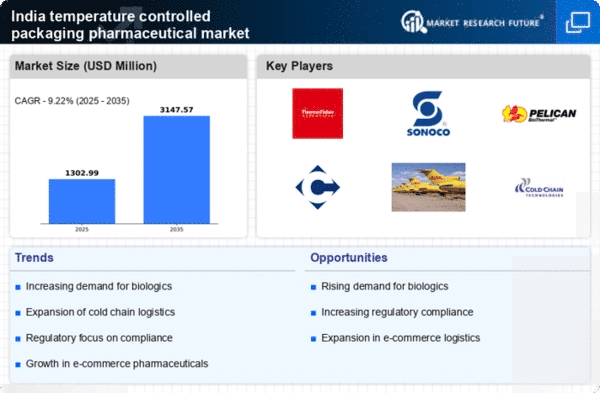
As per Market Research Future analysis, the India temperature controlled packaging pharmaceutical market size was estimated at 1193.0 USD Million in 2024. The India temperature controlled-packaging-pharmaceutical market is projected to grow from 1302.99 USD Million in 2025 to 3147.57 USD Million by 2035, exhibiting a compound annual growth rate (CAGR) of 9.2% during the forecast period 2025 - 2035

Key Market Trends & Highlights

The India The temperature controlled packaging pharmaceutical market is poised for substantial growth, driven by technological advancements and regulatory compliance.

  • Technological advancements in packaging solutions are enhancing the efficiency and reliability of temperature controlled systems.
  • The biopharmaceutical segment remains the largest, while the e-commerce segment is the fastest-growing in the market.
  • Regulatory compliance and standards are becoming increasingly stringent, necessitating robust packaging solutions.
  • Rising demand for biopharmaceuticals and the expansion of e-commerce in pharmaceuticals are key drivers of market growth.

Market Size & Forecast

2024 Market Size 1193.0 (USD Million)
2035 Market Size 3147.57 (USD Million)
CAGR (2025 - 2035) 9.22%

Major Players

Thermo Fisher Scientific (US), Sonoco Products Company (US), Pelican BioThermal (US), CSafe Global (US), DHL Supply Chain (DE), Cold Chain Technologies (US), Envirotainer (SE), Kuehne + Nagel (CH), Geodis (FR)

Our Impact
Enabled $4.3B Revenue Impact for Fortune 500 and Leading Multinationals
Partnering with 2000+ Global Organizations Each Year
30K+ Citations by Top-Tier Firms in the Industry

India Temperature Controlled Packaging Pharmaceutical Market Trends

The temperature controlled packaging pharmaceutical market is experiencing notable growth, driven by the increasing demand for safe and effective transportation of temperature-sensitive products. This market is essential for ensuring the integrity of pharmaceuticals, biologics, and vaccines, which require strict temperature management during transit. The rise in chronic diseases and the expansion of the biopharmaceutical sector contribute to the heightened need for reliable packaging solutions. Furthermore, advancements in technology are enhancing the capabilities of temperature controlled packaging, allowing for better monitoring and compliance with regulatory standards. In addition, the regulatory landscape is evolving, with stricter guidelines being implemented to ensure product safety and efficacy. This has led to a greater emphasis on the development of innovative packaging solutions that can maintain required temperature ranges throughout the supply chain. As the pharmaceutical industry continues to grow, the temperature controlled-packaging-pharmaceutical market is likely to expand, driven by the need for improved logistics and distribution methods. The focus on sustainability and eco-friendly materials is also becoming increasingly relevant, as stakeholders seek to minimize environmental impact while maintaining product quality.

Technological Advancements in Packaging Solutions

The temperature controlled packaging pharmaceutical market is witnessing rapid technological innovations. These advancements include the integration of IoT devices for real-time monitoring of temperature and humidity levels during transit. Such technologies enhance the ability to track and manage temperature-sensitive products, ensuring compliance with regulatory requirements and improving overall supply chain efficiency.

Regulatory Compliance and Standards

The evolving regulatory environment is shaping the temperature controlled-packaging-pharmaceutical market. Stricter guidelines are being established to ensure the safety and efficacy of temperature-sensitive products. Companies are increasingly focusing on compliance with these regulations, which drives the demand for advanced packaging solutions that meet stringent quality standards.

Sustainability Initiatives

There is a growing emphasis on sustainability within the temperature controlled-packaging-pharmaceutical market. Stakeholders are exploring eco-friendly materials and practices to reduce environmental impact. This trend reflects a broader commitment to sustainability, as companies seek to balance product integrity with responsible environmental stewardship.

India Temperature Controlled Packaging Pharmaceutical Market Drivers

Increasing Regulatory Scrutiny

The temperature controlled packaging pharmaceutical market is facing heightened regulatory scrutiny as authorities in India enforce stricter guidelines for the transportation and storage of temperature-sensitive pharmaceuticals. Regulatory bodies are emphasizing the importance of maintaining specific temperature ranges to ensure product safety and efficacy. This trend is likely to drive investments in advanced packaging solutions that comply with these regulations. Companies are compelled to adopt temperature monitoring systems and invest in training to meet compliance requirements. As a result, the market is expected to witness a growth trajectory, with an estimated increase of 10% in demand for compliant temperature controlled packaging solutions over the next few years.

Focus on Supply Chain Efficiency

The emphasis on supply chain efficiency is becoming increasingly relevant in the temperature controlled-packaging-pharmaceutical market. Companies are recognizing the need to optimize their logistics and distribution processes to minimize temperature excursions during transportation. This focus on efficiency is leading to investments in advanced packaging solutions that not only maintain temperature but also reduce costs. The market is projected to grow by around 15% as companies seek to streamline their operations and enhance the reliability of temperature controlled packaging. By improving supply chain efficiency, businesses can ensure that temperature-sensitive pharmaceuticals reach their destinations in optimal condition, thereby safeguarding patient health.

Rising Demand for Biopharmaceuticals

The increasing prevalence of chronic diseases in India is driving the demand for biopharmaceuticals, which require stringent temperature control during transportation and storage. The temperature controlled-packaging-pharmaceutical market is experiencing growth as biopharmaceuticals often necessitate specific temperature ranges to maintain efficacy. According to industry reports, the biopharmaceutical sector is projected to grow at a CAGR of approximately 15% over the next few years. This surge in demand for biopharmaceuticals is compelling manufacturers to invest in advanced temperature controlled packaging solutions to ensure product integrity and compliance with regulatory standards. As a result, the temperature controlled packaging pharmaceutical market is likely to expand significantly to meet the needs of this evolving sector.

Expansion of E-commerce in Pharmaceuticals

The rapid growth of e-commerce in the pharmaceutical sector is reshaping the landscape of the temperature controlled-packaging-pharmaceutical market. With more consumers opting for online purchases of medications, the need for reliable temperature controlled packaging has become paramount. E-commerce platforms are increasingly focusing on ensuring that temperature-sensitive products are delivered within specified temperature ranges. This trend is expected to contribute to a projected growth rate of around 20% in the temperature controlled-packaging-pharmaceutical market over the next few years. Companies are investing in innovative packaging technologies to enhance the safety and efficacy of pharmaceutical products during transit, thereby addressing the challenges posed by temperature fluctuations.

Technological Innovations in Monitoring Systems

Technological advancements in monitoring systems are playing a crucial role in the evolution of the temperature controlled-packaging-pharmaceutical market. Innovations such as IoT-enabled temperature sensors and real-time tracking systems are enhancing the ability to monitor temperature conditions throughout the supply chain. These technologies provide valuable data that can help in maintaining the integrity of temperature-sensitive products. The adoption of such technologies is anticipated to increase efficiency and reduce the risk of product spoilage. As a result, the temperature controlled-packaging-pharmaceutical market is likely to experience a growth rate of approximately 12% in the coming years, driven by the demand for enhanced monitoring solutions.


Market Segment Insights

By Product: Container (Largest) vs. Shippers (Fastest-Growing)

In the India temperature controlled-packaging-pharmaceutical market, the product segment is primarily divided between containers and shippers. Currently, containers hold the largest share due to their ability to maintain temperature integrity over extended durations and accommodate various pharmaceutical products. This segment's dominance is primarily attributed to the increased adoption of biologics and temperature-sensitive drugs, which require rigorous temperature control measures during transit. Conversely, shippers represent the fastest-growing product category as they gain traction with the rise in e-commerce and demand for efficient distribution methods. These flexible and scalable solutions are designed for specific temperature ranges and have improved logistics capabilities. Their growth is driven by a burgeoning pharmaceutical sector and the need for innovative shipping solutions that ensure product safety and compliance with industry regulations.

Shippers (Emerging) vs. Containers (Dominant)

Shippers are increasingly emerging in the India temperature controlled-packaging-pharmaceutical market, characterized by their adaptability and innovation in temperature management for pharmaceutical goods. These solutions are optimized for shorter delivery times, making them ideal for e-commerce applications, particularly in the pharmaceutical realm where speed and reliability are crucial. On the other hand, containers remain the dominant choice, known for their robust construction and capacity to maintain precise temperature control over long distances. Their widespread use in large-scale pharmaceutical transport highlights their essential role in ensuring product safety and efficacy during distribution, thus reinforcing their status as the established standard in temperature-controlled packaging.

By Type: Active System (Largest) vs. Passive System (Fastest-Growing)

In the India temperature controlled-packaging-pharmaceutical market, the Active System segment holds the largest market share, driven by its advanced functionalities and adaptability to various pharmaceutical products. This segment benefits from innovations that enhance temperature regulation, ensuring product integrity during transit. Conversely, the Passive System is rapidly gaining traction, emerging as the fastest-growing segment due to its cost-effectiveness and simplicity in design.

Active System (Dominant) vs. Passive System (Emerging)

The Active System segment is characterized by its use of temperature-controlled technologies that actively maintain the requisite conditions for sensitive pharmaceuticals. These systems incorporate intricate components such as refrigeration units and real-time temperature monitoring, enabling them to adjust conditions dynamically. On the other hand, the Passive System is simpler and often relies on insulated packaging without active temperature regulation. While currently positioned as the emerging option, its appeal lies in reduced costs and ease of use, making it particularly attractive for companies seeking to minimize their operational expenses while ensuring product safety.

By Temperature Range: 2°C to 8°C (Largest) vs. -20°C to 0°C (Fastest-Growing)

The market share distribution in the India temperature controlled-packaging-pharmaceutical market reveals that the 2°C to 8°C segment is the largest, holding a significant share due to its crucial role in the storage of vaccines and biological products. Other segments like -20°C and Below and 8°C to 25°C follow closely, indicating a diverse range of temperature requirements catering to various pharmaceutical needs. As the demand for biopharmaceuticals and vaccines rises, the -20°C to 0°C segment emerges as the fastest-growing, driven by innovations in cold chain logistics. Companies are increasingly investing in advanced packaging solutions to ensure product integrity during transportation. This trend underscores the importance of efficient temperature-controlled packaging, which is critical for maintaining the efficacy of temperature-sensitive pharmaceuticals.

2°C to 8°C (Dominant) vs. -20°C to 0°C (Emerging)

The 2°C to 8°C segment is dominant in the India temperature controlled-packaging-pharmaceutical market, primarily due to its application in storing a vast array of vaccines, which require stringent temperature control to maintain efficacy. It serves as the backbone of the cold chain, ensuring that sensitive products are preserved and remain effective. In contrast, the -20°C to 0°C segment, while emerging, is gaining traction as more biopharmaceuticals requiring ultra-cold conditions are developed. This segment is critical for the transport of specific biologics, thus driving growth and technological advancements such as improved insulation and monitoring solutions to enhance the reliability of cold storage.

By Payload Capacity: Up to 10 L (Largest) vs. 20 L - 40 L (Fastest-Growing)

In the India temperature controlled-packaging-pharmaceutical market, the payload capacity segment showcases a diverse distribution among various ranges. The segment 'Up to 10 L' accounts for a substantial portion of market share, positioning itself as the largest value. Conversely, '20 L - 40 L' emerges as a strong contender for growth, gaining traction through its effective adaptability in logistics and varying pharmaceutical needs. The growth trends in payload capacity reveal a keen emphasis on efficiency and sustainability. Factors such as the increasing demand for biopharmaceuticals and personalized medicine are driving the shift towards larger payload capacities. As pharmaceutical companies expand their product lines, the '10 L - 20 L' and '20 L - 40 L' segments are seeing heightened interest, marking them as pivotal in the future dynamics of the market.

Up to 10 L (Dominant) vs. 20 L - 40 L (Emerging)

The 'Up to 10 L' payload capacity segment is prominent due to its widespread application in smaller batch productions and experimental trials, catering to rapid distribution requirements. This segment is characterized by its efficiency and lower operational costs, making it a preferred choice for many pharmaceutical companies. On the other hand, the '20 L - 40 L' segment is emerging as a significant player, driven by the growing need for larger volume shipments, particularly for vaccines and bulk pharmaceuticals. Its adaptability in responding to market demands, along with advancements in temperature control technologies, positions this segment to capitalize on the evolving trends in the industry.

By Use: Single Use (Largest) vs. Reusable (Fastest-Growing)

In the India temperature controlled-packaging-pharmaceutical market, the Single Use segment holds a significant market share, primarily due to its convenience and hygiene advantages. This segment is favored by pharmaceutical companies as it eliminates the risk of cross-contamination, making it a preferred choice for transporting temperature-sensitive medication. Conversely, the Reusable segment is emerging rapidly, driven by sustainability initiatives and cost-saving strategies. Businesses are increasingly adopting reusable packaging as a means to reduce waste and enhance compliance with environmental regulations. This segment is expected to grow faster due to rising awareness about sustainable practices and a shift towards eco-friendly solutions.

Packaging: Single Use (Dominant) vs. Reusable (Emerging)

The Single Use packaging segment is characterized by its widespread adoption for its ability to ensure safety and reliability in transporting pharmaceuticals and biologics. It caters to a variety of temperature-sensitive products, addressing the critical need for maintaining integrity during transit. Meanwhile, the Reusable segment is gaining traction among companies looking to implement sustainable practices. This segment offers significant savings in the long run and aligns with global efforts toward reducing plastic waste. Both segments play crucial roles, with Single Use being the dominant choice while Reusable is positioning itself as an emerging solution.

By Medicine Type: Vaccine (Largest) vs. Temperature Sensitive Pharmaceutical Drugs (Fastest-Growing)

The market for temperature controlled packaging in the pharmaceutical sector is witnessing a distinctive distribution among its segments. Vaccines currently hold the largest share, reflecting their critical role in healthcare and vaccination programs. This prominence is supported by increasing demand in light of ongoing vaccination campaigns, positioning vaccines as a cornerstone of this market. Meanwhile, Temperature Sensitive Pharmaceutical Drugs are emerging as a fast-growing segment due to their reliance on specific storage conditions to maintain efficacy, driven by advancements in drug development. Growth trends indicate a rising demand for innovative therapies and vaccines, spurred by an increase in disease incidence and public health focus. Factors like advancements in biopharma and regenerative medicine are propelling Temperature Sensitive Pharmaceutical Drugs into prominence, making them a vital segment in the market. Additionally, the need for robust cold chain logistics to support these products enhances their growth potential, showcasing a dynamic shift towards ensuring product integrity and patient safety in the pharmaceutical supply chain.

Vaccine (Dominant) vs. Temperature Sensitive Pharmaceutical Drugs (Emerging)

Vaccines are at the forefront of the India temperature controlled-packaging-pharmaceutical market, being the dominant segment thanks to their established demand and significance in public health initiatives. Their storage and transport require stringent temperature controls to ensure safety and efficacy. On the other hand, Temperature Sensitive Pharmaceutical Drugs represent an emerging segment characterized by advanced therapies that necessitate precise temperature management. This segment is gaining traction due to the growing development and availability of biologics and personalized medicine. As pharmaceutical companies innovate, the emphasis on temperature-sensitive products will likely increase, compelling stakeholders to enhance cold chain solutions and adapt to the evolving market dynamics.

By End-use Industry: Pharmaceuticals (Largest) vs. Clinical Trials (Fastest-Growing)

In the temperature controlled-packaging-pharmaceutical market, the distribution of market share among various end-use industries reveals that Pharmaceuticals dominate the landscape, commanding a significant portion of the market. This sector benefits from a high demand for reliable and efficient temperature-controlled solutions to ensure the integrity of sensitive medications. In contrast, Clinical Trials are emerging as a vital component of this market, fueled by the increasing number of drug development initiatives and the need for precise shipping conditions to maintain product efficacy. Growth trends in this segment are driven by several factors, including the rising prevalence of chronic diseases which necessitates innovative pharmaceuticals that require stringent temperature controls. Moreover, the expansion of Clinical Trials is accelerated by significant investments in research and development, creating a robust demand for temperature sensitive logistics. The increasing regulatory standards and the need for compliance within the pharmaceutical industry further propel the growth of temperature controlled packaging solutions, catering to both established pharmaceutical companies and emerging biotech firms as they engage in Trials.

Pharmaceuticals (Dominant) vs. Clinical Trials (Emerging)

Pharmaceuticals as a dominant segment in the India temperature controlled-packaging-pharmaceutical market are characterized by their significant demand for specialized packaging solutions that ensure product integrity throughout the supply chain. These solutions are crucial for maintaining the efficacy of temperature-sensitive medications, especially those that require specific temperature ranges for storage and transportation. The clinical trial segment, while emerging, is rapidly gaining traction due to the increasing focus on drug development and the importance of maintaining optimal conditions for trial materials. Both segments face unique challenges, with Pharmaceuticals focusing on compliance with stringent regulations and Clinical Trials focusing on adaptability to varied trial conditions, but together they create a cohesive dynamic within the temperature controlled packaging framework.

Get more detailed insights about India Temperature Controlled Packaging Pharmaceutical Market

Key Players and Competitive Insights

The temperature controlled-packaging-pharmaceutical market in India is characterized by a dynamic competitive landscape, driven by the increasing demand for safe and effective transportation of temperature-sensitive pharmaceuticals. Key players are actively engaging in strategies that emphasize innovation, regional expansion, and partnerships to enhance their market positioning. Companies such as Thermo Fisher Scientific (US), Pelican BioThermal (US), and DHL Supply Chain (DE) are at the forefront, leveraging their technological capabilities and extensive distribution networks to meet the growing needs of the pharmaceutical sector. Their collective focus on enhancing supply chain efficiency and ensuring compliance with stringent regulatory standards shapes the competitive environment significantly.In terms of business tactics, localizing manufacturing and optimizing supply chains are pivotal strategies employed by these companies. The market appears moderately fragmented, with several players vying for market share, yet the influence of major companies remains substantial. This competitive structure allows for a diverse range of offerings, catering to various segments within the pharmaceutical industry, while also fostering innovation through competition.

In October Thermo Fisher Scientific (US) announced the launch of a new line of advanced temperature-controlled packaging solutions designed specifically for the Indian market. This strategic move is likely to enhance their product portfolio and cater to the unique requirements of local pharmaceutical companies, thereby strengthening their market presence. The introduction of these solutions may also reflect a broader trend towards customization in packaging, aligning with the specific needs of clients in the region.

In September Pelican BioThermal (US) expanded its operations by establishing a new service center in Mumbai. This facility is expected to provide enhanced support for their temperature-controlled packaging solutions, facilitating quicker turnaround times for clients. The establishment of this center indicates a commitment to improving service delivery and responsiveness to market demands, which could potentially lead to increased customer loyalty and market share.

In August DHL Supply Chain (DE) entered into a strategic partnership with a leading Indian pharmaceutical manufacturer to enhance their cold chain logistics capabilities. This collaboration aims to streamline the distribution of temperature-sensitive products across the country, thereby improving efficiency and reducing costs. Such partnerships are indicative of a trend towards collaborative approaches in the industry, where companies seek to leverage each other's strengths to navigate the complexities of the supply chain.

As of November current trends in the temperature controlled-packaging-pharmaceutical market include a pronounced shift towards digitalization, sustainability, and the integration of AI technologies. These trends are reshaping competitive dynamics, as companies increasingly prioritize innovation and technological advancements over traditional price-based competition. Strategic alliances are becoming more prevalent, allowing firms to enhance their capabilities and adapt to evolving market demands. Looking ahead, it appears that competitive differentiation will hinge on the ability to innovate and ensure supply chain reliability, positioning companies to better serve the needs of the pharmaceutical sector.

Key Companies in the India Temperature Controlled Packaging Pharmaceutical Market include

Industry Developments

The India Temperature Controlled Packaging Pharmaceutical Market has been witnessing significant developments recently. In September 2023, Gati announced enhancements in its cold chain logistics operations to better support the pharmaceutical sector, aiming to boost delivery efficiency and compliance with regulatory standards. In the same month, Rudra Logistics expanded its cold storage facilities to cater to the growing demand for temperature-sensitive medicines, aligning with the increasing healthcare needs post-pandemic. Notably, in August 2023, ASL Logistics reported a strategic partnership with leading pharmaceutical companies that strengthened their temperature-controlled distribution services nationwide.

Furthermore, the market's growth has been propelled by the rising pharmaceutical industry, which is projected to reach USD 65 billion by 2024, leading to heightened investment in logistics solutions. In recent years, especially since April 2022, the emphasis on vaccine distribution efficiency has further stimulated advancements in temperature-controlled logistics, resulting in companies like Blue Dart and DHL enhancing their infrastructure. The competitive landscape is intensifying, driven by increasing health awareness and e-commerce, leading companies like Om Logistics and Safexpress to focus on developing innovative cold chain solutions.

Future Outlook

India Temperature Controlled Packaging Pharmaceutical Market Future Outlook

The temperature controlled-packaging-pharmaceutical market in India is projected to grow at a 9.22% CAGR from 2025 to 2035, driven by increasing demand for biopharmaceuticals and regulatory compliance.

New opportunities lie in:

  • Development of smart packaging solutions with IoT integration
  • Expansion of cold chain logistics networks in tier-2 cities
  • Investment in sustainable packaging materials to meet regulatory standards

By 2035, the market is expected to achieve substantial growth, driven by innovation and strategic investments.

Market Segmentation

India Temperature Controlled Packaging Pharmaceutical Market Use Outlook

  • Single Use
  • Reusable

India Temperature Controlled Packaging Pharmaceutical Market Type Outlook

  • Active System
  • Passive System

India Temperature Controlled Packaging Pharmaceutical Market Product Outlook

  • Shippers
  • Containers

India Temperature Controlled Packaging Pharmaceutical Market Medicine Type Outlook

  • Temperature Sensitive Pharmaceutical Drugs
  • Vaccine
  • Regenerative Medicine

India Temperature Controlled Packaging Pharmaceutical Market End-use Industry Outlook

  • Pharmaceuticals
  • Clinical Trials

India Temperature Controlled Packaging Pharmaceutical Market Payload Capacity Outlook

  • Up to 10 L
  • 10 L - 20 L
  • 20 L - 40 L
  • 40 L - 150 L
  • Above 150 L

India Temperature Controlled Packaging Pharmaceutical Market Temperature Range Outlook

  • -20°C and Below
  • -20°C to 0°C
  • 2°C to 8°C
  • 8°C to 25°C
  • Above 25°C

Report Scope

MARKET SIZE 2024 1193.0(USD Million)
MARKET SIZE 2025 1302.99(USD Million)
MARKET SIZE 2035 3147.57(USD Million)
COMPOUND ANNUAL GROWTH RATE (CAGR) 9.22% (2025 - 2035)
REPORT COVERAGE Revenue Forecast, Competitive Landscape, Growth Factors, and Trends
BASE YEAR 2024
Market Forecast Period 2025 - 2035
Historical Data 2019 - 2024
Market Forecast Units USD Million
Key Companies Profiled Thermo Fisher Scientific (US), Sonoco Products Company (US), Pelican BioThermal (US), CSafe Global (US), DHL Supply Chain (DE), Cold Chain Technologies (US), Envirotainer (SE), Kuehne + Nagel (CH), Geodis (FR)
Segments Covered Product, Type, Temperature Range, Payload Capacity, Use, Medicine Type, End-use Industry
Key Market Opportunities Advancements in sustainable materials enhance efficiency in the temperature controlled-packaging-pharmaceutical market.
Key Market Dynamics Rising demand for temperature controlled packaging driven by regulatory compliance and enhanced supply chain efficiency in pharmaceuticals.
Countries Covered India
Leave a Comment

FAQs

What is the expected market size of the India Temperature Controlled Packaging Pharmaceutical Market in 2024?

The market size is expected to be valued at 1.5 USD Billion in 2024.

What is the projected market value for the India Temperature Controlled Packaging Pharmaceutical Market by 2035?

By 2035, the market is projected to reach a value of 4.5 USD Billion.

What is the expected CAGR for the India Temperature Controlled Packaging Pharmaceutical Market from 2025 to 2035?

The expected CAGR for the market from 2025 to 2035 is 10.503%.

What are the key products in the India Temperature Controlled Packaging Pharmaceutical Market?

The key products are divided into shippers and containers.

What is the expected value of shippers in the India Temperature Controlled Packaging Pharmaceutical Market in 2024?

Shippers are expected to be valued at 0.6 USD Billion in 2024.

What is the expected value of containers in the India Temperature Controlled Packaging Pharmaceutical Market in 2024?

Containers are expected to be valued at 0.9 USD Billion in 2024.

Which companies are the major players in the India Temperature Controlled Packaging Pharmaceutical Market?

Major players include Rudra Logistics, Vishal Logistics, CIMC, and several others.

What is the expected growth value for shippers by 2035 in the India Temperature Controlled Packaging Pharmaceutical Market?

By 2035, the value of shippers is expected to increase to 1.8 USD Billion.

What is the expected growth value for containers by 2035 in the India Temperature Controlled Packaging Pharmaceutical Market?

By 2035, the market value for containers is projected to grow to 2.7 USD Billion.

How is the current market scenario impacting the growth of the India Temperature Controlled Packaging Pharmaceutical Market?

The current market scenario continues to drive demand and innovation within the India Temperature Controlled Packaging Pharmaceutical Market.

Download Free Sample

Kindly complete the form below to receive a free sample of this Report

Compare Licence

×
Features License Type
Single User Multiuser License Enterprise User
Price $4,950 $5,950 $7,250
Maximum User Access Limit 1 User Upto 10 Users Unrestricted Access Throughout the Organization
Free Customization
Direct Access to Analyst
Deliverable Format
Platform Access
Discount on Next Purchase 10% 15% 15%
Printable Versions