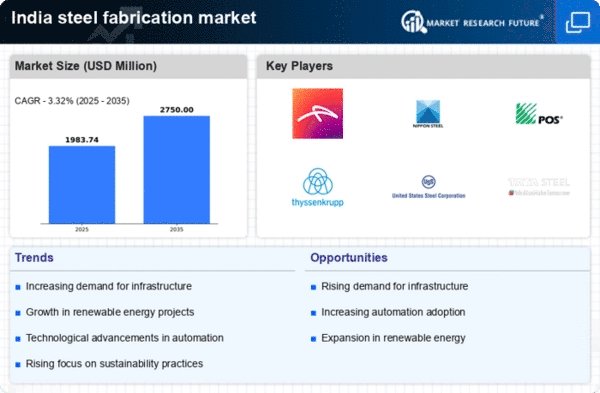
The steel fabrication market in India is characterized by a dynamic competitive landscape, driven by increasing demand from various sectors such as construction, automotive, and infrastructure. Major players are actively pursuing strategies that emphasize innovation, regional expansion, and sustainability. Companies like Tata Steel Limited (IN) and ArcelorMittal (LU) are focusing on enhancing their operational efficiencies and product offerings to maintain a competitive edge. The collective strategies of these firms indicate a shift towards more integrated supply chains and advanced manufacturing technologies, which are likely to reshape the market's competitive environment.Key business tactics within the market include localizing manufacturing to reduce costs and optimize supply chains. The competitive structure appears moderately fragmented, with several key players exerting influence over market dynamics. This fragmentation allows for niche players to emerge, while larger firms leverage their scale to optimize operations and expand their market share. The interplay between these strategies contributes to a complex competitive landscape where agility and responsiveness are paramount.
In September Tata Steel Limited (IN) announced a strategic partnership with a leading technology firm to develop advanced steel fabrication techniques aimed at reducing carbon emissions. This initiative not only aligns with global sustainability goals but also positions Tata Steel as a leader in eco-friendly practices within the industry. The strategic importance of this move lies in its potential to enhance Tata's market position while addressing increasing regulatory pressures for sustainable manufacturing.
In October ArcelorMittal (LU) unveiled a new state-of-the-art facility in India, designed to enhance its production capabilities and meet the growing demand for high-quality steel products. This investment reflects ArcelorMittal's commitment to expanding its footprint in the region and underscores the importance of technological advancement in maintaining competitive advantage. The establishment of this facility is likely to bolster the company's operational efficiency and responsiveness to market needs.
In August POSCO (KR) launched a new line of high-strength steel products tailored for the automotive sector, aiming to capture a larger share of this lucrative market. This strategic move indicates POSCO's focus on innovation and product differentiation, which are critical in a competitive landscape increasingly driven by technological advancements. By catering to specific industry needs, POSCO enhances its value proposition and strengthens its competitive position.
As of November current trends in the steel fabrication market are heavily influenced by digitalization, sustainability, and the integration of artificial intelligence. Strategic alliances are becoming increasingly important, as companies seek to leverage complementary strengths to enhance their market offerings. The competitive differentiation is likely to evolve from traditional price-based competition towards a focus on innovation, technology adoption, and supply chain reliability. This shift suggests that firms that prioritize these aspects will be better positioned to thrive in an increasingly complex market.