×
Request Free Sample ×

Kindly complete the form below to receive a free sample of this Report

* Please use a valid business email

Leading companies partner with us for data-driven Insights

clients tt-cursor
Hero Background

India Smart Education Learning Market

ID: MRFR/ICT/61295-HCR
200 Pages
Aarti Dhapte
February 2026

India Smart Education and Learning Market Size, Share and Research Report: By Software (Learning Management System, Learning Content Management System, Assessment Services, Adaptive Learning Platform), By Hardware (Interactive White Boards, Interactive Displays, Interactive Tables, Student Response Systems) and By Application (Government, Enterprise/Business Education, NGOs And Association, Professional Services, Healthcare)-Forecast to 2035

Share:
Download PDF ×

We do not share your information with anyone. However, we may send you emails based on your report interest from time to time. You may contact us at any time to opt-out.

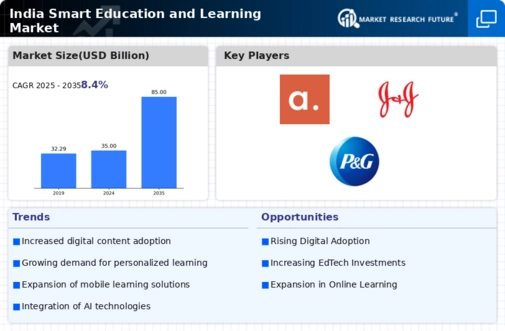
India Smart Education Learning Market Infographic
Purchase Options

India Smart Education Learning Market Summary

As per analysis, The India Smart Education Learning Market is projected to grow from USD 35.82 Billion in 2024 to USD 42.83 Billion by 2025, exhibiting a compound annual growth rate (CAGR) of 17.67% during the forecast period (2025 - 2035).

Key Market Trends & Highlights

The India smart education learning market is poised for substantial growth driven by technological advancements and supportive government policies.

  • Personalized learning solutions are increasingly being adopted across the K-12 education segment, enhancing student engagement and outcomes.
  • The integration of artificial intelligence is transforming educational methodologies, particularly in the largest segment of K-12 education.
  • Corporate training is emerging as the fastest-growing segment, reflecting a shift towards continuous skill development in the workforce.
  • Rising internet penetration and government support for digital education are key drivers propelling the market forward.

Market Size & Forecast

2024 Market Size 35.82 (USD Billion)
2035 Market Size 214.48 (USD Billion)
CAGR (2025 - 2035) 17.67%

Major Players

BYJU'S (IN), Unacademy (IN), Vedantu (IN), Toppr (IN), Simplilearn (IN), UpGrad (IN), Edureka (IN), Khan Academy (US), Coursera (US)

Our Impact
Enabled $4.3B Revenue Impact for Fortune 500 and Leading Multinationals
Partnering with 2000+ Global Organizations Each Year
30K+ Citations by Top-Tier Firms in the Industry

India Smart Education Learning Market Trends

The india smart education learning market is currently experiencing a transformative phase, driven by advancements in technology and a growing emphasis on personalized learning experiences. Educational institutions across the country are increasingly adopting digital tools and platforms to enhance teaching methodologies and improve student engagement. This shift appears to be influenced by the need for more interactive and flexible learning environments, which cater to diverse learning styles and preferences. Furthermore, the integration of artificial intelligence and data analytics into educational frameworks suggests a potential for more tailored educational pathways, allowing students to progress at their own pace. In addition, the government of India has been actively promoting initiatives aimed at enhancing digital literacy and access to quality education. Programs designed to bridge the digital divide are likely to play a crucial role in expanding the reach of smart education solutions, particularly in rural and underserved areas. As educational stakeholders continue to invest in innovative technologies, the landscape of The India Smart Education Learning Market is poised for significant evolution, potentially leading to improved educational outcomes and greater accessibility for learners across the nation.

Personalized Learning Solutions

The trend towards personalized learning solutions is gaining traction within the india smart education learning market. Educational technologies are increasingly being designed to adapt to individual student needs, allowing for customized learning experiences. This approach not only enhances student engagement but also promotes better retention of knowledge, as learners can progress at their own pace.

Integration of Artificial Intelligence

The integration of artificial intelligence in educational tools is becoming more prevalent. AI-driven platforms are being utilized to analyze student performance and provide real-time feedback, which can help educators tailor their teaching strategies. This trend indicates a shift towards data-informed decision-making in education, potentially leading to improved learning outcomes.

Government Initiatives for Digital Education

Government initiatives aimed at promoting digital education are playing a pivotal role in shaping the india smart education learning market. Programs focused on enhancing digital infrastructure and accessibility are likely to facilitate the adoption of smart learning solutions, particularly in remote areas. This emphasis on digital education suggests a commitment to ensuring equitable access to quality learning resources.

India Smart Education Learning Market Drivers

Rising Internet Penetration

The increasing penetration of the internet in India is a pivotal driver for The India Smart Education Learning Market. As of January 2026, approximately 800 million people in India have access to the internet, which facilitates online learning platforms and digital resources. This connectivity enables students from diverse backgrounds to access quality educational materials, thereby democratizing education. Furthermore, the government's initiatives to expand broadband connectivity in rural areas are likely to enhance the reach of smart education solutions. The proliferation of mobile devices also contributes to this trend, as students can engage with educational content anytime and anywhere. This growing digital infrastructure is expected to propel the india smart education learning market forward, creating opportunities for innovative learning solutions.

Growing Demand for Skill Development

The increasing emphasis on skill development in India is a crucial driver for The India Smart Education Learning Market. With the rapid evolution of the job market, there is a pressing need for educational institutions to equip students with relevant skills. The government has recognized this need and has launched various skill development programs, such as the Skill India Mission, which aims to train millions of youth in diverse sectors. This focus on practical skills and vocational training is likely to drive the demand for smart education solutions that offer personalized and adaptive learning experiences. As a result, educational technology providers are expected to innovate and develop platforms that cater to this growing demand, thereby enhancing the overall landscape of the india smart education learning market.

Increased Adoption of EdTech Solutions

The surge in the adoption of educational technology (EdTech) solutions is a prominent driver for The India Smart Education Learning Market. As educational institutions increasingly recognize the benefits of integrating technology into their curricula, the demand for smart learning tools is on the rise. According to recent estimates, the EdTech market in India is projected to reach USD 10 billion by 2025, reflecting a growing acceptance of digital learning platforms. This trend is further fueled by the need for interactive and engaging learning experiences that traditional methods may not provide. Consequently, EdTech companies are innovating to offer diverse solutions, including gamified learning, virtual classrooms, and AI-driven personalized learning paths. This dynamic landscape is likely to shape the future of the india smart education learning market.

Government Support and Policy Framework

The Indian government has been actively promoting digital education through various policies and initiatives, which serves as a significant driver for The India Smart Education Learning Market. Programs such as the National Education Policy (NEP) 2020 emphasize the integration of technology in education, aiming to enhance learning outcomes. The government has allocated substantial funds for the development of digital infrastructure in schools and colleges, which is expected to boost the adoption of smart education tools. Additionally, initiatives like SWAYAM and DIKSHA provide platforms for online courses and resources, further supporting the growth of the market. This robust policy framework indicates a strong commitment to advancing educational technology, thereby fostering a conducive environment for the india smart education learning market.

Focus on Personalized Learning Experiences

The shift towards personalized learning experiences is emerging as a key driver for The India Smart Education Learning Market. Educators and institutions are increasingly recognizing that students have unique learning styles and paces, necessitating tailored educational approaches. The integration of data analytics and artificial intelligence in educational platforms allows for the customization of learning paths, enabling students to progress at their own speed. This trend is supported by the growing body of research indicating that personalized learning can lead to improved academic outcomes. As a result, educational technology providers are likely to invest in developing adaptive learning solutions that cater to individual needs, thereby enhancing the overall effectiveness of the india smart education learning market.


Market Segment Insights

By Application: K-12 Education (Largest) vs. Corporate Training (Fastest-Growing)

In The India Smart Education Learning Market, the K-12 education segment holds the largest share, driven by the increasing adoption of digital tools in schools. This segment benefits from government initiatives focused on improving educational standards and integrating technology into classrooms. In contrast, corporate training is experiencing significant growth, as companies recognize the necessity of upskilling employees to stay competitive. This shift towards e-learning platforms is reshaping traditional training methodologies and attracting substantial investments. The growth trends in the K-12 sector are influenced by technological advancements and a rising demand for personalized learning experiences. The Indian government is actively promoting digital literacy and integrating smart classrooms across public and private schools. On the other hand, the corporate training segment is driven by the need for continuous professional development, with organizations investing in digital training solutions to improve workforce efficiency and adapt to evolving market needs. Emerging trends include a focus on soft skills development and the use of AI-driven learning analytics to tailor training programs.

K-12 Education (Dominant) vs. Skill Development (Emerging)

The K-12 education segment remains dominant in the Indian smart education market, characterized by its extensive reach and investment by both government and private players. This segment emphasizes interactive learning solutions, such as smart boards and e-learning modules, which engage students and facilitate a better understanding of the curriculum. Meanwhile, skill development is emerging rapidly as a crucial area, focusing on imparting practical skills that align with industry demands. Institutions are increasingly adopting blended learning approaches, integrating online resources with hands-on training to prepare students for real-world challenges. As industries evolve, skill development programs are tailored to match the expectations of employers, making it a vital component of the education landscape.

By Technology: Artificial Intelligence (Largest) vs. Cloud Computing (Fastest-Growing)

In The India Smart Education Learning Market, Artificial Intelligence (AI) holds the largest market share, significantly influencing how educational content is delivered and absorbed. Its presence in adaptive learning platforms and personalized education tools has reshaped traditional learning methodologies. Meanwhile, Cloud Computing is emerging as a vital player, enabling scalable and flexible learning solutions that can cater to diverse educational needs across the country. The growth of these technologies is fueled by increasing digitalization in education and a shift towards hybrid learning environments. AI is evolving rapidly, driving innovations in assessment and administrative efficiency, while Cloud Computing offers unprecedented access to resources and collaboration opportunities. This dual growth indicates that the market is rapidly adapting to modern technological demands.

Cloud Computing (Dominant) vs. Augmented Reality (Emerging)

Cloud Computing is the dominant player in the India smart education learning market, providing robust frameworks for online learning, resource sharing, and real-time collaboration among students and educators. Its scalability and flexibility address the challenges of varied educational requirements, making it essential for modern learning environments. On the other hand, Augmented Reality (AR) is an emerging technology, capturing attention for its immersive educational experiences. AR enhances engagement by providing interactive simulations that can deepen understanding and retention of complex concepts. While Cloud Computing drives substantial growth across educational institutions, AR is gradually gaining traction as educators seek innovative ways to deeply engage students, leading to a promising synergy between the two technologies.

By Delivery Mode: Online Learning (Largest) vs. Blended Learning (Fastest-Growing)

The India Smart Education Learning Market is witnessing significant growth across various delivery modes. Online learning currently holds the largest market share, primarily driven by increasing internet penetration and the demand for flexible learning solutions. Additionally, blended learning is rapidly gaining traction as educational institutions recognize its potential to combine traditional classroom experiences with online resources, thereby catering to diverse learning preferences. Growth trends in the delivery mode segment are fueled by advancements in technology and heightened awareness of digital learning benefits. With the COVID-19 pandemic accelerating the adoption of online and blended learning models, educational stakeholders are focusing on developing innovative content and engaging platforms. This shift not only enhances accessibility but also bolsters student engagement, leading to sustained growth in this sector.

Online Learning (Dominant) vs. Blended Learning (Emerging)

Online learning has emerged as the dominant delivery mode in the India smart education learning market, preferred for its flexibility, accessibility, and a wide range of available resources. It allows learners to engage with courses from the comfort of their homes, thereby overcoming geographical barriers. Institutions are increasingly investing in robust learning management systems to deliver high-quality content, thus enhancing student experiences. Conversely, blended learning is an emerging trend that combines the benefits of online and traditional classroom education. This approach is gaining popularity among educators who aim to foster more interactive and personalized learning environments. By integrating both modes, blended learning strikes a balance, enabling students to benefit from direct interactions with instructors while also enjoying the advantages of online materials.

By User Type: Students (Largest) vs. Educators (Fastest-Growing)

In The India Smart Education Learning Market, the user type segment is distinctly categorized into Students, Educators, Institutions, and Corporate Learners. Among these segments, Students hold the largest share, primarily driven by the increasing adoption of smart devices and digital learning solutions in schools and colleges across India. As educational institutions are increasingly incorporating technology into their curriculum, the demand from Students remains robust, making them the most significant user group in this market. On the other hand, Educators are emerging as the fastest-growing segment as they constantly seek innovative tools to enhance teaching methodologies and engage with students effectively. The shift towards blended learning and continuous professional development in digital pedagogy is propelling rapid growth in this segment. Educators are increasingly adopting smart education solutions that facilitate interactive learning experiences, leading to a surge in their market presence and influence in shaping educational trends in India.

Students (Dominant) vs. Educators (Emerging)

Students represent the dominant segment in the India smart education learning market due to their extensive engagement with technology for learning purposes. This group encompasses school-going children to university students who rely on digital tools for access to educational resources, online classes, and collaborative learning platforms. Their keen interest in interactive and personalized learning experiences drives market demand. In contrast, Educators are an emerging segment, increasingly utilizing smart education tools to refine their teaching strategies. This group consists of teachers and lecturers who leverage technology to enhance classroom interaction and student engagement. The rise of online teacher training programs and professional development resources emphasizes their pivotal role in driving the transition to smarter educational practices in India. The combination of Students' dominant presence and Educators’ rapid growth underscores the dynamic nature of the smart education landscape.

By Content Type: Interactive Content (Largest) vs. Video Content (Fastest-Growing)

In The India Smart Education Learning Market, the distribution of content types reflects diverse learning preferences and technological advancements. Interactive Content leads the segment, capturing significant interest due to its immersive capabilities and engaging design. Following closely is Video Content, which has become increasingly popular as educational institutions integrate multimedia learning experiences to enhance student engagement. Textual Content maintains a steady presence, appealing to traditional learners, while Assessment Tools serve a unique niche, focusing on evaluating understanding and performance in real-time. As digital transformation accelerates in education, the growth trends for these content types indicate a shift towards more dynamic learning experiences. Video Content, in particular, is observing rapid growth due to the proliferation of high-speed internet and smartphone usage in India. Interactive Content, though established, continues to evolve with advancements in technology, such as augmented reality and gamification, capturing the attention of learners seeking personalized education experiences.

Interactive Content (Dominant) vs. Assessment Tools (Emerging)

Interactive Content stands out in the India smart education learning market as the dominant type, primarily due to its ability to engage students actively through simulations, gamification, and immersive experiences. This segment promotes hands-on learning and caters to diverse learning styles, making it highly valued by educators and learners alike. On the other hand, Assessment Tools are emerging as crucial components in this landscape, focusing on providing immediate feedback and performance tracking. This segment supports personalized learning paths and data-driven insights for educators, facilitating targeted interventions. The combination of these two segments underscores a transition in education towards more interactive and responsive learning methodologies.

Get more detailed insights about India Smart Education Learning Market

Key Players and Competitive Insights

The competitive landscape of the smart education learning market in India is characterized by rapid innovation and a diverse array of players vying for market share. Key growth drivers include the increasing penetration of digital technologies, a growing emphasis on personalized learning experiences, and the rising demand for upskilling and reskilling among the workforce. Major companies such as BYJU'S (IN), Unacademy (IN), and Vedantu (IN) are strategically positioned to leverage these trends. BYJU'S (IN) focuses on content innovation and has expanded its offerings through acquisitions, while Unacademy (IN) emphasizes partnerships with educators to enhance its platform. Vedantu (IN) is concentrating on live online tutoring, which appears to resonate well with students seeking interactive learning experiences. Collectively, these strategies contribute to a competitive environment that is both dynamic and multifaceted.

In terms of business tactics, companies are increasingly localizing their content and optimizing their supply chains to better serve the diverse Indian market. The competitive structure of the market is moderately fragmented, with numerous players offering specialized services. This fragmentation allows for a variety of educational solutions, catering to different segments of learners, from school students to professionals seeking further education. The collective influence of these key players shapes the market, as they continuously adapt to the evolving needs of learners.

In December 2025, BYJU'S (IN) announced a strategic partnership with a leading technology firm to enhance its AI-driven learning platform. This move is significant as it aims to integrate advanced analytics into the learning experience, potentially providing personalized learning pathways for students. Such innovations may further solidify BYJU'S (IN) position as a market leader, enabling it to offer tailored educational solutions that meet individual learning needs.

In November 2025, Unacademy (IN) launched a new initiative aimed at providing free access to its premium courses for underprivileged students. This initiative not only enhances Unacademy’s brand image but also aligns with the growing trend of corporate social responsibility in education. By expanding access to quality educational resources, Unacademy (IN) may strengthen its user base and foster loyalty among learners who value social impact.

In October 2025, Vedantu (IN) introduced a new feature that allows students to create personalized study plans based on their learning styles and goals. This feature is indicative of a broader trend towards customization in education, as it empowers learners to take control of their educational journeys. By focusing on user-centric innovations, Vedantu (IN) is likely to enhance student engagement and retention, which are critical in a competitive market.

As of January 2026, the most current trends defining competition in the smart education learning market include digitalization, sustainability, and the integration of AI technologies. Strategic alliances are increasingly shaping the landscape, as companies collaborate to enhance their offerings and reach wider audiences. Looking ahead, competitive differentiation is expected to evolve, with a shift from price-based competition to a focus on innovation, technology, and supply chain reliability. This transition may redefine how companies position themselves in the market, emphasizing the importance of delivering unique value propositions that resonate with learners.

Key Companies in the India Smart Education Learning Market include

Industry Developments

The India Smart Education and Learning Market has witnessed significant growth and developments in recent months. Companies like BYJU'S and Unacademy have ramped up their offerings, focusing on personalized learning experiences amid increasing competition. In September 2023, Edureka announced a strategic partnership with a leading tech company to enhance its course offerings in data science and artificial intelligence.

Notably, in August 2023, TalentSprint was reported to have acquired a startup specializing in coding boot camps, marking a significant move in expanding its curriculum. In terms of market valuation, Vedantu recently reported a 15% increase in user subscriptions this year, positively impacting their annual revenue forecast. Last year, in October 2022, WhiteHat Jr was recognized for its innovative teaching methods, further establishing its presence in the competitive landscape.

The overall growth seen in the sector reflects the increasing demand for online learning solutions in India, driven by a tech-savvy youth population and a growing acceptance of digital education formats. This trend is set to continue, supported by government initiatives aimed at enhancing digital literacy across the nation.

Future Outlook

India Smart Education Learning Market Future Outlook

The India smart education learning market is projected to grow at a 17.67% CAGR from 2025 to 2035, driven by technological advancements, increasing digital literacy, and government initiatives.

New opportunities lie in:

  • Development of AI-driven personalized learning platforms
  • Expansion of mobile learning applications for rural areas
  • Partnerships with educational institutions for blended learning solutions

By 2035, the market is expected to be robust, driven by innovation and widespread adoption.

Market Segmentation

India Smart Education Learning Market User Type Outlook

  • Students
  • Educators
  • Institutions
  • Corporate Learners

India Smart Education Learning Market Technology Outlook

  • Artificial Intelligence
  • Augmented Reality
  • Virtual Reality
  • Cloud Computing

India Smart Education Learning Market Application Outlook

  • K-12 Education
  • Higher Education
  • Corporate Training
  • Skill Development

India Smart Education Learning Market Content Type Outlook

  • Interactive Content
  • Video Content
  • Textual Content
  • Assessment Tools

India Smart Education Learning Market Delivery Mode Outlook

  • Online Learning
  • Blended Learning
  • Mobile Learning
  • Classroom Learning

Report Scope

MARKET SIZE 202435.82(USD Billion)
MARKET SIZE 202542.83(USD Billion)
MARKET SIZE 2035214.48(USD Billion)
COMPOUND ANNUAL GROWTH RATE (CAGR)17.67% (2024 - 2035)
REPORT COVERAGERevenue Forecast, Competitive Landscape, Growth Factors, and Trends
BASE YEAR2024
Market Forecast Period2025 - 2035
Historical Data2019 - 2024
Market Forecast UnitsUSD Billion
Key Companies ProfiledBYJU'S (IN), Unacademy (IN), Vedantu (IN), Toppr (IN), Simplilearn (IN), UpGrad (IN), Edureka (IN), Khan Academy (US), Coursera (US)
Segments CoveredApplication, Technology, Delivery Mode, User Type, Content Type
Key Market OpportunitiesIntegration of artificial intelligence in personalized learning solutions within the india smart education learning market.
Key Market DynamicsRapid technological advancements drive innovation and competition in India's smart education learning market.

Countries CoveredIndia
Leave a Comment

FAQs

What is the current valuation of the India smart education learning market?

As of 2024, the market valuation stood at 35.82 USD Billion.

What is the projected market size for the India smart education learning market by 2035?

The market is expected to reach a valuation of 214.48 USD Billion by 2035.

What is the expected CAGR for the India smart education learning market during the forecast period 2025 - 2035?

The market is anticipated to grow at a CAGR of 17.67% from 2025 to 2035.

Which segments are driving growth in the India smart education learning market?

Key segments include K-12 Education, Higher Education, Corporate Training, and Skill Development.

What is the valuation of the K-12 Education segment in the India smart education learning market?

The K-12 Education segment was valued at 10.0 USD Billion in 2024 and is projected to reach 60.0 USD Billion by 2035.

How does the Corporate Training segment perform in the India smart education learning market?

The Corporate Training segment had a valuation of 8.0 USD Billion in 2024, with a projected growth to 50.0 USD Billion by 2035.

What technologies are influencing the India smart education learning market?

Technologies such as Artificial Intelligence, Augmented Reality, and Virtual Reality are significantly impacting the market.

What is the expected growth of online learning in the India smart education learning market?

Online Learning was valued at 10.0 USD Billion in 2024 and is expected to grow to 60.0 USD Billion by 2035.

Who are the key players in the India smart education learning market?

Prominent players include BYJU'S, Unacademy, Vedantu, and Simplilearn, among others.

What types of content are prevalent in the India smart education learning market?

Content types include Interactive Content, Video Content, Textual Content, and Assessment Tools, with Textual Content valued at 15.0 USD Billion in 2024.

Download Free Sample

Kindly complete the form below to receive a free sample of this Report

Compare Licence

×
Features License Type
Single User Multiuser License Enterprise User
Price $4,950 $5,950 $7,250
Maximum User Access Limit 1 User Upto 10 Users Unrestricted Access Throughout the Organization
Free Customization
Direct Access to Analyst
Deliverable Format
Platform Access
Discount on Next Purchase 10% 15% 15%
Printable Versions






