×
Request Free Sample ×

Kindly complete the form below to receive a free sample of this Report

* Please use a valid business email

Leading companies partner with us for data-driven Insights

clients tt-cursor
Hero Background

India Self Sovereign Identity Market

ID: MRFR/ICT/60215-HCR
200 Pages
Aarti Dhapte
February 2026

India Self-Sovereign Identity Market Size, Share and Research Report: By Application (Digital Identity Verification, Identity Management, Access Control, Data Sharing), By End Use Industry (Healthcare, Government, Financial Services, Telecommunications), By Deployment Type (On-Premises, Cloud-Based) and By Technology (Blockchain, Decentralized Identity, Public Key Infrastructure, Biometrics)- Industry Forecast to 2035

Share:
Download PDF ×

We do not share your information with anyone. However, we may send you emails based on your report interest from time to time. You may contact us at any time to opt-out.

India Self Sovereign Identity Market Infographic
Purchase Options

India Self Sovereign Identity Market Summary

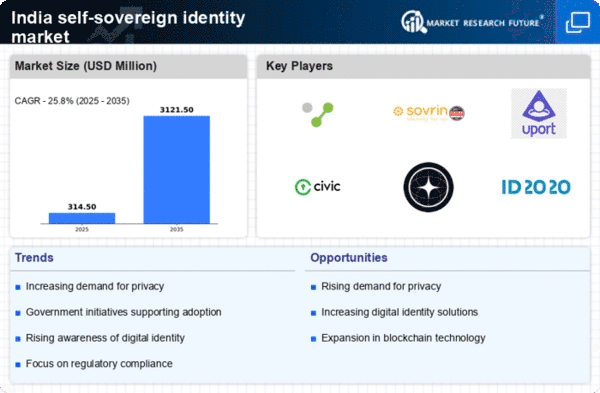
As per Market Research Future analysis, the India Self Sovereign Identity Market size was estimated at 250.0 USD Million in 2024. The Self Sovereign-identity market is projected to grow from 314.5 USD Million in 2025 to 3121.5 USD Million by 2035, exhibiting a compound annual growth rate (CAGR) of 25% during the forecast period 2025 - 2035

Key Market Trends & Highlights

The India self sovereign-identity market is poised for substantial growth driven by technological advancements and increasing demand for privacy solutions.

  • The largest segment in the India self sovereign-identity market is the enterprise sector, which is experiencing a notable rise in demand for secure identity management solutions.
  • The fastest-growing segment is the consumer sector, reflecting a heightened awareness of personal data privacy and security.
  • Regulatory support for digital identity initiatives is fostering a conducive environment for market expansion, particularly in urban regions.
  • Key market drivers include the growing digital economy and increased cybersecurity concerns, which are propelling the adoption of self sovereign-identity solutions.

Market Size & Forecast

2024 Market Size 250.0 (USD Million)
2035 Market Size 3121.5 (USD Million)
CAGR (2025 - 2035) 25.8%

Major Players

Evernym (US), Sovrin Foundation (US), uPort (CH), Civic Technologies (US), SelfKey (HK), ID2020 Alliance (US), Verifiable Credentials (US), Microsoft (US)

Our Impact
Enabled $4.3B Revenue Impact for Fortune 500 and Leading Multinationals
Partnering with 2000+ Global Organizations Each Year
30K+ Citations by Top-Tier Firms in the Industry

India Self Sovereign Identity Market Trends

The India Self Sovereign Identity Market is currently experiencing a transformative phase, driven by the increasing demand for privacy and control over personal data. Individuals are seeking solutions that allow them to manage their identities without relying on centralized authorities. This shift is largely influenced by the growing awareness of data breaches and privacy concerns, prompting users to explore alternatives that empower them. In this context, self sovereign-identity solutions are emerging as viable options, offering enhanced security and user autonomy. Furthermore, the regulatory landscape is evolving, with governments recognizing the importance of digital identity frameworks. Initiatives aimed at establishing robust identity verification systems are gaining traction, which may further bolster the adoption of self sovereign-identity technologies. In addition, the technological advancements in blockchain and cryptographic methods are likely to play a pivotal role in shaping the self sovereign-identity market. These innovations provide the necessary infrastructure for secure and decentralized identity management. As organizations and individuals alike begin to embrace these technologies, the market is poised for significant growth. The convergence of user demand, regulatory support, and technological innovation suggests a promising future for self sovereign-identity solutions, potentially leading to widespread acceptance and integration into various sectors, including finance, healthcare, and e-governance.

Rising Demand for Privacy Solutions

There is an increasing trend towards privacy-centric identity solutions. Users are becoming more aware of their data rights and are actively seeking ways to control their personal information. This shift is likely to drive the adoption of self sovereign-identity technologies, as individuals prioritize their privacy and security.

Regulatory Support for Digital Identity

Governments are beginning to recognize the necessity of robust digital identity frameworks. Initiatives aimed at enhancing identity verification processes are being developed, which may create a favorable environment for the self sovereign-identity market. This regulatory backing could facilitate wider acceptance and implementation of these solutions.

Technological Advancements in Identity Management

Innovations in blockchain and cryptographic technologies are transforming the landscape of identity management. These advancements provide the foundation for secure, decentralized identity solutions. As these technologies mature, they are expected to significantly influence the self sovereign-identity market, enabling more secure and efficient identity verification.

India Self Sovereign Identity Market Drivers

Growing Digital Economy

The rapid expansion of the digital economy in India is a crucial driver for the self sovereign-identity market. As more businesses and services transition online, the need for secure and efficient identity verification becomes paramount. In 2025, India's digital economy is projected to reach $1 trillion, highlighting the increasing reliance on digital platforms. This growth necessitates robust identity solutions that empower individuals to control their personal data. The self sovereign-identity market offers a decentralized approach, allowing users to manage their identities without intermediaries. This shift not only enhances user privacy but also fosters trust in digital transactions, which is essential for the continued growth of the digital economy.

Rising Consumer Awareness

As consumers become more informed about data privacy and security, there is a growing demand for self sovereign-identity solutions. Individuals are increasingly recognizing the importance of controlling their personal information and the risks associated with traditional identity management systems. This shift in consumer mindset is driving the self sovereign-identity market, as users seek solutions that empower them to manage their identities securely. Surveys indicate that over 70% of consumers in India express concerns about data privacy, suggesting a strong market potential for self sovereign-identity solutions. This heightened awareness is likely to encourage businesses to adopt these technologies to meet consumer expectations.

Increased Cybersecurity Concerns

With the rise in cyber threats and data breaches, the demand for enhanced security measures in identity management is intensifying. The self sovereign-identity market addresses these concerns by providing individuals with greater control over their personal information. In India, cybercrime incidents have surged, leading to a heightened awareness of the need for secure identity solutions. The self sovereign-identity framework minimizes the risk of identity theft by allowing users to share only the necessary information for verification. This approach not only protects personal data but also builds confidence among users, thereby driving the adoption of self sovereign-identity solutions across various sectors.

Technological Innovations in Blockchain

Technological advancements, particularly in blockchain technology, are propelling the self sovereign-identity market forward. Blockchain offers a decentralized and secure method for identity verification, which aligns with the principles of self sovereign-identity. In India, the adoption of blockchain is gaining momentum, with various sectors exploring its potential for enhancing security and transparency. By 2025, it is anticipated that blockchain-based identity solutions will become more prevalent, providing users with a reliable means to manage their identities. This technological innovation not only streamlines the verification process but also fosters trust among users, thereby driving the growth of the self sovereign-identity market.

Government Initiatives for Digital Identity

The Indian government has been actively promoting digital identity initiatives, which significantly impact the self sovereign-identity market. Programs such as Aadhaar have laid the groundwork for digital identity verification, encouraging the development of more advanced solutions. In 2025, the government aims to enhance its digital infrastructure, which is expected to facilitate the integration of self sovereign-identity systems. By supporting policies that promote data privacy and user control, the government is likely to create a favorable environment for the self sovereign-identity market to flourish. This alignment with governmental objectives can lead to increased investment and innovation in identity management technologies.

Market Segment Insights

By Application: Digital Identity Verification (Largest) vs. Access Control (Fastest-Growing)

In the India self sovereign-identity market, Digital Identity Verification leads the application segment, capturing the largest share due to its critical role in ensuring secure transactions and authentication. Following closely is Identity Management, which contributes significantly to the overall market but lacks the same dominance. Access Control has emerged as a vital component, gaining traction rapidly as organizations seek enhanced security measures for sensitive information. Data Sharing, while essential, remains a smaller player in the market dynamics. Growth in the application segment is driven by increasing digitalization and the need for secure identity solutions across various sectors. The expanding e-commerce sector and the influx of digital services necessitate robust identity verification processes, thus propelling Digital Identity Verification further. Furthermore, Access Control solutions are rapidly gaining ground owing to rising cyber threats, making them the fastest-growing aspect of the market. The emphasis on privacy and compliance is also shaping these trends, with stakeholders increasingly focusing on secure and user-centric identity management solutions.

Identity Management (Dominant) vs. Data Sharing (Emerging)

Identity Management serves as a dominant force within the India self sovereign-identity market, primarily focusing on the efficient handling and protection of user identities across platforms. This segment includes essential elements like user authentication, administration, and compliance management, making it crucial for organizations grappling with privacy regulations. On the other hand, Data Sharing is an emerging segment, characterized by the growing need for seamless information exchange while maintaining user control over personal data. While still establishing its foothold, this segment is increasingly supported by advancements in blockchain and encryption technologies, allowing for secure channels, which is necessary as trust and transparency become crucial in digital interactions.

By End Use Industry: Healthcare (Largest) vs. Financial Services (Fastest-Growing)

The India self sovereign-identity market exhibits a varied distribution of market share among its key end use industries. Notably, the healthcare sector commands the largest segment, driven by increasing demands for secure patient data management and identity verification. In contrast, the financial services sector is rapidly gaining traction, fueled by the pressing need for enhanced security and customer authentication processes. Growth trends within this market segment point towards a robust adoption of self sovereign-identity systems, particularly in the healthcare and financial services sectors. The surge in digital transformation initiatives and a heightened focus on regulatory compliance are major drivers. Telecommunications and government agencies are also recognizing the benefits, but at a comparatively slower pace, indicating a shift towards the adoption of innovative identity solutions across sectors in the forthcoming years.

Healthcare: Dominant vs. Financial Services: Emerging

In the India self sovereign-identity market, the healthcare sector stands out as a dominant force, primarily due to its critical need for secure and reliable identity management systems. Healthcare providers are increasingly leveraging these identity solutions to protect patient data and streamline operations. On the other hand, the financial services sector is emerging as a fast-growing segment, as institutions seek to implement robust identity verification systems that meet regulatory standards and enhance customer security. Both segments are witnessing significant technological advancements, with healthcare leading in adoption while financial services are quickly closing the gap as they innovate and adapt to the changing landscape of digital identity.

By Deployment Type: Cloud-Based (Largest) vs. On-Premises (Fastest-Growing)

The deployment type segment in the India self sovereign-identity market displays a clear preference for cloud-based solutions, which capture the largest share of the market. Organizations are increasingly adopting cloud-based systems due to their scalability, flexibility, and reduced overhead costs. Conversely, on-premises solutions, while currently smaller in market share, are swiftly gaining traction among enterprises that prioritize data control and security. Growth trends indicate that the on-premises segment is experiencing rapid expansion, driven by heightened awareness of data privacy regulations and the need for localized data storage. As organizations migrate towards self sovereign-identity frameworks, the demand for on-premises deployments is expected to surge, creating a dynamic interplay between both deployment types as clients weigh their specific needs against the benefits offered by each solution.

Deployment Type: Cloud-Based (Dominant) vs. On-Premises (Emerging)

Cloud-based deployment in the India self sovereign-identity market dominates the landscape, offering a range of advantages such as lower initial costs, ease of maintenance, and automatic updates. This model aligns perfectly with the agile approach many organizations are adopting, facilitating seamless integration with existing systems. On the other hand, the on-premises deployment type is emerging as a strong contender, appealing to organizations with stringent security requirements and those dealing with sensitive data. This option allows for greater control over data, catering to businesses that prioritize data sovereignty and compliance with local regulations. Together, these deployment types reflect the diverse preferences of organizations navigating the evolving identity management landscape.

By Technology: Blockchain (Largest) vs. Biometrics (Fastest-Growing)

In the India self sovereign-identity market, the distribution of market share among the various technology segments reveals that Blockchain retains the largest share, showcasing its foundational role in enabling secure and autonomous identity management. Decentralized Identity follows closely, emphasizing its importance in personal data control. Public Key Infrastructure, while essential, has a slightly smaller but significant share, whereas Biometrics is rapidly gaining traction, rounding out the market with its innovative verification methods. Growth trends in this segment are heavily influenced by increased digital transformation initiatives and a rising demand for privacy and data security. The evolution of Blockchain technology underpins many solutions, while Decentralized Identity frameworks are becoming preferred for user-centered approaches. Biometrics is capitalizing on advancements in AI and machine learning, making it the fastest-growing segment as organizations seek more reliable identification methods to enhance user experiences.

Technology: Blockchain (Dominant) vs. Biometrics (Emerging)

Blockchain technology, as the dominant force, provides a robust foundation for the India self sovereign-identity market by ensuring secure, transparent, and immutable identity verification processes. Its decentralized nature fosters trust without needing a central authority, making it integral to self-sovereign identity frameworks. Biometrics, however, represents an emerging segment characterized by rapid innovation and adoption, leveraging biometric data for identification and authentication. This segment's growth is driven by technological advancements, including improved recognition algorithms and increased accuracy. As consumer expectations for seamless and secure interactions rise, the demand for biometric solutions is surging, positioning it as a key player in the evolving landscape of identity verification.

Get more detailed insights about India Self Sovereign Identity Market

Key Players and Competitive Insights

The self sovereign-identity market is currently characterized by a dynamic competitive landscape, driven by the increasing demand for secure and user-centric identity solutions. Key players are actively pursuing strategies that emphasize innovation, partnerships, and regional expansion. For instance, Evernym (US) has positioned itself as a leader in decentralized identity solutions, focusing on enhancing user privacy and control. Similarly, Microsoft (US) has been integrating self-sovereign identity capabilities into its Azure platform, thereby leveraging its existing cloud infrastructure to offer robust identity management solutions. These strategic moves collectively shape a competitive environment that is increasingly focused on technological advancement and user empowerment.In terms of business tactics, companies are localizing their operations to better cater to regional markets, optimizing supply chains to enhance efficiency, and forming strategic alliances to bolster their market presence. The competitive structure of the market appears moderately fragmented, with several players vying for dominance. However, the influence of major companies like Microsoft (US) and Evernym (US) is significant, as they set benchmarks for innovation and operational excellence that smaller firms strive to emulate.

In October Evernym (US) announced a partnership with a leading Indian fintech company to develop a localized self-sovereign identity solution tailored for the Indian market. This strategic collaboration is expected to enhance user adoption by addressing specific regulatory and cultural needs, thereby positioning Evernym as a key player in the region. The partnership underscores the importance of local insights in developing effective identity solutions that resonate with users.

In September Microsoft (US) launched a new feature within its Azure Active Directory that integrates self-sovereign identity capabilities, allowing users to manage their identities more securely and efficiently. This move not only strengthens Microsoft's position in the identity management space but also reflects a broader trend towards integrating advanced identity solutions within existing digital ecosystems. The strategic importance of this development lies in its potential to attract enterprise clients seeking comprehensive identity solutions that enhance security and user experience.

In August Civic Technologies (US) expanded its operations in India by establishing a local office and hiring a dedicated team to focus on regional identity solutions. This expansion is indicative of Civic's commitment to tapping into the growing demand for self-sovereign identity solutions in India, where digital identity verification is becoming increasingly critical. The establishment of a local presence is likely to facilitate better customer engagement and foster partnerships with local stakeholders.

As of November the self sovereign-identity market is witnessing trends that emphasize digitalization, sustainability, and the integration of AI technologies. Strategic alliances are becoming increasingly pivotal, as companies recognize the need to collaborate to enhance their offerings and market reach. Looking ahead, competitive differentiation is expected to evolve, with a shift from price-based competition towards innovation, technological advancement, and supply chain reliability. This transition suggests that companies that prioritize these aspects will likely gain a competitive edge in the rapidly evolving landscape.

Key Companies in the India Self Sovereign Identity Market include

Industry Developments

In recent months, the India Self-Sovereign Identity Market has seen significant activity. Companies like Tech Mahindra, Infosys, and Wipro are increasingly investing in blockchain technology to enhance user privacy and security. The adoption of Self-Sovereign Identity (SSI) frameworks is gaining traction, driven by regulatory support and initiatives like India's Digital India program. In March 2023, Tata Consultancy Services announced a collaboration with Microsoft to create more secure identity solutions, further solidifying their position in the market. Additionally, in August 2023, Cognizant acquired a niche SSI startup to complement its digital identity solutions portfolio. 

The market valuation of companies such as AuthMe and IDfy grew by approximately 30% over the past year due to increased demand for secure digital verification systems. Over the last few years, significant milestones include the introduction of Aadhaar-based digital identity services, which have revolutionized the landscape in India. With the focus on digital transformation, this market is expected to expand rapidly, making advancements in technology imperative for businesses involved in identity solutions across the region. Economic growth and regulatory changes will continue to shape the future of SSI in India.

Future Outlook

India Self Sovereign Identity Market Future Outlook

The self sovereign-identity market in India is projected to grow at a 25.8% CAGR from 2025 to 2035, driven by technological advancements and increasing demand for data privacy.

New opportunities lie in:

  • Development of decentralized identity verification platforms for enterprises.
  • Integration of blockchain technology in identity management solutions.
  • Creation of mobile applications for secure self-sovereign identity access.

By 2035, the self sovereign-identity market is expected to be robust, driven by innovation and user adoption.

Market Segmentation

India Self Sovereign Identity Market Technology Outlook

  • Blockchain
  • Decentralized Identity
  • Public Key Infrastructure
  • Biometrics

India Self Sovereign Identity Market Application Outlook

  • Digital Identity Verification
  • Identity Management
  • Access Control
  • Data Sharing

India Self Sovereign Identity Market Deployment Type Outlook

  • On-Premises
  • Cloud-Based

India Self Sovereign Identity Market End Use Industry Outlook

  • Healthcare
  • Government
  • Financial Services
  • Telecommunications

Report Scope

MARKET SIZE 2024 250.0(USD Million)
MARKET SIZE 2025 314.5(USD Million)
MARKET SIZE 2035 3121.5(USD Million)
COMPOUND ANNUAL GROWTH RATE (CAGR) 25.8% (2025 - 2035)
REPORT COVERAGE Revenue Forecast, Competitive Landscape, Growth Factors, and Trends
BASE YEAR 2024
Market Forecast Period 2025 - 2035
Historical Data 2019 - 2024
Market Forecast Units USD Million
Key Companies Profiled Evernym (US), Sovrin Foundation (US), uPort (CH), Civic Technologies (US), SelfKey (HK), ID2020 Alliance (US), Verifiable Credentials (US), Microsoft (US)
Segments Covered Application, End Use Industry, Deployment Type, Technology
Key Market Opportunities Growing demand for secure digital identities drives innovation in the self sovereign-identity market.
Key Market Dynamics Rising demand for secure digital identities drives innovation and regulatory frameworks in the self sovereign-identity market.
Countries Covered India
Leave a Comment

FAQs

What is the expected market size of the India Self-Sovereign Identity Market in 2024?

The India Self-Sovereign Identity Market is expected to be valued at 91.0 USD Million in 2024.

What is the projected market valuation for the India Self-Sovereign Identity Market by 2035?

By 2035, the India Self-Sovereign Identity Market is expected to reach a valuation of 1500.0 USD Million.

What is the expected CAGR for the India Self-Sovereign Identity Market during the forecast period?

The India Self-Sovereign Identity Market is projected to have a CAGR of 29.015% from 2025 to 2035.

Which application segment of the India Self-Sovereign Identity Market will have the highest valuation in 2035?

The Digital Identity Verification segment is expected to be the highest valued application, reaching 490.0 USD Million by 2035.

What will be the market value for the Identity Management application in 2024?

The Identity Management application is expected to have a market value of 25.0 USD Million in 2024.

Who are some of the major players in the India Self-Sovereign Identity Market?

Major players in the market include Tech Mahindra, Cognizant, Wipro, Infosys, and Accenture.

What is the expected market size for the Access Control application by 2035?

The Access Control application is expected to grow to a market size of 310.0 USD Million by 2035.

What will be the market value of the Data Sharing application in 2024?

The Data Sharing application is projected to have a market value of 16.0 USD Million in 2024.

What challenges might the India Self-Sovereign Identity Market face in its growth?

Challenges may include regulatory hurdles and data privacy issues impacting adoption rates.

How will the growth rate for Digital Identity Verification compare to other segments by 2035?

Digital Identity Verification is expected to outperform other segments with significant growth, projected to reach 490.0 USD Million by 2035.

Download Free Sample

Kindly complete the form below to receive a free sample of this Report

Compare Licence

×
Features License Type
Single User Multiuser License Enterprise User
Price $4,950 $5,950 $7,250
Maximum User Access Limit 1 User Upto 10 Users Unrestricted Access Throughout the Organization
Free Customization
Direct Access to Analyst
Deliverable Format
Platform Access
Discount on Next Purchase 10% 15% 15%
Printable Versions