×
Request Free Sample ×

Kindly complete the form below to receive a free sample of this Report

* Please use a valid business email

Leading companies partner with us for data-driven Insights

clients tt-cursor
Hero Background

India Rockwool Market

ID: MRFR/CnM/47007-HCR
200 Pages
Chitranshi Jaiswal
February 2026

India Rockwool Market Research Report By Type (Roving, Chopped Strands, Fabric, Mesh or Grids) and By End User (Construction, Automotive, Aerospace & Defense, Power Generation, Sports & Related Accessories)- Forecast to 2035

Share:
Download PDF ×

We do not share your information with anyone. However, we may send you emails based on your report interest from time to time. You may contact us at any time to opt-out.

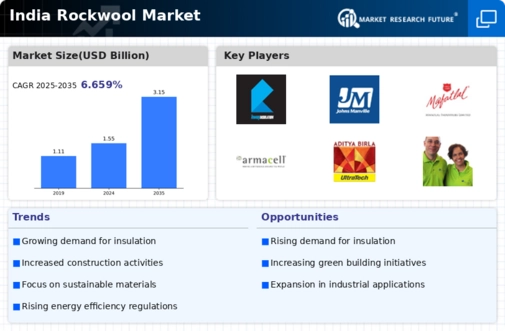
India Rockwool Market Infographic
Purchase Options

India Rockwool Market Summary

As per analysis, the India Rockwool Market is projected to grow from USD 1.57 Billion in 2025 to USD 2.7 Billion by 2035, exhibiting a compound annual growth rate (CAGR) of 5.65% during the forecast period (2025 - 2035).

Key Market Trends & Highlights

The India rockwool market is poised for growth driven by sustainability and urbanization.

  • The thermal insulation segment remains the largest contributor to the rockwool market, reflecting a strong demand in construction.
  • Acoustic insulation is emerging as the fastest-growing segment, driven by increasing noise pollution concerns in urban areas.
  • Urbanization and infrastructure development are key trends shaping the market, as cities expand and require efficient building materials.
  • Sustainable building practices and regulatory compliance are major drivers propelling the rockwool market forward.

Market Size & Forecast

2024 Market Size 1.48 (USD Billion)
2035 Market Size 2.7 (USD Billion)
CAGR (2025 - 2035) 5.65%

Major Players

Rockwool International A/S (DK), Saint-Gobain (FR), Knauf Insulation (DE), Paroc Group (FI), Johns Manville (US), Owens Corning (US), Thermafiber (US), Isolcell (IT)

Our Impact
Enabled $4.3B Revenue Impact for Fortune 500 and Leading Multinationals
Partnering with 2000+ Global Organizations Each Year
30K+ Citations by Top-Tier Firms in the Industry

India Rockwool Market Trends

The India Rockwool Market is currently experiencing a notable transformation, driven by increasing awareness regarding energy efficiency and sustainable building practices. As the construction sector in India expands, the demand for insulation materials, particularly rockwool, is on the rise. This material is recognized for its excellent thermal and acoustic insulation properties, making it a preferred choice among builders and architects. Furthermore, the government's initiatives to promote green building standards and energy-efficient construction methods are likely to bolster the market's growth. The emphasis on reducing carbon footprints and enhancing energy conservation aligns well with the characteristics of rockwool, which is derived from natural minerals and is recyclable. In addition to the construction industry, the india rockwool market is also witnessing interest from the industrial sector, where it is utilized for fire protection and soundproofing applications. The increasing focus on workplace safety and regulatory compliance is expected to further drive the adoption of rockwool products. Moreover, as urbanization accelerates, the need for effective insulation solutions in residential and commercial buildings is becoming more pronounced. This trend suggests a promising outlook for the india rockwool market, as stakeholders seek innovative solutions to meet the evolving demands of the construction and industrial sectors.

Sustainable Building Practices

The india rockwool market is increasingly influenced by the shift towards sustainable construction methods. Builders and developers are prioritizing materials that contribute to energy efficiency and environmental conservation. Rockwool, with its natural composition and recyclability, aligns with these values, making it a favored choice in eco-friendly projects.

Regulatory Compliance and Safety Standards

The industrial sector's focus on safety regulations is propelling the demand for rockwool products. As companies strive to meet stringent fire safety and acoustic standards, rockwool's properties make it an ideal solution for insulation and fire protection, thereby enhancing its market presence.

Urbanization and Infrastructure Development

Rapid urbanization in India is driving the need for effective insulation solutions in both residential and commercial buildings. The growing construction activities in urban areas are likely to boost the demand for rockwool, as it offers superior thermal and acoustic insulation, catering to the needs of modern infrastructure.

India Rockwool Market Drivers

Energy Efficiency Initiatives

Energy efficiency initiatives are increasingly influencing the India rockwool market. The Indian government has launched various programs aimed at reducing energy consumption in buildings, which directly impacts the demand for insulation materials. Rockwool, with its superior thermal performance, helps in minimizing energy loss, making it an attractive option for energy-efficient construction. The Energy Conservation Building Code (ECBC) encourages the use of materials that enhance energy efficiency, thereby promoting rockwool insulation. As energy costs continue to rise, builders and homeowners are likely to seek solutions that offer long-term savings, further driving the market. Recent data indicates that the energy-efficient building materials market in India is expected to grow significantly, suggesting a favorable outlook for the rockwool market.

Sustainable Building Practices

The growing emphasis on sustainable building practices is a pivotal driver for the India rockwool market. As environmental concerns escalate, builders and architects are increasingly opting for materials that offer superior insulation and fire resistance. Rockwool, being a natural and recyclable product, aligns well with these sustainable practices. The Indian government has also been promoting green building initiatives, which further encourages the adoption of rockwool insulation. According to recent data, the market for sustainable building materials in India is projected to grow at a CAGR of 12% over the next five years, indicating a robust demand for rockwool products. This trend not only enhances energy efficiency in buildings but also contributes to reducing carbon footprints, making it a crucial factor in the growth of the India rockwool market.

Regulatory Compliance and Safety Standards

Regulatory compliance and safety standards play a significant role in shaping the India rockwool market. The Bureau of Indian Standards (BIS) has established stringent guidelines for building materials, particularly concerning fire safety and thermal insulation. Rockwool, known for its non-combustible properties, meets these regulations effectively, making it a preferred choice among builders. The increasing enforcement of safety standards in construction projects, especially in urban areas, is likely to drive the demand for rockwool insulation. Furthermore, the National Building Code of India emphasizes the use of materials that enhance safety and energy efficiency, which positions rockwool favorably in the market. As compliance becomes more critical, the India rockwool market is expected to witness a surge in demand, driven by the need for safer and more efficient building solutions.

Technological Advancements in Manufacturing

Technological advancements in manufacturing processes are transforming the India rockwool market. Innovations in production techniques have led to improved quality and reduced costs of rockwool products. Enhanced manufacturing capabilities allow for the production of customized solutions that meet specific insulation needs, catering to a diverse range of applications. The introduction of automated processes and advanced machinery has increased efficiency and consistency in product quality. As manufacturers adopt these technologies, the competitive landscape of the rockwool market is likely to evolve, with a focus on sustainability and performance. Furthermore, the integration of smart technologies in building materials is expected to create new opportunities for the India rockwool market, as consumers increasingly demand high-performance insulation solutions.

Urbanization and Infrastructure Development

Urbanization and infrastructure development are key drivers propelling the India rockwool market forward. With India's urban population projected to reach 600 million by 2031, there is an escalating demand for residential and commercial buildings. This rapid urbanization necessitates the use of high-quality insulation materials like rockwool, which provide excellent thermal and acoustic insulation. The government's initiatives, such as the Smart Cities Mission, aim to enhance urban infrastructure, further boosting the demand for rockwool products. Recent estimates suggest that the construction sector in India is expected to grow at a CAGR of 8% over the next decade, indicating a substantial opportunity for the rockwool market. As cities expand and infrastructure projects proliferate, the India rockwool market is poised for significant growth.


Market Segment Insights

By Application: Thermal Insulation (Largest) vs. Acoustic Insulation (Fastest-Growing)

In the India rockwool market, the application segment is primarily dominated by thermal insulation, which holds the largest market share. This is attributed to the increasing demand for energy-efficient solutions in residential and commercial buildings. Acoustic insulation follows as a significant segment, witnessing rapid growth due to greater awareness of soundproofing in urban environments. Other applications such as fire protection and sound absorption also contribute but to a lesser extent in comparison. As the construction sector in India expands, the growth of the rockwool market is bolstered by stringent building regulations focusing on thermal and acoustic performance. Thermal insulation is driven by the push for energy conservation, while acoustic insulation is gaining traction from the rise in metropolitan dwellers seeking noise reduction solutions. Fire protection is increasingly integrated with safety standards while sound absorption caters to a niche market aimed at improving urban life quality.

Thermal Insulation (Dominant) vs. Acoustic Insulation (Emerging)

Thermal insulation remains the dominant application in the India rockwool market, essential for enhancing energy efficiency in buildings and reducing HVAC costs. Its widespread use spans residential, commercial, and industrial sectors due to increasing energy regulations and government incentives promoting sustainable construction practices. Conversely, acoustic insulation is an emerging segment, reflecting a growing trend towards sound management in urban settings. Factors such as rising population density and urbanization demand improved soundproofing solutions. Acoustic insulation not only enhances comfort in living and working spaces but also meets new challenges posed by increased noise pollution. Both segments are vital for the sustainable development and modernization of the Indian construction industry.

By End Use: Construction (Largest) vs. Industrial (Fastest-Growing)

In the India rockwool market, the end-use segment distribution showcases construction as the largest segment, driven by robust infrastructure development and stringent insulation regulations. Industrial applications follow suit, gaining traction from rising energy efficiency mandates and the need for thermal management in manufacturing processes. Marine and transportation sectors represent niche markets but are gaining attention due to emerging applications in fire safety and insulation, crucial for temperature-sensitive goods.

Construction: Building Insulation (Dominant) vs. Industrial Insulation (Emerging)

The construction segment is characterized by its dominance, leveraging rockwool's superior thermal and acoustic insulation properties, thus promoting energy efficiency in residential and commercial buildings. As urbanization accelerates, this segment continues to thrive, focusing on sustainable building practices. In contrast, the industrial insulation segment is emerging as a key player, driven by sectors such as manufacturing and petrochemicals, where the need for process safety and energy conservation is paramount. This segment is witnessing rapid growth as industries recognize rockwool's ability to withstand high temperatures and contribute to overall operational efficiency.

By Material Type: Rock Wool (Largest) vs. Glass Wool (Fastest-Growing)

In the India rockwool market, the material type segment is led predominantly by rock wool, which has established itself as the largest market share contributor. With its excellent thermal and acoustic insulation properties, rock wool appeals to a wide range of applications in construction and manufacturing. Glass wool, while currently smaller in market share, is rapidly gaining traction due to its lightweight characteristics and competitive pricing, making it attractive for various insulation projects, particularly in the residential sector. The growth trends in this segment point towards an increasing preference for sustainable and energy-efficient building materials. Rock wool continues to be preferred for its durability and fire resistance, while glass wool is expected to expand its share as advancements in production techniques lower costs and enhance performance. This dynamic is supported by government initiatives favoring energy-efficient materials in building codes.

Material Type: Rock Wool (Dominant) vs. Glass Wool (Emerging)

Rock wool, known for its superior thermal and acoustic insulation, dominates the India rockwool market, primarily due to its application in commercial and industrial insulation solutions. Its ability to withstand high temperatures and resist fire makes it appealing for building projects where safety and durability are paramount. On the other hand, glass wool is carving out a significant niche as an emerging material, particularly favored in residential insulation due to its lightweight and cost-effective nature. Both materials are increasingly acknowledged for their eco-friendly properties, yet rock wool’s established reputation stands strong in the market. As consumer preferences shift towards sustainability, the competitive landscape between these two materials is expected to intensify, with glass wool catching up rapidly.

By Form: Batts (Largest) vs. Loose Fill (Fastest-Growing)

In the India rockwool market, the 'Form' segment is characterized by a diverse range of solutions, with Batts commanding the largest share. These products have established a strong foothold in various applications due to their excellent thermal and acoustic insulation properties. Blankets and Panels follow closely, catering to specific industrial needs. Loose Fill, while currently smaller in market share, is emerging rapidly as an innovative solution for insulation, particularly in complex and irregularly shaped spaces. Overall, the segment showcases a robust distribution, driven by varying application requirements across different sectors. Growth in the 'Form' segment is influenced by increasing demand for energy-efficient building solutions and evolving insulation needs in construction. The push towards sustainable construction practices has accelerated the adoption of Loose Fill as it caters to unique insulation challenges. Batts and Blankets remain staples due to their reliability, while Panels are gaining ground in industrial sectors. Regulatory policies promoting energy conservation are anticipated to further propel this segment's growth, creating potential opportunities for development in niche insulation applications.

Batts (Dominant) vs. Loose Fill (Emerging)

Batts are currently the dominant form in the India rockwool market, offering a reliable and efficient insulation solution for residential and commercial buildings. Their standardized dimensions allow for easy installation, making them a preferred choice among builders and contractors. With their excellent thermal performance and sound absorption capabilities, Batts cater to the growing focus on energy efficiency and sustainability in construction. In contrast, Loose Fill is an emerging segment that provides flexibility in application, particularly in attics, walls, and irregular spaces, where traditional batts may not fit effectively. Loose Fill's growth stems from rising awareness about energy conservation and the diversity of applications it offers, driving its adoption for custom insulation projects across various sectors.

By Density: Medium Density (Largest) vs. High Density (Fastest-Growing)

In the India rockwool market, the density segment is characterized by three primary categories: low density, medium density, and high density. Medium density rockwool holds the largest market share due to its versatile applications in insulation and building materials. Low density rockwool, while popular for its lightweight properties, captures a slightly smaller segment, while high density rockwool is rising in popularity, driven by its applications in fire protection and acoustic insulation. The growth trends in this segment are heavily impacted by rising construction activities and the emphasis on energy-efficient building solutions. The medium density segment benefits from its balanced performance, meeting diverse insulation requirements, while high density is positioned as the fastest-growing segment, fueled by increasing adoption in industrial applications and stringent building regulations promoting fire safety and energy efficiency.

Medium Density (Dominant) vs. High Density (Emerging)

Medium density rockwool is esteemed for its excellent thermal and acoustic insulation properties, making it a favored choice in the construction and industrial sectors. Its balanced characteristics allow it to cater to a wide variety of applications, leading to its dominant position in the India rockwool market. On the other hand, high density rockwool is quickly emerging as a preferred option, particularly in applications requiring superior fire resistance and soundproofing capabilities. This growth can be attributed to the increasing awareness of safety standards and energy efficiency in building designs. As the market evolves, high density rockwool is likely to capture more market share, driven by its specialized use in high-performance building environments.

Get more detailed insights about India Rockwool Market

Key Players and Competitive Insights

The competitive dynamics within the rockwool market in India are characterized by a blend of innovation, strategic partnerships, and regional expansion. Key players such as Rockwool International A/S (DK), Saint-Gobain (FR), and Knauf Insulation (DE) are actively shaping the landscape. Rockwool International A/S (DK) has positioned itself as a leader through a focus on sustainability and product innovation, emphasizing eco-friendly solutions that cater to the growing demand for energy-efficient building materials. Meanwhile, Saint-Gobain (FR) has been enhancing its operational footprint by investing in local manufacturing capabilities, which not only reduces lead times but also aligns with the government’s push for self-reliance in manufacturing. Knauf Insulation (DE) appears to be leveraging strategic partnerships to enhance its market presence, indicating a trend towards collaborative growth in the sector.

The market structure is moderately fragmented, with several players vying for market share. Key business tactics include localizing manufacturing to reduce costs and optimize supply chains, which is crucial in a market where logistics can significantly impact pricing and availability. The collective influence of these major players suggests a competitive environment where innovation and operational efficiency are paramount, potentially leading to a consolidation of market power among the most agile companies.

In November 2025, Rockwool International A/S (DK) announced the opening of a new manufacturing facility in Maharashtra, aimed at increasing production capacity to meet the rising demand for insulation products. This strategic move not only enhances their operational capabilities but also positions them closer to key markets, thereby reducing transportation costs and improving service delivery. The establishment of this facility underscores the company's commitment to sustainability, as it incorporates advanced technologies designed to minimize environmental impact during production.

In December 2025, Saint-Gobain (FR) launched a new line of high-performance rockwool insulation products tailored for the Indian market, focusing on energy efficiency and fire resistance. This product launch is significant as it aligns with the increasing regulatory emphasis on building safety and energy conservation in India. By introducing these innovative products, Saint-Gobain (FR) aims to capture a larger share of the growing demand for sustainable building materials, thereby reinforcing its competitive position.

In January 2026, Knauf Insulation (DE) entered into a strategic partnership with a local construction firm to develop customized insulation solutions for large-scale projects. This collaboration is indicative of a broader trend towards tailored solutions that meet specific client needs, which could enhance customer loyalty and market penetration. Such partnerships may also facilitate knowledge transfer and innovation, further solidifying Knauf's presence in the Indian market.

As of January 2026, the rockwool market is witnessing trends that emphasize digitalization, sustainability, and the integration of advanced technologies such as AI in production processes. Strategic alliances are increasingly shaping the competitive landscape, allowing companies to pool resources and expertise. The shift from price-based competition to a focus on innovation, technology, and supply chain reliability is becoming evident. Companies that can effectively differentiate themselves through these avenues are likely to thrive in this evolving market.

Key Companies in the India Rockwool Market include

Industry Developments

The India Rockwool Market has been witnessing significant developments recently, reflecting its growth and potential. In October 2023, Knauf Insulation announced plans to increase its production capacity in India to meet the rising demand for sustainable insulation solutions. Companies like Rockwool International have also expanded their offerings, focusing on energy-efficient products that comply with the updated energy conservation codes in India. In September 2023, Johns Manville introduced new fire-resistant Rockwool products aimed at enhancing safety in industrial applications, showcasing innovative approaches within the market.

Additionally, Mafatlal Industries has been investing in R&D to improve product performance, aligning with the growing emphasis on quality and sustainability. While no recent mergers or acquisitions specifically in the Rockwool segment were reported, the growth trajectory of companies such as UltraTech Cement and Thermafiber indicates increasing interest in acquiring complementary businesses to broaden their product portfolios. The overall market valuation continues to rise, driven by infrastructure projects and government initiatives promoting eco-friendly construction practices. Recent years have seen heightened activity, particularly around policies encouraging the use of thermal insulation materials, bolstering the market's growth prospects and strategic advancements.

Future Outlook

India Rockwool Market Future Outlook

The India rockwool market is projected to grow at a 5.65% CAGR from 2025 to 2035, driven by increasing demand for insulation and fire safety solutions.

New opportunities lie in:

  • Expansion into renewable energy sector insulation solutions.
  • Development of eco-friendly rockwool products for sustainable construction.
  • Implementation of advanced manufacturing technologies to enhance production efficiency.

By 2035, the market is expected to solidify its position as a leader in insulation solutions.

Market Segmentation

India Rockwool Market Form Outlook

  • Batts
  • Blankets
  • Loose Fill
  • Panels

India Rockwool Market Density Outlook

  • Low Density
  • Medium Density
  • High Density

India Rockwool Market End Use Outlook

  • Construction
  • Industrial
  • Marine
  • Transportation

India Rockwool Market Application Outlook

  • Thermal Insulation
  • Acoustic Insulation
  • Fire Protection
  • Sound Absorption

India Rockwool Market Material Type Outlook

  • Mineral Wool
  • Glass Wool
  • Rock Wool

Report Scope

MARKET SIZE 20241.48(USD Billion)
MARKET SIZE 20251.57(USD Billion)
MARKET SIZE 20352.7(USD Billion)
COMPOUND ANNUAL GROWTH RATE (CAGR)5.65% (2024 - 2035)
REPORT COVERAGERevenue Forecast, Competitive Landscape, Growth Factors, and Trends
BASE YEAR2024
Market Forecast Period2025 - 2035
Historical Data2019 - 2024
Market Forecast UnitsUSD Billion
Key Companies ProfiledRockwool International A/S (DK), Saint-Gobain (FR), Knauf Insulation (DE), Paroc Group (FI), Johns Manville (US), Owens Corning (US), Thermafiber (US), Isolcell (IT)
Segments CoveredApplication, End Use, Material Type, Form, Density
Key Market OpportunitiesGrowing demand for energy-efficient insulation solutions in the india rockwool market presents significant opportunities.
Key Market DynamicsRising demand for energy-efficient insulation drives growth in India's rockwool market amid evolving regulatory standards.
Countries CoveredIndia
Leave a Comment

FAQs

What is the current valuation of the India rockwool market?

The India rockwool market was valued at 1.48 USD Billion in 2024.

What is the projected market size for the India rockwool market by 2035?

The market is projected to reach 2.7 USD Billion by 2035.

What is the expected CAGR for the India rockwool market during the forecast period?

The expected CAGR for the India rockwool market from 2025 to 2035 is 5.65%.

Which companies are the key players in the India rockwool market?

Key players include Rockwool International A/S, Saint-Gobain, Knauf Insulation, and others.

What are the main applications of rockwool in the Indian market?

Main applications include thermal insulation, acoustic insulation, fire protection, and sound absorption.

How does the construction sector impact the India rockwool market?

The construction sector accounted for 0.74 USD Billion in 2024 and is projected to grow significantly.

What are the different material types used in the India rockwool market?

Material types include mineral wool, glass wool, and rock wool, with varying market valuations.

What forms of rockwool are available in the Indian market?

Available forms include batts, blankets, loose fill, and panels, each with distinct market values.

How does density affect the rockwool market in India?

Density categories such as low, medium, and high density show varying market valuations, indicating diverse applications.

What trends are expected in the India rockwool market by 2035?

Trends suggest continued growth in applications and increased demand across various sectors, particularly construction.

Download Free Sample

Kindly complete the form below to receive a free sample of this Report

Compare Licence

×
Features License Type
Single User Multiuser License Enterprise User
Price $4,950 $5,950 $7,250
Maximum User Access Limit 1 User Upto 10 Users Unrestricted Access Throughout the Organization
Free Customization
Direct Access to Analyst
Deliverable Format
Platform Access
Discount on Next Purchase 10% 15% 15%
Printable Versions