×
Request Free Sample ×

Kindly complete the form below to receive a free sample of this Report

* Please use a valid business email

Leading companies partner with us for data-driven Insights

clients tt-cursor
Hero Background

India Rectovaginal Fistula Market

ID: MRFR/HC/52048-HCR
200 Pages
Garvit Vyas
February 2026

India Rectovaginal Fistula Market Research Report By Diagnosis (Physical Exam, Contrast Tests, Blue Dye Test, Computerized Tomography (CT) Scan), By Treatment (Medications, Surgery) and By End User (Hospitals & Clinics, Diagnostic Centers) - Growth & Industry Forecast 2025 To 2035

Share:
Download PDF ×

We do not share your information with anyone. However, we may send you emails based on your report interest from time to time. You may contact us at any time to opt-out.

India Rectovaginal Fistula Market Infographic
Purchase Options

India Rectovaginal Fistula Market Summary

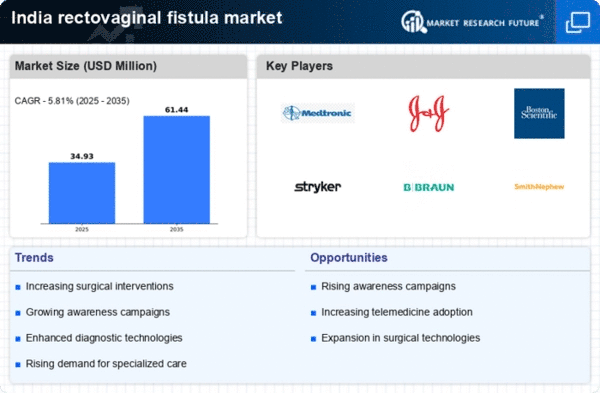
As per Market Research Future analysis, the India Rectovaginal Fistula Market size was estimated at 33.01 USD Million in 2024. The Rectovaginal Fistula market is projected to grow from 34.93 USD Million in 2025 to 61.44 USD Million by 2035, exhibiting a compound annual growth rate (CAGR) of 5.8% during the forecast period 2025 - 2035

Key Market Trends & Highlights

The India rectovaginal fistula market is experiencing notable growth driven by increased awareness and advancements in treatment.

  • Rising awareness and education regarding rectovaginal fistula are enhancing patient engagement and treatment outcomes.
  • Advancements in surgical techniques are improving the efficacy and safety of rectovaginal fistula repairs.
  • Multidisciplinary treatment approaches are becoming more prevalent, integrating various specialties for comprehensive care.
  • The increasing incidence of childbirth complications and government initiatives are key drivers propelling market growth.

Market Size & Forecast

2024 Market Size 33.01 (USD Million)
2035 Market Size 61.44 (USD Million)
CAGR (2025 - 2035) 5.81%

Major Players

Medtronic (US), Johnson & Johnson (US), Boston Scientific (US), Stryker (US), B. Braun Melsungen AG (DE), Smith & Nephew (GB), Coloplast (DK), Hollister Incorporated (US), ConvaTec Group (GB)

Our Impact
Enabled $4.3B Revenue Impact for Fortune 500 and Leading Multinationals
Partnering with 2000+ Global Organizations Each Year
30K+ Citations by Top-Tier Firms in the Industry

India Rectovaginal Fistula Market Trends

the India Rectovaginal Fistula Market is currently experiencing growth, driven by a combination of increasing awareness and advancements in surgical techniques. The condition, often resulting from childbirth complications, has historically been stigmatized, leading to underreporting and inadequate treatment options. However, recent initiatives by healthcare organizations and government bodies aim to enhance education and access to care. This shift appears to be fostering a more supportive environment for affected individuals, encouraging them to seek medical assistance. Furthermore, the integration of innovative technologies in surgical procedures is likely to improve patient outcomes, thereby increasing the demand for specialized services in this market. In addition, the rectovaginal fistula market is witnessing a growing emphasis on multidisciplinary approaches to treatment. Healthcare providers are increasingly collaborating across specialties to offer comprehensive care that addresses both the physical and psychological aspects of the condition. This trend suggests a movement towards holistic treatment models, which may enhance recovery rates and patient satisfaction. As awareness continues to rise, it is anticipated that the market will expand, driven by both the need for effective interventions and the commitment to improving the quality of life for those affected by rectovaginal fistulas.

Rising Awareness and Education

There is a noticeable increase in awareness regarding rectovaginal fistulas, largely due to educational campaigns led by healthcare organizations. These initiatives aim to inform the public about the condition, its causes, and available treatments, which may lead to more individuals seeking help.

Advancements in Surgical Techniques

Innovations in surgical methods are transforming the rectovaginal fistula market. Enhanced techniques and technologies are improving surgical outcomes, which could result in higher patient satisfaction and a greater willingness to undergo treatment.

Multidisciplinary Treatment Approaches

The trend towards multidisciplinary care is becoming more prominent. Healthcare professionals from various fields are collaborating to provide comprehensive treatment, addressing both the physical and emotional needs of patients, which may improve overall recovery.

India Rectovaginal Fistula Market Drivers

Rising Healthcare Expenditure

the rectovaginal fistula market is expected to grow as healthcare expenditure in India continues to rise. With an increase in disposable income and a growing middle class, more individuals are seeking medical care for conditions such as rectovaginal fistulas. According to the National Health Accounts, India's healthcare expenditure has reached approximately 4.2% of GDP, indicating a shift towards prioritizing health services. This trend suggests that patients are more likely to seek surgical interventions and follow-up care for rectovaginal fistulas, thereby expanding the market. Additionally, the increasing availability of private healthcare facilities is likely to enhance treatment options, further driving demand in the rectovaginal fistula market.

Government Initiatives and Funding

Government initiatives aimed at improving women's health are significantly impacting the rectovaginal fistula market. The Indian government has launched various programs to address maternal health, including the Pradhan Mantri Surakshit Matritva Abhiyan, which focuses on providing comprehensive care during pregnancy and childbirth. Such initiatives are likely to increase funding for hospitals and clinics specializing in the treatment of obstetric complications, including rectovaginal fistulas. With an estimated budget allocation of over $1 billion for maternal health in recent years, the rectovaginal fistula market stands to benefit from enhanced resources and infrastructure. This financial support may lead to improved surgical outcomes and increased patient access to treatment, thereby fostering growth in the market.

Growing Awareness of Women's Health Issues

The rectovaginal fistula market is benefiting from a growing awareness of women's health issues in India. Advocacy groups and non-governmental organizations are actively working to educate women about the risks associated with childbirth and the importance of seeking medical help for complications. Campaigns aimed at destigmatizing conditions like rectovaginal fistulas are encouraging women to come forward for treatment. This increased awareness is likely to lead to higher rates of diagnosis and treatment, thereby expanding the rectovaginal fistula market. Additionally, educational programs in rural areas are helping to bridge the knowledge gap, ensuring that more women understand their health rights and available treatment options.

Technological Advancements in Medical Devices

Technological advancements in medical devices are transforming the rectovaginal fistula market. Innovations in surgical instruments and techniques, such as minimally invasive procedures, are improving patient outcomes and recovery times. The introduction of advanced suturing devices and imaging technologies has made it easier for surgeons to perform complex repairs. As a result, hospitals and clinics are increasingly adopting these technologies, which could lead to a rise in the number of successful surgeries for rectovaginal fistulas. Furthermore, the Indian medical device market is projected to grow at a CAGR of 15% over the next few years, indicating a favorable environment for the rectovaginal fistula market to thrive as new technologies become available.

Increasing Incidence of Childbirth Complications

The rectovaginal fistula market is experiencing growth due to the rising incidence of childbirth complications in India. Obstetric fistulas, which often lead to rectovaginal fistulas, are prevalent in regions with inadequate maternal healthcare. According to the National Health Mission, approximately 1 in 1,000 women in India may develop obstetric fistulas during childbirth. This alarming statistic highlights the need for effective surgical interventions and rehabilitation services, thereby driving demand in the rectovaginal fistula market. Furthermore, the increasing focus on maternal health initiatives by the Indian government aims to reduce these complications, which could further stimulate market growth. As awareness of these issues rises, healthcare providers are likely to invest more in training and resources, enhancing the overall landscape of the rectovaginal fistula market.


Market Segment Insights

By Diagnosis: Physical Exam (Largest) vs. Contrast Tests (Fastest-Growing)

In the India rectovaginal fistula market, the Diagnosis segment reveals a diverse range of methods employed for accurate detection. The Physical Exam remains the largest segment, predominantly utilized due to its simplicity and effectiveness in initial assessments. In contrast, Contrast Tests are emerging rapidly, showcasing significant growth owing to advancements in technology and the increasing demand for precise diagnostic tools. The interplay between traditional and innovative methods shapes the competitive landscape of this market. Growth trends in the Diagnosis segment reflect a shift towards more technologically advanced procedures, driven primarily by the rising awareness of rectovaginal fistulas and the need for better patient outcomes. The adoption of Contrast Tests and imaging techniques like MRI and CT Scans is expected to accelerate, fueled by healthcare providers' dedication to fostering accurate diagnoses and enhancing treatment efficacy. Furthermore, the integration of innovative diagnostic tools is set to propel the segment toward a more effective and comprehensive approach in the management of rectovaginal fistulas.

Physical Exam (Dominant) vs. Contrast Tests (Emerging)

The Physical Exam has established itself as the dominant diagnostic method in the India rectovaginal fistula market, primarily due to its cost-effectiveness and accessibility. It allows healthcare providers to assess initial symptoms swiftly, facilitating immediate patient care decisions. Conversely, Contrast Tests signify an emerging trend toward more sophisticated diagnostics, leveraging advanced imaging technology to improve diagnostic accuracy. The growing preference for non-invasive and high-accuracy tests positions Contrast Tests as a vital player in enhancing the diagnostic process, illustrating the market's shift toward the adoption of advanced methodologies to combat rectovaginal fistulas effectively.

By Treatment: Surgery (Largest) vs. Antibiotics (Fastest-Growing)

In the India rectovaginal fistula market, the treatment segment is heavily influenced by surgical procedures, which currently dominate the overall market share. Surgery is the most common intervention, with the highest prevalence among treatment options, encompassing techniques such as sewing an anal fistula plug or patch, tissue grafts, and repairing anal sphincter muscles. Antibiotics, while traditionally viewed as supportive treatment, have gained traction as a rapidly growing option due to increased awareness and need for improved patient care solutions. The growth trends in the treatment segment indicate a significant shift towards surgical interventions that provide longer-term solutions for rectovaginal fistula repair. Factors such as advancements in surgical techniques, an increase in healthcare facilities, and a rise in awareness about surgical options among patients contribute to this trend. Additionally, the use of antibiotics continues to rise, especially in pre-operative scenarios, highlighting their emerging role as a fast-growing component in response to infection control and management throughout the healing process.

Surgery: Sew an Anal Fistula Plug (Dominant) vs. Antibiotics (Emerging)

Sewing an anal fistula plug or patch is a dominant treatment method that addresses rectovaginal fistula effectively, offering patients a minimally invasive option with promising results. This technique leverages biologic tissue to promote healing and closure of the fistula, making it a preferred choice among surgeons. On the other hand, antibiotics are emerging as critical in managing infections and facilitating pre-operative conditions, underscoring their vital role in the treatment strategy. The integration of antibiotics into patient care ensures that associated risks during the healing process are mitigated, making them a key focus area as doctors and patients prioritize comprehensive care solutions in the evolving landscape of the market.

By End User: Hospitals & Clinics (Largest) vs. Diagnostic Centers (Fastest-Growing)

In the India rectovaginal fistula market, Hospitals & Clinics hold the largest share, reflecting their critical role in patient care and treatment for this condition. They provide comprehensive services, including diagnosis, treatment, and follow-up care, making them essential in managing rectovaginal fistula cases. Diagnostic Centers follow closely, catering to the need for specialized testing and evaluations, which are increasingly demanded as awareness of the condition grows. The growth trends in this segment are driven by an increase in awareness and education around rectovaginal fistulas, leading to earlier diagnosis and intervention. The emphasis on surgical advancements and improved postoperative care in Hospitals & Clinics contributes significantly to their dominant position. Meanwhile, Diagnostic Centers are emerging rapidly, supported by technological advancements and the continuous expansion of healthcare facilities, attracting more patients seeking diagnostic services.

Hospitals & Clinics (Dominant) vs. Diagnostic Centers (Emerging)

Hospitals & Clinics serve as the dominant players in the India rectovaginal fistula market due to their extensive resources and capabilities in treating complex medical conditions. They offer an array of services, including surgical interventions, preoperative assessments, and postoperative care, ensuring comprehensive patient management. Their infrastructure enables them to handle high patient volumes effectively, leading to better patient outcomes. On the other hand, Diagnostic Centers represent the emerging segment, characterized by their increasing role in early detection and evaluation of rectovaginal fistulas. They utilize advanced diagnostic tools and technologies, providing timely and accurate assessments, thus supporting healthcare providers in formulating effective treatment plans. The expansion of these centers aligns with the growing demand for specialized diagnostic services.

Get more detailed insights about India Rectovaginal Fistula Market

Key Players and Competitive Insights

The rectovaginal fistula market in India is characterized by a competitive landscape that is increasingly shaped by innovation, strategic partnerships, and regional expansion. Key players such as Medtronic (US), Johnson & Johnson (US), and Boston Scientific (US) are at the forefront, leveraging their extensive portfolios and technological advancements to capture market share. Medtronic (US) focuses on enhancing its product offerings through continuous innovation, while Johnson & Johnson (US) emphasizes strategic acquisitions to bolster its capabilities in surgical solutions. Boston Scientific (US) appears to be concentrating on expanding its presence in emerging markets, which may enhance its competitive positioning in the region. Collectively, these strategies contribute to a dynamic environment where companies are not only competing on product efficacy but also on their ability to adapt to local market needs.In terms of business tactics, companies are increasingly localizing manufacturing to reduce costs and improve supply chain efficiency. This approach is particularly relevant in a moderately fragmented market where smaller players also vie for attention. The competitive structure is influenced by the presence of both multinational corporations and local manufacturers, creating a diverse landscape that fosters innovation and responsiveness to consumer demands. The collective influence of these key players is significant, as they set industry standards and drive advancements in treatment options for rectovaginal fistulas.

In October Medtronic (US) announced the launch of a new minimally invasive surgical device specifically designed for rectovaginal fistula repair. This strategic move is likely to enhance patient outcomes and reduce recovery times, positioning Medtronic as a leader in innovative surgical solutions. The introduction of this device may also reflect the company's commitment to addressing unmet medical needs in the region, potentially increasing its market share.

In September Johnson & Johnson (US) completed the acquisition of a local medical device company specializing in advanced surgical techniques for pelvic floor disorders. This acquisition is expected to strengthen Johnson & Johnson's portfolio and expand its reach within the Indian market. By integrating local expertise and technology, the company may enhance its competitive edge and better serve the needs of healthcare providers and patients alike.

In August Boston Scientific (US) entered into a strategic partnership with a prominent Indian healthcare provider to develop and distribute innovative treatment options for rectovaginal fistulas. This collaboration is indicative of a broader trend towards strategic alliances that leverage local knowledge and resources, potentially accelerating the development and adoption of new therapies. Such partnerships may also facilitate access to a wider patient base, enhancing Boston Scientific's market presence.

As of November current competitive trends in the rectovaginal fistula market are increasingly defined by digitalization, sustainability, and the integration of artificial intelligence (AI) in product development and patient care. Strategic alliances are playing a crucial role in shaping the landscape, as companies seek to combine resources and expertise to drive innovation. The shift from price-based competition to a focus on technological advancements and supply chain reliability is evident, suggesting that future differentiation will hinge on the ability to deliver superior products and services that meet evolving patient needs.

Key Companies in the India Rectovaginal Fistula Market include

Industry Developments

Recent developments in the India Rectovaginal Fistula Market indicate an increased focus on advanced surgical techniques and post-operative care, driven by healthcare providers such as Manipal Hospitals, Max Healthcare, and Apollo Hospitals. These institutions are enhancing their treatment protocols to improve patient outcomes, particularly after a significant rise in reported cases linked to childbirth complications.

In 2022, Tata Memorial Hospital launched a new awareness campaign focusing on early diagnosis and treatment of rectovaginal fistulas, reflecting a heightened awareness among medical professionals. Currently, the growth of Medanta The Medicity and Care Hospitals emphasizes the expanding capabilities in dealing with complex fistula cases.

Furthermore, a significant collaboration was noted in June 2023 between HCG Hospitals and Sun Pharma, aiming to integrate pharmaceutical advancements with surgical innovations to enhance recovery protocols. The recent financial reports reveal an upward valuation trend among these companies, with industry analysts projecting a strong growth rate for the market, influenced by improved service access and enhanced medical education focused on women's health.

The cumulative impact of these developments is contributing to a more sophisticated healthcare environment addressing rectovaginal fistulas in India.

Future Outlook

India Rectovaginal Fistula Market Future Outlook

The Rectovaginal Fistula Market in India is projected to grow at a 5.81% CAGR from 2025 to 2035, driven by increasing awareness and advancements in surgical techniques.

New opportunities lie in:

  • Development of specialized surgical kits for rectovaginal fistula repair
  • Expansion of telemedicine services for pre- and post-operative care
  • Investment in training programs for healthcare professionals on advanced surgical methods

By 2035, the rectovaginal fistula market is expected to achieve substantial growth and improved patient outcomes.

Market Segmentation

India Rectovaginal Fistula Market End User Outlook

  • Hospitals & Clinics
  • Diagnostic Centers
  • Academic Institutions and Research Organizations
  • Others

India Rectovaginal Fistula Market Diagnosis Outlook

  • Physical Exam
  • Contrast Tests
  • Blue Dye Test
  • Computerized Tomography (CT) Scan
  • Magnetic Resonance Imaging (MRI)
  • Anorectal Ultrasound
  • Anorectal Manometry
  • Others

India Rectovaginal Fistula Market Treatment Outlook

  • Medications
  • Antibiotics
  • Infliximab
  • Surgery
  • Sewing an Anal Fistula Plug or Patch of Biologic Tissue into the Fistula
  • Using a Tissue Graft
  • Repairing the Anal Sphincter Muscles
  • Performing a Colostomy before Repairing a Fistula in Complex or Recurrent Cases

Report Scope

MARKET SIZE 2024 33.01(USD Million)
MARKET SIZE 2025 34.93(USD Million)
MARKET SIZE 2035 61.44(USD Million)
COMPOUND ANNUAL GROWTH RATE (CAGR) 5.81% (2025 - 2035)
REPORT COVERAGE Revenue Forecast, Competitive Landscape, Growth Factors, and Trends
BASE YEAR 2024
Market Forecast Period 2025 - 2035
Historical Data 2019 - 2024
Market Forecast Units USD Million
Key Companies Profiled Medtronic (US), Johnson & Johnson (US), Boston Scientific (US), Stryker (US), B. Braun Melsungen AG (DE), Smith & Nephew (GB), Coloplast (DK), Hollister Incorporated (US), ConvaTec Group (GB)
Segments Covered Diagnosis, Treatment, End User
Key Market Opportunities Advancements in minimally invasive surgical techniques enhance treatment options in the rectovaginal fistula market.

Key Market Dynamics Rising awareness and treatment options for rectovaginal fistula drive market growth and innovation in India.
Countries Covered India
Leave a Comment

FAQs

What is the projected market size of the India Rectovaginal Fistula Market for 2024?

The projected market size for the India Rectovaginal Fistula Market in 2024 is valued at 45.0 USD Million.

What is the expected market size for the India Rectovaginal Fistula Market by 2035?

By 2035, the India Rectovaginal Fistula Market is expected to reach a value of 81.0 USD Million.

What is the compound annual growth rate (CAGR) for the India Rectovaginal Fistula Market from 2025 to 2035?

The compound annual growth rate for the India Rectovaginal Fistula Market from 2025 to 2035 is expected to be 5.489%.

Which segment is expected to have the largest market share in the India Rectovaginal Fistula Market diagnosis category in 2024?

The Physical Exam segment is expected to hold the largest market share within the diagnosis category in 2024, valued at 14.0 USD Million.

What are the major diagnostic methods for rectovaginal fistula and their market valuations in 2024?

The major diagnostic methods and their valuations in 2024 include Physical Exam at 14.0 USD Million, Contrast Tests at 10.0 USD Million, Blue Dye Test at 8.0 USD Million, and CT Scan at 13.0 USD Million.

Who are the key players operating in the India Rectovaginal Fistula Market?

Key players in the India Rectovaginal Fistula Market include Manipal Hospitals, Max Healthcare, Aster DM Healthcare, KIMS Hospitals, and Apollo Hospitals, among others.

What is the valuation of the Contrast Tests segment in the India Rectovaginal Fistula Market for 2035?

The Contrast Tests segment is projected to be valued at 18.0 USD Million in the India Rectovaginal Fistula Market by 2035.

How much is the Blue Dye Test segment expected to be valued by 2035?

The Blue Dye Test segment is expected to reach a valuation of 14.0 USD Million by 2035 in the India Rectovaginal Fistula Market.

What factors are driving the growth of the India Rectovaginal Fistula Market?

The growth of the India Rectovaginal Fistula Market is driven by increased awareness, advances in diagnostic procedures, and improvements in healthcare infrastructure.

What is the expected market size for the Computerized Tomography (CT) Scan segment by 2035?

The Computerized Tomography (CT) Scan segment is expected to be valued at 24.0 USD Million in the India Rectovaginal Fistula Market by 2035.

Download Free Sample

Kindly complete the form below to receive a free sample of this Report

Compare Licence

×
Features License Type
Single User Multiuser License Enterprise User
Price $4,950 $5,950 $7,250
Maximum User Access Limit 1 User Upto 10 Users Unrestricted Access Throughout the Organization
Free Customization
Direct Access to Analyst
Deliverable Format
Platform Access
Discount on Next Purchase 10% 15% 15%
Printable Versions