
×
Request Free Sample ×

Kindly complete the form below to receive a free sample of this Report

* Please use a valid business email

Leading companies partner with us for data-driven Insights

clients tt-cursor
Hero Background

India Recovered Carbon Black Market

ID: MRFR/CnM/47542-CR
200 Pages
Chitranshi Jaiswal
February 2026

India Recovered Carbon Black Market Research Report Information by Application (Tires, Non-Tire Rubber Products, Plastics, Dyes & Pigments, Inks & Coatings and Others), By End-Use Industry (Automotive, Industrial Manufacturing, Building & Construction, Electric & Electronics and Others) and By Region - Forecast to 2035

Share:
Download PDF ×

We do not share your information with anyone. However, we may send you emails based on your report interest from time to time. You may contact us at any time to opt-out.

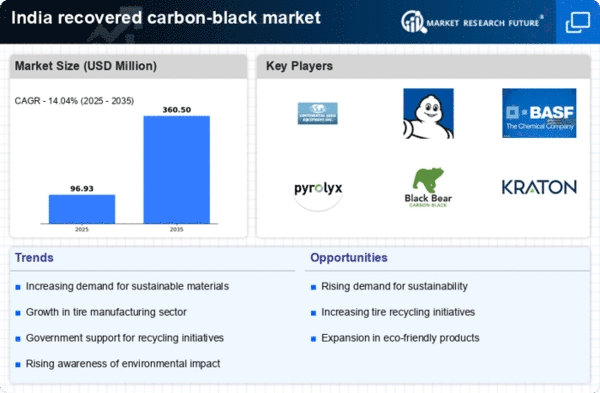
India Recovered Carbon Black Market Infographic
Purchase Options

India Recovered Carbon Black Market Summary

As per Market Research Future analysis, the India Recovered Carbon Black Market Size was estimated at USD 16,699 Million in 2024. The India Recovered Carbon Black Market industry is projected to grow from USD 18,989 Million in 2025 to 72,561 USD Million by 2035, exhibiting a compound annual growth rate (CAGR) of 11.8% during the forecast period 2025 - 2035.

Key Market Trends & Highlights

India Recovered Carbon Black Market is continues to evolve rapidly, building on prior trends like regulatory pushes and tech upgrades.

  • Budget 2026 proposed 50% subsidy on pyrolysis tech imports. EPR phased to 30% recycled content in tires by FY28. Biochar co-product incentives spurred dual-output plants.
  • Exports doubled to Southeast Asia and Europe, fueled by REACH compliance. India's virgin carbon black capacity rise by FY27 indirectly supported rCB via integrated recycling.
  • Clusters in Mundra and Dahej hosted R&D, yielding high-surface-area rCB variants. Collaborations with IITs advanced nano-enhanced grades for EVs.
  • B2B demand prioritized ISCC-certified rCB, with 80% buyers mandating it by 2026. Branding as "green black" gained traction in tire marketing.
  • Oil price fluctuations posed virgin substitution threats; hedging via futures stabilized supplies. R&D investments of USD 50 million countered quality gaps.

Market Size & Forecast

2024 Market Size 18,989 (USD Million)
2035 Market Size 72,561 (USD Million)
CAGR (2025 - 2035) 11.8%

Major Players

Hi-Green Carbon Ltd, Finster Carbon, Capital Carbon, Epsilon Carbon Private Limited, RichTech Green Energy, Jisha Export, Absolute Green Polymers Private Limited, GoGreen Enterprises.
Our Impact
Enabled $4.3B Revenue Impact for Fortune 500 and Leading Multinationals
Partnering with 2000+ Global Organizations Each Year
30K+ Citations by Top-Tier Firms in the Industry

India Recovered Carbon Black Market Trends

The India Recovered Carbon Black (rCB) Market is experiencing remarkable growth driven by increasing environmental consciousness, stringent waste management regulations, and rising demand for sustainable alternatives across various industries including tire manufacturing, plastics, inks and coatings, and rubber goods. Recovered carbon black, derived primarily from end-of-life tire pyrolysis processes, offers comparable performance characteristics to virgin carbon black while providing significant environmental and cost benefits, making it integral to applications such as tire production, rubber reinforcement, plastic masterbatch, color formulations, and industrial coatings. As industries seek more sustainable and cost-effective raw materials, the market is witnessing a paradigm shift toward circular economy principles in response to growing environmental regulations and corporate sustainability commitments.

The surge in tire waste generation from India's rapidly expanding automotive sector, coupled with the government's push for waste-to-wealth initiatives and the Make in India program, has further accelerated the adoption of recovered carbon black, particularly in tire manufacturing and rubber processing industries. As demand for eco-friendly, cost-efficient, and high-performance carbon black alternatives continues to rise, the India recovered carbon black market is expected to expand significantly, with substantial potential driven by the country's massive tire waste generation, growing automotive industry, and supportive government policies promoting waste recycling and circular economy practices.

India Recovered Carbon Black Market Drivers

Government Push for Circular Economy

The Government initiatives such as India’s draft Resource Efficiency Policy (2020) and the National Action Plan for Climate Change (NAPCC) are closely aligned with promoting recycling and the use of secondary raw materials. Though still in various stages of implementation, these policy frameworks offer strategic support for industrial ecosystems engaged in recovered carbon black (rCB) production. India’s commitment to reducing carbon intensity by 45% by 2030, under its nationally determined contributions (NDCs), has further accelerated the development and adoption of low-carbon solutions. Producing rCB emits up to 80% less carbon compared to virgin carbon black, positioning it as a crucial contributor to achieving the country’s climate targets. The International Carbon Black Association highlighted that substituting one tonne of virgin carbon black with rCB can prevent up to 2.4 tonnes of CO₂-equivalent emissions. This significant environmental benefit is motivating industrial users to reconsider their material sourcing strategies. With over 700 small and medium-sized rubber processing units in India, the market potential for rCB is substantial—provided that consistent product quality and a reliable supply chain can be ensured. Within the broader circular economy framework, rCB is emerging not just as a waste by-product but as a strategically valuable green input.

Rising End-of-Life Tire (ELT) Generation

India's tire manufacturing sector ranks among the largest and most dynamic globally, driven by strong domestic demand, rising exports, and a rapidly expanding aftermarket. Tire production spans across various vehicle categories, including 2/3-wheelers, passenger cars, commercial vehicles (CVs), tractors, and specialty segments, each contributing to India’s growing End-of-Life Tire (ELT) pool. The 2/3-wheeler segment dominates in volume, with over 1,146.28 lakh units produced in 2022–23, reflecting the country’s two-wheeler-centric mobility landscape, especially in Tier 2 and Tier 3 cities. Passenger car tires followed with 582.4 lakh units, while CV tires—including truck and light commercial vehicle categories—accounted for 314.07 lakh units. Tractor and agricultural tires added another 103.81 lakh units, showcasing the diversity of India's tire output. India’s tire production has demonstrated notable resilience. For instance, passenger car tire production surged by 40% year-on-year in 2021–22, bouncing back from pandemic-related slowdowns. Tire lifespans in India typically range from 3 to 5 years depending on usage and vehicle type, meaning the production batch from 2018–2023 is now reaching end-of-life status—translating into millions of tons of potential feedstock for recovered carbon black (rCB) manufacturing.

Market Segment Insights

By End-Use Industry: Automotive (Largest) vs. Industrial Manufacturing (Fastest-Growing)

On the basis of End-Use Industry, recovered carbon black (rCB) is finding broad-based adoption across various end-use sectors in India, driven by its affordability, functional performance, and alignment with sustainability goals. In the automotive sector, rCB is extensively used in tires and non-critical rubber components like hoses, belts, seals, and dampers—especially in two-wheelers, three-wheelers, and budget vehicles. It is also gaining traction among aftermarket and EV manufacturers for parts such as mats and grommets. The industrial manufacturing sector is increasingly incorporating rCB in products like conveyor belts, rubber rollers, molded components, and machine parts, particularly in cost-sensitive industries like steel, mining, agriculture, and textiles. SMEs in industrial hubs such as Pune and Ludhiana are leading adoption due to local availability and supply chain advantages. In building and construction, rCB is used in waterproof membranes, roofing sheets, sealants, expansion joints, and drainage gaskets, where its UV resistance, electrical insulation, and low cost are ideal for large-scale infrastructure projects and rural housing under schemes like PMAY and Smart Cities Mission.

By Application: Tire (Largest) vs. Plastics (Fastest-Growing)

Based on Application, recovered carbon black (rCB) is gaining widespread traction across multiple industries in India, driven by its cost-effectiveness, sustainability credentials, and alignment with circular economy goals. The tire sector remains the largest consumer, with rCB increasingly used in non-critical components such as inner liners, sidewalls, and tread bases—especially by retreaders and low-tier manufacturers seeking to reduce reliance on virgin carbon black (vCB). Beyond tires, rCB is making significant inroads into the non-tire rubber segment, including hoses, belts, gaskets, seals, and a variety of molded rubber products. In hoses and belts, rCB offers a balance between reinforcement and affordability for low- to medium-performance applications, particularly in irrigation, small-scale industrial systems, and general automotive use. Other rubber items such as footwear soles, mats, weather strips, and anti-vibration components are also embracing rCB due to relaxed performance requirements and the material's affordability. The large enterprise in the bare metal cloud space, accounts for a huge share owing to the sophisticated infrastructure requirements, high compliance requirements, and performance-driven workloads of large-scale businesses. Applications like ERP, AI/ML modeling, high-frequency trading, and large database operations.

Get more detailed insights about India Recovered Carbon Black Market

Key Players and Competitive Insights

Many global, regional, and local vendors characterize the India Recovered Carbon Black (rCB) Market. The market is highly competitive, with all the players competing to gain market share. Intense competition, rapid advances in technology, frequent changes in government policies, and environmental regulations are key factors that confront market growth. The vendors compete based on cost, product quality, reliability, and government regulations. Vendors must provide cost-efficient, high-quality products to survive and succeed in an intensely competitive market. Hi-Green Carbon Ltd, Finster Carbon, Capital Carbon, Epsilon Carbon Private Limited, RichTech Green Energy, Jisha Export, Absolute Green Polymers Private Limited, GoGreen Enterprises.
Key Companies in the India Recovered Carbon Black Market include

Industry Developments

In 2025, GoGreen Enterprises has Operates India's largest pyrolysis plant, pioneering the world's first pelletized rCB for uniform dispersion in tires and rubber.

Future Outlook

India Recovered Carbon Black Market Future Outlook

The India Recovered Carbon Black (rCB) Market is projected to grow at a 11.8%% CAGR from 2025 to 2035, driven by growing geriatric population and technological advancements.

New opportunities lie in:

  • Collaborations With Oems and Tire Majors.

By 2035, the market is expected to achieve substantial growth and increased sustainability.

Market Segmentation

India Recovered Carbon Black Application Outlook

  • Tires
  • Non-Tire Rubber Products
  • Plastics
  • Dyes & Pigments
  • Inks & Coatings and Others

India Recovered Carbon Black End-Use Industry Outlook

  • Automotive
  • Industrial Manufacturing
  • Building & Construction
  • Electric & Electronics and Others

Report Scope

Market Size 2024

16,699 (USD Million)

Market Size 2025

18,989 (USD Million)

Market Size 2035

72,561 (USD Million)

Compound Annual Growth Rate (CAGR)

11.8%% (2025 - 2035

Report Coverage

Revenue Forecast, Competitive Landscape, Growth Factors, and Trends

Base Year

2024

Market Forecast Period

2025 - 2035

Historical Data

2019 - 2023

Market Forecast Units

USD Million

Key Companies Profiled

Hi-Green Carbon Ltd, Finster Carbon, Capital Carbon, Epsilon Carbon Private Limited, RichTech Green Energy, Jisha Export, Absolute Green Polymers Private Limited, GoGreen Enterprises.

Segments Covered

By Application, By End-Use Industry

Key Market Opportunities

  • Collaborations With Oems and Tire Majors.

Key Market Dynamics

·         Rising End-Of-Life Tire (ELT) Generation

·         Government Push for Circular Economy

Countries Covered

India.

Leave a Comment

FAQs

How much is the India Recovered Carbon Black Market?

The India Recovered Carbon Black Market size is expected to be valued at USD 18,989 Million in 2025.

What is the growth rate of the India Recovered Carbon Black Market?

The global market is projected to grow at a CAGR of 11.8% during the forecast period, 2025-2035.

Who are the key players in the India Recovered Carbon Black Market?

The key players in the market are Hi-Green Carbon Ltd, Finster Carbon, Capital Carbon, Epsilon Carbon Private Limited, Rich Tech Green Energy, Jisha Export, Absolute Green Polymers Private Limited, GoGreen Enterprises.

Which application segment led the India Recovered Carbon Black Market?

The Plastics dominated the market in 2025

Download Free Sample

Kindly complete the form below to receive a free sample of this Report

Compare Licence

×
Features License Type
Single User Multiuser License Enterprise User
Price $4,950 $5,950 $7,250
Maximum User Access Limit 1 User Upto 10 Users Unrestricted Access Throughout the Organization
Free Customization
Direct Access to Analyst
Deliverable Format
Platform Access
Discount on Next Purchase 10% 15% 15%
Printable Versions