×
Request Free Sample ×

Kindly complete the form below to receive a free sample of this Report

* Please use a valid business email

Leading companies partner with us for data-driven Insights

clients tt-cursor
Hero Background

India Mobile Radiography Systems Market

ID: MRFR/HC/49037-HCR
200 Pages
Rahul Gotadki
February 2026

India Mobile Radiography Systems Market Research Report By Product Type (General radiography system, Computed radiography (CT) system, Fluoroscopy system, The magnetic resonance imaging system, Others), By Power Source (In-line mobile radiography systems, Battery-powered mobile radiography systems), By Imaging Type (Film, Digital), By Application (Imaging, Orthopedic imaging, Chest imaging, Dental imaging, Others, Image-guided procedures & biopsies) and By End User (Hospitals & Clinics, Academic & Medical Research Institutes, Diagnostic Centers, Intended Audience, Medical imaging companies, Government and private laboratories, Research and development (R&D) companies, Medical research laboratories, Market research, and consulting service providers) -Forecast to 2035

Share:
Download PDF ×

We do not share your information with anyone. However, we may send you emails based on your report interest from time to time. You may contact us at any time to opt-out.

India Mobile Radiography Systems Market Infographic
Purchase Options

India Mobile Radiography Systems Market Summary

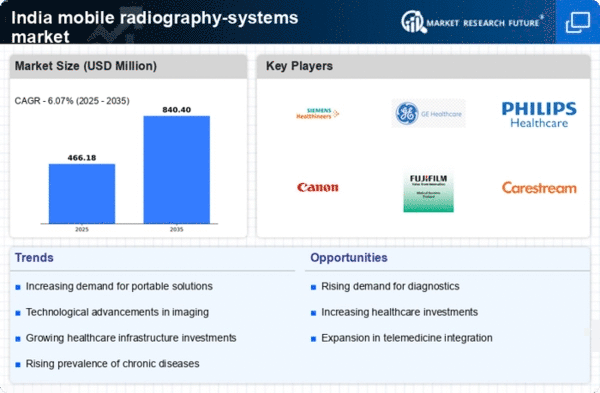
As per Market Research Future analysis, the India Mobile Radiography Systems Market size was estimated at 439.5 USD Million in 2024. The Mobile Radiography-systems market is projected to grow from 466.18 USD Million in 2025 to 840.4 USD Million by 2035, exhibiting a compound annual growth rate (CAGR) of 6.0% during the forecast period 2025 - 2035

Key Market Trends & Highlights

The India mobile radiography-systems market is poised for substantial growth driven by technological advancements and increasing demand for portable solutions.

  • Technological advancements are enhancing the capabilities of mobile radiography systems, making them more efficient and user-friendly.
  • The largest segment in the market is the portable radiography systems, which are increasingly favored for their convenience and flexibility.
  • The fastest-growing segment is the digital radiography systems, reflecting a shift towards advanced imaging technologies.
  • Rising healthcare expenditure and a growing geriatric population are key drivers propelling the market forward.

Market Size & Forecast

2024 Market Size 439.5 (USD Million)
2035 Market Size 840.4 (USD Million)
CAGR (2025 - 2035) 6.07%

Major Players

Siemens Healthineers (DE), GE Healthcare (US), Philips Healthcare (NL), Canon Medical Systems (JP), Fujifilm Medical Systems (JP), Carestream Health (US), Agfa HealthCare (BE), Hitachi Medical Systems (JP), Konica Minolta Healthcare (JP)

Our Impact
Enabled $4.3B Revenue Impact for Fortune 500 and Leading Multinationals
Partnering with 2000+ Global Organizations Each Year
30K+ Citations by Top-Tier Firms in the Industry

India Mobile Radiography Systems Market Trends

The India Mobile Radiography Systems Market is currently experiencing notable growth, driven by advancements in technology and increasing demand for portable imaging solutions. The integration of digital radiography with mobile systems enhances diagnostic capabilities, allowing healthcare providers to deliver timely and accurate results. This trend is particularly relevant in rural and underserved areas, where access to traditional imaging facilities may be limited. Furthermore, the emphasis on patient-centered care is prompting healthcare institutions to adopt mobile solutions that facilitate bedside imaging, thereby improving patient comfort and reducing the need for transportation. In addition, the mobile radiography-systems market is influenced by the rising prevalence of chronic diseases and the need for efficient diagnostic tools. As healthcare systems evolve, there is a growing recognition of the importance of mobility in medical imaging. This shift is likely to encourage investments in innovative technologies that enhance the functionality and efficiency of mobile radiography systems. The ongoing development of lightweight, battery-operated devices is expected to further propel market growth, as these features align with the increasing demand for flexibility and convenience in healthcare delivery.

Technological Advancements

Recent innovations in imaging technology are transforming the mobile radiography-systems market. Enhanced digital imaging capabilities, such as improved image quality and faster processing times, are becoming standard features. These advancements not only facilitate better diagnostics but also streamline workflows in healthcare settings.

Increased Demand for Portable Solutions

The need for portable imaging solutions is rising, particularly in emergency and rural healthcare settings. Mobile radiography systems offer flexibility and accessibility, allowing healthcare providers to perform imaging procedures at the point of care, which is crucial for timely diagnosis and treatment.

Focus on Patient-Centric Care

There is a growing emphasis on patient-centric care within the healthcare sector. Mobile radiography systems contribute to this trend by enabling bedside imaging, which enhances patient comfort and reduces the need for transportation, thereby improving overall patient experience.

India Mobile Radiography Systems Market Drivers

Growing Geriatric Population

India's demographic shift towards an aging population is significantly impacting the mobile radiography-systems market. By 2025, it is estimated that the geriatric population will constitute about 10% of the total population, leading to a higher prevalence of chronic diseases that require regular imaging. Mobile radiography systems offer a convenient solution for elderly patients who may have mobility issues, allowing for timely diagnosis and treatment. The demand for these systems is likely to increase as healthcare providers seek to cater to the needs of this demographic. Additionally, the integration of mobile radiography systems in home healthcare services is expected to gain traction, further driving market growth. This trend indicates a shift towards more accessible healthcare solutions, aligning with the needs of an aging population.

Rising Healthcare Expenditure

The mobile radiography-systems market in India is experiencing growth due to the increasing healthcare expenditure by both the government and private sectors. As the Indian government allocates more funds to healthcare, the demand for advanced medical technologies, including mobile radiography systems, is likely to rise. In 2025, healthcare spending in India is projected to reach approximately $370 billion, reflecting a growth rate of around 12% annually. This increase in investment is expected to enhance the availability of mobile radiography systems in hospitals and clinics, thereby improving diagnostic capabilities and patient outcomes. Furthermore, the expansion of private healthcare facilities is anticipated to contribute to the market's growth, as these institutions often seek to adopt the latest technologies to attract patients and provide high-quality care.

Technological Innovations in Imaging

The mobile radiography-systems market is being propelled by continuous technological innovations in imaging techniques. Advancements such as digital radiography and wireless technology are enhancing the efficiency and accuracy of mobile imaging systems. In 2025, the market for digital radiography in India is projected to grow at a CAGR of approximately 15%, indicating a strong shift towards digital solutions. These innovations not only improve image quality but also reduce radiation exposure for patients, making mobile radiography systems more appealing to healthcare providers. As hospitals and clinics increasingly adopt these advanced technologies, the demand for mobile radiography systems is expected to rise, reflecting a broader trend towards modernization in the healthcare sector.

Increased Focus on Emergency Services

The mobile radiography-systems market is benefiting from an increased focus on emergency medical services in India. With the growing incidence of accidents and health emergencies, there is a pressing need for rapid diagnostic solutions that can be deployed in various settings, including ambulances and disaster response units. Mobile radiography systems provide immediate imaging capabilities, which are crucial for timely diagnosis and treatment in emergency situations. As the Indian government and private sector invest in enhancing emergency medical services, the demand for mobile radiography systems is likely to surge. This trend underscores the importance of having portable imaging solutions readily available in critical care scenarios, thereby improving patient outcomes and operational efficiency.

Expansion of Diagnostic Imaging Facilities

The mobile radiography-systems market is poised for growth due to the expansion of diagnostic imaging facilities across India. As healthcare infrastructure improves, more hospitals and clinics are incorporating advanced imaging technologies to meet the rising demand for diagnostic services. The establishment of new healthcare facilities, particularly in rural and semi-urban areas, is expected to drive the adoption of mobile radiography systems. By 2025, the number of diagnostic imaging centers in India is projected to increase by approximately 20%, creating a larger market for mobile solutions. This expansion not only enhances access to healthcare services but also encourages the integration of mobile radiography systems into routine diagnostic practices, thereby fostering market growth.


Market Segment Insights

By System: General radiography system (Largest) vs. Computed radiography (CT) system (Fastest-Growing)

In the India mobile radiography-systems market, the General radiography system holds the largest share, reflecting its widespread adoption in clinical settings due to its versatility and effectiveness. The significant market presence of General radiography systems is bolstered by the increasing demand for diagnostic imaging across hospitals and diagnostic centers. Conversely, the Computed radiography (CT) system is emerging rapidly, capturing a growing segment of the market as advancements in technology enhance its capabilities and accessibility. Growth in this segment is driven by an increasing focus on diagnostic imaging accuracy and efficiency. The demand for mobile solutions is on the rise, especially in rural and underserved areas, leading to innovations in the Computed radiography (CT) systems. Additionally, the aging population and an increase in chronic diseases are propelling the need for enhanced imaging technologies to support timely diagnoses and patient care initiatives.

General radiography system (Dominant) vs. Computed radiography (CT) system (Emerging)

The General radiography system is the dominant force in the market, characterized by its robust technology and essential role in primary diagnostics. It is trusted for a variety of imaging needs, thus becoming the backbone of many healthcare facilities. On the other hand, the Computed radiography (CT) system represents an emerging segment that is rapidly gaining traction due to its advanced capabilities, including faster imaging and better image quality. This system is particularly appealing in emergency and trauma care situations, as it enables quick assessments. Both systems cater to varying operational needs in healthcare, with the General radiography system firmly established while the Computed radiography (CT) system positions itself as a crucial tool for modern medical diagnostics.

By Power Source: In-line mobile radiography systems (Largest) vs. Battery-powered mobile radiography systems (Fastest-Growing)

In the India mobile radiography-systems market, in-line mobile radiography systems hold the largest share, driven by their robust performance and reliability in clinical settings. Battery-powered mobile radiography systems, while currently smaller in market share, are rapidly gaining traction due to their flexibility and ease of use in diverse environments. Growth trends indicate a significant shift towards battery-powered systems as healthcare facilities seek more portable and versatile imaging solutions. Factors contributing to this trend include technological advancements, increased demand for on-the-go medical imaging, and a growing need for systems that can operate without dependency on fixed power sources. The pace of innovation in battery technology also suggests a promising future for battery-powered mobile alternatives.

Power Source: In-line (Dominant) vs. Battery-powered (Emerging)

In-line mobile radiography systems are characterized by their integration into existing radiographic frameworks, offering high reliability and consistent imaging quality in a wide range of medical applications. Their dominant market position is attributed to their established presence in hospitals, where they are essential for immediate imaging needs. Conversely, battery-powered mobile radiography systems represent the emerging trend, providing the capability for imaging in remote and challenging locations. These systems embody flexibility and portability, appealing to facilities looking to enhance patient care by eliminating constraints associated with conventional power connections.

By Imaging Type: Digital (Largest) vs. Film (Fastest-Growing)

In the India mobile radiography-systems market, digital imaging types hold the largest share, significantly outpacing film-based systems. The rapid adoption of digital technologies in medical imaging has led to increased market penetration, dominating the preferences of healthcare providers looking for efficiency and precision in diagnostics. This shift can be attributed to higher accuracy, faster processing times, and the ability to store and share images seamlessly. Conversely, film-based systems are witnessing growth as they cater to specific niches where traditional imaging remains valued. The resurgence of film is driven by cost-conscious facilities and regions with limited access to advanced technologies. Innovations in film quality and processing speeds are also contributing to its growth, making it an emerging contender in a predominantly digital landscape.

Imaging Technology: Digital (Dominant) vs. Film (Emerging)

Digital imaging technology in the India mobile radiography-systems market is characterized by its high accuracy, efficiency, and advanced capabilities, making it the dominant choice among modern healthcare facilities. Its ability to rapidly process and transmit images enhances diagnostics and patient care significantly. Furthermore, digital systems require less physical storage space and possess integrated software solutions for easy image management and retrieval. In contrast, film imaging remains an emerging option, appealing primarily to specific demographics and facilities that prioritize affordability and simplicity. While film may not compete with digital in speed or storage, it retains a loyal user base that appreciates its tangible nature and familiarity, allowing it to grow steadily in a predominantly digital environment.

By Application: Imaging (Largest) vs. Image-guided procedures & biopsies (Fastest-Growing)

In the India mobile radiography-systems market, the application segment is primarily dominated by Imaging, which holds the largest market share. Other significant contributors include Image-guided procedures & biopsies, Orthopedic imaging, and Chest imaging. While Imaging boasts the highest share, both Dental imaging and Others occupy a smaller portion, reflecting diverse needs across the healthcare landscape. The market dynamics reveal an increasing shift towards specialized areas such as Image-guided procedures, which reflect the evolving requirements of patient care and technological integration. The growth of the Application segment is influenced by several factors, including advancements in mobile radiography technology, increased healthcare awareness, and the rising demand for precise diagnostics in various medical fields. Innovations in imaging technologies are driving the adoption of Image-guided procedures, presenting them as the fastest-growing segment. Furthermore, the focus on minimally invasive techniques and improved patient outcomes continue to shape the growth patterns in this field, presenting opportunities for future development.

Imaging (Dominant) vs. Image-guided procedures & biopsies (Emerging)

The Imaging segment stands as the dominant force in the India mobile radiography-systems market, characterized by its widespread application across diagnostics and patient care. This segment benefits from established technologies and significant investments in infrastructure, making it crucial for hospitals and diagnostic centers. Conversely, Image-guided procedures & biopsies represent an emerging segment that is rapidly gaining traction due to increasing demand for less invasive procedures and higher diagnostic accuracy. This dynamic is fueled by advancements in imaging modalities and a growing emphasis on procedural efficiency, reflecting a transformative trend in medical imaging that enhances clinical decision-making and patient satisfaction.

By End User: Hospitals & Clinics (Largest) vs. Diagnostic Centers (Fastest-Growing)

The market share of the segments within the India mobile radiography-systems market reveals that hospitals and clinics dominate significantly, accounting for the majority of the market due to the high demand for advanced diagnostic imaging. Academic and medical research institutes also hold a considerable share, but their growth is comparatively slower as they focus primarily on research and education rather than commercial applications. Diagnostic centers, however, are emerging strongly in the market due to their increasing role in the healthcare system and efficient patient service offerings. Growth trends within this segment indicate a robust expansion in diagnostic centers, driven by a rising demand for early disease detection and increasing healthcare awareness among the population. The integration of innovative technologies in radiography systems is also propelling growth, enabling more accurate diagnostics. Hospitals and clinics continue to invest in advanced systems to enhance service delivery, further solidifying their dominant position while supporting the expansion of diagnostic centers as they adapt to market needs.

Hospitals & Clinics (Dominant) vs. Diagnostic Centers (Emerging)

Hospitals and clinics are considered the dominant end-user segment in the India mobile radiography-systems market, leveraging substantial investments in advanced imaging technology to enhance their diagnostic capabilities. They cater to a wide patient base, particularly in urban regions, ensuring high utilization rates of mobile radiography systems. On the other hand, diagnostic centers are emerging as significant players, characterized by their specialized services and ability to provide quick, targeted imaging solutions. Their growth is fueled by the increasing trend of health check-ups, convenience, and accessibility, which positions them well against traditional settings. Both segments play crucial roles, with hospitals focusing on comprehensive care while diagnostic centers emphasize efficiency and niche market needs.

Get more detailed insights about India Mobile Radiography Systems Market

Key Players and Competitive Insights

The mobile radiography-systems market in India is characterized by a dynamic competitive landscape, driven by technological advancements and increasing healthcare demands. Major players such as Siemens Healthineers (Germany), GE Healthcare (US), and Philips Healthcare (Netherlands) are at the forefront, focusing on innovation and strategic partnerships to enhance their market presence. Siemens Healthineers (Germany) emphasizes digital transformation and AI integration, while GE Healthcare (US) is known for its robust supply chain optimization and localized manufacturing strategies. Philips Healthcare (Netherlands) is actively pursuing regional expansion, particularly in underserved areas, thereby shaping a competitive environment that is increasingly focused on technological differentiation and customer-centric solutions.The market structure appears moderately fragmented, with several key players vying for market share. Localizing manufacturing has emerged as a critical tactic, allowing companies to reduce costs and improve supply chain efficiency. This strategy not only enhances responsiveness to local market needs but also mitigates risks associated with global supply chain disruptions. The collective influence of these major players fosters a competitive atmosphere where innovation and operational efficiency are paramount.

In October Siemens Healthineers (Germany) announced the launch of a new mobile radiography system that integrates advanced AI capabilities for image analysis. This strategic move is likely to enhance diagnostic accuracy and streamline workflows in clinical settings, positioning Siemens as a leader in technological innovation within the market. The introduction of AI-driven solutions may also attract healthcare providers seeking to improve patient outcomes and operational efficiency.

In September GE Healthcare (US) expanded its manufacturing capabilities in India, focusing on producing mobile radiography systems tailored to local healthcare needs. This expansion is significant as it not only strengthens GE's supply chain but also demonstrates a commitment to meeting the growing demand for accessible healthcare solutions in the region. By localizing production, GE Healthcare can potentially reduce costs and improve delivery times, thereby enhancing its competitive edge.

In August Philips Healthcare (Netherlands) entered into a strategic partnership with a leading Indian healthcare provider to co-develop mobile radiography solutions. This collaboration is indicative of a broader trend towards strategic alliances aimed at leveraging local expertise and resources. Such partnerships may facilitate the development of customized solutions that address specific market challenges, thereby enhancing Philips' market positioning and fostering innovation.

As of November the competitive trends in the mobile radiography-systems market are increasingly defined by digitalization, sustainability, and the integration of AI technologies. Strategic alliances are playing a crucial role in shaping the landscape, enabling companies to pool resources and expertise. Looking ahead, competitive differentiation is likely to evolve from traditional price-based competition to a focus on innovation, technological advancements, and supply chain reliability. This shift underscores the importance of adaptability and forward-thinking strategies in navigating the complexities of the market.

Key Companies in the India Mobile Radiography Systems Market include

Industry Developments

Recent developments in the India Mobile Radiography Systems Market indicate a significant push towards modernization and technological integration in healthcare. Companies such as Hitachi, Siemens Healthineers, and GE Healthcare are enhancing their mobile radiography systems to provide improved diagnostic capabilities. The market is witnessing an increase in demand for portable and efficient radiography solutions, particularly due to the recent focus on providing healthcare in remote areas, spurred by the ongoing challenges of the COVID-19 pandemic. Notably, the acquisition of Zonal Medical Systems by Siemens Healthineers in June 2023 indicates strategic consolidation aimed at increasing market presence.

Furthermore, Mindray launched new advanced mobile systems in July 2023, targeting hospitals looking for flexible imaging solutions. In terms of market valuation, the Indian Mobile Radiography Systems Market is projected to grow substantially, driven by increasing investments from both public and private sectors in healthcare infrastructure. This growth reflects the Indian government's emphasis on strengthening healthcare facilities across tier-2 and tier-3 cities. Market players are also focusing on enhancing user experience and efficiency through software integration and AI technologies, aligning with global trends while catering to local needs.


Future Outlook

India Mobile Radiography Systems Market Future Outlook

The Mobile Radiography Systems Market in India is projected to grow at a 6.07% CAGR from 2025 to 2035, driven by technological advancements and increasing healthcare demands.

New opportunities lie in:

  • Development of portable imaging solutions for remote diagnostics.
  • Integration of AI for enhanced image analysis and workflow efficiency.
  • Expansion of service contracts for maintenance and upgrades of existing systems.

By 2035, the market is expected to achieve substantial growth, reflecting evolving healthcare needs.

Market Segmentation

India Mobile Radiography Systems Market System Outlook

  • General radiography system
  • Computed radiography (CT) system
  • Fluoroscopy system
  • Magnetic resonance imaging system
  • Others

India Mobile Radiography Systems Market End User Outlook

  • Hospitals & Clinics
  • Academic & Medical Research Institutes
  • Diagnostic Centers

India Mobile Radiography Systems Market Application Outlook

  • Imaging
  • Image-guided procedures & biopsies
  • Orthopedic imaging
  • Chest imaging
  • Dental imaging
  • Others

India Mobile Radiography Systems Market Imaging Type Outlook

  • Film
  • Digital

India Mobile Radiography Systems Market Power Source Outlook

  • In-line mobile radiography systems
  • Battery-powered mobile radiography systems

Report Scope

MARKET SIZE 2024 439.5(USD Million)
MARKET SIZE 2025 466.18(USD Million)
MARKET SIZE 2035 840.4(USD Million)
COMPOUND ANNUAL GROWTH RATE (CAGR) 6.07% (2025 - 2035)
REPORT COVERAGE Revenue Forecast, Competitive Landscape, Growth Factors, and Trends
BASE YEAR 2024
Market Forecast Period 2025 - 2035
Historical Data 2019 - 2024
Market Forecast Units USD Million
Key Companies Profiled Siemens Healthineers (DE), GE Healthcare (US), Philips Healthcare (NL), Canon Medical Systems (JP), Fujifilm Medical Systems (JP), Carestream Health (US), Agfa HealthCare (BE), Hitachi Medical Systems (JP), Konica Minolta Healthcare (JP)
Segments Covered System, Power Source, Imaging Type, Application, End User
Key Market Opportunities Integration of advanced imaging technologies enhances diagnostic capabilities in the mobile radiography-systems market.
Key Market Dynamics Technological advancements drive demand for mobile radiography systems, enhancing diagnostic capabilities in healthcare facilities.
Countries Covered India
Leave a Comment

FAQs

What is the expected market size of the India Mobile Radiography Systems Market in 2024?

The India Mobile Radiography Systems Market is expected to be valued at 650.0 million USD in 2024.

What is the projected market value for the India Mobile Radiography Systems Market by 2035?

By 2035, the market is anticipated to grow to a value of 1500.0 million USD.

What is the expected compound annual growth rate (CAGR) for the India Mobile Radiography Systems Market from 2025 to 2035?

The market is projected to grow at a CAGR of 7.899% during the forecast period from 2025 to 2035.

Which product type holds a significant market share in the India Mobile Radiography Systems Market?

The Computed Radiography (CT) system is expected to have a notable market share, valued at 200.0 million USD in 2024.

What is the market size for General Radiography Systems in 2024?

The General Radiography Systems segment is valued at 150.0 million USD in 2024.

Which companies are considered major players in the India Mobile Radiography Systems Market?

Key players in the market include Siemens Healthineers, GE Healthcare, and Canon Medical Systems among others.

How much is the Fluoroscopy System market expected to grow by 2035?

The Fluoroscopy System segment is projected to reach 230.0 million USD by 2035.

What is the expected market value for the Magnetic Resonance Imaging System by 2035?

The Magnetic Resonance Imaging System market is expected to grow to 290.0 million USD by 2035.

How does the market for Computed Radiography Systems compare to the overall market growth?

The Computed Radiography Systems segment is poised for significant growth, expected to reach 460.0 million USD by 2035.

What key trends are influencing the growth of the India Mobile Radiography Systems Market?

Emerging trends include advancements in technology, increasing demand for portable systems, and greater focus on diagnostic imaging.

Download Free Sample

Kindly complete the form below to receive a free sample of this Report

Compare Licence

×
Features License Type
Single User Multiuser License Enterprise User
Price $4,950 $5,950 $7,250
Maximum User Access Limit 1 User Upto 10 Users Unrestricted Access Throughout the Organization
Free Customization
Direct Access to Analyst
Deliverable Format
Platform Access
Discount on Next Purchase 10% 15% 15%
Printable Versions