×
Request Free Sample ×

Kindly complete the form below to receive a free sample of this Report

* Please use a valid business email

Leading companies partner with us for data-driven Insights

clients tt-cursor
Hero Background

India Mixed Reality Market

ID: MRFR/ICT/59219-HCR
200 Pages
Aarti Dhapte
February 2026

India Mixed Reality Market Research Report By Application (Gaming, Healthcare, Education, Retail, Real Estate), By Technology (Hardware-based, Software-based, Mixed Reality as a Service), By End Use (Consumer, Commercial, Industrial) and By Device Type (Head-mounted Display, Smart Glasses, Smart Phones, Tablets)- Forecast to 2035

Share:
Download PDF ×

We do not share your information with anyone. However, we may send you emails based on your report interest from time to time. You may contact us at any time to opt-out.

India Mixed Reality Market Infographic
Purchase Options

India Mixed Reality Market Summary

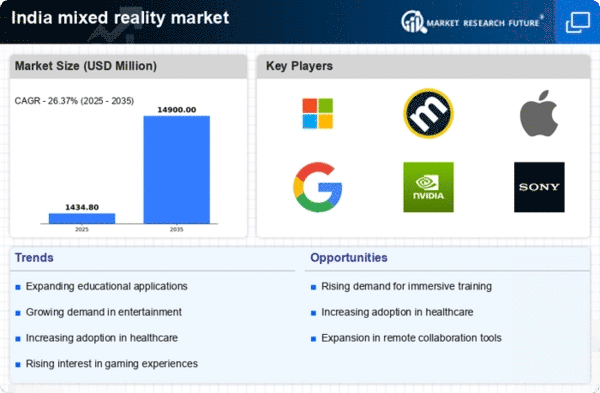
As per Market Research Future analysis, the India Mixed Reality Market size was estimated at 1135.4 USD Million in 2024. The Mixed Reality market is projected to grow from 1434.8 USD Million in 2025 to 14900.0 USD Million by 2035, exhibiting a compound annual growth rate (CAGR) of 26.3% during the forecast period 2025 - 2035

Key Market Trends & Highlights

The India mixed reality market is experiencing robust growth driven by technological advancements and increasing applications across various sectors.

  • The education segment is witnessing increased adoption of mixed reality technologies to enhance learning experiences.
  • Healthcare applications are expanding, with mixed reality being utilized for training and patient care.
  • The entertainment and gaming sectors are rapidly growing, reflecting a shift towards immersive experiences.
  • Technological advancements in hardware and rising demand for remote collaboration tools are key drivers of market growth.

Market Size & Forecast

2024 Market Size 1135.4 (USD Million)
2035 Market Size 14900.0 (USD Million)
CAGR (2025 - 2035) 26.37%

Major Players

Microsoft (US), Meta (US), Apple (US), Google (US), NVIDIA (US), Sony (JP), Samsung (KR), Magic Leap (US), HTC (TW)

Our Impact
Enabled $4.3B Revenue Impact for Fortune 500 and Leading Multinationals
Partnering with 2000+ Global Organizations Each Year
30K+ Citations by Top-Tier Firms in the Industry

India Mixed Reality Market Trends

The India Mixed Reality Market is experiencing notable growth, driven by advancements in technology and increasing adoption across various sectors. Industries such as education, healthcare, and entertainment are integrating mixed reality solutions to enhance user experiences and improve operational efficiency. The rise of affordable hardware and software solutions is making these technologies more accessible, thereby expanding their reach. Furthermore, the demand for immersive training and simulation tools is propelling the market forward, as organizations seek innovative ways to engage their workforce and improve learning outcomes. In addition, the mixed reality market is witnessing a surge in investment from both public and private sectors. Government initiatives aimed at promoting digital transformation are fostering an environment conducive to innovation. As a result, startups and established companies alike are exploring new applications and use cases for mixed reality technologies. This trend suggests a promising future for the market, with potential for further expansion and diversification in the coming years.

Increased Adoption in Education

Educational institutions are increasingly utilizing mixed reality to create immersive learning environments. This technology allows students to engage with complex concepts through interactive simulations, enhancing understanding and retention.

Growth in Healthcare Applications

The healthcare sector is leveraging mixed reality for training medical professionals and improving patient care. By simulating real-life scenarios, practitioners can refine their skills and provide better treatment.

Expansion in Entertainment and Gaming

The entertainment industry is embracing mixed reality to offer unique experiences. This trend includes interactive gaming and virtual events, attracting a wider audience and enhancing user engagement.

India Mixed Reality Market Drivers

Government Initiatives and Support

Government initiatives aimed at promoting technology adoption are playing a crucial role in the growth of the mixed reality market in India. Various programs and policies are being implemented to encourage research, development, and investment in emerging technologies. For example, the Digital India initiative aims to enhance digital infrastructure, which is essential for the deployment of mixed reality applications. Additionally, funding and grants for startups in the mixed reality space are becoming more prevalent, fostering innovation. As a result, the mixed reality market is likely to benefit from increased government support, which could lead to a more vibrant ecosystem for technology development.

Integration of Mixed Reality in Retail

The retail sector in India is increasingly integrating mixed reality solutions to enhance customer experiences and streamline operations. Retailers are utilizing mixed reality applications for virtual try-ons, interactive displays, and personalized shopping experiences. This integration is expected to drive a growth rate of approximately 20% in the mixed reality market within the retail segment over the next few years. By leveraging mixed reality, retailers can engage customers more effectively, leading to higher conversion rates and customer satisfaction. Thus, the mixed reality market is likely to see substantial advancements as retailers adopt these innovative technologies to stay competitive.

Technological Advancements in Hardware

The mixed reality market in India is experiencing a surge due to rapid advancements in hardware technology. Innovations in headsets, sensors, and computing power are enhancing user experiences and making mixed reality applications more accessible. For instance, the introduction of lightweight, high-resolution headsets has improved usability, leading to increased adoption across various sectors. The market for mixed reality hardware is projected to grow at a CAGR of approximately 30% over the next five years, indicating a robust demand for advanced devices. This growth is likely to drive investments in research and development, further propelling the mixed reality market in India.

Rising Demand for Remote Collaboration Tools

The mixed reality market is witnessing a notable increase in demand for remote collaboration tools, particularly in the wake of evolving work environments. Companies are increasingly adopting mixed reality solutions to facilitate virtual meetings and collaborative projects, enhancing productivity and engagement. The market for remote collaboration tools is expected to grow by around 25% annually, reflecting a shift towards more interactive and immersive communication methods. This trend is particularly relevant in sectors such as architecture, engineering, and design, where mixed reality applications are transforming workflows. Consequently, the mixed reality market is poised for significant growth as organizations seek innovative solutions to improve collaboration.

Educational Institutions Embracing Mixed Reality

Educational institutions in India are progressively embracing mixed reality technologies to enhance learning experiences. By incorporating mixed reality into curricula, schools and universities are providing students with immersive and interactive educational tools. This trend is expected to contribute to a growth rate of around 15% in the mixed reality market within the education sector. The ability to visualize complex concepts and engage in hands-on learning through mixed reality applications is transforming traditional teaching methods. Consequently, the mixed reality market is poised for expansion as educational institutions recognize the value of these technologies in fostering student engagement and understanding.


Market Segment Insights

By Application: Gaming (Largest) vs. Healthcare (Fastest-Growing)

The application segment of the India mixed reality market is characterized by a diverse distribution among five primary values: Gaming, Healthcare, Education, Retail, and Real Estate. Gaming holds the largest share, driven by a robust interest in immersive experiences and interactive content among consumers. Healthcare follows as a strong segment, leveraging mixed reality for training, patient care, and remote consultations, showcasing a competitive presence in terms of market share. Growth trends in the application sector are primarily bolstered by technological advancements and increased adoption across various industries. Gaming remains at the forefront due to the surge in mobile and online gaming. Conversely, Healthcare is emerging as the fastest-growing segment as the pandemic accelerated the need for solutions in virtual training and patient engagement, indicating a notable shift towards digital transformation in the medical field.

Gaming: Dominant vs. Healthcare: Emerging

Gaming has established itself as the dominant application within the mixed reality sector, attracting substantial investment and a growing user base. It integrates innovative technologies to create immersive environments that enhance user engagement and gaming experiences. This sector is continually evolving, incorporating elements like augmented reality and gamification to retain user interest. In contrast, Healthcare, while still emerging, is rapidly gaining traction. Its potential to revolutionize medical training and patient interaction is compelling, with applications ranging from virtual simulations to remote diagnosis. The adoption of mixed reality in Healthcare is largely driven by its ability to improve outcomes and enhance the quality of care, positioning it as a pivotal area for future growth.

By Technology: Hardware-based (Largest) vs. Mixed Reality as a Service (Fastest-Growing)

In the India mixed reality market, the distribution of market share among the various technological segments reveals Hardware-based solutions leading with a significant proportion. This dominance is attributed to the increasing adoption of advanced hardware components that enhance user experience and visual fidelity. Mixed Reality as a Service follows closely, capturing attention due to its flexible subscription model, which appeals to businesses keen on reducing their upfront investments in technology. The growth trends in this segment are bolstered by rapid advancements in hardware technology and the increasing demand for immersive experiences across various industries. The push towards remote working and virtual collaboration enhances the appeal of Mixed Reality as a Service, positioning it as the fastest-growing segment. Additionally, the rise of the gaming sector and training applications drives the adoption of hardware-based solutions, reflecting a robust growth trajectory in the market.

Technology: Hardware-based (Dominant) vs. Mixed Reality as a Service (Emerging)

Hardware-based solutions are currently the dominant players in the India mixed reality market, characterized by a wide array of devices such as headsets, sensors, and interactive displays that deliver immersive experiences. Their strong market presence is supported by innovations in graphics processing power and sensor technology, fostering higher demand across sectors including gaming, education, and enterprise training. On the other hand, Mixed Reality as a Service is an emerging segment, gaining traction due to its operational flexibility and cost-effective nature. This model allows businesses to leverage state-of-the-art mixed reality tools without heavy investment in infrastructure, making it an attractive option for startups and medium-sized enterprises looking to enhance their offerings while keeping costs manageable.

By End Use: Commercial (Largest) vs. Consumer (Fastest-Growing)

In the India mixed reality market, the distribution of market share among end-use segments reveals a significant lead by the commercial segment. This sector encompasses applications in real estate, education, and entertainment, accounting for the largest share of the market. Following closely is the consumer segment, which, while smaller in comparison, is rapidly gaining traction due to increasing adoption of mixed reality technologies in home entertainment and gaming. The growth trends indicate that the commercial segment will continue to dominate, bolstered by increasing investments in AR/VR technologies aimed at enhancing consumer engagement. On the other hand, the consumer segment is experiencing the fastest growth driven by the rising availability of affordable devices and a burgeoning interest in immersive gaming experiences, presenting vast opportunities for innovation and expansion in the coming years.

Commercial (Dominant) vs. Consumer (Emerging)

The commercial segment in the India mixed reality market stands as the dominant player, leveraging vast applications across various industries including architecture, training, and retail. Its strong market presence is attributed to the ongoing digital transformation within businesses, which seek to utilize immersive technologies to improve customer experiences and operational efficiencies. In contrast, the emerging consumer segment appeals to individual users primarily through enhanced gaming experiences and social media interactions. This segment is characterized by rapid technological advancements and an expanding product range, appealing particularly to younger demographics. As the market evolves, both segments will play vital roles in shaping the future landscape of mixed reality technologies in India.

By Device Type: Head-mounted Display (Largest) vs. Smart Glasses (Fastest-Growing)

In the India mixed reality market, the market share is primarily dominated by Head-mounted Displays, which are preferred for their immersive experiences and gaming capabilities. Smart Glasses are also establishing a foothold, particularly in enterprise applications, showcasing a growing trend towards wearables. The growth trends indicate that Smart Glasses are becoming the fastest-growing segment, driven by advancements in augmented reality applications and increasing adoption in training and maintenance within various sectors. Furthermore, the enthusiasm for Head-mounted Displays remains robust, attributed to the rapid development of virtual reality content and experiences, elevating their popularity among consumers.

Head-mounted Display (Dominant) vs. Smart Glasses (Emerging)

Head-mounted Displays are characterized by their ability to offer immersive experiences, making them the dominant force in the market. With robust applications in gaming, education, and tourism, these devices have captured the attention of both consumers and enterprises. On the other hand, Smart Glasses, although emerging, are rapidly gaining traction due to their convenient form factors and applications in real-world scenarios, such as navigation and real-time information display. Their appeal in the corporate sector, especially in training and collaboration, signifies a shift towards more integrated mixed reality solutions. As technology continues to evolve, both segments are expected to grow, yet Head-mounted Displays currently lead the way in overall market presence.

Get more detailed insights about India Mixed Reality Market

Key Players and Competitive Insights

The mixed reality market in India is currently characterized by a dynamic competitive landscape, driven by rapid technological advancements and increasing consumer demand for immersive experiences. Major players such as Microsoft (US), Meta (US), and Apple (US) are strategically positioning themselves through innovation and regional expansion. Microsoft (US) focuses on enhancing its HoloLens offerings, while Meta (US) emphasizes its metaverse initiatives, aiming to integrate mixed reality into social platforms. Apple (US) is reportedly investing heavily in augmented reality (AR) capabilities, suggesting a robust commitment to capturing market share in this evolving sector. Collectively, these strategies indicate a competitive environment that is increasingly centered around technological innovation and user engagement.Key business tactics within the mixed reality market include localizing manufacturing and optimizing supply chains to enhance operational efficiency. The market structure appears moderately fragmented, with several key players exerting influence over various segments. This fragmentation allows for diverse offerings, yet the collective impact of major companies shapes the competitive dynamics, fostering an environment where innovation is paramount.

In October Microsoft (US) announced a partnership with a leading Indian tech firm to develop localized applications for its HoloLens platform. This strategic move is likely to enhance user experience by tailoring solutions to meet the specific needs of the Indian market, thereby strengthening Microsoft's foothold in the region. Such collaborations may also facilitate knowledge transfer and skill development, further embedding the company within the local ecosystem.

In September Meta (US) unveiled its latest AR headset, designed specifically for educational institutions in India. This initiative underscores Meta's commitment to leveraging mixed reality for educational purposes, potentially transforming learning experiences. By targeting this niche market, Meta not only diversifies its product offerings but also positions itself as a leader in the educational technology space, which could yield long-term benefits.

In August Apple (US) launched a new AR development kit aimed at Indian developers, encouraging the creation of localized applications. This strategic action reflects Apple's intent to foster innovation within the local developer community, potentially leading to a surge in AR content tailored for Indian consumers. By empowering developers, Apple may enhance its ecosystem, driving user engagement and loyalty.

As of November current trends in the mixed reality market include a pronounced focus on digitalization, sustainability, and the integration of artificial intelligence (AI). Strategic alliances are increasingly shaping the competitive landscape, as companies collaborate to enhance technological capabilities and market reach. Looking ahead, competitive differentiation is likely to evolve, with a shift from price-based competition to a focus on innovation, technology, and supply chain reliability. This transition suggests that companies will need to prioritize unique value propositions to maintain a competitive edge in the rapidly evolving mixed reality market.

Key Companies in the India Mixed Reality Market include

Industry Developments

The India Mixed Reality Market has witnessed notable developments in recent months, particularly with companies like Tech Mahindra, and L&T Technology Services, expanding their mixed reality offerings to cater to diverse sectors, including healthcare and manufacturing. In September 2023, Wipro launched a comprehensive mixed reality solution aimed at enhancing workplace productivity, emphasizing the increasing integration of virtual and augmented reality technologies. Additionally, Infosys collaborated with Microsoft to utilize cloud technology in developing immersive experiences for enterprises, which reflects the growing partnership trend among tech giants in this arena. 

The market valuation for mixed reality in India is projected to escalate, with investments from Facebook and Google contributing significantly to growth and technological advancement. In the last two to three years, major milestones include the increasing adoption of mixed reality applications in e-commerce and live entertainment, bolstering consumer engagement and business operations. This evolving landscape underlines the importance of mixed reality as a transformational force within various industries across India.

Future Outlook

India Mixed Reality Market Future Outlook

The Mixed Reality Market in India is poised for growth at 26.37% CAGR from 2025 to 2035, driven by technological advancements and increasing adoption across sectors.

New opportunities lie in:

  • Development of immersive training solutions for enterprises
  • Integration of mixed reality in healthcare for surgical simulations
  • Creation of AR-enhanced retail experiences to boost customer engagement

By 2035, the mixed reality market is expected to achieve substantial growth and innovation.

Market Segmentation

India Mixed Reality Market End Use Outlook

  • Consumer
  • Commercial
  • Industrial

India Mixed Reality Market Technology Outlook

  • Hardware-based
  • Software-based
  • Mixed Reality as a Service

India Mixed Reality Market Application Outlook

  • Gaming
  • Healthcare
  • Education
  • Retail
  • Real Estate

India Mixed Reality Market Device Type Outlook

  • Head-mounted Display
  • Smart Glasses
  • Smart Phones
  • Tablets

Report Scope

MARKET SIZE 2024 1135.4(USD Million)
MARKET SIZE 2025 1434.8(USD Million)
MARKET SIZE 2035 14900.0(USD Million)
COMPOUND ANNUAL GROWTH RATE (CAGR) 26.37% (2025 - 2035)
REPORT COVERAGE Revenue Forecast, Competitive Landscape, Growth Factors, and Trends
BASE YEAR 2024
Market Forecast Period 2025 - 2035
Historical Data 2019 - 2024
Market Forecast Units USD Million
Key Companies Profiled Microsoft (US), Meta (US), Apple (US), Google (US), NVIDIA (US), Sony (JP), Samsung (KR), Magic Leap (US), HTC (TW)
Segments Covered Application, Technology, End Use, Device Type
Key Market Opportunities Growing demand for immersive training solutions in various industries enhances prospects in the mixed reality market.
Key Market Dynamics Rising demand for immersive experiences drives innovation and competition in the mixed reality market.
Countries Covered India
Leave a Comment

FAQs

What is the expected market size of the India Mixed Reality Market in 2024?

The India Mixed Reality Market is expected to be valued at 1.62 billion USD in 2024.

What will the market valuation be by 2035?

By 2035, the India Mixed Reality Market is anticipated to reach a value of 29.32 billion USD.

What is the expected CAGR for the India Mixed Reality Market from 2025 to 2035?

The expected CAGR for the India Mixed Reality Market from 2025 to 2035 is 30.122%.

Which application has the highest projected market size in 2035?

In 2035, the Gaming application is projected to have the highest market size at 6.47 billion USD.

What is the expected market value for Healthcare applications in 2024?

The Healthcare application segment is expected to be valued at 0.3 billion USD in 2024.

Who are the major players in the India Mixed Reality Market?

Key players in the India Mixed Reality Market include Tech Mahindra, L&T Technology Services, Cognizant, and Microsoft, among others.

What is the market size for the Retail application in 2035?

The Retail application segment is expected to reach a market size of 6.32 billion USD by 2035.

How much is the Real Estate application valued at in 2024?

The Real Estate application is valued at 0.33 billion USD in 2024.

What are the growth opportunities in the India Mixed Reality Market?

The rise in technology adoption across industries presents significant growth opportunities in the India Mixed Reality Market.

What will the Education application market size be in 2035?

The Education application market is expected to reach 4.89 billion USD by 2035.

Download Free Sample

Kindly complete the form below to receive a free sample of this Report

Compare Licence

×
Features License Type
Single User Multiuser License Enterprise User
Price $4,950 $5,950 $7,250
Maximum User Access Limit 1 User Upto 10 Users Unrestricted Access Throughout the Organization
Free Customization
Direct Access to Analyst
Deliverable Format
Platform Access
Discount on Next Purchase 10% 15% 15%
Printable Versions