×
Request Free Sample ×

Kindly complete the form below to receive a free sample of this Report

* Please use a valid business email

Leading companies partner with us for data-driven Insights

clients tt-cursor
Hero Background

India Medical Carts Market

ID: MRFR/MED/48720-HCR
200 Pages
Rahul Gotadki
February 2026

India Medical Carts Market Research Report By Type (Medication Carts, Emergency Carts, Anesthesia Carts, Procedure Carts), By Material (Metal, Plastic, Wood), By Configuration (Mobile Carts, Wall-Mounted Carts, Stationary Carts) and By End Use (Hospitals, Nursing Homes, Ambulatory Surgical Centers, Home Healthcare) -Forecast to 2035

Share:
Download PDF ×

We do not share your information with anyone. However, we may send you emails based on your report interest from time to time. You may contact us at any time to opt-out.

India Medical Carts Market Infographic
Purchase Options

India Medical Carts Market Summary

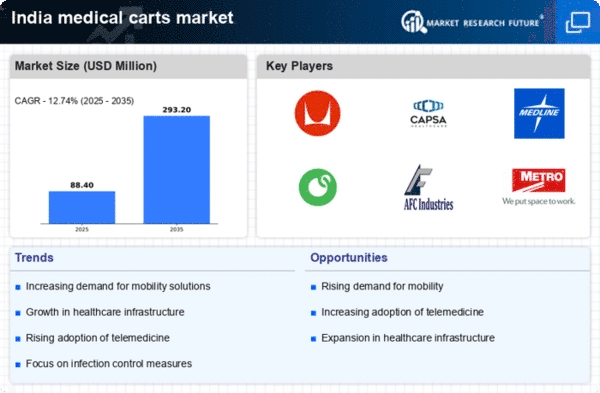
As per Market Research Future analysis, the India Medical Carts Market size was estimated at 78.41 USD Million in 2024. The Medical Carts market is projected to grow from 88.4 USD Million in 2025 to 293.2 USD Million by 2035, exhibiting a compound annual growth rate (CAGR) of 12.7% during the forecast period 2025 - 2035

Key Market Trends & Highlights

The India medical carts market is experiencing robust growth driven by technological advancements and increasing healthcare demands.

  • Technological integration in medical carts enhances operational efficiency and improves patient care.
  • The focus on infection control is driving the adoption of specialized medical carts in healthcare facilities.
  • Customization and versatility of medical carts cater to diverse healthcare needs, making them essential in various settings.
  • Rising healthcare expenditure and increasing demand for mobile healthcare solutions are key drivers propelling market growth.

Market Size & Forecast

2024 Market Size 78.41 (USD Million)
2035 Market Size 293.2 (USD Million)
CAGR (2025 - 2035) 12.74%

Major Players

Herman Miller (US), Capsa Healthcare (US), Medline Industries (US), Omnicell (US), AFC Industries (US), InterMetro Industries (US), Tenaquip Limited (CA), Stryker Corporation (US), Graham-Field Health Products (US)

Our Impact
Enabled $4.3B Revenue Impact for Fortune 500 and Leading Multinationals
Partnering with 2000+ Global Organizations Each Year
30K+ Citations by Top-Tier Firms in the Industry

India Medical Carts Market Trends

The India Medical Carts Market is experiencing notable growth, driven by the increasing demand for efficient healthcare delivery systems. Hospitals and clinics are increasingly adopting advanced medical carts to enhance patient care and streamline operations. These carts are designed to facilitate the storage and transportation of medical supplies, equipment, and medications, thereby improving workflow and reducing the risk of errors. The integration of technology into these carts, such as electronic health record systems and telemedicine capabilities, further supports healthcare professionals in providing timely and effective care. As the healthcare sector evolves, the emphasis on patient safety and operational efficiency continues to shape the development of medical carts. In addition, the rising focus on infection control and hygiene standards is influencing the design and functionality of medical carts. Manufacturers are innovating to create carts that are easy to clean and made from materials that minimize the risk of contamination. This trend aligns with the broader healthcare objective of ensuring safe environments for both patients and staff. Furthermore, the growing number of healthcare facilities in India, including specialty hospitals and outpatient centers, is likely to contribute to the sustained demand for medical carts, as these institutions seek to optimize their service delivery and enhance patient experiences.

Technological Integration

The medical carts market is witnessing a trend towards the incorporation of advanced technologies. Features such as electronic health record systems, telemedicine capabilities, and automated medication dispensing are becoming increasingly common. This integration not only enhances the efficiency of healthcare delivery but also supports healthcare professionals in making informed decisions.

Focus on Infection Control

There is a growing emphasis on infection control within the medical carts market. Manufacturers are developing carts that utilize materials resistant to microbial growth and are designed for easy cleaning. This trend reflects the healthcare sector's commitment to maintaining high hygiene standards and ensuring patient safety.

Customization and Versatility

The demand for customized medical carts is on the rise, as healthcare facilities seek solutions tailored to their specific needs. Versatile designs that accommodate various medical equipment and supplies are becoming more prevalent. This trend allows for greater flexibility in healthcare settings, enhancing operational efficiency.

India Medical Carts Market Drivers

Rising Healthcare Expenditure

The increasing healthcare expenditure in India is a pivotal driver for the medical carts market. As the government and private sectors allocate more funds towards healthcare infrastructure, hospitals and clinics are investing in advanced medical equipment, including medical carts. According to recent data, healthcare spending in India is projected to reach approximately $370 billion by 2025, reflecting a growth rate of around 12% annually. This surge in investment is likely to enhance the demand for medical carts, which are essential for efficient patient care and management. The medical carts market is expected to benefit significantly from this trend, as healthcare facilities seek to improve operational efficiency and patient outcomes through better equipment. Consequently, the rising healthcare expenditure is anticipated to propel the growth of the medical carts market in India.

Growing Number of Healthcare Facilities

The expansion of healthcare facilities in India is a crucial driver for the medical carts market. With the increasing number of hospitals, clinics, and diagnostic centers, there is a heightened demand for medical equipment, including medical carts. The medical carts market is poised to benefit from this growth, as new healthcare establishments require efficient solutions for patient management and care delivery. According to estimates, the number of hospitals in India is expected to increase by 20% over the next five years, further fueling the demand for medical carts. This proliferation of healthcare facilities is likely to create a robust market environment for medical carts, as providers seek to equip their establishments with essential tools for effective healthcare delivery.

Focus on Patient Safety and Quality of Care

Patient safety and quality of care remain paramount in the healthcare sector, driving the medical carts market in India. Healthcare facilities are increasingly recognizing the importance of using high-quality medical carts that ensure safe storage and easy access to medical supplies. The medical carts market is responding to this need by offering products designed with safety features, such as secure locking mechanisms and ergonomic designs. As hospitals strive to minimize errors and enhance patient outcomes, the demand for reliable medical carts is likely to increase. Furthermore, regulatory bodies are emphasizing compliance with safety standards, which may further boost the adoption of advanced medical carts. This focus on patient safety is expected to play a crucial role in shaping the future of the medical carts market in India.

Technological Advancements in Medical Equipment

Technological advancements in medical equipment are significantly impacting the medical carts market in India. Innovations such as integrated electronic health record systems, advanced monitoring devices, and telehealth capabilities are being incorporated into medical carts, enhancing their functionality. The medical carts market is witnessing a transformation as manufacturers develop smart carts equipped with technology that improves workflow efficiency and patient care. As healthcare providers seek to leverage technology for better service delivery, the demand for technologically advanced medical carts is likely to grow. This trend indicates a shift towards more sophisticated medical equipment, which could redefine operational standards in healthcare facilities across India.

Increasing Demand for Mobile Healthcare Solutions

The growing trend towards mobile healthcare solutions is influencing the medical carts market in India. With the rise of telemedicine and mobile health applications, healthcare providers are increasingly adopting mobile medical carts to facilitate patient care in various settings. These carts enable healthcare professionals to access patient data, administer medications, and perform diagnostics on the go. The medical carts market is witnessing a shift towards more versatile and mobile solutions, which are essential for modern healthcare delivery. As hospitals and clinics aim to enhance patient engagement and streamline workflows, the demand for mobile medical carts is expected to rise. This trend is likely to contribute to the overall growth of the medical carts market, as healthcare facilities prioritize mobility and accessibility in their operations.


Market Segment Insights

By Type: Medication Carts (Largest) vs. Emergency Carts (Fastest-Growing)

In the India medical carts market, Medication Carts hold the largest share, accounting for a significant portion of the segment distribution, followed closely by Emergency Carts. These carts are essential for healthcare settings, facilitating efficient drug delivery and emergency response. Anesthesia and Procedure Carts, while important, contribute a smaller percentage to the overall market share, indicating a clear preference for Medication and Emergency Carts in the current landscape. The growth trends in this segment are largely driven by the increasing demand for streamlined medication administration and enhanced emergency preparedness in healthcare facilities. The rise in healthcare expenditure, coupled with a focus on improving patient care quality, fuels the adoption of these carts. Innovations in design and technology are also pushing Emergency Carts to become the fastest-growing segment, reflecting a shift towards more efficient and accessible emergency medical supplies.

Medication Carts (Dominant) vs. Emergency Carts (Emerging)

Medication Carts are recognized as the dominant force within the India medical carts market, characterized by their robust design and focus on optimizing medication management in clinical environments. These carts are equipped with secure storage compartments and user-friendly layouts, facilitating streamlined access to medications for healthcare professionals. On the other hand, Emergency Carts are emerging quickly, responding to the heightened need for rapid emergency care solutions. They are designed to be mobile and fully stocked with essential emergency supplies, enabling swift interventions during critical situations. As hospitals continue to prioritize readiness for unforeseen emergencies, the prominence of Emergency Carts is steadily increasing, highlighting their essential role in modern healthcare.

By Material: Metal (Largest) vs. Plastic (Fastest-Growing)

In the India medical carts market, metal emerges as the largest segment, commanding a significant share due to its durability and reliability in high-demand healthcare settings. This material is favored for its strength and longevity, making it ideal for various applications within healthcare facilities. Plastic, on the other hand, is rapidly gaining traction, particularly in environments where weight and versatility are critical, appealing to a segment that prioritizes ease of mobility and maintenance. The growth trends in this market segment indicate a shifting preference towards lighter and more adaptable materials. The demand for plastic medical carts is driven by the increasing emphasis on infection control and hygiene, as plastics are easier to clean and maintain. Additionally, innovations in composite plastics are enhancing their strength, making them more competitive against traditional metal carts. This evolution signifies a changing landscape where both metal and plastic play vital roles in meeting the operational needs of healthcare providers.

Metal (Dominant) vs. Plastic (Emerging)

Metal medical carts are established as the dominant choice within the India medical carts market, primarily due to their robust construction and ability to withstand heavy loads typical in medical environments. These carts are often designed for specific functionalities and can be integrated with advanced technology to streamline healthcare operations. In contrast, plastic carts are emerging due to their lightweight nature and ability to be molded into various shapes, providing flexibility and ease of use. The growth of plastic carts aligns with the increasing focus on infection control, as they can be sanitized more efficiently. The adaptability and innovative designs of plastic carts are making them a favorable choice among healthcare professionals seeking to enhance mobility while maintaining a clean environment.

By Configuration: Mobile Carts (Largest) vs. Stationary Carts (Fastest-Growing)

In the India medical carts market, Mobile Carts dominate the configuration segment, commanding a significant share due to their versatility and ease of movement across various healthcare settings. This makes them highly preferred for patient care and medical equipment storage. Stationary Carts, while representing a smaller portion, are rapidly gaining traction as they provide stable and secure solutions for specific applications in hospitals and clinics. The growth trends in the configuration segment reflect an increasing demand for versatile and specialized storage solutions in healthcare facilities. Mobile Carts are being favored for their adaptability, while the rise in telemedicine and remote consultations is driving the need for Stationary Carts in fixed locations. Factors like innovative designs, ergonomic features, and advancements in healthcare logistics are also contributing to the evolution of the segment.

Mobile Carts (Dominant) vs. Stationary Carts (Emerging)

Mobile Carts have established a strong position in the India medical carts market, recognized for their flexible designs that accommodate various medical equipment and supplies, allowing healthcare professionals to easily move them as needed. Their dominance is attributed to their multifunctionality and effectiveness in supporting patient care across diverse environments. In contrast, Stationary Carts are emerging as a key player, providing dedicated and optimized storage solutions for specific tasks in healthcare settings. They are increasingly utilized in fixed locations where stability and organization are paramount, making them essential for effective healthcare delivery. As technology advances and the requirements of healthcare facilities evolve, both configurations will coexist, catering to diverse operational needs.

By End Use: Hospitals (Largest) vs. Nursing Homes (Fastest-Growing)

The market share distribution in the India medical carts market shows that hospitals dominate the landscape, accounting for the largest segment in terms of usage and demand. Nursing homes, while smaller in share, are witnessing increased adoption of medical carts as they focus on enhancing patient care and operational efficiencies. This trend highlights a shift in healthcare delivery mechanisms, favoring streamlined processes and better inventory management. Growth trends for this segment are driven by the increasing emphasis on healthcare infrastructure improvements and the rise of outpatient care facilities. Ambulatory surgical centers are also registering significant growth as they provide cost-effective and efficient surgical solutions. Home healthcare is emerging as a key area, driven by an aging population and the desire for more personalized care options, ensuring a robust future for medical carts across these end-use segments.

Hospitals: Dominant vs. Nursing Homes: Emerging

Hospitals represent the dominant end-use segment in the India medical carts market due to their extensive need for efficient equipment management and patient care facilitation. Their reliance on a variety of medical carts ensures streamlined workflow and enhances overall operational efficiency. On the other hand, nursing homes are emerging as a vital segment, rapidly growing as they adapt to the shift towards higher-quality patient care. These facilities recognize the importance of modernized medical carts to support multi-functional uses, including storage and transportation of medical supplies. With stricter regulations and an increasing focus on patient safety, nursing homes are now investing more in medical carts, thereby strengthening their market position.

Get more detailed insights about India Medical Carts Market

Key Players and Competitive Insights

The medical carts market in India is characterized by a dynamic competitive landscape, driven by increasing healthcare demands and technological advancements. Key players such as Stryker Corporation (US), Omnicell (US), and Capsa Healthcare (US) are strategically positioned to leverage innovation and regional expansion. Stryker Corporation (US) focuses on enhancing its product offerings through advanced technology integration, while Omnicell (US) emphasizes digital transformation in medication management. Capsa Healthcare (US) is actively pursuing partnerships to broaden its market reach, collectively shaping a competitive environment that prioritizes innovation and customer-centric solutions.
In terms of business tactics, companies are increasingly localizing manufacturing to reduce costs and enhance supply chain efficiency. The market appears moderately fragmented, with several players vying for market share. This competitive structure allows for a diverse range of products and services, fostering innovation as companies strive to differentiate themselves in a crowded marketplace.
In October 2025, Stryker Corporation (US) announced the launch of a new line of customizable medical carts designed to improve workflow efficiency in hospitals. This strategic move is significant as it aligns with the growing demand for tailored healthcare solutions, enabling Stryker to strengthen its market position and respond to specific customer needs. The introduction of these carts is likely to enhance operational efficiency and patient care, reinforcing Stryker's commitment to innovation.
In September 2025, Omnicell (US) expanded its partnership with a leading Indian healthcare provider to implement its automated medication management systems across multiple facilities. This collaboration is crucial as it not only enhances Omnicell's footprint in the Indian market but also underscores the importance of digital solutions in modern healthcare. By integrating advanced technology into medication management, Omnicell positions itself as a leader in improving patient safety and operational efficiency.
In August 2025, Capsa Healthcare (US) launched a new initiative aimed at sustainability by introducing eco-friendly medical carts made from recyclable materials. This initiative reflects a growing trend towards sustainability in healthcare, appealing to environmentally conscious consumers and institutions. Capsa's focus on sustainable practices may provide a competitive edge as healthcare facilities increasingly prioritize eco-friendly solutions.
As of November 2025, the competitive trends in the medical carts market are heavily influenced by digitalization, sustainability, and the integration of artificial intelligence (AI). Strategic alliances are becoming more prevalent, allowing companies to pool resources and expertise to enhance their offerings. The shift from price-based competition to a focus on innovation, technology, and supply chain reliability is evident, suggesting that future competitive differentiation will hinge on the ability to deliver advanced, efficient, and sustainable solutions.

Key Companies in the India Medical Carts Market include

Industry Developments

Recent developments in the India Medical Carts Market highlight significant growth and innovation within the sector. Companies like Huntleigh Healthcare, Mindray, and BPL Medical Technologies are actively enhancing their product offerings to include advanced features, catering to the rising demand for efficiency in healthcare delivery. The market valuation is projected to grow due to the increasing need for medical equipment tied to the growing healthcare infrastructure in India, particularly post-COVID-19, which saw a heightened demand for hospital supplies.Notable mergers and acquisitions have been scarce recently, with no widely reported activities among the targeted companies.

However, in October 2022, Hindustan Syringes and Medical Devices expanded its production capacity significantly, aligning with the Indian government's push for self-reliance in medical manufacturing. Additionally, research institutions like Sree Chitra Tirunal Institute are collaborating with industry players to innovate in medical cart designs.Overall, the increasing emphasis on quality healthcare and government initiatives to bolster medical equipment manufacturing are strong drivers of growth within the India Medical Carts Market. The ongoing developments signify a robust trajectory for the market as stakeholders respond to both challenges and demands in healthcare.


Future Outlook

India Medical Carts Market Future Outlook

The Medical Carts Market in India is projected to grow at a 12.74% CAGR from 2025 to 2035, driven by technological advancements, increasing healthcare infrastructure, and rising demand for efficient patient care solutions.

New opportunities lie in:

  • Development of customizable mobile medical carts for specialized departments.
  • Integration of IoT technology for real-time inventory management.
  • Expansion of telehealth solutions through portable medical carts.

By 2035, the medical carts market is expected to achieve substantial growth, reflecting evolving healthcare needs.

Market Segmentation

India Medical Carts Market Type Outlook

  • Medication Carts
  • Emergency Carts
  • Anesthesia Carts
  • Procedure Carts

India Medical Carts Market End Use Outlook

  • Hospitals
  • Nursing Homes
  • Ambulatory Surgical Centers
  • Home Healthcare

India Medical Carts Market Material Outlook

  • Metal
  • Plastic
  • Wood

India Medical Carts Market Configuration Outlook

  • Mobile Carts
  • Wall-Mounted Carts
  • Stationary Carts

Report Scope

MARKET SIZE 2024 78.41(USD Million)
MARKET SIZE 2025 88.4(USD Million)
MARKET SIZE 2035 293.2(USD Million)
COMPOUND ANNUAL GROWTH RATE (CAGR) 12.74% (2025 - 2035)
REPORT COVERAGE Revenue Forecast, Competitive Landscape, Growth Factors, and Trends
BASE YEAR 2024
Market Forecast Period 2025 - 2035
Historical Data 2019 - 2024
Market Forecast Units USD Million
Key Companies Profiled Herman Miller (US), Capsa Healthcare (US), Medline Industries (US), Omnicell (US), AFC Industries (US), InterMetro Industries (US), Tenaquip Limited (CA), Stryker Corporation (US), Graham-Field Health Products (US)
Segments Covered Type, Material, Configuration, End Use
Key Market Opportunities Integration of advanced telehealth solutions in the medical carts market enhances patient care and operational efficiency.
Key Market Dynamics Rising demand for advanced medical carts driven by technological innovations and evolving healthcare infrastructure in India.
Countries Covered India
Leave a Comment

FAQs

What is the projected market size of the India Medical Carts Market in 2024?

The India Medical Carts Market is expected to be valued at 173.0 million USD in 2024.

What will be the expected value of the India Medical Carts Market by 2035?

By 2035, the India Medical Carts Market is anticipated to reach 418.0 million USD.

What is the expected compound annual growth rate (CAGR) for the India Medical Carts Market from 2025 to 2035?

The market is expected to grow at a CAGR of 8.35% from 2025 to 2035.

Which type of medical cart is projected to have the highest market value in 2035?

Medication Carts are projected to have the highest market value at 120.0 million USD in 2035.

What is the expected market value for Emergency Carts in 2035?

The expected market value for Emergency Carts in 2035 is 100.0 million USD.

Who are the key players in the India Medical Carts Market?

Major players in the market include Huntleigh Healthcare, Mindray, and Medline Industries among others.

What is the projected market size for Anesthesia Carts in 2024?

The market size for Anesthesia Carts is expected to be 30.0 million USD in 2024.

What challenges does the India Medical Carts Market face in terms of growth?

Challenges include rising competitor activity and fluctuating healthcare budgets that may impact growth.

What opportunities are anticipated in the India Medical Carts Market through 2035?

Opportunities include advancements in technology and increased healthcare spending leading to higher demand for medical carts.

What will be the market value of Procedure Carts in 2035?

The market value for Procedure Carts is expected to reach 123.0 million USD by 2035.

Download Free Sample

Kindly complete the form below to receive a free sample of this Report

Compare Licence

×
Features License Type
Single User Multiuser License Enterprise User
Price $4,950 $5,950 $7,250
Maximum User Access Limit 1 User Upto 10 Users Unrestricted Access Throughout the Organization
Free Customization
Direct Access to Analyst
Deliverable Format
Platform Access
Discount on Next Purchase 10% 15% 15%
Printable Versions