×
Request Free Sample ×

Kindly complete the form below to receive a free sample of this Report

* Please use a valid business email

Leading companies partner with us for data-driven Insights

clients tt-cursor
Hero Background

India Gesture Recognition Market

ID: MRFR/ICT/62992-HCR
200 Pages
Aarti Dhapte
February 2026

India Gesture Recognition Market Size, Share and Research Report: By Technology (Sensor, 2D Gesture Technology, 3D Gesture Technology), By Application (Automotive, Healthcare, Consumer Electronics, Transportation, Commercial, IT/Telecom) and By Product (Touchless, Touch-Based)- Industry Forecast to 2035

Share:
Download PDF ×

We do not share your information with anyone. However, we may send you emails based on your report interest from time to time. You may contact us at any time to opt-out.

India Gesture Recognition Market Infographic
Purchase Options

India Gesture Recognition Market Summary

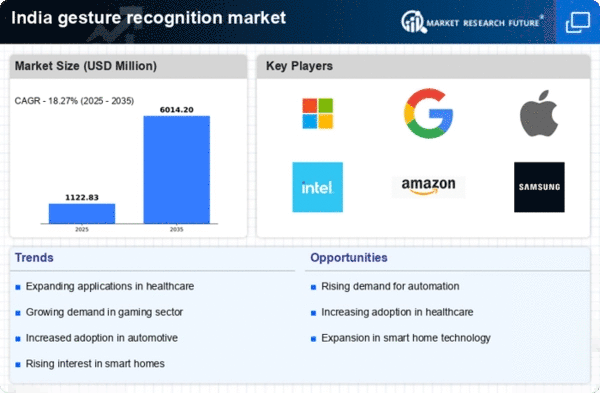
As per Market Research Future analysis, the India Gesture Recognition Market size was estimated at 949.38 USD Million in 2024. The Gesture Recognition market is projected to grow from 1122.83 USD Million in 2025 to 6014.2 USD Million by 2035, exhibiting a compound annual growth rate (CAGR) of 18.2% during the forecast period 2025 - 2035

Key Market Trends & Highlights

The India gesture recognition market is experiencing robust growth driven by technological advancements and increasing consumer demand.

  • The largest segment in the India gesture recognition market is consumer electronics, reflecting a rising adoption of smart devices.
  • Automotive applications represent the fastest-growing segment, indicating a shift towards advanced driver-assistance systems.
  • The market is characterized by a surge in smart device usage and an increased focus on touchless interfaces.
  • Key drivers include advancements in AI and machine learning, which enhance user experience and drive market expansion.

Market Size & Forecast

2024 Market Size 949.38 (USD Million)
2035 Market Size 6014.2 (USD Million)
CAGR (2025 - 2035) 18.27%

Major Players

Microsoft (US), Google (US), Apple (US), Intel (US), Amazon (US), Samsung (KR), Sony (JP), GestureTek (CA), Leap Motion (US)

Our Impact
Enabled $4.3B Revenue Impact for Fortune 500 and Leading Multinationals
Partnering with 2000+ Global Organizations Each Year
30K+ Citations by Top-Tier Firms in the Industry

India Gesture Recognition Market Trends

The India Gesture Recognition Market is experiencing notable advancements. This growth is driven by the increasing integration of technology in various sectors. In India, the demand for gesture recognition systems is growing, particularly in areas such as consumer electronics, automotive, and healthcare. This growth is largely attributed to the rising adoption of smart devices and the need for intuitive user interfaces. As industries seek to enhance user experience, gesture recognition technology is becoming a focal point for innovation. Furthermore, the government's push towards digitalization and smart city initiatives is likely to bolster the development and implementation of gesture recognition solutions across multiple applications. Moreover, The gesture recognition market is shifting towards more sophisticated algorithms and machine learning techniques. These advancements enable more accurate and responsive systems, which are essential for applications in virtual reality, gaming, and security. The increasing investment in research and development by both public and private sectors indicates a strong commitment to advancing this technology. As the market evolves, it appears that collaboration between technology providers and end-users will be crucial in shaping the future landscape of gesture recognition solutions in India. This collaborative approach may lead to tailored solutions that meet specific industry needs, further driving market growth.

Rising Adoption in Consumer Electronics

The gesture recognition market is seeing a surge in adoption within the consumer electronics sector. As smart devices become more prevalent, manufacturers are increasingly integrating gesture recognition technology to enhance user interaction. This trend is likely to continue as consumers seek more intuitive and seamless experiences with their devices.

Integration in Automotive Applications

The gesture recognition market is making significant inroads into the automotive industry. With the growing emphasis on driver safety and convenience, automotive manufacturers are exploring gesture-based controls for infotainment systems and navigation. This integration is expected to improve user engagement while minimizing distractions.

Advancements in Healthcare Solutions

The gesture recognition market is finding applications in healthcare, particularly for touchless interactions in medical devices and patient monitoring systems. This trend is indicative of a broader movement towards enhancing hygiene and safety in healthcare environments, particularly in settings where contactless technology is essential.

India Gesture Recognition Market Drivers

Surge in Smart Device Usage

The proliferation of smart devices in India is a pivotal driver for the gesture recognition market. With an increasing number of households adopting smart TVs, smartphones, and home automation systems, the demand for intuitive user interfaces is on the rise. Gesture recognition technology enhances user experience by allowing seamless interaction without physical contact. According to recent estimates, the smart device penetration rate in India is projected to reach 50% by 2026, which could significantly boost the gesture recognition market. As consumers seek more advanced functionalities, manufacturers are likely to invest in gesture recognition capabilities, thereby expanding the market landscape. This trend indicates a shift towards more interactive and user-friendly technology, positioning gesture recognition as a key component in the evolution of smart devices.

Advancements in AI and Machine Learning

The advancements in artificial intelligence (AI) and machine learning are playing a crucial role in shaping the gesture recognition market. In India, the integration of AI with gesture recognition technology enhances the accuracy and efficiency of gesture detection systems. This synergy allows for more sophisticated applications across various sectors, including automotive, healthcare, and consumer electronics. As AI algorithms become more refined, the ability to interpret complex gestures in real-time improves, making gesture recognition systems more viable for commercial use. The Indian AI market is projected to reach $7.8 billion by 2025, indicating a strong potential for growth in related technologies. Consequently, the gesture recognition market is likely to benefit from these advancements, as businesses seek to leverage AI-driven solutions for enhanced user experiences.

Increased Focus on Touchless Interfaces

The growing emphasis on touchless interfaces in various sectors is a significant driver for the gesture recognition market. In India, industries such as retail, hospitality, and healthcare are increasingly adopting touchless technologies to enhance customer experiences and ensure safety. Gesture recognition technology allows users to interact with systems without physical contact, which is particularly appealing in environments where hygiene is a concern. For instance, retail stores are implementing gesture-based kiosks to facilitate contactless shopping experiences. This trend is likely to continue, with the gesture recognition market expected to witness a compound annual growth rate (CAGR) of 25% over the next five years. As businesses prioritize customer safety and convenience, the demand for gesture recognition solutions is anticipated to grow, driving market expansion.

Growth in Gaming and Entertainment Sectors

The gaming and entertainment sectors in India are experiencing rapid growth, which serves as a substantial driver for the gesture recognition market. With the rise of immersive gaming experiences, developers are increasingly integrating gesture recognition technology to enhance gameplay. The Indian gaming industry is expected to reach a valuation of $3.75 billion by 2024, indicating a robust demand for innovative gaming solutions. Gesture recognition allows players to interact with games in a more engaging manner, potentially increasing user retention and satisfaction. Furthermore, the entertainment industry is exploring gesture-based controls for virtual reality (VR) and augmented reality (AR) applications, which could further propel the adoption of gesture recognition technology. This synergy between gaming and gesture recognition suggests a promising future for the market.

Rising Demand for Enhanced User Experience

The increasing demand for enhanced user experiences across various platforms is a key driver for the gesture recognition market. In India, consumers are becoming more discerning, seeking intuitive and engaging interactions with technology. This trend is evident in sectors such as gaming, automotive, and smart home devices, where gesture recognition technology is being utilized to create more immersive experiences. As companies strive to differentiate their products in a competitive landscape, the integration of gesture recognition capabilities is becoming a strategic priority. Market analysts suggest that the gesture recognition market could see a growth trajectory of approximately 30% by 2027, driven by the need for innovative user interfaces. This focus on user experience is likely to propel the adoption of gesture recognition technology, further solidifying its position in the market.


Market Segment Insights

By Technology: Sensor (Largest) vs. 3D Gesture Technology (Fastest-Growing)

The India gesture recognition market exhibits a dynamic interplay between its various technological segments. The Sensor category captures the largest share, reflecting its fundamental role in gesture recognition devices, while 2D Gesture Technology maintains a steady presence. In contrast, 3D Gesture Technology shows significant promise, fueled by advancements in hardware and software capabilities, indicating an evolving preference towards more complex and accurate gesture recognition solutions. Growth trends in this segment are driven by the increasing integration of gesture recognition systems in consumer electronics, automotive, and healthcare applications. The rise of smart home devices has particularly spurred interest in 3D Gesture Technology, as users seek more interactive and intuitive interfaces. Other factors include heightened demand for contactless controls and the merging of gesture recognition with AI, propelling the technology into mainstream usage.

Technology: Sensor (Dominant) vs. 2D Gesture Technology (Emerging)

The Sensor segment remains dominant within the India gesture recognition market due to its critical function in facilitating accurate gesture capture. Sensors are integral to a variety of devices, translating physical movements into digital signals with precision and reliability. On the other hand, 2D Gesture Technology is considered an emerging segment, capturing interest for its cost-effectiveness and ease of implementation. While it currently lags behind in terms of market share, ongoing innovations and the increasing adoption of augmented reality (AR) and virtual reality (VR) technologies are likely to enhance its position. As user demand for intuitive interaction systems continues to rise, both segments present unique opportunities for growth, with Sensors leading the charge and 2D Gesture Technology on the brink of expansion.

By Application: Consumer Electronics (Largest) vs. Healthcare (Fastest-Growing)

In the India gesture recognition market, the application segments exhibit diverse engagement, with Consumer Electronics leading the share owing to its widespread adoption in smart devices and entertainment systems. Following closely are Automotive and Healthcare sectors, both showing substantial interest as technology integration strengthens. Transportation, Commercial, and IT/Telecom are also critical, yet they remain at a nascent stage in terms of market penetration. Growth trends in this market are driven by increasing technology adoption across various industries, with Healthcare experiencing the fastest growth as remote monitoring and telehealth rise. The demand for contactless user interfaces in Automotive and Consumer Electronics also contributes to market expansion. Additionally, the ongoing digital transformation in IT/Telecom and rising automation in Commercial applications are influencing growth positively.

Consumer Electronics: Dominant vs. Healthcare: Emerging

Consumer Electronics has established itself as the dominant application in the India gesture recognition market, significantly impacting user experiences by enabling intuitive interactions with devices such as smartphones, tablets, and gaming consoles. This segment is characterized by rapid innovation and high consumer demand, which propel continuous upgrades and new product introductions. On the other hand, the Healthcare segment is appearing as an emerging player within this landscape, driven by advancements in gesture technology that facilitate non-invasive features in medical devices. This segment's growth is fueled by an increasing focus on patient-centered care and the integration of smart technologies in health monitoring systems, marking it as a pivotal area for future developments.

By Product: Touchless (Largest) vs. Touch-Based (Fastest-Growing)

In the India gesture recognition market, the distribution of market share between touchless and touch-based solutions highlights the dominance of touchless technology. This segment captures a significant portion of the overall market due to its advanced capabilities and increasing adoption across various sectors, including automotive, healthcare, and retail. Touch-based solutions, while having a smaller share, are gaining traction as many users prefer the tactile interaction they offer. Growth trends indicate that the touchless segment is propelled by a rising demand for contactless interactions, particularly in the wake of health concerns and hygiene preferences. This trend is further amplified by technological advancements that enhance the accuracy and efficiency of gesture recognition systems. In contrast, the touch-based segment is experiencing rapid innovation, leading to emerging applications that reinforce its relevance in consumer electronics and interactive displays.

Touchless (Dominant) vs. Touch-Based (Emerging)

Touchless gesture recognition technologies are characterized by their ability to provide seamless interactions without physical contact, making them highly desirable in environments where hygiene is a priority. These systems utilize advanced motion-sensing capabilities to interpret user gestures with high precision. On the other hand, touch-based gesture recognition remains an emerging force, particularly favored in personal devices and interactive environments as users often enjoy the physical feedback provided by such interactions. While touchless systems dominate due to their relevance in health-conscious applications, touch-based solutions are carving their niche by integrating traditional interaction with innovative user experiences.

Get more detailed insights about India Gesture Recognition Market

Key Players and Competitive Insights

The gesture recognition market in India is currently characterized by a dynamic competitive landscape, driven by rapid technological advancements and increasing consumer demand for intuitive user interfaces. Major players such as Microsoft (US), Google (US), and Apple (US) are strategically positioned to leverage their extensive research and development capabilities, focusing on innovation and user experience. These companies are not only enhancing their product offerings but are also exploring partnerships and collaborations to expand their market reach. The collective strategies of these key players contribute to a competitive environment that is both innovative and rapidly evolving, as they seek to capitalize on the growing adoption of gesture recognition technologies across various sectors, including gaming, healthcare, and smart home applications.In terms of business tactics, companies are increasingly localizing manufacturing and optimizing supply chains to enhance operational efficiency and reduce costs. The market structure appears moderately fragmented, with a mix of established players and emerging startups. This fragmentation allows for diverse offerings and competitive pricing, although the influence of major players remains significant. The presence of these key companies shapes the market dynamics, as they set benchmarks for technology and service quality, compelling smaller firms to innovate and differentiate their products.

In October Microsoft (US) announced the launch of its new gesture recognition software, designed to integrate seamlessly with its existing suite of productivity tools. This strategic move is likely to enhance user engagement and streamline workflows, positioning Microsoft as a leader in the enterprise segment of the market. The integration of gesture recognition into everyday applications could potentially redefine user interaction, making it more intuitive and efficient.

In September Google (US) unveiled a partnership with a leading Indian tech startup to develop gesture-based controls for smart home devices. This collaboration not only signifies Google's commitment to expanding its footprint in the Indian market but also highlights the growing trend of integrating gesture recognition into IoT applications. Such partnerships may accelerate the adoption of smart home technologies, as consumers increasingly seek seamless and user-friendly interfaces.

In August Apple (US) introduced advanced gesture recognition capabilities in its latest iPhone model, which allows users to navigate the device without physical contact. This innovation is indicative of Apple's focus on enhancing user experience and maintaining its competitive edge in the smartphone market. The strategic importance of this development lies in its potential to attract tech-savvy consumers who prioritize cutting-edge technology and seamless interaction.

As of November the competitive trends in the gesture recognition market are heavily influenced by digitalization, AI integration, and sustainability initiatives. Companies are increasingly forming strategic alliances to enhance their technological capabilities and market presence. The shift from price-based competition to a focus on innovation and technology is evident, as firms strive to differentiate themselves through unique offerings and reliable supply chains. Looking ahead, it appears that competitive differentiation will increasingly hinge on the ability to innovate and adapt to changing consumer preferences, suggesting a promising trajectory for the gesture recognition market.

Key Companies in the India Gesture Recognition Market include

Industry Developments

The India Gesture Recognition Market has recently seen significant developments, especially with companies like HaptX, NVIDIA, Google, and GestureTek focusing on enhancing biometric technologies and user interaction experiences. In September 2023, NVIDIA introduced new AI-based tools aimed at improving gesture recognition in smart devices, attracting interest from various sectors including retail and entertainment. Additionally, Google has been investing in Research and Development for advanced gesture control systems that can integrate seamlessly with various operating systems in India. 

Notable acquisitions include Microsoft’s acquisition of a gesture recognition startup in March 2023, bolstering their portfolio in innovative user interaction technologies. The market has experienced growth in valuation, with estimates projecting an increase driven by the rising demand for contactless solutions across industries. In 2022, Samsung unveiled a new gesture-control platform tailored for smart home devices, thereby pushing its technology further into the Indian market. Furthermore, the Indian Government's initiatives to promote smart technology deployment in urban areas have been instrumental in advancing gesture recognition applications, resulting in increased investments and collaborations among key industry players.

Future Outlook

India Gesture Recognition Market Future Outlook

The Gesture Recognition Market in India is poised for growth at 18.27% CAGR from 2025 to 2035, driven by advancements in AI, increasing demand for touchless interfaces, and expanding applications in various sectors.

New opportunities lie in:

  • Development of gesture-controlled smart home devices
  • Integration of gesture recognition in automotive safety systems
  • Expansion of gesture-based interfaces in healthcare applications

By 2035, The gesture recognition market is expected to experience substantial growth and innovation.

Market Segmentation

India Gesture Recognition Market Product Outlook

  • Touchless
  • Touch-Based

India Gesture Recognition Market Technology Outlook

  • Sensor
  • 2D Gesture Technology
  • 3D Gesture Technology

India Gesture Recognition Market Application Outlook

  • Automotive
  • Healthcare
  • Consumer Electronics
  • Transportation
  • Commercial
  • IT/Telecom

Report Scope

MARKET SIZE 2024 949.38(USD Million)
MARKET SIZE 2025 1122.83(USD Million)
MARKET SIZE 2035 6014.2(USD Million)
COMPOUND ANNUAL GROWTH RATE (CAGR) 18.27% (2025 - 2035)
REPORT COVERAGE Revenue Forecast, Competitive Landscape, Growth Factors, and Trends
BASE YEAR 2024
Market Forecast Period 2025 - 2035
Historical Data 2019 - 2024
Market Forecast Units USD Million
Key Companies Profiled Microsoft (US), Google (US), Apple (US), Intel (US), Amazon (US), Samsung (KR), Sony (JP), GestureTek (CA), Leap Motion (US)
Segments Covered Technology, Application, Product
Key Market Opportunities Integration of gesture recognition in smart home devices enhances user experience and accessibility.
Key Market Dynamics Rising demand for touchless interfaces drives innovation in gesture recognition technology across various sectors.
Countries Covered India
Leave a Comment

FAQs

What is the expected market size of the India Gesture Recognition Market in 2024?

The India Gesture Recognition Market is expected to be valued at 1.2 billion USD in 2024.

What is the projected market size for the India Gesture Recognition Market by 2035?

The market is projected to reach 9.3 billion USD by the year 2035.

What is the expected CAGR for the India Gesture Recognition Market from 2025 to 2035?

The expected CAGR for the India Gesture Recognition Market during the forecast period is 20.461 percent.

Which technology segment is expected to dominate the India Gesture Recognition Market by 2035?

The sensor technology segment is anticipated to dominate the market, valued at 3.8 billion USD by 2035.

What is the market size for the 2D Gesture Technology segment in 2024?

The 2D Gesture Technology segment is valued at 0.4 billion USD in 2024.

Who are the key players in the India Gesture Recognition Market?

Key players in this market include HaptX, NVIDIA, Google, and Samsung among others.

What is the market size for the 3D Gesture Technology segment by 2035?

The 3D Gesture Technology segment is expected to reach a market size of 2.5 billion USD by 2035.

What are some of the key applications driving the India Gesture Recognition Market?

Key applications include consumer electronics, automotive, and healthcare sectors, among others.

What challenges does the India Gesture Recognition Market face?

Challenges include the high cost of technology and the need for user adaptability.

How is the current market growth trend for Gesture Recognition in India?

The market is experiencing rapid growth driven by increasing demand for innovative interactive technologies.

Download Free Sample

Kindly complete the form below to receive a free sample of this Report

Compare Licence

×
Features License Type
Single User Multiuser License Enterprise User
Price $4,950 $5,950 $7,250
Maximum User Access Limit 1 User Upto 10 Users Unrestricted Access Throughout the Organization
Free Customization
Direct Access to Analyst
Deliverable Format
Platform Access
Discount on Next Purchase 10% 15% 15%
Printable Versions