×
Request Free Sample ×

Kindly complete the form below to receive a free sample of this Report

* Please use a valid business email

Leading companies partner with us for data-driven Insights

clients tt-cursor
Hero Background

India Enterprise Risk Management Market

ID: MRFR/ICT/58130-HCR
200 Pages
Aarti Dhapte
February 2026

India Enterprise Risk Management Market Size, Share and Trends Analysis Report By Type (Hazard Risk, Financial Risk, Operational Risk, Strategic Risks) and By Application (Banks, Credit Unions, Thrifts)- Forecast to 2035

Share:
Download PDF ×

We do not share your information with anyone. However, we may send you emails based on your report interest from time to time. You may contact us at any time to opt-out.

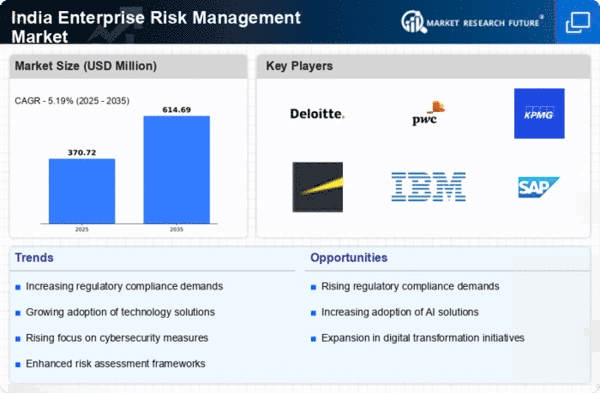
India Enterprise Risk Management Market Infographic
Purchase Options

India Enterprise Risk Management Market Summary

As per Market Research Future analysis, the India Enterprise Risk Management Market Size was estimated at 352.43 USD Million in 2024. The India enterprise risk-management market is projected to grow from 370.72 USD Million in 2025 to 614.69 USD Million by 2035, exhibiting a compound annual growth rate (CAGR) of 5.1% during the forecast period 2025 - 2035

Key Market Trends & Highlights

The India The enterprise risk-management market is experiencing a transformative shift. This shift is driven by technological integration and regulatory demands.

  • The integration of technology in risk management is reshaping traditional practices, enhancing efficiency and accuracy.
  • Regulatory compliance remains a critical focus, as organizations strive to meet evolving legal requirements and standards.
  • The emphasis on resilience and business continuity is becoming increasingly vital for organizations to navigate uncertainties.
  • Key market drivers include growing awareness of risk management and increased regulatory scrutiny, particularly in the context of cybersecurity risks.

Market Size & Forecast

2024 Market Size 352.43 (USD Million)
2035 Market Size 614.69 (USD Million)
CAGR (2025 - 2035) 5.19%

Major Players

Deloitte (US), PwC (GB), KPMG (NL), EY (GB), IBM (US), SAP (DE), Risk Management Solutions (US), LogicManager (US)

Our Impact
Enabled $4.3B Revenue Impact for Fortune 500 and Leading Multinationals
Partnering with 2000+ Global Organizations Each Year
30K+ Citations by Top-Tier Firms in the Industry

India Enterprise Risk Management Market Trends

The enterprise risk-management market is currently evolving. This evolution is driven by the increasing complexity of business environments and the necessity for organizations to navigate various risks effectively. In India, the demand for robust risk management frameworks is growing, as companies recognize the importance of identifying, assessing, and mitigating potential threats to their operations. This shift is influenced by regulatory changes, technological advancements, and a heightened awareness of the need for resilience in the face of uncertainties. As organizations strive to enhance their risk management capabilities, they are increasingly adopting integrated solutions that encompass various aspects of risk, including financial, operational, and reputational factors. Moreover, the enterprise risk-management market is likely to witness further growth as businesses seek to align their risk strategies with overall corporate objectives. The integration of advanced analytics and artificial intelligence into risk management processes appears to be a key trend, enabling organizations to make data-driven decisions and respond proactively to emerging risks. Additionally, the emphasis on compliance with regulatory requirements is expected to drive investments in risk management solutions. As the landscape continues to evolve, organizations in India are poised to leverage innovative approaches to enhance their risk management practices, ensuring they remain competitive and resilient in an ever-changing environment.

Integration of Technology in Risk Management

The enterprise risk-management market is increasingly incorporating advanced technologies such as artificial intelligence and machine learning. These innovations facilitate better data analysis, enabling organizations to identify potential risks more effectively and respond in real-time. This trend suggests a shift towards more proactive risk management strategies.

Regulatory Compliance and Risk Management

With the evolving regulatory landscape, organizations are placing greater emphasis on compliance as a critical component of their risk management strategies. This trend indicates that businesses are investing in solutions that not only address risks but also ensure adherence to legal and regulatory requirements.

Focus on Resilience and Business Continuity

Organizations are recognizing the importance of resilience in their risk management frameworks. This trend highlights a growing commitment to developing comprehensive business continuity plans that address potential disruptions, ensuring that operations can continue smoothly in the face of unforeseen challenges.

India Enterprise Risk Management Market Drivers

Focus on Cybersecurity Risks

The rising threat of cyberattacks is a significant driver of the enterprise risk-management market in India. As organizations increasingly rely on digital platforms, the potential for cyber risks has escalated, prompting businesses to prioritize cybersecurity within their risk management strategies. The enterprise risk-management market is adapting to this need by offering specialized solutions that address cybersecurity threats. According to industry reports, the cybersecurity market in India is projected to reach $3 billion by 2025, indicating a growing recognition of the importance of safeguarding digital assets. This focus on cybersecurity is likely to drive demand for integrated risk management solutions that encompass both traditional and cyber risks, thereby enhancing overall organizational resilience.

Increased Regulatory Scrutiny

The enterprise risk-management market in India is experiencing growth due to increased regulatory scrutiny across various sectors. Regulatory bodies are imposing stricter compliance requirements, compelling organizations to adopt robust risk management frameworks. This trend is particularly pronounced in the financial services sector, where regulations such as the Reserve Bank of India's guidelines necessitate comprehensive risk assessments. As organizations strive to meet these regulatory demands, the enterprise risk-management market is likely to benefit from heightened investments in compliance solutions. It is estimated that compliance-related expenditures could account for up to 30% of total risk management budgets in the coming years. This shift underscores the critical role of effective risk management in ensuring compliance and maintaining operational integrity.

Growing Awareness of Risk Management

The increasing awareness of risk management among organizations in India is driving the enterprise risk-management market. Companies are recognizing the importance of identifying, assessing, and mitigating risks to ensure business continuity and sustainability. This awareness is reflected in the rising investments in risk management solutions, which are projected to reach approximately $1.5 billion by 2026. As organizations strive to enhance their risk management frameworks, the demand for comprehensive enterprise risk-management market solutions is likely to grow. This trend is particularly evident in sectors such as finance, healthcare, and manufacturing, where the potential impact of risks can be substantial. Consequently, the enterprise risk-management market is expected to expand as businesses prioritize risk management as a critical component of their strategic planning.

Emphasis on Sustainable Business Practices

The enterprise risk-management market is influenced by the increasing emphasis on sustainable business practices in India. Organizations are recognizing that sustainability is not only a moral imperative but also a critical component of risk management. By integrating environmental, social, and governance (ESG) factors into their risk management frameworks, companies can better anticipate and mitigate risks associated with sustainability challenges. This trend is reflected in the growing number of businesses adopting ESG reporting standards, which is expected to rise by 40% by 2026. As organizations align their risk management strategies with sustainability goals, the enterprise risk-management market is likely to see a corresponding increase in demand for solutions that facilitate this integration.

Technological Advancements in Risk Assessment

Technological advancements are significantly influencing the enterprise risk-management market in India. The integration of artificial intelligence (AI), machine learning (ML), and big data analytics into risk assessment processes is enhancing the ability of organizations to identify and mitigate risks effectively. These technologies enable real-time monitoring and predictive analytics, allowing businesses to respond proactively to potential threats. As a result, the enterprise risk-management market is witnessing a surge in demand for innovative solutions that leverage these technologies. According to estimates, the market for AI-driven risk management solutions is expected to grow at a CAGR of over 20% through 2025. This trend indicates a shift towards more sophisticated risk management practices, positioning organizations to better navigate the complexities of the modern business environment.


Market Segment Insights

By Type: Financial Risk (Largest) vs. Operational Risk (Fastest-Growing)

In the India enterprise risk-management market, the distribution of market share among segment values indicates that Financial Risk holds the largest share, strongly driven by businesses' prioritization of fiscal stability and regulatory compliance. Hazard Risk follows, while Operational and Strategic Risks are gaining traction as companies increasingly recognize their significance in a holistic risk management approach. Growth trends within this segment are fueled by rising awareness around risk mitigation strategies, technological advancements in risk assessment tools, and a shift towards proactive risk management paradigms. Operational Risk is emerging as the fastest-growing segment, propelled by the growing complexities of business processes and the need for organizations to adapt swiftly to market changes, reflecting an evolving landscape of risk perceptions.

Financial Risk: Dominant vs. Operational Risk: Emerging

Financial Risk is characterized by its traditional dominance in the market, focusing on fiscal aspects, credit risk analysis, and maintaining liquidity, making it crucial for organizations seeking long-term stability. Businesses prioritize this risk type due to regulatory frameworks and economic volatility, which necessitate robust financial controls. On the other hand, Operational Risk, while emerging, is gaining immense traction as firms seek to navigate increasing complexities in their operations. Factors like supply chain disruptions, cybersecurity threats, and human errors highlight this risk type’s growing importance. Organizations are now investing in technologies and strategies designed to streamline operations, thereby enhancing their resilience against potential disruptions while fostering a proactive risk management culture.

By Application: Banks (Largest) vs. Credit Unions (Fastest-Growing)

In the India enterprise risk-management market, the distribution of market share among the application segment values shows that banks hold a dominant position due to their extensive operations and regulatory requirements. The strong presence of banks is supported by their large customer base and a significant need for risk management solutions to effectively manage financial uncertainties and compliance challenges. On the other hand, credit unions, while smaller in market share, are rapidly gaining traction as they become more aware of the need for robust risk management frameworks tailored to their unique operational challenges. The growth trends for the application segment in this market reveal that credit unions are emerging as the fastest-growing segment, primarily driven by the increasing focus on member satisfaction and risk mitigation. They are increasingly adopting technology solutions to enhance their risk management capabilities, ensuring compliance and improving operational efficiency. This is further fueled by regulatory changes that encourage these institutions to invest in better risk management solutions to protect their assets and members.

Banks (Dominant) vs. Credit Unions (Emerging)

Banks are the dominant players in the application segment, characterized by their extensive infrastructure, compliance requirements, and a comprehensive range of risk management products. Their size allows them to absorb risks more effectively due to diversified portfolios and deep expertise in risk assessment. Conversely, credit unions represent the emerging segment, increasingly focusing on tailored risk management solutions to cater to the distinct needs of their memberships. Their community-oriented approach allows them to address risks uniquely, often with innovative strategies that differ from traditional banks, ultimately leading to enhanced member trust and engagement in risk management processes.

Get more detailed insights about India Enterprise Risk Management Market

Key Players and Competitive Insights

The enterprise risk-management market in India is currently characterized by a dynamic competitive landscape, driven by increasing regulatory requirements and the growing complexity of business operations. Major players such as Deloitte (US), PwC (GB), and KPMG (NL) are strategically positioned to leverage their extensive expertise in risk assessment and management. These firms are focusing on digital transformation and innovation, which are essential for addressing the evolving needs of clients. Their collective strategies not only enhance their service offerings but also contribute to a more competitive environment, as they continuously adapt to the changing risk landscape.
Key business tactics employed by these firms include localizing services to better meet regional demands and optimizing their supply chains to enhance efficiency. The market appears moderately fragmented, with a mix of large multinational corporations and smaller specialized firms. This structure allows for a diverse range of services, although the influence of key players remains significant in shaping market trends and client expectations.
In October 2025, Deloitte (US) announced a strategic partnership with a leading technology firm to enhance its risk analytics capabilities. This collaboration is expected to integrate advanced AI tools into their risk management solutions, thereby improving predictive analytics and decision-making processes for clients. Such a move underscores Deloitte's commitment to innovation and positions it favorably in a market increasingly driven by technology.
In September 2025, PwC (GB) launched a new suite of risk management services tailored specifically for the financial sector. This initiative aims to address the unique challenges faced by financial institutions in managing regulatory compliance and operational risks. By focusing on this niche, PwC is likely to strengthen its market presence and attract a broader client base, reflecting a strategic shift towards sector-specific solutions.
In August 2025, KPMG (NL) expanded its risk management consulting services through the acquisition of a local firm specializing in cybersecurity. This acquisition not only enhances KPMG's service portfolio but also indicates a growing recognition of the importance of cybersecurity in enterprise risk management. The integration of these services is expected to provide clients with a more comprehensive approach to risk mitigation, aligning with current market demands.
As of November 2025, the competitive trends in the enterprise risk-management market are increasingly defined by digitalization, sustainability, and the integration of AI technologies. Strategic alliances among key players are shaping the landscape, fostering innovation and enhancing service delivery. Looking ahead, it is anticipated that competitive differentiation will evolve, with a shift from traditional price-based competition towards a focus on technological innovation, reliability in supply chains, and the ability to provide tailored solutions that meet the specific needs of clients.

Key Companies in the India Enterprise Risk Management Market include

Industry Developments

During its SAP NOW AI Tour in April 2025, SAP India presented use cases for AI-powered risk management. These use cases included automated risk workflows integrated into SAP Business Cloud, predictive forecasting, and natural language compliance monitoring, indicating active adoption across industries such as IT, manufacturing, and finance.

Using AI-driven risk assessment tools like MigrateX to reduce disruption and improve operational resilience, Deloitte India launched in January 2025 a Near Zero Cost Migration initiative with SAP and AWS to expedite business transitions to cloud-based RISE with SAP S/4HANA.In order to assist infrastructure and financial institutions, PwC India introduced an ERM-as-a-Service offering in February 2025 that was aimed at vital industries. It included frameworks that were in line with ISO 31000 with scenario simulation and real-time risk dashboards.

Aon India previously launched its life and health reinsurance business in March 2024, offering sophisticated risk modeling and capital optimization services specifically designed for Indian insurers.Last but not least, Capgemini India strengthened enterprise-wide risk frameworks through unified portals and compliance procedures by implementing credit risk analytics systems utilizing Oracle and SAS technologies in late 2024 in collaboration with regional banks.

These advancements highlight India's quickly changing ERM ecosystem, which is marked by cloud-led risk migration initiatives, AI-enhanced platforms, SaaS-based consulting services, and data-driven capital solutions that are in line with national business and regulatory agendas.

Future Outlook

India Enterprise Risk Management Market Future Outlook

The enterprise risk-management market in India is projected to grow at a 5.19% CAGR from 2025 to 2035, driven by regulatory compliance, technological advancements, and increasing awareness of risk mitigation.

New opportunities lie in:

  • Development of AI-driven risk assessment tools for real-time analytics.
  • Integration of blockchain technology for enhanced data security and transparency.
  • Expansion of risk management consulting services tailored for SMEs.

By 2035, the enterprise risk-management market is expected to be robust, reflecting substantial growth and innovation.

Market Segmentation

India Enterprise Risk Management Market Type Outlook

  • Hazard Risk
  • Financial Risk
  • Operational Risk
  • Strategic Risks

India Enterprise Risk Management Market Application Outlook

  • Banks
  • Credit Unions
  • Thrifts

Report Scope

MARKET SIZE 2024 352.43(USD Million)
MARKET SIZE 2025 370.72(USD Million)
MARKET SIZE 2035 614.69(USD Million)
COMPOUND ANNUAL GROWTH RATE (CAGR) 5.19% (2025 - 2035)
REPORT COVERAGE Revenue Forecast, Competitive Landscape, Growth Factors, and Trends
BASE YEAR 2024
Market Forecast Period 2025 - 2035
Historical Data 2019 - 2024
Market Forecast Units USD Million
Key Companies Profiled Deloitte (US), PwC (GB), KPMG (NL), EY (GB), IBM (US), SAP (DE), Risk Management Solutions (US), LogicManager (US)
Segments Covered Type, Application
Key Market Opportunities Integration of advanced analytics and artificial intelligence in the enterprise risk-management market.
Key Market Dynamics Growing regulatory scrutiny drives demand for comprehensive enterprise risk-management solutions in India.
Countries Covered India
Leave a Comment

FAQs

What is the projected market size of the India Enterprise Risk Management Market by 2035?

The India Enterprise Risk Management Market is expected to be valued at 800.0 million USD by 2035.

What is the expected compound annual growth rate (CAGR) for the India Enterprise Risk Management Market from 2025 to 2035?

The expected CAGR for the India Enterprise Risk Management Market from 2025 to 2035 is 6.504%.

What was the market value for Hazard Risk in 2024, and what is it expected to be in 2035?

The market value for Hazard Risk in 2024 is 90.0 million USD, and it is anticipated to reach 180.0 million USD by 2035.

What is the size of the Financial Risk segment in the India Enterprise Risk Management Market for the years 2024 and 2035?

The Financial Risk segment is valued at 100.0 million USD in 2024 and is expected to grow to 200.0 million USD by 2035.

Which segments constitute the largest share in the India Enterprise Risk Management Market?

Operational Risk and Strategic Risks comprise substantial shares in the India Enterprise Risk Management Market.

Who are the prominent players in the India Enterprise Risk Management Market?

The key players include Zinnov, SAP, Capgemini, RiskPro, Wipro, and Infosys among others.

What growth is anticipated for the Operational Risk segment between 2024 and 2035?

The Operational Risk segment is expected to grow from 95.0 million USD in 2024 to 190.0 million USD by 2035.

How much is the Strategic Risks segment valued at in 2024 and what is its forecasted value in 2035?

The Strategic Risks segment is valued at 115.0 million USD in 2024 and projected to be 230.0 million USD in 2035.

What are the primary growth drivers for the India Enterprise Risk Management Market?

Increasing regulatory requirements and rising awareness of risk management practices are key growth drivers for the market.

What challenges does the India Enterprise Risk Management Market currently face?

The market faces challenges like data security concerns and the evolving nature of risks associated with digital transformation.

Download Free Sample

Kindly complete the form below to receive a free sample of this Report

Compare Licence

×
Features License Type
Single User Multiuser License Enterprise User
Price $4,950 $5,950 $7,250
Maximum User Access Limit 1 User Upto 10 Users Unrestricted Access Throughout the Organization
Free Customization
Direct Access to Analyst
Deliverable Format
Platform Access
Discount on Next Purchase 10% 15% 15%
Printable Versions