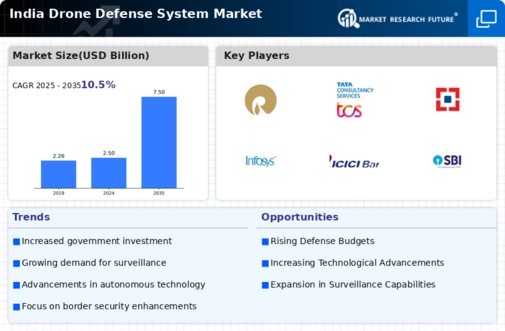
The drone defense system market in India is characterized by a rapidly evolving competitive landscape, driven by technological advancements and increasing defense expenditures. Key players such as Bharat Electronics Limited (India), Hindustan Aeronautics Limited (India), and DRDO (Defence Research and Development Organisation) (India) are at the forefront, focusing on innovation and strategic partnerships to enhance their operational capabilities. These companies are not only investing in research and development but are also exploring collaborations with international firms to leverage advanced technologies, thereby shaping a competitive environment that emphasizes both local expertise and global best practices.
In terms of business tactics, localizing manufacturing has emerged as a critical strategy among major players, allowing them to reduce costs and enhance supply chain efficiency. The market structure appears moderately fragmented, with several domestic and international firms vying for market share. This fragmentation is indicative of a dynamic environment where established companies and new entrants alike are striving to carve out their niches, thus intensifying competition.
In December 2025, Hindustan Aeronautics Limited (India) announced a strategic partnership with a leading European defense contractor to co-develop advanced drone systems tailored for surveillance and reconnaissance missions. This collaboration is expected to enhance Hindustan Aeronautics Limited's technological capabilities and expand its product offerings, positioning the company favorably in the competitive landscape. The partnership underscores the importance of international collaboration in driving innovation within the sector.
In November 2025, Bharat Electronics Limited (India) unveiled a new line of drone defense systems equipped with AI-driven capabilities for threat detection and response. This launch is significant as it reflects the company's commitment to integrating cutting-edge technology into its offerings, potentially setting a new standard in the market. The incorporation of AI not only enhances operational efficiency but also aligns with global trends towards automation in defense systems.
In January 2026, DRDO (Defence Research and Development Organisation) (India) successfully conducted a series of tests for its indigenous drone defense system, showcasing its capabilities in neutralizing aerial threats. This achievement is pivotal as it demonstrates India's growing self-reliance in defense technology and reinforces DRDO's role as a key player in the market. The successful tests may lead to increased demand for indigenous solutions, further shaping the competitive dynamics.
As of January 2026, current trends in the drone defense system market are increasingly defined by digitalization, sustainability, and the integration of AI technologies. Strategic alliances are becoming more prevalent, as companies recognize the need to pool resources and expertise to remain competitive. Looking ahead, it is likely that competitive differentiation will evolve, shifting from traditional price-based competition to a focus on innovation, technological advancement, and supply chain reliability. This transition may redefine the parameters of success in the market, emphasizing the importance of agility and responsiveness to emerging threats.