×
Request Free Sample ×

Kindly complete the form below to receive a free sample of this Report

* Please use a valid business email

Leading companies partner with us for data-driven Insights

clients tt-cursor
Hero Background

India Dercums Disease Market

ID: MRFR/HC/47428-HCR
200 Pages
Rahul Gotadki
February 2026

India Dercum's Disease Market Research Report By Treatment (Surgery, Medication, Liposuction, Electrotherapy, Acupuncture, Others), By End user (Hospital & Clinics, Ambulatory Surgical Centers, Others) andBy Distribution Channel (Hospital Pharmacies, Retail Pharmacies, Others) - Growth & Industry Forecast 2025 To 2035

Share:
Download PDF ×

We do not share your information with anyone. However, we may send you emails based on your report interest from time to time. You may contact us at any time to opt-out.

India Dercums Disease Market Infographic
Purchase Options

India Dercums Disease Market Summary

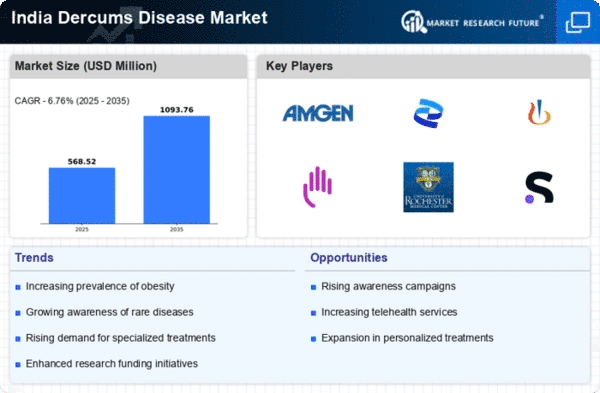
As per Market Research Future analysis, the India dercums disease market size was estimated at 532.52 USD Million in 2024. The India dercums disease market is projected to grow from 568.52 USD Million in 2025 to 1093.76 USD Million by 2035, exhibiting a compound annual growth rate (CAGR) of 6.7% during the forecast period 2025 - 2035

Key Market Trends & Highlights

The India dercums disease market is experiencing notable growth driven by increased awareness and advancements in treatment options.

  • Rising awareness and education about dercums disease are enhancing patient engagement and diagnosis.
  • Advancements in treatment options are expanding the therapeutic landscape for patients with dercums disease.
  • Patient-centric approaches are becoming more prevalent, focusing on individualized care and support.
  • The increasing prevalence of dercums disease and government initiatives are key drivers of market growth.

Market Size & Forecast

2024 Market Size 532.52 (USD Million)
2035 Market Size 1093.76 (USD Million)
CAGR (2025 - 2035) 6.76%

Major Players

Amgen (US), Pfizer (US), Novartis (CH), Bristol-Myers Squibb (US), Roche (CH), Sanofi (FR), Eli Lilly (US), AstraZeneca (GB)

Our Impact
Enabled $4.3B Revenue Impact for Fortune 500 and Leading Multinationals
Partnering with 2000+ Global Organizations Each Year
30K+ Citations by Top-Tier Firms in the Industry

India Dercums Disease Market Trends

the dercums disease market is currently experiencing significant growth, driven by increasing awareness and understanding of the condition. This rare disorder, characterized by painful lipomas, has garnered attention from both healthcare professionals and patients alike. As a result, there is a growing demand for effective treatment options and management strategies. The healthcare sector is responding to this need by developing innovative therapies and enhancing patient support systems. Furthermore, the integration of advanced technologies in diagnostics and treatment is likely to play a crucial role in shaping the future landscape of the market. In addition, the dercums disease market is witnessing a shift towards personalized medicine, where treatments are tailored to individual patient profiles. This approach improves patient outcomes and fosters a more patient-centric healthcare environment. Collaboration among stakeholders, including researchers, healthcare providers, and patient advocacy groups, appears to be strengthening, which may lead to more comprehensive care solutions. Overall, the market is poised for growth, with ongoing research and development efforts likely to yield new insights and advancements in the management of this complex condition.

Rising Awareness and Education

There is an increasing focus on raising awareness about dercums disease among healthcare professionals and the general public. Educational initiatives aim to improve understanding of the condition, its symptoms, and available treatment options. This trend is likely to enhance early diagnosis and encourage patients to seek medical advice sooner.

Advancements in Treatment Options

The dercums disease market is witnessing significant advancements in treatment methodologies. Innovative therapies, including minimally invasive procedures and targeted medications, are being explored to alleviate symptoms and improve quality of life for patients. This trend suggests a shift towards more effective management strategies.

Patient-Centric Approaches

A growing emphasis on patient-centric care is evident within the dercums disease market. Healthcare providers are increasingly focusing on personalized treatment plans that consider individual patient needs and preferences. This approach may lead to improved patient satisfaction and better health outcomes.

India Dercums Disease Market Drivers

Government Initiatives and Support

Government initiatives aimed at improving healthcare access and funding for rare diseases are pivotal for the dercums disease market. In India, the government has been actively promoting awareness and research into rare diseases through various programs and policies. For instance, the National Policy for Rare Diseases encourages the development of treatment protocols and financial support for patients. Such initiatives not only enhance the visibility of Dercums disease but also facilitate access to necessary treatments and care. The allocation of funds for research and development in rare diseases is expected to increase, potentially leading to breakthroughs in treatment options. This supportive environment is likely to attract pharmaceutical companies and researchers to invest in the dercums disease market, ultimately benefiting patients and healthcare providers alike.

Increasing Prevalence of Dercums Disease

The rising incidence of Dercums disease in India is a crucial driver for the dercums disease market. Recent studies indicate that the prevalence of this rare condition is gradually increasing, with estimates suggesting that approximately 1 in 100,000 individuals may be affected. This growing patient population necessitates enhanced healthcare services and treatment options, thereby expanding the market. As awareness of the disease spreads among healthcare professionals and the general public, more individuals are likely to seek diagnosis and treatment, further propelling market growth. The increasing prevalence also highlights the need for specialized medical research and development, which could lead to innovative therapies and management strategies within the dercums disease market. Consequently, stakeholders in the healthcare sector are likely to invest more resources into addressing this condition, fostering a more robust market environment.

Technological Advancements in Diagnostics

Technological advancements in diagnostic tools and methodologies are significantly influencing the dercums disease market. Innovations such as genetic testing and advanced imaging techniques are enabling earlier and more accurate diagnosis of Dercums disease. These advancements are crucial, as timely diagnosis can lead to better management of the condition and improved patient outcomes. The integration of artificial intelligence and machine learning in diagnostic processes is also emerging, potentially streamlining the identification of rare diseases. As diagnostic capabilities improve, healthcare providers are likely to see an increase in the number of diagnosed cases, which could drive demand for treatment options and services within the dercums disease market. This trend suggests a growing need for healthcare professionals to stay updated on the latest diagnostic technologies to effectively address patient needs.

Rising Investment in Rare Disease Research

The increasing investment in research and development for rare diseases is a significant driver for the dercums disease market. In India, both public and private sectors are recognizing the importance of addressing rare conditions, leading to a surge in funding for research initiatives. This investment is likely to foster collaborations between academic institutions, pharmaceutical companies, and healthcare organizations, aimed at discovering new treatment modalities for Dercums disease. Furthermore, the establishment of research grants and incentives for rare disease studies is expected to attract more researchers to this field. As a result, the dercums disease market may witness a rise in innovative therapies and clinical trials, ultimately enhancing treatment options available to patients. This focus on research not only benefits those affected by Dercums disease but also contributes to the overall advancement of medical science.

Growing Patient Advocacy and Support Groups

The emergence of patient advocacy and support groups is playing a vital role in shaping the dercums disease market. In India, these organizations are dedicated to raising awareness about Dercums disease, providing resources for patients and families, and advocating for better healthcare policies. By fostering a community of support, these groups empower patients to seek appropriate medical care and participate in clinical trials. Their efforts in educating the public and healthcare professionals about the disease are likely to lead to increased diagnosis rates and demand for treatment options. Additionally, patient advocacy groups often collaborate with pharmaceutical companies and researchers to influence the development of new therapies. This collaborative approach not only enhances the visibility of Dercums disease but also drives innovation within the dercums disease market, ultimately benefiting patients and healthcare providers.

Market Segment Insights

By Treatment: Surgery (Largest) vs. Medication (Fastest-Growing)

In the India dercums disease market, the treatment landscape is diverse, showcasing significant variations in market share among different methodologies. Surgery remains the largest segment, leveraging advanced technologies and specialized procedures to address severe cases. Meanwhile, medication has gained notable traction due to increased accessibility and growing awareness about pharmacological options for treatment. The growth of the treatment segment is driven by factors such as technological advancements and an increasing emphasis on minimally invasive procedures. Medication is emerging rapidly as patients benefit from new drug developments and personalized treatment approaches. Furthermore, alternative therapies like acupuncture and electrotherapy are gaining acceptance, contributing positively to the dynamics of the market as patients seek holistic and complementary treatment options.

Surgery (Dominant) vs. Medication (Emerging)

Surgery plays a dominant role in the treatment of dercums disease, characterized by precise operative techniques and the use of advanced surgical equipment. This segment is preferred for its immediate effectiveness in severe cases, ensuring rapid recovery and optimal patient outcomes. Conversely, medication is becoming an emerging choice among patients due to its convenience and as a non-invasive alternative. This segment focuses on innovative drug formulations and enhanced treatment regimens, which are tailored to individual needs. The increasing reliance on pharmaceuticals is reshaping patient expectations, and both segments emphasize quality and efficacy to cater to the evolving demands in the India dercums disease market.

By End User: Hospital & Clinics (Largest) vs. Ambulatory Surgical Centers (Fastest-Growing)

In the India dercums disease market, the market share distribution among end user segments reveals that Hospitals & Clinics hold the largest share, evidencing their critical role in managing and treating the disease. Ambulatory Surgical Centers represent a rapidly gaining portion of the market as they adapt to meet the increasing demand for outpatient surgical procedures related to dercums disease. This shift underscores the evolving nature of healthcare delivery in the region. Growth trends in this segment are significantly influenced by the increasing prevalence of dercums disease and the corresponding rise in patient awareness and healthcare access. Ambulatory Surgical Centers, in particular, are witnessing rapid growth due to their cost-effectiveness and convenience, making them a preferred choice for many patients. Hospitals & Clinics continue to dominate due to their comprehensive services and established reputation, further solidifying their market standing.

Hospitals & Clinics (Dominant) vs. Ambulatory Surgical Centers (Emerging)

In the context of the India dercums disease market, Hospitals & Clinics are the dominant segment characterized by their extensive facilities, healthcare professionals, and integrated services that cater to a wide range of patient needs. These establishments not only provide emergency care but also offer specialized treatments for dercums disease, leading to a steady influx of patients. Conversely, Ambulatory Surgical Centers serve as an emerging segment that is reshaping the landscape of surgical care. They focus on outpatient procedures, allowing patients to undergo surgery and return home the same day. This model appeals to a growing demographic that prioritizes convenience and efficiency in healthcare, showcasing how the market is adapting to changing patient preferences.

By Distribution Channel: Retail Pharmacies (Largest) vs. Hospital Pharmacies (Fastest-Growing)

In the India dercums disease market, the distribution of sales among various channels shows that retail pharmacies hold the largest share, dominating the landscape significantly due to their accessibility and convenience for patients. In contrast, hospital pharmacies are recognized as the fastest-growing segment, catering to a more specialized customer base that requires tailored medical care and prescriptions. This dynamic creates a competitive play where each channel appeals to different patient needs and purchasing behaviors. The growth trends in the distribution channel segment reveal an overall increase in demand for pharmaceuticals, evidenced by the rising number of retail pharmacies across urban and rural areas. Hospital pharmacies are growing rapidly owing to the increasing prevalence of dercums disease and the resulting need for specialized medications and treatment regimens. This dual focus on convenience and specialized care is driving innovation and expanding the customer base within the market.

Retail Pharmacies (Dominant) vs. Hospital Pharmacies (Emerging)

Retail pharmacies are recognized as the dominant distribution channel in the India dercums disease market, providing easy access to a wide range of pharmaceutical products. Their strength lies in their extensive network and ability to serve diverse customer demographics, making medications easily available. Additionally, retail pharmacies are increasingly engaging in digital outreach and e-commerce to enhance patient engagement. On the other hand, hospital pharmacies represent an emerging segment that is rapidly gaining traction, driven by the rising number of patients requiring specialized care for dercums disease. These pharmacies are often better positioned to offer tailored medications and expert advice, allowing them to cater to patients with complex needs. As patient awareness and accessibility improve, both channels are likely to continue evolving.

Get more detailed insights about India Dercums Disease Market

Key Players and Competitive Insights

The dercums disease market is characterized by a complex competitive landscape, driven by a combination of innovative therapies, strategic partnerships, and regional expansions. Key players such as Amgen (US), Pfizer (US), and Novartis (CH) are actively shaping the market dynamics through their focused operational strategies. Amgen (US) emphasizes innovation in biologics, particularly in developing targeted therapies that address the unique challenges of dercums disease. Pfizer (US), on the other hand, is leveraging its extensive research capabilities to enhance drug efficacy and patient outcomes, while Novartis (CH) is pursuing strategic collaborations to broaden its therapeutic portfolio, thereby enhancing its market presence. Collectively, these strategies foster a competitive environment that prioritizes patient-centric solutions and technological advancements.In terms of business tactics, companies are increasingly localizing manufacturing to reduce costs and improve supply chain efficiency. This approach not only enhances responsiveness to market demands but also aligns with sustainability goals. The competitive structure of the market appears moderately fragmented, with several players vying for market share. However, the influence of major companies is substantial, as they set benchmarks for innovation and operational excellence, thereby shaping the overall market dynamics.

In October Amgen (US) announced a strategic partnership with a leading Indian biotech firm to co-develop a novel treatment for dercums disease. This collaboration is expected to leverage local expertise and accelerate the development process, potentially leading to faster market entry and improved patient access. Such strategic alliances are crucial in navigating the complexities of the Indian healthcare landscape, where localized solutions are increasingly favored.

In September Pfizer (US) launched a new digital health initiative aimed at enhancing patient engagement and adherence to treatment protocols for dercums disease. This initiative utilizes advanced analytics and AI-driven tools to monitor patient progress and optimize treatment plans. The strategic importance of this move lies in its potential to improve patient outcomes while simultaneously gathering valuable data that can inform future product development.

In August Novartis (CH) expanded its clinical trial network in India, focusing on innovative therapies for dercums disease. This expansion is indicative of the company's commitment to investing in local research capabilities, which may enhance its competitive edge by facilitating faster and more relevant clinical insights. Such investments are likely to yield long-term benefits, positioning Novartis as a leader in the therapeutic landscape.

As of November current trends in the dercums disease market are increasingly defined by digitalization, sustainability, and the integration of AI technologies. Strategic alliances are becoming more prevalent, as companies recognize the value of collaborative innovation in addressing complex healthcare challenges. Looking ahead, competitive differentiation is expected to evolve, shifting from traditional price-based competition to a focus on innovation, technological advancements, and supply chain reliability. This transition underscores the importance of agility and responsiveness in a rapidly changing market environment.

Key Companies in the India Dercums Disease Market include

Industry Developments

Recent developments in the India Dercum's Disease Market indicate a growing focus on patient care and innovative treatments. Roche India and Sanofi India are actively involved in enhancing their product portfolios to address the unique needs of Dercum's Disease patients. The market has seen a push towards more personalized medicine and targeted therapies, with companies like Lupin and Pfizer India making significant investments in Research and Development to develop effective treatments.

In terms of mergers and acquisitions, there have not been any publicly known transactions related specifically to Dercum's Disease among the listed companies in recent months. However, the pharmaceutical sector in India is witnessing consistent growth, with companies like Dr. Reddy's Laboratories and Sun Pharmaceutical Industries expanding their reach in the therapeutic areas related to this condition. The Indian government continues to support healthcare initiatives, which is conducive to drug development and distribution.

The overall market valuation for companies addressing Dercum's Disease has been on an upward trajectory, facilitating better access to treatments and improved patient outcomes in the region. Over the last few years, significant attention has also been placed on raising awareness about this rare condition among healthcare professionals in India.

Future Outlook

India Dercums Disease Market Future Outlook

The Dercums Disease Market is projected to grow at a 6.76% CAGR from 2025 to 2035, driven by increasing awareness, advancements in treatment options, and rising healthcare investments.

New opportunities lie in:

  • Development of targeted therapies for symptom management
  • Expansion of telehealth services for patient monitoring
  • Investment in patient education programs to enhance treatment adherence

By 2035, the dercums disease market is expected to achieve substantial growth and innovation.

Market Segmentation

India Dercums Disease Market End User Outlook

  • Hospital & Clinics
  • Ambulatory Surgical Centers
  • Others

India Dercums Disease Market Treatment Outlook

  • Surgery
  • Medication
  • Liposuction
  • Electrotherapy
  • Acupuncture
  • Others

India Dercums Disease Market Distribution Channel Outlook

  • Hospital Pharmacies
  • Retail Pharmacies
  • Others

Report Scope

MARKET SIZE 2024 532.52(USD Million)
MARKET SIZE 2025 568.52(USD Million)
MARKET SIZE 2035 1093.76(USD Million)
COMPOUND ANNUAL GROWTH RATE (CAGR) 6.76% (2025 - 2035)
REPORT COVERAGE Revenue Forecast, Competitive Landscape, Growth Factors, and Trends
BASE YEAR 2024
Market Forecast Period 2025 - 2035
Historical Data 2019 - 2024
Market Forecast Units USD Million
Key Companies Profiled Amgen (US), Pfizer (US), Novartis (CH), Bristol-Myers Squibb (US), Roche (CH), Sanofi (FR), Eli Lilly (US), AstraZeneca (GB)
Segments Covered Treatment, End User, Distribution Channel
Key Market Opportunities Emerging therapies and personalized treatment options present growth potential in the dercums disease market.
Key Market Dynamics Rising awareness and diagnosis of Dercum's disease drive demand for targeted therapies and patient support services.
Countries Covered India
Leave a Comment

FAQs

What is the current market size of the India Dercum's Disease Market in 2024?

The India Dercum's Disease Market is expected to be valued at 532.4 USD million in 2024.

What is the projected market size for the India Dercum's Disease Market in 2035?

By 2035, the India Dercum's Disease Market is expected to reach a valuation of 1128.0 USD million.

What is the expected CAGR for the India Dercum's Disease Market from 2025 to 2035?

The expected CAGR for the India Dercum's Disease Market during the forecast period is 7.064 percent.

Which treatment segment is projected to generate the highest revenue in 2035?

In 2035, the Surgery treatment segment is projected to generate approximately 253.0 USD million.

Who are the major players in the India Dercum's Disease Market?

Significant players in the market include Roche India, Sanofi India, and Lupin among others.

What is the estimated market value for Medication treatment segment in 2024?

The Medication treatment segment is estimated to be valued at 160.0 USD million in 2024.

What is the expected market growth for Liposuction treatment segment by 2035?

The Liposuction treatment segment is expected to grow to about 210.0 USD million by 2035.

How much is the Electrotherapy treatment segment valued at in 2024?

Electrotherapy is valued at 82.4 USD million in the year 2024.

What are the growth drivers influencing the India Dercum's Disease Market?

Factors such as increasing awareness and advancements in treatment options are driving market growth.

What is the expected value of Acupuncture treatment segment in 2035?

In 2035, the Acupuncture treatment segment is anticipated to reach approximately 138.0 USD million.

Download Free Sample

Kindly complete the form below to receive a free sample of this Report

Compare Licence

×
Features License Type
Single User Multiuser License Enterprise User
Price $4,950 $5,950 $7,250
Maximum User Access Limit 1 User Upto 10 Users Unrestricted Access Throughout the Organization
Free Customization
Direct Access to Analyst
Deliverable Format
Platform Access
Discount on Next Purchase 10% 15% 15%
Printable Versions