×
Request Free Sample ×

Kindly complete the form below to receive a free sample of this Report

* Please use a valid business email

Leading companies partner with us for data-driven Insights

clients tt-cursor
Hero Background

India Connected Healthcare Market

ID: MRFR/MED/54630-HCR
200 Pages
Garvit Vyas
February 2026

India Connected Healthcare Market Research Report By Type (M-Health Services, M-Health Devices, E-Prescription) andBy Application (Monitoring, Diagnosis, Treatment, Education, Awareness, Healthcare Management, Wellness, Prevention) - Growth & Industry Forecast 2025 To 2035

Share:
Download PDF ×

We do not share your information with anyone. However, we may send you emails based on your report interest from time to time. You may contact us at any time to opt-out.

India Connected Healthcare Market Infographic
Purchase Options

India Connected Healthcare Market Summary

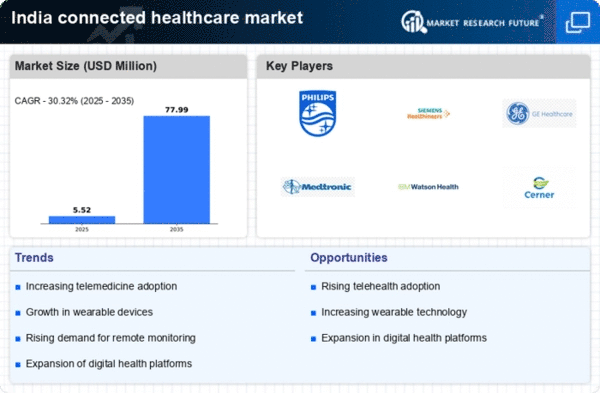
As per Market Research Future analysis, the India Connected Healthcare Market size was estimated at 4.24 USD Million in 2024. The Connected Healthcare market is projected to grow from 5.52 USD Million in 2025 to 77.99 USD Million by 2035, exhibiting a compound annual growth rate (CAGR) of 30.3% during the forecast period 2025 - 2035

Key Market Trends & Highlights

The India connected healthcare market is experiencing robust growth driven by technological advancements and increasing consumer demand.

  • Telemedicine adoption is rapidly increasing, making it a crucial segment in the healthcare landscape.
  • Wearable health technology is emerging as the fastest-growing segment, reflecting a shift towards proactive health management.
  • Data analytics in healthcare is becoming essential for improving patient outcomes and operational efficiency.
  • Rising demand for remote patient monitoring and government initiatives are key drivers propelling market expansion.

Market Size & Forecast

2024 Market Size 4.24 (USD Million)
2035 Market Size 77.99 (USD Million)
CAGR (2025 - 2035) 30.32%

Major Players

Philips (NL), Siemens Healthineers (DE), GE Healthcare (US), Medtronic (US), IBM Watson Health (US), Cerner Corporation (US), Roche Diagnostics (CH), Johnson & Johnson (US), Allscripts Healthcare Solutions (US)

Our Impact
Enabled $4.3B Revenue Impact for Fortune 500 and Leading Multinationals
Partnering with 2000+ Global Organizations Each Year
30K+ Citations by Top-Tier Firms in the Industry

India Connected Healthcare Market Trends

The India Connected Healthcare Market is experiencing notable growth, driven by advancements in technology and increasing demand for efficient healthcare solutions. The integration of digital tools and platforms is transforming traditional healthcare delivery, enabling remote monitoring, telemedicine, and data analytics. This shift not only enhances patient engagement but also improves access to healthcare services, particularly in rural areas. As healthcare providers adopt innovative solutions, the market is likely to witness a surge in investments and collaborations aimed at enhancing service delivery and patient outcomes. Moreover, the regulatory environment is evolving to support the expansion of the connected healthcare market. Government initiatives promoting digital health and the adoption of electronic health records are paving the way for a more connected ecosystem. The emphasis on data security and patient privacy is also becoming paramount, as stakeholders seek to build trust in digital health solutions. As the landscape continues to evolve, the connected healthcare market appears poised for sustained growth, with potential for new entrants and innovations that could further reshape the industry.

Telemedicine Adoption

The rise of telemedicine is a defining trend within the connected healthcare market. With the increasing availability of high-speed internet and mobile connectivity, healthcare providers are leveraging telehealth platforms to offer remote consultations. This trend not only enhances patient convenience but also reduces the burden on healthcare facilities, allowing for more efficient resource allocation.

Wearable Health Technology

Wearable devices are gaining traction in the connected healthcare market, enabling continuous health monitoring. These devices, which track vital signs and physical activity, empower patients to take charge of their health. The data collected can be shared with healthcare professionals, facilitating timely interventions and personalized care.

Data Analytics in Healthcare

The utilization of data analytics is transforming decision-making processes in the connected healthcare market. By analyzing patient data, healthcare providers can identify trends, improve treatment protocols, and enhance operational efficiency. This trend underscores the importance of data-driven strategies in delivering high-quality healthcare services.

India Connected Healthcare Market Drivers

Increased Smartphone Penetration

The rapid increase in smartphone penetration across India is a crucial driver for the connected healthcare market. As of November 2025, smartphone users in India are estimated to reach 800 million, providing a vast platform for health applications and services. This accessibility enables patients to engage with healthcare providers through telemedicine, access health information, and utilize wearable health technologies. The proliferation of mobile health applications is likely to enhance patient adherence to treatment plans and promote preventive healthcare measures. Consequently, the connected healthcare market is poised for significant expansion, with mobile health solutions becoming an integral part of everyday healthcare practices.

Government Initiatives and Support

The Indian government is actively promoting digital health initiatives, which significantly impact the connected healthcare market. Programs such as the National Digital Health Mission aim to create a robust digital health ecosystem, facilitating the integration of technology in healthcare delivery. By 2025, the government has allocated over $500 million to enhance telehealth services and digital infrastructure. These initiatives are designed to improve access to healthcare services, especially in rural areas, where traditional healthcare facilities may be lacking. The support from the government not only encourages innovation but also attracts investments in the connected healthcare market, fostering a conducive environment for growth and development.

Growing Focus on Preventive Healthcare

There is a notable shift towards preventive healthcare in India, which is significantly influencing the connected healthcare market. With rising healthcare costs and an increasing burden of diseases, both patients and providers are prioritizing preventive measures. This trend is reflected in the growing adoption of health monitoring devices and wellness applications. By 2025, the preventive healthcare segment is anticipated to account for over 40% of the connected healthcare market. This focus on prevention not only empowers individuals to take charge of their health but also reduces the overall healthcare expenditure. As a result, the connected healthcare market is likely to experience robust growth, driven by the demand for solutions that promote health and well-being.

Integration of Artificial Intelligence

The integration of artificial intelligence (AI) in healthcare is transforming the connected healthcare market in India. AI technologies are being utilized for predictive analytics, personalized medicine, and operational efficiency. By 2025, it is projected that AI applications in healthcare could generate savings of up to $10 billion annually. These advancements enable healthcare providers to analyze vast amounts of data, leading to improved patient outcomes and streamlined operations. The adoption of AI-driven solutions is likely to enhance diagnostic accuracy and treatment efficacy, thereby fostering trust in the connected healthcare market. As AI continues to evolve, its impact on healthcare delivery in India is expected to grow exponentially.

Rising Demand for Remote Patient Monitoring

The increasing prevalence of chronic diseases in India is driving the demand for remote patient monitoring solutions within the connected healthcare market. As of 2025, approximately 30% of the Indian population suffers from chronic conditions, necessitating continuous health monitoring. This trend is further fueled by the growing awareness of health management among patients and healthcare providers. Remote monitoring technologies enable real-time data collection and analysis, allowing healthcare professionals to make informed decisions. The connected healthcare market is expected to witness substantial growth, with projections indicating a market size of $2 million by 2026. This demand for remote monitoring solutions is likely to enhance patient engagement and improve health outcomes, thereby transforming the healthcare landscape in India.


Market Segment Insights

By Type: M-Health Services (Largest) vs. E-Prescription (Fastest-Growing)

In the India connected healthcare market, M-Health Services hold a significant share, dominating the landscape with a robust user base and widespread adoption across various demographics. E-Prescription, on the other hand, is emerging rapidly as a substantial force, driven by an increasing inclination towards digital solutions in healthcare. This distribution reflects the diverse preferences of consumers and the growing importance of mobile health solutions in everyday healthcare management. Growth trends within the segment are notably vibrant, with M-Health Devices also contributing significantly to the market's dynamics. Factors such as rising smartphone penetration, increased health awareness, and a surge in chronic diseases are propelling the adoption of these technologies. E-Prescription is experiencing notable acceleration, fueled by the urgency for contactless healthcare interactions, especially in the post-pandemic environment, positioning it as a key player in the future of healthcare delivery.

M-Health Services (Dominant) vs. E-Prescription (Emerging)

M-Health Services have established themselves as the dominant segment within the India connected healthcare market, characterized by a comprehensive range of applications that enhance patient engagement and health management. These services leverage mobile platforms to deliver healthcare solutions, such as appointment scheduling, remote monitoring, and health tracking, facilitating easy access and convenience for users. In contrast, E-Prescription represents an emerging trend that streamlines the prescription process and minimizes errors related to manual prescriptions. The rapid adoption of E-Prescription systems is indicative of the industry's shift towards digitization, showcasing the need for efficient, transparent, and reliable methods in prescription management. Both segments highlight the transformative potential of technology in reshaping healthcare delivery and access.

By Application: Monitoring Applications (Largest) vs. Diagnosis & Treatment (Fastest-Growing)

The application segment in the India connected healthcare market is primarily dominated by Monitoring Applications, which capture the largest share. This segment benefits from the rising need for real-time health data monitoring and chronic disease management. In contrast, Diagnosis & Treatment applications are rapidly gaining traction, appealing to both healthcare providers and patients looking for timely health interventions. The diverse range of applications enhances user engagement and fuels market growth. Growth trends indicate a strong demand for innovative healthcare solutions driven by technology. The pandemic has accelerated the adoption of digital health applications, increasing awareness of preventive healthcare and wellness programs. Factors such as a surge in smartphone penetration and internet connectivity, along with government initiatives to promote digital health, are key drivers propelling the market forward. This ecosystem fosters opportunities for new entrants and established players alike to innovate and cater to changing consumer needs.

Monitoring Applications: Dominant vs. Diagnosis & Treatment: Emerging

Monitoring Applications are characterized by their ability to facilitate continuous patient observation, which enhances disease management and improves patient outcomes. These applications typically integrate wearables and smartphone technologies, providing users with easy access to their health data. They hold a dominant position in the market due to their high adoption rate among chronic disease sufferers and a growing preference for remote monitoring. Conversely, Diagnosis & Treatment applications are emerging as critical tools for healthcare professionals, providing timely diagnostic support and treatment recommendations through advanced algorithms. These applications leverage big data and artificial intelligence to enhance diagnostic accuracy and ensure personalized treatment plans, reflecting the increasing consumer shift towards proactive healthcare management.

Get more detailed insights about India Connected Healthcare Market

Key Players and Competitive Insights

The connected healthcare market in India is currently characterized by a dynamic competitive landscape, driven by rapid technological advancements and increasing demand for integrated healthcare solutions. Major players such as Philips (NL), Siemens Healthineers (DE), and GE Healthcare (US) are strategically positioning themselves through innovation and partnerships. Philips (NL) focuses on enhancing patient outcomes through its advanced imaging and monitoring solutions, while Siemens Healthineers (DE) emphasizes digital transformation and AI integration in diagnostics. GE Healthcare (US) is leveraging its extensive portfolio to expand its presence in emerging markets, indicating a collective shift towards comprehensive healthcare solutions that enhance operational efficiency and patient care.Key business tactics within this market include localizing manufacturing and optimizing supply chains to meet the unique demands of the Indian healthcare ecosystem. The competitive structure appears moderately fragmented, with several players vying for market share. However, the influence of key players is substantial, as they drive innovation and set industry standards, thereby shaping the overall market dynamics.

In October Siemens Healthineers (DE) announced a strategic partnership with a leading Indian hospital chain to implement its AI-driven diagnostic solutions. This collaboration aims to enhance diagnostic accuracy and reduce turnaround times, reflecting a growing trend towards integrating advanced technologies in healthcare delivery. Such partnerships are likely to bolster Siemens' market position while simultaneously improving patient care standards in India.

In September GE Healthcare (US) launched a new telehealth platform tailored for rural healthcare providers in India. This initiative is significant as it addresses the accessibility challenges faced by underserved populations, thereby expanding GE's reach and reinforcing its commitment to inclusive healthcare. The platform's introduction may also catalyze further investments in telemedicine, aligning with the broader trend of digital health solutions gaining traction in the region.

In August Philips (NL) unveiled a new remote patient monitoring system designed specifically for chronic disease management. This system integrates seamlessly with existing healthcare infrastructures, allowing for real-time data collection and analysis. The strategic importance of this launch lies in its potential to improve patient engagement and adherence to treatment plans, which is crucial in managing chronic conditions effectively.

As of November the competitive trends in the connected healthcare market are increasingly defined by digitalization, sustainability, and the integration of AI technologies. Strategic alliances among key players are shaping the landscape, fostering innovation and enhancing service delivery. Looking ahead, competitive differentiation is likely to evolve from traditional price-based competition towards a focus on technological innovation, reliability in supply chains, and the ability to deliver superior patient outcomes. This shift underscores the importance of adaptability and forward-thinking strategies in navigating the complexities of the connected healthcare market.

Key Companies in the India Connected Healthcare Market include

Industry Developments

The India Connected Healthcare Market has witnessed significant developments in recent months, particularly among key players such as Qure.ai, PharmEasy, and Practo. In August 2023, Qure.ai expanded its services into more rural areas, enhancing access to diagnostic tools. PharmEasy announced a strategic partnership with Apollo Hospitals in July 2023 to improve telehealth services.

This push for integrated healthcare solutions is reflective of a growing trend in the sector, emphasized by the increasing number of digital health startups in India which received substantial funding, surpassing USD 2 billion in the first half of 2023 alone. In September 2023, HCL Technologies announced the acquisition of a AI healthcare solutions firm to bolster its digital health services.

Additionally, Tata Consultancy Services has been involved in partnerships to enhance healthcare data management systems. Recent advancements in artificial intelligence for health diagnostics were showcased by CureMetrix and Niramai.

These developments illuminate a rapidly evolving market characterized by collaboration and innovation, fundamentally transforming healthcare delivery in India and improving patient outcomes.

Future Outlook

India Connected Healthcare Market Future Outlook

The Connected Healthcare Market in India is poised for growth at 30.32% CAGR from 2025 to 2035, driven by technological advancements, increasing healthcare demand, and policy support.

New opportunities lie in:

  • Telehealth platforms for chronic disease management
  • Wearable health monitoring devices for real-time data
  • AI-driven analytics for personalized patient care

By 2035, the market is expected to achieve substantial growth, enhancing healthcare delivery and accessibility.

Market Segmentation

India Connected Healthcare Market Type Outlook

  • M-Health Services
  • M-Health Devices
  • E-prescription

India Connected Healthcare Market Application Outlook

  • Monitoring Applications
  • Diagnosis & Treatment
  • Education & Awareness
  • Healthcare Management
  • Wellness & Prevention
  • Other Application

Report Scope

MARKET SIZE 2024 4.24(USD Million)
MARKET SIZE 2025 5.52(USD Million)
MARKET SIZE 2035 77.99(USD Million)
COMPOUND ANNUAL GROWTH RATE (CAGR) 30.32% (2025 - 2035)
REPORT COVERAGE Revenue Forecast, Competitive Landscape, Growth Factors, and Trends
BASE YEAR 2024
Market Forecast Period 2025 - 2035
Historical Data 2019 - 2024
Market Forecast Units USD Million
Key Companies Profiled Philips (NL), Siemens Healthineers (DE), GE Healthcare (US), Medtronic (US), IBM Watson Health (US), Cerner Corporation (US), Roche Diagnostics (CH), Johnson & Johnson (US), Allscripts Healthcare Solutions (US)
Segments Covered Type, Application
Key Market Opportunities Integration of artificial intelligence and telehealth solutions enhances patient engagement in the connected healthcare market.
Key Market Dynamics Rapid technological advancements drive growth in connected healthcare, enhancing patient engagement and data management in India.
Countries Covered India
Leave a Comment

FAQs

What was the market size of the India Connected Healthcare Market in 2024?

The India Connected Healthcare Market was valued at 20.0 million USD in 2024.

What market value is projected for the India Connected Healthcare Market by 2035?

By 2035, the India Connected Healthcare Market is expected to reach a value of 120.0 million USD.

What is the projected CAGR for the India Connected Healthcare Market from 2025 to 2035?

The projected CAGR for the India Connected Healthcare Market from 2025 to 2035 is 17.69%.

What segment of the market is expected to dominate in terms of value in the year 2035?

In 2035, M-Health Devices are expected to dominate the market with a value of 48.0 million USD.

How much was the M-Health Services segment valued in 2024?

In 2024, the M-Health Services segment was valued at 6.0 million USD.

What is the market value for E-Prescription in 2035?

In 2035, the E-Prescription segment is projected to be valued at 36.0 million USD.

Who are the key players in the India Connected Healthcare Market?

Key players in the market include Qure.ai, PharmEasy, JustDoc, HCL Technologies, and Practo, among others.

What growth opportunities are present in the India Connected Healthcare Market?

The growth opportunities in the market are driven by advancements in technology, increasing smartphone penetration, and growing healthcare demands.

Which region is expected to see the highest growth in the India Connected Healthcare Market?

The overall market growth is anticipated across India, with urban areas likely experiencing the highest demand.

What challenges does the India Connected Healthcare Market face?

Challenges in the market include regulatory hurdles, data privacy concerns, and the need for robust infrastructure.

Download Free Sample

Kindly complete the form below to receive a free sample of this Report

Compare Licence

×
Features License Type
Single User Multiuser License Enterprise User
Price $4,950 $5,950 $7,250
Maximum User Access Limit 1 User Upto 10 Users Unrestricted Access Throughout the Organization
Free Customization
Direct Access to Analyst
Deliverable Format
Platform Access
Discount on Next Purchase 10% 15% 15%
Printable Versions