×
Request Free Sample ×

Kindly complete the form below to receive a free sample of this Report

* Please use a valid business email

Leading companies partner with us for data-driven Insights

clients tt-cursor
Hero Background

India Condiments Market

ID: MRFR/FnB/46847-HCR
128 Pages
Snehal Singh
February 2026

India Condiments Market Size, Share, Industry Trend & Analysis Research Report: By Condiments Type (Spices, Sauces & Ketchup, Dressings, Others), By Condiments Packaging Type (Bottles, Pouches & Sachets, Others) andBy Condiments Distribution Channel (Store-Based, Non-Store-Based)- Forecast to 2035

Share:
Download PDF ×

We do not share your information with anyone. However, we may send you emails based on your report interest from time to time. You may contact us at any time to opt-out.

India Condiments Market Infographic
Purchase Options

India Condiments Market Summary

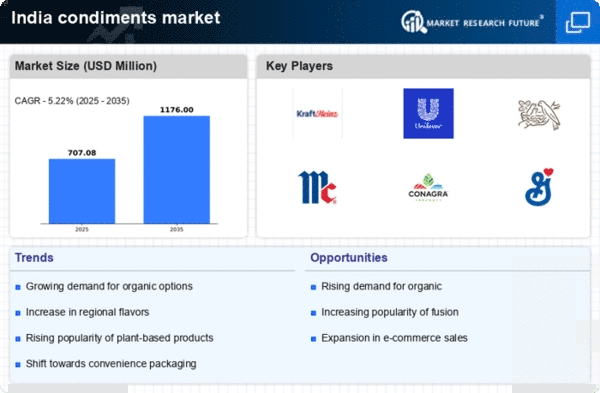
As per Market Research Future analysis, the India condiments market Size was estimated at 672.0 USD Million in 2024. The India condiments market is projected to grow from 707.08 USD Million in 2025 to 1176.0 USD Million by 2035, exhibiting a compound annual growth rate (CAGR) of 5.2% during the forecast period 2025 - 2035

Key Market Trends & Highlights

The India condiments market is experiencing a dynamic shift towards health-conscious and gourmet products, driven by evolving consumer preferences.

  • The largest segment in the India condiments market is the spicy sauces segment, which continues to dominate sales.
  • The fastest-growing segment is the gourmet and artisanal condiments, reflecting a rising consumer interest in unique flavors.
  • E-commerce is rapidly expanding as a distribution channel, facilitating greater access to diverse condiment options.
  • Key market drivers include the rising demand for spicy flavors and the growing interest in organic and natural ingredients.

Market Size & Forecast

2024 Market Size 672.0 (USD Million)
2035 Market Size 1176.0 (USD Million)
CAGR (2025 - 2035) 5.22%

Major Players

Kraft Heinz (US), Unilever (GB), Nestle (CH), McCormick (US), Conagra Brands (US), General Mills (US), Danone (FR), Hormel Foods (US), Pinnacle Foods (US)

Our Impact
Enabled $4.3B Revenue Impact for Fortune 500 and Leading Multinationals
Partnering with 2000+ Global Organizations Each Year
30K+ Citations by Top-Tier Firms in the Industry

India Condiments Market Trends

The condiments market in India exhibits a dynamic landscape characterized by evolving consumer preferences and increasing demand for diverse flavor profiles. As culinary practices become more experimental, there is a noticeable shift towards gourmet and artisanal products. This trend reflects a growing interest in unique taste experiences, prompting manufacturers to innovate and expand their product lines. Additionally, the rise of health-conscious consumers has led to a surge in demand for organic and natural condiments, as individuals seek healthier alternatives to traditional options. The emphasis on clean labels and transparency in ingredient sourcing is reshaping the market, encouraging brands to adopt sustainable practices. Moreover, the digital transformation within the condiments market is noteworthy. E-commerce platforms are gaining traction, providing consumers with convenient access to a wide array of products. This shift not only enhances consumer choice but also allows smaller brands to reach a broader audience. Social media plays a pivotal role in influencing purchasing decisions, as consumers increasingly rely on online reviews and recommendations. Overall, the condiments market in India is poised for continued growth, driven by innovation, health trends, and the digitalization of retail channels.

Health-Conscious Choices

There is a growing inclination among consumers towards healthier condiment options. This trend is evident in the increasing popularity of organic and natural products, as individuals prioritize clean ingredients and nutritional value. Brands are responding by reformulating existing products and introducing new lines that cater to this demand.

Gourmet and Artisanal Products

The market is witnessing a rise in gourmet and artisanal condiments, reflecting a shift in consumer preferences towards unique and high-quality flavor experiences. This trend encourages manufacturers to explore innovative recipes and premium ingredients, appealing to discerning palates.

E-Commerce Expansion

The digital landscape is transforming the condiments market, with e-commerce platforms becoming essential for product distribution. This trend allows consumers to access a wider variety of products conveniently, while also enabling smaller brands to establish a presence in the market.

India Condiments Market Drivers

Rising Demand for Spicy Flavors

The condiments market in India is experiencing a notable surge in demand for spicy flavors, driven by the country's rich culinary heritage. Consumers are increasingly seeking out products that enhance the heat and flavor of their meals. This trend is reflected in the growing popularity of chili sauces, pickles, and spicy chutneys, which have seen a rise in sales by approximately 15% over the past year. The condiments market is adapting to this shift by introducing innovative products that cater to regional tastes, thereby expanding their consumer base. As more individuals experiment with diverse cuisines, the inclination towards spicy condiments is likely to continue, suggesting a robust growth trajectory for this segment of the market.

Convenience and Ready-to-Use Products

In the fast-paced lifestyle of urban India, convenience plays a crucial role in consumer purchasing decisions. The condiments market is witnessing a significant increase in the demand for ready-to-use products, such as sauces and dressings that require minimal preparation. This shift is evidenced by a 20% increase in sales of packaged condiments over the last year. Busy consumers are gravitating towards products that save time while still delivering flavor, leading manufacturers to innovate and expand their offerings. The trend towards convenience is likely to shape the future of the condiments market, as brands strive to meet the needs of a time-conscious population.

Influence of Social Media and Food Trends

The rise of social media platforms has transformed the way consumers engage with food, significantly impacting the condiments market in India. Influencers and food bloggers are increasingly showcasing unique recipes and innovative uses for various condiments, driving consumer interest and experimentation. This trend has led to a notable increase in the visibility of niche products, with some brands reporting a 30% rise in sales attributed to social media marketing efforts. The condiments market is capitalizing on this trend by leveraging digital platforms to reach a broader audience. As social media continues to shape food trends, the market is likely to see ongoing growth and diversification.

Cultural Influences and Regional Variations

India's diverse cultural landscape significantly impacts the condiments market, with regional variations playing a pivotal role in consumer preferences. Different states have unique culinary traditions that influence the types of condiments favored by local populations. For instance, the popularity of coconut chutney in the South contrasts with the demand for tangy pickles in the North. This cultural richness leads to a dynamic market environment, where the condiments market must adapt to local tastes and preferences. As consumers become more adventurous in their culinary explorations, the demand for region-specific condiments is likely to grow, fostering innovation and variety within the market.

Growing Interest in Organic and Natural Ingredients

The condiments market in India is increasingly influenced by a growing consumer preference for organic and natural ingredients. As health awareness rises, individuals are becoming more discerning about the products they consume, leading to a shift towards condiments made from organic sources. This trend is reflected in the market, where organic condiments have seen a growth rate of approximately 25% in the past year. The condiments market is responding by launching new lines of organic sauces, dressings, and spreads, appealing to health-conscious consumers. This movement towards organic products is expected to continue, potentially reshaping the landscape of the condiments market in the coming years.


Market Segment Insights

By Type: Spices (Largest) vs. Sauces & Ketchup (Fastest-Growing)

In the India condiments market, the distribution among the various types of condiments reveals that Spices hold the largest market share, driven by cultural preferences and culinary practices that favor traditional spice blends. Meanwhile, Sauces & Ketchup are showing remarkable growth, appealing to younger demographics and urban consumers who seek convenience and flavor enhancement in their meals. The growth trends in this market segment are influenced significantly by the rising demand for ready-to-eat meals and increasing consumer awareness about flavor variety. Additionally, the trend towards health-conscious eating has led to the emergence of gourmet and organic sauces, which are contributing to the strong performance of the Sauces & Ketchup segment. Consumer preferences are shifting towards products with clean labels, which reflects in the speedy growth of this category.

Spices: Dominant vs. Sauces & Ketchup: Emerging

Spices are deeply entrenched in Indian culinary culture, making them a dominant force in the India condiments market. They are characterized by their versatility and the ability to enhance flavor profiles across a wide range of dishes. The consumer base spans both traditional households and modern kitchens, driving consistent demand. In contrast, Sauces & Ketchup represent an emerging category, particularly favored by the younger population seeking quick meal solutions. The innovative flavors and convenient packaging offered in this segment have made them popular among urban dwellers. As health trends evolve, both segments are adapting, with spices being integrated into health-focused products, while sauces are innovating with natural ingredients, reflecting changing consumer preferences.

By Packaging Type: Bottles (Largest) vs. Pouches & Sachets (Fastest-Growing)

In the India condiments market, the packaging type segment is prominently characterized by bottles, pouches & sachets, and others. Bottles hold the largest market share due to their widespread acceptance and convenience among consumers. Pouches & sachets are gaining traction, especially in the context of single-serve portions, which cater to the evolving consumer preferences for convenience and portability. The growth trends within the packaging type segment are largely driven by changing consumer lifestyles and the increasing demand for on-the-go products. Bottles remain a staple, particularly in the liquid condiments sector, while pouches & sachets are emerging as favorites among younger consumers seeking accessibility and ease of use. This dynamic is indicative of a shifting market landscape, where both packaging forms play crucial roles in attracting diverse consumer demographics.

Bottles (Dominant) vs. Pouches & Sachets (Emerging)

Bottles dominate the packaging type segment due to their established presence and functionality, making them suitable for various condiment applications. They offer advantages such as ease of dispensing and preservation of product quality. Consumers appreciate the variety of sizes and designs available, which enhances brand visibility on retail shelves. In contrast, pouches & sachets represent an emerging trend, offering lightweight, space-efficient solutions for consumers who prioritize convenience. Their ability to provide single-serving options aligns perfectly with busy lifestyles, driving their popularity among younger demographics. Both packaging types are expected to evolve further to meet sustainability demands, with a noticeable shift towards eco-friendly materials in both segments.

By Distribution Channel: Store-Based (Largest) vs. Non-Store-Based (Fastest-Growing)

In the India condiments market, the distribution channel landscape is decidedly dominated by store-based retail, commanding a significant share of the overall market. Brick-and-mortar stores remain the preferred choice for consumers purchasing condiments due to their immediate accessibility and broad product variety. Non-store-based channels, although smaller, are steadily gaining traction with consumers, especially with the rise of ecommerce platforms offering convenience and home delivery. The growth trends for these segments reveal a dynamic shift, with non-store-based channels emerging as the fastest-growing segment. The increasing penetration of internet services and mobile commerce, coupled with changing consumer preferences for online shopping, are pivotal drivers enhancing the growth of non-store-based retail. Conversely, while store-based channels remain dominant, they are steadily adapting to incorporate online strategies to retain market share in this evolving landscape.

Store-Based (Dominant) vs. Non-Store-Based (Emerging)

Store-based distribution in the India condiments market signifies the robust network of supermarkets, hypermarkets, and local grocery stores that dominate how consumers access these products. This channel thrives on the immediacy and tactile experience of shopping, where customers prefer to see and choose their condiments firsthand. On the other hand, non-store-based distribution, which includes online retailers and home delivery services, is poised as an emerging player in this market. With the rise of digital platforms and changing consumer habits favoring convenience, this segment is rapidly evolving, appealing especially to tech-savvy consumers who prioritize ease of access and variety. As both segments grow, their interplay will shape the future landscape of the distribution of condiments.

Get more detailed insights about India Condiments Market

Key Players and Competitive Insights

The condiments market in India is characterized by a dynamic competitive landscape, driven by evolving consumer preferences and increasing demand for diverse flavor profiles. Major players such as Kraft Heinz (US), Unilever (GB), and Nestle (CH) are actively shaping the market through strategic initiatives focused on innovation and regional expansion. Kraft Heinz (US) has positioned itself as a leader in the premium segment, emphasizing quality and unique flavors, while Unilever (GB) leverages its extensive distribution network to enhance market penetration. Nestle (CH), on the other hand, is concentrating on health-oriented products, reflecting a growing consumer trend towards wellness and nutrition. Collectively, these strategies contribute to a competitive environment that is both fragmented and concentrated, with key players vying for market share through differentiated offerings.In terms of business tactics, companies are increasingly localizing manufacturing to reduce costs and improve supply chain efficiency. This approach not only enhances responsiveness to local tastes but also mitigates risks associated with global supply chain disruptions. The market structure appears moderately fragmented, with a mix of established brands and emerging players. The collective influence of these key players fosters a competitive atmosphere where innovation and adaptability are paramount.

In October Kraft Heinz (US) announced the launch of a new line of organic sauces aimed at health-conscious consumers. This strategic move is significant as it aligns with the growing trend towards organic and clean-label products, potentially capturing a larger share of the health-focused segment. By investing in organic offerings, Kraft Heinz (US) not only diversifies its product portfolio but also strengthens its brand image as a health-oriented company.

In September Unilever (GB) unveiled a partnership with local farmers to source ingredients for its condiment range, emphasizing sustainability and local sourcing. This initiative is crucial as it not only supports local economies but also enhances Unilever's commitment to sustainable practices. By integrating local sourcing into its supply chain, Unilever (GB) may improve its brand loyalty among environmentally conscious consumers, thereby reinforcing its market position.

In August Nestle (CH) expanded its condiment portfolio by acquiring a regional player specializing in traditional Indian sauces. This acquisition is strategically important as it allows Nestle (CH) to tap into the growing demand for authentic regional flavors, thereby enhancing its competitive edge. The integration of local expertise into its operations could lead to innovative product development that resonates with Indian consumers.

As of November the competitive trends in the condiments market are increasingly defined by digitalization, sustainability, and the integration of artificial intelligence in product development and marketing strategies. Strategic alliances are becoming more prevalent, enabling companies to leverage shared resources and expertise. Looking ahead, competitive differentiation is likely to evolve from traditional price-based competition to a focus on innovation, technology, and supply chain reliability. This shift underscores the importance of adaptability and responsiveness to consumer trends in maintaining a competitive advantage.

Key Companies in the India Condiments Market include

Industry Developments

In recent months, the India Condiments Market has observed significant developments. In October 2023, ITC announced the launch of a new range of spices aimed at enhancing the flavor profiles of traditional Indian recipes, showcasing the rising trend of heritage cuisine. Additionally, in September 2023, Patanjali Ayurved emphasized its expansion strategy by introducing organic condiments, aligning with the growing consumer preference for health and wellness-oriented products. The market valuation of leading companies, including Hindustan Unilever and Britannia Industries, has steadily increased due to heightened consumer interest in convenience and innovative flavors.

Furthermore, the condiments market witnessed the acquisition of Eastern Condiments by a regional player in August 2023, further consolidating market dynamics. Last year, in June 2022, Tata Consumer Products launched a premium range of gourmet spices, reflecting a shift towards niche market offerings. These movements indicate a robust growth trajectory fueled by evolving consumer preferences and the increasing popularity of cooking at home following the pandemic. Overall, the India Condiments Market continues to thrive as companies adapt to consumer trends and enhance their product lines to cater to a diverse clientele.

Future Outlook

India Condiments Market Future Outlook

The Condiments Market in India is projected to grow at 5.22% CAGR from 2025 to 2035, driven by increasing consumer demand for diverse flavors and convenience.

New opportunities lie in:

  • Expansion of e-commerce platforms for condiment sales.
  • Development of organic and health-focused condiment lines.
  • Introduction of innovative packaging solutions for enhanced shelf life.

By 2035, the condiments market is expected to achieve robust growth, reflecting evolving consumer preferences.

Market Segmentation

India Condiments Market Type Outlook

  • Spices
  • Sauces & Ketchup
  • Dressings
  • Others

India Condiments Market Packaging Type Outlook

  • Bottles
  • Pouches & Sachets
  • Others

India Condiments Market Distribution Channel Outlook

  • Store-Based
  • Non-Store-Based

Report Scope

MARKET SIZE 2024 672.0(USD Million)
MARKET SIZE 2025 707.08(USD Million)
MARKET SIZE 2035 1176.0(USD Million)
COMPOUND ANNUAL GROWTH RATE (CAGR) 5.22% (2025 - 2035)
REPORT COVERAGE Revenue Forecast, Competitive Landscape, Growth Factors, and Trends
BASE YEAR 2024
Market Forecast Period 2025 - 2035
Historical Data 2019 - 2024
Market Forecast Units USD Million
Key Companies Profiled Kraft Heinz (US), Unilever (GB), Nestle (CH), McCormick (US), Conagra Brands (US), General Mills (US), Danone (FR), Hormel Foods (US), Pinnacle Foods (US)
Segments Covered Type, Packaging Type, Distribution Channel
Key Market Opportunities Growing demand for organic and health-focused condiments presents a lucrative opportunity in the condiments market.
Key Market Dynamics Rising consumer preference for organic condiments drives innovation and competition among local and international brands.
Countries Covered India
Leave a Comment

FAQs

What is the expected market size of the India Condiments Market by 2024?

The India Condiments Market is expected to be valued at 750.0 million USD in 2024.

How much is the India Condiments Market projected to grow by 2035?

By 2035, the market is projected to grow to 1350.0 million USD.

What is the expected compound annual growth rate (CAGR) for the India Condiments Market from 2025 to 2035?

The expected CAGR for the India Condiments Market from 2025 to 2035 is 5.489%.

Which segment of condiments has the highest market value in 2024?

In 2024, the spices segment has the highest market value at 300.0 million USD.

What is the market value of sauces and ketchup in the India Condiments Market in 2024?

The sauces and ketchup segment is valued at 200.0 million USD in 2024.

Who are the key players in the India Condiments Market?

Key players include Dabur, ITC, Shan Foods, Nestle, and Britannia Industries.

What is the anticipated market value for dressings within the India Condiments Market by 2035?

The anticipated market value for dressings by 2035 is 250.0 million USD.

What are the main growth drivers for the India Condiments Market?

Main growth drivers include increased consumer preference for flavorful foods and convenience in cooking.

How much is the others segment projected to be valued by 2035?

The others segment is projected to be valued at 180.0 million USD by 2035.

What challenges does the India Condiments Market face in terms of competition?

The market faces challenges from established brands and rising demand for innovative condiment products.

Download Free Sample

Kindly complete the form below to receive a free sample of this Report

Compare Licence

×
Features License Type
Single User Multiuser License Enterprise User
Price $4,950 $5,950 $7,250
Maximum User Access Limit 1 User Upto 10 Users Unrestricted Access Throughout the Organization
Free Customization
Direct Access to Analyst
Deliverable Format
Platform Access
Discount on Next Purchase 10% 15% 15%
Printable Versions