×
Request Free Sample ×

Kindly complete the form below to receive a free sample of this Report

* Please use a valid business email

Leading companies partner with us for data-driven Insights

clients tt-cursor
Hero Background

India Communications Interface Market

ID: MRFR/ICT/57822-HCR
200 Pages
Aarti Dhapte
February 2026

India Communications Interface Market Research Report By Technology (Wireless Communication, Wired Communication, Satellite Communication, Optical Communication), By Application (Telecommunications, Automotive, Consumer Electronics, Industrial Automation, Healthcare), By End Use (Residential, Commercial, Government, Transportation) and By Data Transmission Type (Analog, Digital, Hybrid)- Forecast to 2035

Share:
Download PDF ×

We do not share your information with anyone. However, we may send you emails based on your report interest from time to time. You may contact us at any time to opt-out.

India Communications Interface Market Infographic
Purchase Options

India Communications Interface Market Summary

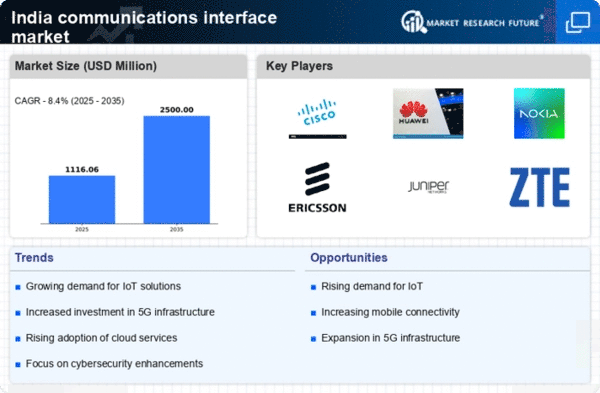
As per Market Research Future analysis, the India Communications Interface Market size was estimated at 1029.58 USD Million in 2024. The Communications Interface market industry is projected to grow from 1116.06 USD Million in 2025 to 2500.0 USD Million by 2035, exhibiting a compound annual growth rate (CAGR) of 8% during the forecast period 2025 - 2035

Key Market Trends & Highlights

The India communications interface market is poised for substantial growth driven by technological advancements and increasing demand for connectivity.

  • The integration of AI in communication interfaces is transforming user experiences and operational efficiencies.
  • IoT connectivity solutions are witnessing rapid adoption, making them a crucial segment in the market.
  • Regulatory support for digital infrastructure is enhancing the overall market landscape, particularly in urban areas.
  • Rising demand for seamless connectivity and advancements in telecommunications technology are key drivers propelling market growth.

Market Size & Forecast

2024 Market Size 1029.58 (USD Million)
2035 Market Size 2500.0 (USD Million)
CAGR (2025 - 2035) 8.4%

Major Players

Cisco Systems (US), Huawei Technologies (CN), Nokia (FI), Ericsson (SE), Juniper Networks (US), ZTE Corporation (CN), Alcatel-Lucent (FR), Broadcom Inc. (US), Qualcomm (US)

Our Impact
Enabled $4.3B Revenue Impact for Fortune 500 and Leading Multinationals
Partnering with 2000+ Global Organizations Each Year
30K+ Citations by Top-Tier Firms in the Industry

India Communications Interface Market Trends

The India Communications Interface Market is currently experiencing a dynamic evolution, driven by advancements in technology and increasing demand for seamless connectivity. As digital transformation accelerates across various sectors, the need for efficient communication solutions has become paramount. This market encompasses a wide range of products and services, including hardware and software that facilitate communication between devices and systems. The rise of the Internet of Things (IoT) and smart technologies is further propelling the growth of this market, as organizations seek to enhance operational efficiency and improve user experiences. Moreover, the integration of artificial intelligence and machine learning into communication interfaces is likely to redefine user interactions, making them more intuitive and responsive. In addition, the regulatory environment in India is evolving to support innovation in the communications interface market. Government initiatives aimed at promoting digital infrastructure and enhancing connectivity are expected to create a conducive environment for market players. The push for local manufacturing and the emphasis on self-reliance may also influence the competitive landscape, encouraging domestic companies to innovate and expand their offerings. As the market continues to mature, stakeholders must remain agile and responsive to emerging trends and consumer preferences, ensuring that they can capitalize on new opportunities as they arise.

Integration of AI in Communication Interfaces

The incorporation of artificial intelligence into communication interfaces is transforming user experiences. AI-driven solutions enhance personalization and streamline interactions, making systems more efficient. This trend is likely to gain momentum as businesses seek to leverage data analytics for improved decision-making.

Growth of IoT Connectivity Solutions

The increasing adoption of IoT devices is driving demand for robust communication interfaces. As more devices become interconnected, the need for reliable and scalable solutions is paramount. This trend suggests a shift towards more integrated systems that can handle diverse communication protocols.

Regulatory Support for Digital Infrastructure

Government initiatives aimed at enhancing digital infrastructure are fostering growth in the communications interface market. Policies promoting local manufacturing and innovation are likely to create a favorable environment for market participants, encouraging investment and development.

India Communications Interface Market Drivers

Rising Demand for Seamless Connectivity

The communications interface market in India is experiencing a notable surge in demand for seamless connectivity solutions. As businesses and consumers increasingly rely on digital communication, the need for efficient and reliable interfaces has become paramount. This trend is driven by the proliferation of mobile devices and the growing adoption of cloud-based services. According to recent data, the market is projected to grow at a CAGR of approximately 15% over the next five years. This growth is indicative of the increasing reliance on digital communication tools, which necessitate advanced communications interfaces. Furthermore, the rise of remote work and digital collaboration tools has further amplified this demand, compelling companies to invest in robust communications infrastructure. Consequently, the communications interface market is poised for significant expansion as organizations seek to enhance their connectivity capabilities.

Emergence of Smart Devices and Applications

The emergence of smart devices and applications is significantly impacting the communications interface market in India. With the proliferation of smartphones, tablets, and IoT devices, there is an increasing need for interfaces that can seamlessly connect and communicate with these technologies. This trend is fostering innovation in the development of user-friendly communication interfaces that cater to diverse applications, from smart homes to industrial automation. Recent statistics indicate that the smart device market in India is projected to grow by over 25% in the next few years, which will likely drive demand for compatible communications interfaces. As consumers and businesses alike seek to leverage the capabilities of smart technologies, the communications interface market is expected to evolve rapidly, adapting to the changing landscape of digital communication.

Advancements in Telecommunications Technology

Technological advancements in telecommunications are significantly influencing the communications interface market in India. The rollout of 5G technology is expected to revolutionize communication by providing faster data speeds and lower latency. This transition is likely to enhance the performance of various communication interfaces, making them more efficient and user-friendly. As per industry estimates, the 5G rollout could lead to a market growth of around 20% in the next few years. Additionally, innovations in fiber optics and satellite communications are also contributing to the evolution of the communications interface market. These advancements not only improve connectivity but also expand the reach of communication services to rural and underserved areas. As a result, the market is witnessing a shift towards more sophisticated and versatile communication solutions that cater to diverse user needs.

Increased Investment in Digital Infrastructure

The communications interface market in India is benefiting from increased investment in digital infrastructure. The government and private sector are channeling substantial resources into enhancing connectivity across urban and rural areas. This investment is aimed at bridging the digital divide and ensuring that all citizens have access to reliable communication services. Recent reports indicate that the Indian government plans to invest over $1 billion in digital infrastructure projects in the coming years. This influx of capital is likely to stimulate growth in the communications interface market, as it encourages the development of new technologies and solutions. Furthermore, the emphasis on smart cities and digital transformation initiatives is driving demand for advanced communications interfaces that can support a wide range of applications. Consequently, this trend is expected to propel the market forward, fostering innovation and improving overall communication capabilities.

Growing Adoption of Unified Communication Solutions

The growing adoption of unified communication solutions is reshaping the communications interface market in India. Organizations are increasingly recognizing the benefits of integrating various communication tools into a single platform, which enhances collaboration and productivity. This trend is particularly evident in the corporate sector, where businesses are investing in unified communication systems to streamline operations. Market analysis suggests that the unified communication segment could account for approximately 30% of the overall communications interface market by 2026. This shift is driven by the need for efficient communication channels that facilitate real-time collaboration among teams, especially in a hybrid work environment. As companies continue to prioritize employee engagement and operational efficiency, the demand for unified communication solutions is expected to rise, further propelling the growth of the communications interface market.


Market Segment Insights

By Technology: Wireless Communication (Largest) vs. Satellite Communication (Fastest-Growing)

In the India communications interface market, Wireless Communication dominates with a significant market share, driven by the increasing demand for mobile connectivity and data services. The transition towards 5G technology is further solidifying its position, making it a vital component for future developments. In contrast, Satellite Communication is rapidly capturing attention, especially in remote areas where traditional wired services struggle to reach. This segment is characterized by its unique ability to provide coverage in hard-to-reach regions and is experiencing accelerated growth as more investments pour into satellite infrastructure. The growth trends in these segments highlight a clear shift towards advanced technology adoption. Wireless Communication continues to thrive due to its scalability and the rising reliance on mobile devices, positioned as the backbone of future connectivity solutions. Meanwhile, the Satellite Communication segment is emerging as a crucial player in bridging connectivity gaps, spurred by advancements in low-earth orbit (LEO) satellite technology, which promises enhanced speed and reduced latency. The ongoing technological innovations and increasing demand for seamless communication services are key drivers propelling these segments' growth trajectories.

Technology: Wireless Communication (Dominant) vs. Satellite Communication (Emerging)

Wireless Communication stands as the dominant technology within the India communications interface market, characterized by its vast infrastructure and widespread adoption across urban and rural areas. Its ability to offer high-speed internet and seamless connectivity aligns well with the growing consumer demand for digital services. In contrast, Satellite Communication is categorized as an emerging technology with immense potential to fill gaps left by traditional communication methods. It enables internet access in remote regions where other solutions are not feasible, thus supporting inclusivity in the digital era. As investments in technology infrastructure grow, both segments are expected to evolve, with Wireless Communication maintaining its leadership while Satellite Communication seeks to capture larger market share through innovation and expansion.

By Application: Telecommunications (Largest) vs. Automotive (Fastest-Growing)

The India communications interface market is characterized by distinct applications, with telecommunications commanding the largest share among the various sectors. This segment significantly influences market dynamics, leveraging advancements in communication technology and broadening connectivity across urban and rural areas. Meanwhile, automotive applications also showcase substantial potential, increasingly integrating advanced communication solutions in vehicles, which foster enhanced user experiences and smart functionalities. Growth trends indicate that while telecommunications remains robust, the automotive sector is emerging as the fastest-growing application within the market. This is fueled by the escalating demand for connected vehicles, advancements in automotive technology, and government initiatives aimed at promoting smart transportation solutions. As connectivity becomes a cornerstone of automotive technology, further innovations are expected to drive substantial growth in this area.

Telecommunications: Dominant vs. Automotive: Emerging

Telecommunications stands out as the dominant application in the India communications interface market, characterized by its extensive infrastructure and widespread adoption of cutting-edge communication technologies. This sector effectively supports mobile, broadband, and internet services, catering to a diverse range of users, from individual consumers to large enterprises. In contrast, the automotive application is emerging rapidly, driven by trends such as electric vehicles and the Internet of Things (IoT). The integration of communication interfaces in automotive systems is enhancing vehicle safety and operational efficiency, leading to greater consumer acceptance and fostering a technological shift within the industry.

By End Use: Residential (Largest) vs. Government (Fastest-Growing)

In the India communications interface market, the end use segment is characterized by a diverse distribution among residential, commercial, government, and transportation sectors. The residential segment holds the largest market share, driven by increasing demand for smart homes and IoT-enabled devices. In contrast, while the commercial segment shows steady growth, the government segment is rapidly gaining traction with rising investments in digital infrastructure and smart city initiatives. The growth trends in this segment are shaped by technological advancements and consumer preferences. The residential end use is being propelled by the need for enhanced connectivity and automation in households. Meanwhile, the government segment is emerging as the fastest-growing area as policies favoring digital transformation lead to increased adoption of communications interfaces in public services, further blending technology with governance.

Residential: Dominant vs. Government: Emerging

The residential segment of the India communications interface market is distinguished by its extensive adoption of technologies that facilitate connectivity, such as smart home devices and integrated communication systems. This segment thrives on consumer-driven innovations, offering solutions that enhance daily life through convenience and efficiency. Conversely, the government segment, although currently smaller, is swiftly emerging as a significant player in this market. Driven by government initiatives and programs aimed at modernization, this sector focuses on integrating communication technologies into public services, striving to improve transparency and efficiency. Both segments are critical, with residential offering stability and government providing rapid growth potential.

By Data Transmission Type: Digital (Largest) vs. Analog (Fastest-Growing)

In the India communications interface market, the data transmission type segment is predominantly led by digital communications, commanding the largest share due to its efficiency and versatility in various applications. Digital technologies have transformed the way data is transmitted, allowing for higher speeds and better reliability, making them the preferred choice for many users. Meanwhile, analog transmission methods, although historically significant, are seeing a resurgence in specific applications, particularly where simplicity and cost-effectiveness are crucial. The growth trends in this segment indicate a robust shift towards hybrid systems that combine the strengths of both digital and analog methods. This trend is driven by advancements in technology and the increasing demand for seamless connectivity in diverse sectors such as telecommunications and broadcasting. As industries evolve, the integration of hybrid solutions is gaining traction, with analog systems emerging as the fastest-growing category, catering to niche markets and specific user needs.

Digital (Dominant) vs. Analog (Emerging)

Digital transmission stands as the dominant data transmission type in the India communications interface market due to its superior speed, quality, and efficiency. Businesses and consumers alike favor digital systems for their reliability and the ability to handle complex data streams, making them essential for modern applications. In contrast, analog transmission, despite being less prevalent, is emerging in specific sectors where traditional methods suffice and cost factors are paramount. The resurgence of analog can be attributed to its simplicity and lower implementation costs, appealing to industries that do not require the high bandwidth offered by digital technologies. Thus, while digital remains the leader, analog is positioning itself to meet the needs of an evolving market.

Get more detailed insights about India Communications Interface Market

Key Players and Competitive Insights

The communications interface market in India is characterized by a dynamic competitive landscape, driven by rapid technological advancements and increasing demand for seamless connectivity. Major players such as Cisco Systems (US), Huawei Technologies (CN), and Ericsson (SE) are strategically positioned to leverage innovation and regional expansion. Cisco Systems (US) focuses on enhancing its software-defined networking capabilities, while Huawei Technologies (CN) emphasizes its 5G solutions and partnerships with local telecom operators. Ericsson (SE) is actively pursuing digital transformation initiatives, which collectively shape a competitive environment that is increasingly reliant on cutting-edge technology and strategic collaborations.
Key business tactics within this market include localizing manufacturing and optimizing supply chains to enhance operational efficiency. The competitive structure appears moderately fragmented, with several key players exerting influence over market dynamics. This fragmentation allows for a diverse range of offerings, catering to various customer needs while fostering innovation through competition.
In October 2025, Cisco Systems (US) announced a strategic partnership with a leading Indian telecom operator to deploy advanced 5G infrastructure across urban areas. This move is significant as it not only strengthens Cisco's foothold in the Indian market but also aligns with the government's push for digital transformation, potentially enhancing connectivity for millions of users.
In September 2025, Huawei Technologies (CN) launched a new suite of AI-driven communication solutions tailored for the Indian market. This initiative is crucial as it positions Huawei to capitalize on the growing demand for intelligent networking solutions, thereby enhancing its competitive edge against local and international rivals.
In August 2025, Ericsson (SE) expanded its research and development facilities in India, focusing on next-generation communication technologies. This expansion is indicative of Ericsson's commitment to innovation and its long-term strategy to develop localized solutions that meet the specific needs of Indian consumers and businesses.
As of November 2025, current trends in the communications interface market are heavily influenced by digitalization, sustainability, and the integration of AI technologies. Strategic alliances among key players are shaping the competitive landscape, fostering innovation and enhancing service delivery. Looking ahead, competitive differentiation is likely to evolve from traditional price-based competition to a focus on technological innovation, supply chain reliability, and sustainable practices, reflecting the changing priorities of consumers and businesses alike.

Key Companies in the India Communications Interface Market include

Industry Developments

In recent developments within the India Communications Interface Market, major players are actively pursuing growth and collaboration strategies. Tech Mahindra has been enhancing its digital offerings, focusing on AI and cloud-based solutions. BSNL is advancing its efforts towards 5G technology deployment, which is crucial for the country’s digital infrastructure. Reliance Industries continues to reinforce its leadership position with significant investments in broadband and telecommunications. Additionally, Juniper Networks and HCL Technologies recently partnered to boost software-defined networking capabilities for enterprises, reflecting a shift towards more agile network solutions.

In terms of mergers and acquisitions, Tata Communications announced its acquisition of BitGravity, a move aimed at enhancing its content delivery network services, which was publicly reported in August 2023. Meanwhile, in the last couple of years, key partnerships like Vodafone Idea's collaboration with Ericsson to expand 5G accessibility have notably impacted service delivery. The overall market valuation of the communications sector continues to grow, with an increasing focus on innovation and enhanced service reliability to meet the rising demand for digital connectivity, which has been accelerated by the ongoing digital transformation across industries in India.

Future Outlook

India Communications Interface Market Future Outlook

The communications interface market in India is projected to grow at an 8.4% CAGR from 2025 to 2035, driven by technological advancements and increasing demand for connectivity.

New opportunities lie in:

  • Development of AI-driven communication platforms for enhanced user engagement.
  • Expansion of IoT integration services for smart home applications.
  • Investment in 5G infrastructure to support high-speed data transmission.

By 2035, the market is expected to achieve substantial growth, driven by innovation and increased connectivity demands.

Market Segmentation

India Communications Interface Market End Use Outlook

  • Residential
  • Commercial
  • Government
  • Transportation

India Communications Interface Market Technology Outlook

  • Wireless Communication
  • Wired Communication
  • Satellite Communication
  • Optical Communication

India Communications Interface Market Application Outlook

  • Telecommunications
  • Automotive
  • Consumer Electronics
  • Industrial Automation
  • Healthcare

India Communications Interface Market Data Transmission Type Outlook

  • Analog
  • Digital
  • Hybrid

Report Scope

MARKET SIZE 2024 1029.58(USD Million)
MARKET SIZE 2025 1116.06(USD Million)
MARKET SIZE 2035 2500.0(USD Million)
COMPOUND ANNUAL GROWTH RATE (CAGR) 8.4% (2025 - 2035)
REPORT COVERAGE Revenue Forecast, Competitive Landscape, Growth Factors, and Trends
BASE YEAR 2024
Market Forecast Period 2025 - 2035
Historical Data 2019 - 2024
Market Forecast Units USD Million
Key Companies Profiled Cisco Systems (US), Huawei Technologies (CN), Nokia (FI), Ericsson (SE), Juniper Networks (US), ZTE Corporation (CN), Alcatel-Lucent (FR), Broadcom Inc. (US), Qualcomm (US)
Segments Covered Technology, Application, End Use, Data Transmission Type
Key Market Opportunities Integration of advanced artificial intelligence in the communications interface market enhances user experience and operational efficiency.
Key Market Dynamics Rapid technological advancements drive innovation and competition in the communications interface market.
Countries Covered India
Leave a Comment

FAQs

What is the expected market size of the India Communications Interface Market in 2024?

The expected market size of the India Communications Interface Market in 2024 is valued at 1.5 billion USD.

What is the projected market size for the India Communications Interface Market by 2035?

By 2035, the India Communications Interface Market is projected to reach a size of 3.5 billion USD.

What is the expected compound annual growth rate (CAGR) for the India Communications Interface Market from 2025 to 2035?

The expected CAGR for the India Communications Interface Market from 2025 to 2035 is 8.007 percent.

Which segment of the India Communications Interface Market holds the largest share in 2024?

In 2024, the Wireless Communication segment holds the largest share valued at 0.6 billion USD.

What is the projected value of the Wireless Communication segment by 2035?

The projected value of the Wireless Communication segment by 2035 is 1.4 billion USD.

Who are the key players in the India Communications Interface Market?

Key players in the India Communications Interface Market include Tech Mahindra, BSNL, Reliance Industries, and Cisco Systems among others.

How much is the Wired Communication segment valued at in 2024?

The Wired Communication segment is valued at 0.4 billion USD in 2024.

What is the expected market growth for Satellite Communication by 2035?

The Satellite Communication segment is expected to grow to 0.7 billion USD by 2035.

What challenges may impact the growth of the India Communications Interface Market?

Challenges such as technological advancements and regulatory changes may impact the growth of the India Communications Interface Market.

What opportunity does the increasing demand for Optical Communication present?

The increasing demand for Optical Communication presents an opportunity for significant growth, projected to reach 0.5 billion USD by 2035.

Download Free Sample

Kindly complete the form below to receive a free sample of this Report

Compare Licence

×
Features License Type
Single User Multiuser License Enterprise User
Price $4,950 $5,950 $7,250
Maximum User Access Limit 1 User Upto 10 Users Unrestricted Access Throughout the Organization
Free Customization
Direct Access to Analyst
Deliverable Format
Platform Access
Discount on Next Purchase 10% 15% 15%
Printable Versions