×
Request Free Sample ×

Kindly complete the form below to receive a free sample of this Report

* Please use a valid business email

Leading companies partner with us for data-driven Insights

clients tt-cursor
Hero Background

India Commerce as a Service Market

ID: MRFR/ICT/57786-HCR
200 Pages
Aarti Dhapte
February 2026

India Commerce as a Service Market Size, Share and Trends Analysis Report By Component (Solutions, Services), By Solution Type (Content & Site Management, Product Information Management, Experience Management, Inventory & Order Management, Payment Process Management, Multi-site Management), By Delivery Model (B2B, B2C, Machine-2-machine Commerce) and By Deployment Type (Public, Private, Hybrid)-Forecast to 2035

Share:
Download PDF ×

We do not share your information with anyone. However, we may send you emails based on your report interest from time to time. You may contact us at any time to opt-out.

India Commerce as a Service Market Infographic
Purchase Options

India Commerce as a Service Market Summary

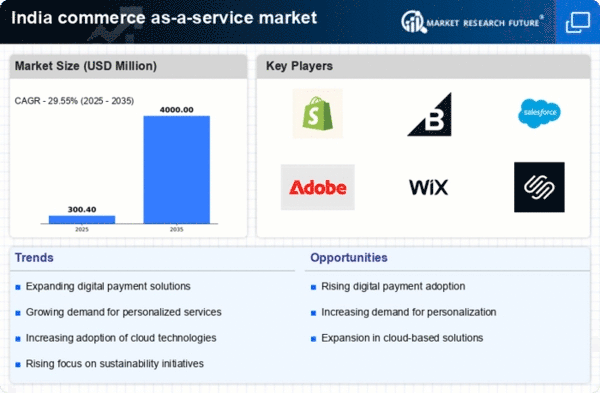
As per Market Research Future analysis, the India Commerce as a Service Market size was estimated at 231.88 USD Million in 2024. The Commerce As-a-service market is projected to grow from 300.4 USD Million in 2025 to 4000.0 USD Million by 2035, exhibiting a compound annual growth rate (CAGR) of 29.5% during the forecast period 2025 - 2035

Key Market Trends & Highlights

The India commerce as-a-service market is experiencing robust growth driven by technological advancements and evolving consumer preferences.

  • The market is witnessing increased adoption of cloud-based solutions, enhancing operational efficiency.
  • Personalization and customer experience are becoming central to service offerings, reflecting changing consumer expectations.
  • Integration of advanced technologies is reshaping service delivery, particularly in the largest segment of e-commerce.
  • Rising e-commerce demand and government initiatives are key drivers propelling market expansion.

Market Size & Forecast

2024 Market Size 231.88 (USD Million)
2035 Market Size 4000.0 (USD Million)
CAGR (2025 - 2035) 29.55%

Major Players

Shopify (CA), BigCommerce (US), Salesforce (US), Adobe (US), Wix (IL), Square (US), Stripe (US), Zalando (DE), Lightspeed (CA)

Our Impact
Enabled $4.3B Revenue Impact for Fortune 500 and Leading Multinationals
Partnering with 2000+ Global Organizations Each Year
30K+ Citations by Top-Tier Firms in the Industry

India Commerce as a Service Market Trends

The India Commerce as a Service Market is experiencing a transformative phase driven by the increasing demand for flexible and scalable solutions. This market offers a range of services that enable companies to streamline their operations, enhance customer experiences, and reduce overhead costs. As organizations seek to adapt to rapidly changing consumer preferences, the adoption of commerce as-a-service solutions appears to be gaining momentum. Advanced technologies, such as artificial intelligence and machine learning, are likely to play a pivotal role in shaping the future landscape of this market. Furthermore, the emphasis on data-driven decision-making suggests that businesses are increasingly relying on analytics to optimize their strategies and improve overall performance. In addition, the rise of e-commerce and digital payment systems is contributing to the growth of the commerce as-a-service market. Companies are recognizing the need for robust platforms that can support various payment methods and provide seamless transactions. This trend indicates a shift towards more customer-centric approaches, where businesses prioritize user experience and convenience. As the market evolves, it is expected that new players will emerge, offering innovative solutions tailored to meet the diverse needs of businesses across different sectors. Overall, the commerce as-a-service market is poised for significant growth, driven by technological advancements and changing consumer behaviors.

Increased Adoption of Cloud-Based Solutions

The shift towards cloud-based services is becoming more pronounced in the commerce as-a-service market. Businesses are increasingly leveraging cloud technology to enhance scalability and flexibility, allowing them to respond swiftly to market demands. This trend indicates a preference for solutions that minimize infrastructure costs while maximizing operational efficiency.

Focus on Personalization and Customer Experience

There is a growing emphasis on personalization within the commerce as-a-service market. Companies are utilizing data analytics to tailor their offerings to individual customer preferences. This trend suggests that enhancing customer experience is becoming a priority, as businesses aim to foster loyalty and drive repeat purchases.

Integration of Advanced Technologies

The incorporation of advanced technologies, such as artificial intelligence and machine learning, is reshaping the commerce as-a-service market. These technologies enable businesses to automate processes, improve decision-making, and enhance overall efficiency. This trend indicates a move towards more intelligent and responsive service offerings.

India Commerce as a Service Market Drivers

Consumer Behavior Shifts

Changing consumer behavior is a notable driver for the commerce as-a-service market in India. As consumers become more tech-savvy, their expectations for seamless online shopping experiences have risen. They now demand personalized services, quick delivery options, and easy return policies. This shift in consumer preferences compels businesses to adopt advanced commerce as-a-service solutions that can provide these features. Companies that fail to adapt may find themselves at a competitive disadvantage. The commerce as-a-service market is thus positioned to grow as businesses seek to meet these evolving consumer demands, with market analysts suggesting a potential growth rate of 20% annually as companies invest in enhancing their digital capabilities.

Rising E-commerce Demand

The surge in e-commerce activities in India is a primary driver for the commerce as-a-service market. With a growing internet penetration rate, which reached approximately 50% in 2025, more consumers are engaging in online shopping. This shift is further supported by the increasing number of smartphone users, which is projected to exceed 1 billion by the end of 2025. As businesses seek to capitalize on this trend, they are turning to commerce as-a-service solutions to streamline their operations and enhance customer engagement. The commerce as-a-service market is expected to grow significantly, with estimates suggesting a compound annual growth rate (CAGR) of around 25% over the next five years, driven by the need for scalable and flexible e-commerce platforms.

Cost Efficiency and Scalability

Cost efficiency remains a crucial factor influencing the commerce as-a-service market in India. Businesses, particularly small and medium enterprises (SMEs), are increasingly adopting these services to reduce operational costs associated with traditional e-commerce setups. By leveraging commerce as-a-service solutions, companies can avoid hefty upfront investments in infrastructure and technology. Instead, they can pay for services on a subscription basis, which allows for better cash flow management. Furthermore, the scalability offered by these platforms enables businesses to expand their operations without the need for significant additional investments. This flexibility is particularly appealing in a rapidly changing market environment, where adaptability is key to survival.

Government Initiatives and Support

The Indian government has been actively promoting digital transformation across various sectors, which significantly impacts the commerce as-a-service market. Initiatives such as Digital India aim to enhance digital infrastructure and encourage businesses to adopt online platforms. The government's push for a cashless economy and the introduction of various digital payment solutions have further facilitated the growth of e-commerce. As a result, the commerce as-a-service market is likely to benefit from increased investments in technology and infrastructure, fostering an environment conducive to innovation and growth. This support is expected to drive market expansion, with projections indicating a potential increase in market size by over 30% in the next few years.

Integration of Omnichannel Strategies

The integration of omnichannel strategies is increasingly recognized as a vital driver for the commerce as-a-service market. Businesses in India are realizing the importance of providing a cohesive shopping experience across various channels, including online, mobile, and physical stores. This approach not only enhances customer satisfaction but also drives sales by allowing consumers to interact with brands in multiple ways. As a result, companies are turning to commerce as-a-service solutions that facilitate seamless integration of these channels. The market is expected to witness substantial growth, with estimates indicating that omnichannel strategies could contribute to a 15% increase in overall sales for businesses that effectively implement them.


Market Segment Insights

By Component: Solutions (Largest) vs. Services (Fastest-Growing)

In the India commerce as-a-service market, the distribution of market share between Solutions and Services highlights a significant dominance of Solutions as the largest component. As businesses increasingly adopt comprehensive solutions to streamline operations and enhance customer experiences, Solutions have managed to capture a substantial portion of the market. Conversely, Services are emerging as a vital segment, attracting businesses looking for customized offerings and specialized support. The growth dynamics between these two segments reflect the evolving landscape of commerce solutions. The growth of the India commerce as-a-service market is driven by increasing digital transformation initiatives, e-commerce proliferation, and a shift towards cloud-based solutions. Solutions exhibit steady growth due to their robust nature, providing businesses with integrated features. On the other hand, Services are recognized as the fastest-growing segment, driven by a surge in demand for specialized assistance, training, and customer support, positioning them as critical players in adapting to market challenges.

Solutions: Dominant vs. Services: Emerging

Solutions in the India commerce as-a-service market are characterized by their comprehensive capabilities, integrating various functions to provide businesses with end-to-end solutions that enhance operational efficiencies. They encompass a range of offerings, from payment gateways to inventory management systems, ensuring businesses can deliver seamless customer experiences. In contrast, Services are emerging rapidly, catering to specific needs such as consulting, technical support, and advanced user training. This segment's growth is propelled by the increasing complexity of commerce solutions, pushing businesses to seek external expertise to optimize their operations. Together, both segments play crucial roles in shaping the commerce landscape, with Solutions leading in market share and Services rapidly evolving to meet emerging demands.

By Solution Type: Inventory & Order Management (Largest) vs. Payment Process Management (Fastest-Growing)

The solution type segment in the India commerce as-a-service market is characterized by significant variations in market share among its components. Inventory & Order Management leads as the largest segment, driven by the increasing need for businesses to streamline operations and manage product availability effectively. Meanwhile, Payment Process Management is gaining traction, being recognized for its vital role in facilitating seamless transactions, which is essential for enhancing customer experiences and operational efficiency. Growth trends in this segment are influenced by technological advancements and changing consumer expectations. Particularly, the rise of digital commerce fuels demand for comprehensive solutions that enhance functionality and user engagement. With the rapid adoption of e-commerce platforms across sectors, Inventory & Order Management continues to evolve, while Payment Process Management is emerging as a focal point for innovation, driven by the integration of mobile payment solutions and enhanced security features.

Inventory & Order Management (Dominant) vs. Payment Process Management (Emerging)

Inventory & Order Management stands out in the India commerce as-a-service market as the dominant solution, enabling businesses to effectively oversee stock levels and fulfill orders proficiently. Its robustness in addressing supply chain challenges makes it indispensable for retailers and suppliers alike. In contrast, Payment Process Management is gaining ground as an emerging solution, primarily due to the surge in online transactions and the imperative for secure payment methods. This segment is characterized by its focus on integrating diverse payment options, including digital wallets and instant payment platforms, thereby enhancing transaction efficiency and customer satisfaction. Together, these segments reflect the evolving landscape of commerce as businesses adapt to a rapidly changing digital environment.

By Delivery Model: B2C (Largest) vs. B2B (Fastest-Growing)

The India commerce as-a-service market has seen significant segmentation, particularly in the delivery model category, with B2C platforms taking the largest share. B2C models cater predominantly to consumers, driving their expansion through enhanced customer engagement and technology integration, while B2B models are rapidly gaining traction, targeting businesses looking to streamline operations and reduce costs through efficient commerce solutions. Market dynamics have favored B2C due to the increasing disposable income and changing consumer preferences, allowing it to maintain its lead in this evolving landscape. In recent years, the growth of B2B models has accelerated, primarily driven by digital transformation initiatives and the push for increased operational efficiency. Businesses are increasingly turning to as-a-service solutions that enhance their supply chain management and customer experience. On the other hand, Machine-2-Machine commerce is slowly growing, propelled by advancements in IoT, yet it remains a niche segment compared to the dominant B2C and emerging B2B models. This trend indicates a shift towards integrated commerce systems that foster seamless transactions across different platforms.

B2C (Dominant) vs. B2B (Emerging)

B2C is currently the dominant delivery model in the India commerce as-a-service market. It allows businesses to reach individual consumers directly, leveraging digital channels to enhance customer experiences and engagement. The significant rise in online shopping and mobile commerce has propelled B2C models to the forefront, enabling brands to customize offerings and build loyalty. Meanwhile, B2B commerce is emerging as a vital player, focusing on transactions between businesses that prioritize efficiency and cost management. This segment encompasses a range of services including bulk orders and supply chain solutions, appealing to companies seeking to optimize their purchasing processes and improve margins. The interplay between these two models highlights the evolving nature of commerce strategies.

By Deployment Type: Public (Largest) vs. Hybrid (Fastest-Growing)

Among the deployment types in the India commerce as-a-service market, Public cloud solutions hold the largest share, reflecting a strong preference for accessibility and cost efficiency. Private deployments, while significant, lag behind as businesses weigh the benefits of control against the operational costs involved. Hybrid solutions, combining elements of both public and private models, are gradually gaining traction as organizations seek flexible and scalable solutions to meet their evolving needs. The growth trends in the deployment type segment are influenced by several factors, including digital transformation initiatives and increased cloud adoption among enterprises. The demand for Hybrid solutions is propelled by businesses seeking an optimal balance between security and flexibility, leading to a faster growth trajectory compared to Public and Private deployments. Additionally, the shift towards remote work has catalyzed organizations to consider dynamic deployment strategies.

Public (Dominant) vs. Hybrid (Emerging)

The Public deployment model is characterized by its wide accessibility and lower costs, making it a dominant choice among businesses in the India commerce as-a-service market. It allows organizations to leverage shared infrastructure and resources, leading to cost reductions and rapid scaling options. In contrast, the Hybrid deployment model, while still emerging, is increasingly recognized for its potential to offer businesses flexibility and tailored solutions that cater to specific operational needs. As organizations navigate complexities in data management and security, Hybrid deployments enable a blended approach that harnesses the strengths of both Public and Private models, positioning them as a vital player in the market.

Get more detailed insights about India Commerce as a Service Market

Key Players and Competitive Insights

The commerce as-a-service market in India is currently characterized by a dynamic competitive landscape, driven by rapid digital transformation and increasing consumer demand for seamless online shopping experiences. Major players such as Shopify (CA), BigCommerce (US), and Salesforce (US) are strategically positioning themselves to capture market share through innovative solutions and robust service offerings. Shopify (CA), for instance, focuses on empowering small to medium-sized enterprises (SMEs) with user-friendly tools that facilitate e-commerce setup and management. Meanwhile, Salesforce (US) emphasizes its customer relationship management (CRM) capabilities, integrating them with commerce solutions to enhance customer engagement and retention. Collectively, these strategies contribute to a competitive environment that is increasingly centered around customer-centric innovations and technological advancements.In terms of business tactics, companies are increasingly localizing their operations to better serve the Indian market. This includes optimizing supply chains and tailoring services to meet local consumer preferences. The market structure appears moderately fragmented, with a mix of established players and emerging startups vying for attention. The collective influence of key players is significant, as they drive trends in service offerings and customer engagement strategies, thereby shaping the overall market dynamics.

In October Shopify (CA) announced the launch of a new localized payment gateway specifically designed for Indian merchants, which is expected to streamline transactions and enhance user experience. This strategic move not only addresses the unique payment preferences of Indian consumers but also positions Shopify as a more attractive option for local businesses looking to expand their online presence. The introduction of this payment solution could potentially increase Shopify's market penetration in India, reflecting its commitment to understanding and catering to local needs.

In September BigCommerce (US) expanded its partnership with local logistics providers to enhance its fulfillment capabilities in India. This initiative aims to reduce delivery times and improve customer satisfaction, which are critical factors in the competitive e-commerce landscape. By aligning with local logistics firms, BigCommerce (US) demonstrates its strategic focus on operational efficiency and customer service, which are essential for maintaining a competitive edge in the market.

In August Salesforce (US) unveiled a new AI-driven analytics tool tailored for Indian retailers, designed to provide insights into consumer behavior and purchasing patterns. This tool is expected to empower businesses to make data-driven decisions, thereby enhancing their marketing strategies and operational efficiencies. The integration of AI into commerce solutions signifies a broader trend towards leveraging technology for competitive differentiation in the market.

As of November the most pressing trends shaping competition in the commerce as-a-service market include digitalization, sustainability, and the integration of AI technologies. Strategic alliances among key players are increasingly prevalent, as companies seek to enhance their service offerings and operational capabilities. Looking ahead, competitive differentiation is likely to evolve, with a shift from price-based competition towards innovation, technology adoption, and supply chain reliability. This transition underscores the importance of agility and responsiveness in meeting the ever-changing demands of consumers.

Key Companies in the India Commerce as a Service Market include

Industry Developments

The India Commerce as a Service Market has seen significant activity recently, with various companies making headlines for their strategic developments. Notably, in September 2023, Swiggy launched its subscription service called Swiggy One, aimed at enhancing customer loyalty and providing benefits across its food delivery and grocery services. Meanwhile, CRED made strides by introducing CRED Stash in October 2023, allowing users to invest in fractional shares, marking its expansion into financial services.

In the realm of mergers and acquisitions, Delhivery, a logistics company, acquired the express logistics business of a smaller firm in August 2023, strengthening its distribution network. Zomato also announced its decision to acquire a controlling stake in a restaurant chain in July 2023, adding to its growing portfolio of services.

The growth in company valuations within this market is noteworthy, with companies like Paytm and Flipkart experiencing increased funding rounds that bolster their market presence. Over the last few years, the India Commerce as a Service Market has demonstrated robust resilience and dynamism, reflecting changing consumer behaviors and technological advancements.

Future Outlook

India Commerce as a Service Market Future Outlook

The Commerce as a Service Market in India is projected to grow at a 29.55% CAGR from 2025 to 2035, driven by digital transformation, increased e-commerce adoption, and enhanced customer experiences.

New opportunities lie in:

  • Integration of AI-driven analytics for personalized customer engagement.
  • Development of subscription-based service models for recurring revenue.
  • Expansion of mobile commerce platforms to capture on-the-go consumers.

By 2035, the market is expected to achieve substantial growth, positioning itself as a leader in innovative commerce solutions.

Market Segmentation

India Commerce as a Service Market Component Outlook

  • Solutions
  • Services

India Commerce as a Service Market Solution Type Outlook

  • Content & Site Management
  • Product Information Management
  • Experience Management
  • Inventory & Order Management
  • Payment Process Management
  • Multi-site Management

India Commerce as a Service Market Delivery Model Outlook

  • B2B
  • B2C
  • Machine-2-machine Commerce

India Commerce as a Service Market Deployment Type Outlook

  • Public
  • Private
  • Hybrid

Report Scope

MARKET SIZE 2024 231.88(USD Million)
MARKET SIZE 2025 300.4(USD Million)
MARKET SIZE 2035 4000.0(USD Million)
COMPOUND ANNUAL GROWTH RATE (CAGR) 29.55% (2025 - 2035)
REPORT COVERAGE Revenue Forecast, Competitive Landscape, Growth Factors, and Trends
BASE YEAR 2024
Market Forecast Period 2025 - 2035
Historical Data 2019 - 2024
Market Forecast Units USD Million
Key Companies Profiled Shopify (CA), BigCommerce (US), Salesforce (US), Adobe (US), Wix (IL), Square (US), Stripe (US), Zalando (DE), Lightspeed (CA)
Segments Covered Component, Solution Type, Delivery Model, Deployment Type
Key Market Opportunities Integration of advanced analytics and AI enhances personalization in the commerce as-a-service market.
Key Market Dynamics Rising demand for integrated solutions drives innovation and competition in the commerce as-a-service market.
Countries Covered India
Leave a Comment

FAQs

What is the expected market size of the India Commerce as a Service Market in 2024?

The India Commerce as a Service Market is expected to reach a value of 250.0 USD Million in 2024.

What is the projected market size for the India Commerce as a Service Market by 2035?

By 2035, the India Commerce as a Service Market is projected to be valued at 5250.0 USD Million.

What is the expected compound annual growth rate (CAGR) for the India Commerce as a Service Market from 2025 to 2035?

The India Commerce as a Service Market is expected to grow at a CAGR of 31.887% from 2025 to 2035.

What will be the estimated value of Solutions in the India Commerce as a Service Market by 2035?

Solutions in the India Commerce as a Service Market are projected to reach an estimated value of 2100.0 USD Million by 2035.

What will be the anticipated value of Services in the India Commerce as a Service Market by 2035?

The value of Services in the India Commerce as a Service Market is anticipated to reach 3150.0 USD Million by 2035.

Who are the major players in the India Commerce as a Service Market?

The major players in the market include Licious, CRED, Myntra, Swiggy, Ola, Paytm, Flipkart, ShopClues, Meesho, Zomato, Amazon, Delhivery, Nykaa, Tata Cliq, and Snapdeal.

What are the key applications driving growth in the India Commerce as a Service Market?

Key applications driving growth include e-commerce solutions, payment processing, and delivery services.

What are the emerging trends in the India Commerce as a Service Market?

Emerging trends include increased adoption of digital payments and enhanced customer experience through technology integration.

What challenges does the India Commerce as a Service Market face currently?

Challenges include intense competition and rapidly changing consumer preferences.

How has the global economic scenario influenced the India Commerce as a Service Market?

The global economic scenario has led to increased demand for online services, enhancing market growth opportunities.

Download Free Sample

Kindly complete the form below to receive a free sample of this Report

Compare Licence

×
Features License Type
Single User Multiuser License Enterprise User
Price $4,950 $5,950 $7,250
Maximum User Access Limit 1 User Upto 10 Users Unrestricted Access Throughout the Organization
Free Customization
Direct Access to Analyst
Deliverable Format
Platform Access
Discount on Next Purchase 10% 15% 15%
Printable Versions