×
Request Free Sample ×

Kindly complete the form below to receive a free sample of this Report

* Please use a valid business email

Leading companies partner with us for data-driven Insights

clients tt-cursor
Hero Background

India Cell Line Development Market

ID: MRFR/MED/48061-HCR
200 Pages
Rahul Gotadki
February 2026

India Cell Line Development Market Research Report By Application (Drug Discovery, Bioproduction, Toxicity Testing, Stem Cell Research, Genetic Engineering), By Type (Hybridoma Cell Lines, Recombinant Cell Lines, Continuous Cell Lines, Primary Cell Lines), By End User (Pharmaceutical Companies, Biotechnology Companies, Academic Research Institutions, Contract Research Organizations) and By Process (Cell Line Development, Cell Line Banking, Characterization, Quality Control) - Growth & Industry Forecast 2025 To 2035

Share:
Download PDF ×

We do not share your information with anyone. However, we may send you emails based on your report interest from time to time. You may contact us at any time to opt-out.

India Cell Line Development Market Infographic
Purchase Options

India Cell Line Development Market Summary

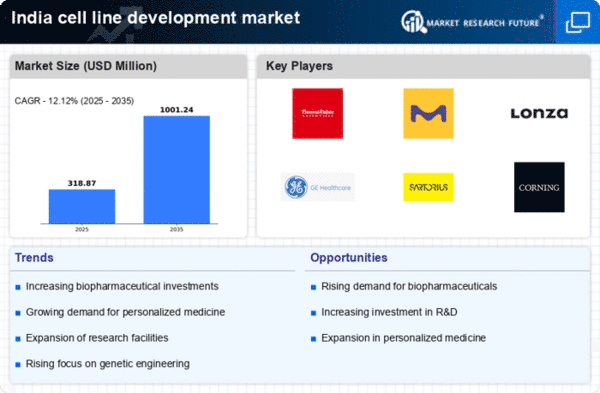
As per Market Research Future analysis, the India cell line development market size was estimated at 284.4 USD Million in 2024. The India cell line-development market is projected to grow from 318.87 USD Million in 2025 to 1001.24 USD Million by 2035, exhibiting a compound annual growth rate (CAGR) of 12.1% during the forecast period 2025 - 2035

Key Market Trends & Highlights

The India The India cell line development market is poised for substantial growth. This growth is driven by technological advancements and increased investment in biopharmaceuticals.

  • Technological advancements are enhancing the efficiency and scalability of cell line development processes.
  • The biopharmaceutical segment represents the largest share of the market, while the regenerative medicine segment is the fastest-growing.
  • Regulatory compliance and quality assurance are becoming increasingly critical in the cell line development landscape.
  • Rising demand for personalized medicine and expansion of biotechnology research are key drivers propelling market growth.

Market Size & Forecast

2024 Market Size 284.4 (USD Million)
2035 Market Size 1001.24 (USD Million)
CAGR (2025 - 2035) 12.12%

Major Players

Thermo Fisher Scientific (US), Merck KGaA (DE), Lonza Group (CH), GE Healthcare (US), Sartorius AG (DE), Corning Incorporated (US), WuXi AppTec (CN), Charles River Laboratories (US), Sigma-Aldrich (US)

Our Impact
Enabled $4.3B Revenue Impact for Fortune 500 and Leading Multinationals
Partnering with 2000+ Global Organizations Each Year
30K+ Citations by Top-Tier Firms in the Industry

India Cell Line Development Market Trends

The cell line development market is experiencing notable growth, driven by advancements in biotechnology and increasing demand for biopharmaceuticals. The rise in research activities, particularly in the fields of drug discovery and development, is propelling the need for high-quality cell lines. Furthermore, the growing prevalence of chronic diseases necessitates innovative therapeutic solutions, which in turn fuels the expansion of this market. As researchers and pharmaceutical companies seek to enhance their capabilities, the focus on developing robust and versatile cell lines becomes paramount. In addition, the regulatory landscape in India is evolving, with authorities emphasizing the importance of quality assurance in biomanufacturing processes. This shift is likely to encourage investments in cell line development, as companies strive to meet stringent regulatory requirements. Moreover, collaborations between academic institutions and industry players are fostering innovation, leading to the emergence of novel cell lines tailored for specific applications. Overall, the cell line-development market is poised for sustained growth, reflecting the dynamic interplay between scientific advancement and market demand.

Technological Advancements

The cell line development market is witnessing rapid technological innovations, particularly in gene editing and cell culture techniques. These advancements enable the creation of more precise and efficient cell lines, enhancing their applicability in research and therapeutic development.

Increased Investment in Biopharmaceuticals

There is a growing trend of investment in biopharmaceuticals, which is significantly impacting the cell line-development market. As companies seek to develop new biologics, the demand for specialized cell lines is likely to rise, driving market growth.

Regulatory Compliance and Quality Assurance

The emphasis on regulatory compliance and quality assurance is becoming increasingly pronounced within the cell line-development market. Companies are focusing on adhering to stringent guidelines, which is expected to enhance the reliability and safety of cell lines used in research and production.

India Cell Line Development Market Drivers

Expansion of Biotechnology Research

The expansion of biotechnology research in India is a pivotal driver for the cell line-development market. With an increasing number of research institutions and universities focusing on biotechnological innovations, there is a heightened demand for specialized cell lines. This trend is further bolstered by government initiatives aimed at promoting biotechnology as a key sector for economic growth. The Indian biotechnology sector is expected to reach a valuation of $100 billion by 2025, indicating a robust environment for research and development. As researchers require diverse cell lines for various applications, the cell line-development market is likely to see substantial growth, catering to the needs of both academic and industrial research.

Rising Demand for Personalized Medicine

The cell line development market in India is experiencing a notable surge due to the increasing demand for personalized medicine. As healthcare shifts towards tailored therapies, the need for specific cell lines that can mimic patient responses becomes critical. This trend is supported by the growing prevalence of chronic diseases, which necessitates the development of customized treatment plans. According to recent estimates, the market for personalized medicine is projected to grow at a CAGR of approximately 10% over the next five years. This growth is likely to drive investments in cell line development, as pharmaceutical companies seek to create more effective and targeted therapies. Consequently, the cell line-development market is positioned to benefit significantly from this shift towards personalized healthcare solutions.

Growing Investment in Regenerative Medicine

Investment in regenerative medicine is emerging as a significant driver for the cell line-development market in India. As the field of regenerative medicine evolves, the demand for specific cell lines that can support research and therapeutic applications is increasing. This sector is projected to grow at a CAGR of around 15% over the next few years, reflecting the rising interest from both public and private sectors. Companies are increasingly focusing on developing cell lines that can be used in cell therapy and tissue engineering, which are crucial for advancing regenerative medicine. The cell line-development market is thus likely to benefit from this influx of investment, as it aligns with the broader goals of improving healthcare outcomes through innovative therapies.

Emergence of Advanced Cell Culture Techniques

The emergence of advanced cell culture techniques is reshaping the landscape of the cell line-development market in India. Innovations such as 3D cell culture and organ-on-a-chip technologies are gaining traction, offering more physiologically relevant models for research. These advancements are likely to enhance the efficacy of drug testing and development processes, making them more reliable. As researchers and companies adopt these cutting-edge techniques, the demand for specialized cell lines that can be utilized in these systems is expected to rise. This shift towards more sophisticated methodologies could potentially lead to a transformation in the cell line-development market, as it aligns with the broader trends of improving research accuracy and therapeutic outcomes.

Increased Focus on Drug Discovery and Development

The cell line development market is significantly influenced by the increased focus on drug discovery and development in India. Pharmaceutical companies are investing heavily in research to discover new drugs, which necessitates the use of various cell lines for screening and testing. The Indian pharmaceutical market is expected to reach $55 billion by 2025, with a substantial portion allocated to research and development activities. This trend indicates a growing reliance on cell line models to facilitate the drug development process, thereby driving demand within the cell line-development market. As companies strive to enhance their drug pipelines, the need for high-quality cell lines becomes paramount, further propelling market growth.


Market Segment Insights

By Application: Drug Discovery (Largest) vs. Toxicity Testing (Fastest-Growing)

The India cell line-development market showcases a diverse distribution among various applications. Drug Discovery emerges as the largest segment, leveraging extensive research and investment in new therapeutics. In contrast, Toxicity Testing is gaining traction as a significant segment, driven by increasing regulatory requirements and the need for safety assessments in drug development. Growth trends indicate a robust upward trajectory for both Drug Discovery and Toxicity Testing. The rise in chronic diseases and personalized medicine are pivotal to Drug Discovery's prominence. Meanwhile, Toxicity Testing is expanding rapidly as pharmaceutical and biotechnology companies focus on reducing development costs and improving safety profiles through advanced testing methodologies. The adoption of innovative technologies in these areas further fuels market growth.

Drug Discovery (Dominant) vs. Toxicity Testing (Emerging)

Drug Discovery is characterized by its substantial investment in research and development, offering innovative solutions and therapies to combat various diseases. It holds a dominant position in the India cell line-development market owing to its critical role in advancing pharmaceutical research and development initiatives. On the other hand, Toxicity Testing is an emerging segment that caters to the growing need for safe, effective medicinal products. This segment increasingly uses advanced in vitro and in vivo testing methods, making it integral to helping companies adhere to stringent safety regulations. The dynamic nature of these segments reflects their unique contributions to the overall landscape of the India cell line-development market.

By Type: Hybridoma Cell Lines (Largest) vs. Recombinant Cell Lines (Fastest-Growing)

Among the various types of cell lines utilized in research and development, Hybridoma cell lines dominate the market due to their wide range of applications in monoclonal antibody production and diagnostic assays. In contrast, Recombinant cell lines are capturing significant attention and rapidly gaining market share owing to their versatility in therapeutic protein production and the scalability they offer for various biopharmaceutical processes. Growth trends indicate that the Recombinant cell lines segment is expanding more swiftly than others owing to advancements in genetic engineering technologies and the increasing demand for biologics. Additionally, the integration of automation in cell line development processes contributes to increased efficiency and faster development timelines, making Recombinant technologies particularly appealing to biotechnology firms in their product development journeys.

Hybridoma Cell Lines (Dominant) vs. Continuous Cell Lines (Emerging)

Hybridoma cell lines are characterized by their ability to produce monoclonal antibodies, which play a crucial role in research, diagnostics, and therapeutics, cementing their position as the dominant cell line type in the market. In contrast, Continuous cell lines are emerging as a vital resource due to their capability of indefinite growth while maintaining genetic stability. This characteristic makes them suitable for large-scale production and a preferred choice in various applications, including vaccine development and cancer research. The scalability and adaptability of Continuous cell lines are attracting interest from researchers looking to enhance productivity and reduce costs in cell culture processes.

By End User: Pharmaceutical Companies (Largest) vs. Biotechnology Companies (Fastest-Growing)

In the India cell line-development market, Pharmaceutical Companies hold the largest market share due to their extensive research and development activities. These companies capitalize on cell lines for drug discovery and development, leading to a significant portion of market revenue. Conversely, Biotechnology Companies are rapidly gaining traction as they leverage innovative technologies and advancements in personalized medicine, marking them as a critical segment within the market. Growth trends in this segment are driven by increased investment in biopharmaceuticals and a surge in research activities related to novel therapies. The demand for cell lines is escalating as both Pharmaceutical and Biotechnology Companies focus on enhancing therapeutic outcomes and meeting regulatory requirements. This rising interest enables a robust competitive landscape, fostering innovation within the market.

Pharmaceutical Companies (Dominant) vs. Biotechnology Companies (Emerging)

Pharmaceutical Companies dominate the market due to their established infrastructures and vast financial resources, enabling them to invest heavily in cell line technologies. They utilize these cell lines for a range of applications including drug testing, toxicology studies, and creating biologics. On the other hand, Biotechnology Companies represent an emerging force within the market. They focus on developing unconventional therapies and harnessing cellular models for research purposes. Their agile nature and ability to innovate rapidly allow them to respond effectively to shifting market demands, making this segment an exciting area for growth as they increasingly collaborate with academic institutions and research organizations.

By Process: Cell Line Development (Largest) vs. Characterization (Fastest-Growing)

The India cell line-development market exhibits significant diversity across its processes. Cell Line Development holds the largest market share, reflecting its critical role in biopharmaceuticals and research. Cell Line Banking and Quality Control also contribute solidly to market dynamics but trail behind in overall share, indicating strong demand for their services in supporting development workflows. In recent years, the Characterization segment has emerged as the fastest-growing area driven by advancements in technology and regulatory frameworks demanding rigorous cell line validation. Furthermore, the rising need for personalized medicine and biologics is propelling investment in Characterization, highlighting its role in ensuring quality and consistency in product development and regulatory compliance.

Cell Line Banking (Dominant) vs. Quality Control (Emerging)

Cell Line Banking stands as a dominant force within the India cell line-development market, providing essential resources for long-term storage and management of cell lines which are crucial for ongoing research and development. The segment is characterized by a robust infrastructure that ensures viability and accessibility of cell lines. On the other hand, Quality Control is an emerging segment that is gaining traction as biologic manufacturing intensifies. Companies are increasingly prioritizing Quality Control to meet stringent regulatory standards and maintain the integrity of cell line products. This focus on quality assurance promotes confidence among stakeholders and is becoming a vital aspect of the overarching development process.

Get more detailed insights about India Cell Line Development Market

Key Players and Competitive Insights

The cell line-development market in India is characterized by a dynamic competitive landscape, driven by increasing demand for biopharmaceuticals and advancements in biotechnology. Key players such as Thermo Fisher Scientific (US), Merck KGaA (DE), and Lonza Group (CH) are strategically positioned to leverage innovation and regional expansion. These companies focus on enhancing their product offerings through technological advancements and partnerships, which collectively shape a competitive environment that is increasingly focused on quality and efficiency.In terms of business tactics, companies are localizing manufacturing to reduce costs and optimize supply chains, which is crucial in a moderately fragmented market. The competitive structure is influenced by the presence of both multinational corporations and local players, creating a diverse ecosystem where collaboration and competition coexist. This structure allows for a variety of approaches to market entry and growth, with established firms often partnering with local entities to enhance their market reach.

In October Thermo Fisher Scientific (US) announced the opening of a new manufacturing facility in Pune, aimed at increasing its production capacity for cell culture products. This strategic move is significant as it not only enhances local supply capabilities but also aligns with the growing demand for bioprocessing solutions in the region. By investing in local infrastructure, Thermo Fisher aims to strengthen its market position and improve service delivery to its customers.

In September Merck KGaA (DE) launched a new line of cell line development services tailored for the Indian market, focusing on personalized medicine applications. This initiative reflects Merck's commitment to innovation and its strategy to cater to the specific needs of the Indian biopharmaceutical sector. By introducing specialized services, Merck is likely to enhance its competitive edge and attract a broader customer base.

In August Lonza Group (CH) entered into a strategic partnership with a leading Indian biotech firm to co-develop cell lines for therapeutic applications. This collaboration is indicative of a trend towards strategic alliances that enhance research capabilities and accelerate product development timelines. Such partnerships are essential for navigating the complexities of the Indian market and can lead to significant advancements in biopharmaceutical development.

As of November current trends in the cell line-development market include a strong emphasis on digitalization, sustainability, and the integration of artificial intelligence (AI) in research processes. These trends are reshaping the competitive landscape, as companies increasingly seek to differentiate themselves through innovative technologies and sustainable practices. Strategic alliances are becoming more prevalent, allowing firms to pool resources and expertise. Looking ahead, the competitive differentiation is expected to evolve from traditional price-based competition to a focus on innovation, technological advancements, and reliable supply chains, which will be critical for success in this rapidly changing market.

Key Companies in the India Cell Line Development Market include

Industry Developments

The India Cell Line Development Market has seen several significant developments recently, reflecting its growth and dynamism. Notable companies like Parker Hannifin, Lonza, and Thermo Fisher Scientific are actively expanding their presence and capabilities in this sector. For example, in July 2023, Thermo Fisher Scientific announced a strategic partnership aimed at enhancing bioproduction processes, which is expected to further advance cell line development processes in India.

Additionally, in August 2023, Merck KGaA launched new cell lines in India, aiming to meet the growing demand in pharmaceutical research.Moreover, the market has experienced a considerable valuation increase, driven by rising investments in biotechnology and healthcare. Companies such as GenScript and Sartorius AG are investing in Research and Development to innovate and improve their product offerings in cell line development.Looking back over the past two to three years, various companies have pursued mergers and acquisitions to strengthen their market position, including BD's acquisition of a local biotech firm in November 2022 to enhance its portfolio in cell culture solutions.

Overall, these trends indicate a robust growth trajectory for the India Cell Line Development Market, fueled by investments and advancements in technology.

Future Outlook

India Cell Line Development Market Future Outlook

The Cell Line Development Market in India is poised for growth at 12.12% CAGR from 2025 to 2035, driven by advancements in biopharmaceuticals, increasing R&D investments, and rising demand for personalized medicine.

New opportunities lie in:

  • Development of high-throughput screening technologies for rapid cell line generation.
  • Expansion of contract research organizations (CROs) offering specialized cell line services.
  • Investment in automation solutions for enhanced efficiency in cell line production.

By 2035, the market is expected to achieve substantial growth, reflecting robust demand and innovation.

Market Segmentation

India Cell Line Development Market Type Outlook

  • Hybridoma Cell Lines
  • Recombinant Cell Lines
  • Continuous Cell Lines
  • Primary Cell Lines

India Cell Line Development Market Process Outlook

  • Cell Line Development
  • Cell Line Banking
  • Characterization
  • Quality Control

India Cell Line Development Market End User Outlook

  • Pharmaceutical Companies
  • Biotechnology Companies
  • Academic Research Institutions
  • Contract Research Organizations

India Cell Line Development Market Application Outlook

  • Drug Discovery
  • Bioproduction
  • Toxicity Testing
  • Stem Cell Research
  • Genetic Engineering

Report Scope

MARKET SIZE 2024 284.4(USD Million)
MARKET SIZE 2025 318.87(USD Million)
MARKET SIZE 2035 1001.24(USD Million)
COMPOUND ANNUAL GROWTH RATE (CAGR) 12.12% (2025 - 2035)
REPORT COVERAGE Revenue Forecast, Competitive Landscape, Growth Factors, and Trends
BASE YEAR 2024
Market Forecast Period 2025 - 2035
Historical Data 2019 - 2024
Market Forecast Units USD Million
Key Companies Profiled Thermo Fisher Scientific (US), Merck KGaA (DE), Lonza Group (CH), GE Healthcare (US), Sartorius AG (DE), Corning Incorporated (US), WuXi AppTec (CN), Charles River Laboratories (US), Sigma-Aldrich (US)
Segments Covered Application, Type, End User, Process
Key Market Opportunities Advancements in gene editing technologies enhance efficiency in the cell line-development market.
Key Market Dynamics Rising demand for biopharmaceuticals drives innovation and competition in the cell line-development market.
Countries Covered India
Leave a Comment

FAQs

What was the market size of the India Cell Line Development Market in 2024?

The India Cell Line Development Market was valued at 155.1 million USD in 2024.

What will the market value of the India Cell Line Development Market be by 2035?

By 2035, the India Cell Line Development Market is expected to reach a value of 500.0 million USD.

What is the expected CAGR for the India Cell Line Development Market from 2025 to 2035?

The expected CAGR for the India Cell Line Development Market from 2025 to 2035 is 11.228%.

Which application segment of the India Cell Line Development Market has the largest projected value in 2035?

The Drug Discovery application segment is projected to have the largest value at 180.0 million USD in 2035.

What are the expected market values for the Bioproduction application segment in 2024 and 2035?

The Bioproduction application segment is expected to be valued at 45.0 million USD in 2024 and 150.0 million USD in 2035.

What is the market size forecast for the Toxicity Testing segment by 2035?

The Toxicity Testing segment is forecasted to reach a market size of 60.0 million USD by 2035.

Who are the key players in the India Cell Line Development Market?

Major players in the market include Lonza, ATCC, Thermo Fisher Scientific, and Charles River Laboratories, among others.

What will be the market value for Stem Cell Research in 2035?

The Stem Cell Research segment is expected to be valued at 80.0 million USD in 2035.

What is the projected market size for Genetic Engineering in 2035?

The Genetic Engineering segment is projected to reach a market size of 30.0 million USD by 2035.

What are the key factors driving growth in the India Cell Line Development Market?

Key factors driving growth include advancements in drug discovery technologies, increasing R&D activities, and rising demand for biopharmaceuticals.

Download Free Sample

Kindly complete the form below to receive a free sample of this Report

Compare Licence

×
Features License Type
Single User Multiuser License Enterprise User
Price $4,950 $5,950 $7,250
Maximum User Access Limit 1 User Upto 10 Users Unrestricted Access Throughout the Organization
Free Customization
Direct Access to Analyst
Deliverable Format
Platform Access
Discount on Next Purchase 10% 15% 15%
Printable Versions