×
Request Free Sample ×

Kindly complete the form below to receive a free sample of this Report

* Please use a valid business email

Leading companies partner with us for data-driven Insights

clients tt-cursor
Hero Background

India Biostimulants Market

ID: MRFR/Agri/44800-HCR
128 Pages
Harshita Gorade
February 2026

India Biostimulants Market Size, Share, Industry Trend & Analysis Research Report: By Active Ingredients (Humic Substances, Humic Acid, Microbial Amendments, Fulvic Acid, Trace Minerals, Seaweed Extracts, Amino Acids, Other Active Ingredients), By Mode of Application (Foliar Treatment, Soil Treatment, Seed Treatment), By Form (Liquid, Dry) andBy Crop Type (CerealsGrains, OilseedsPulses, FruitsVegetables, TurfsOrnamentals, Others)- Forecast to 2035

Share:
Download PDF ×

We do not share your information with anyone. However, we may send you emails based on your report interest from time to time. You may contact us at any time to opt-out.

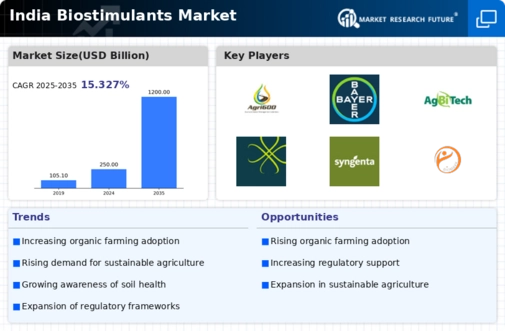
India Biostimulants Market Infographic
Purchase Options

India Biostimulants Market Summary

As per analysis, the India biostimulants market is projected to grow from USD 364.88 Million in 2024 to USD 1,373.75 Million by 2035, exhibiting a compound annual growth rate (CAGR) of 12.81% during the forecast period (2025 - 2035).

Key Market Trends & Highlights

The India biostimulants market is poised for substantial growth driven by increasing demand for sustainable agricultural practices.

  • The soil application segment remains the largest contributor to the biostimulants market, reflecting a strong preference among farmers.
  • Seed treatment is emerging as the fastest-growing segment, indicating a shift towards innovative agricultural practices.
  • Microbial biostimulants dominate the market, while seaweed extracts are rapidly gaining traction due to their effectiveness.
  • Rising awareness of sustainable agriculture and supportive government policies are key drivers propelling market expansion.

Market Size & Forecast

2024 Market Size 364.88 (USD Million)
2035 Market Size 1373.75 (USD Million)
CAGR (2025 - 2035) 12.81%

Major Players

BASF SE (DE), Syngenta AG (CH), Bayer AG (DE), UPL Limited (IN), Novozymes A/S (DK), Valagro S.p.A. (IT), Biolchim S.p.A. (IT), FMC Corporation (US), Koppert Biological Systems (NL)

Our Impact
Enabled $4.3B Revenue Impact for Fortune 500 and Leading Multinationals
Partnering with 2000+ Global Organizations Each Year
30K+ Citations by Top-Tier Firms in the Industry

India Biostimulants Market Trends

The India Biostimulants Market is currently experiencing a notable transformation, driven by increasing awareness among farmers regarding sustainable agricultural practices. This shift is largely influenced by the growing demand for organic produce and the need to enhance crop productivity without relying heavily on chemical fertilizers. As a result, biostimulants, which are natural substances that promote plant growth and health, are gaining traction. The government of India has been actively promoting the use of biostimulants through various initiatives aimed at improving agricultural productivity and sustainability. This has led to a rise in research and development activities focused on the formulation and application of biostimulants tailored to local conditions. Moreover, the regulatory framework surrounding the India Biostimulants Market is evolving, with the government implementing guidelines to ensure the quality and efficacy of these products. This regulatory support is likely to foster innovation and encourage more companies to enter the market. Additionally, the increasing collaboration between research institutions and agricultural companies is expected to enhance the development of effective biostimulant products. Overall, the India Biostimulants Market appears poised for growth, driven by a combination of consumer demand, government support, and advancements in agricultural technology.

Rising Demand for Organic Farming

There is a growing trend towards organic farming in India, as consumers increasingly prefer chemical-free produce. This shift is prompting farmers to adopt biostimulants, which enhance soil health and crop yield without synthetic inputs.

Government Initiatives and Support

The Indian government is actively promoting the use of biostimulants through various schemes and policies aimed at sustainable agriculture. This support is likely to encourage more farmers to integrate biostimulants into their farming practices.

Research and Development Advancements

There is a noticeable increase in research and development activities focused on biostimulants in India. Collaborations between academic institutions and agricultural companies are fostering innovation, leading to the creation of more effective biostimulant products.

India Biostimulants Market Drivers

Increasing Crop Production Needs

The growing demand for food due to India's rising population is a critical driver for the India biostimulants market. With the population projected to reach 1.5 billion by 2030, there is an urgent need to enhance agricultural productivity. Biostimulants offer a viable solution to improve crop yields and quality without the adverse effects associated with chemical fertilizers. Recent studies indicate that biostimulants can increase crop yields by 10-20%, making them an attractive option for farmers facing the challenges of limited arable land and changing climate conditions. This increasing need for efficient crop production is likely to propel the adoption of biostimulants across various agricultural sectors in India.

Government Policies Promoting Biostimulants

The Indian government has implemented various policies aimed at promoting the use of biostimulants within the agricultural sector. Initiatives such as the Pradhan Mantri Krishi Sinchai Yojana and the National Mission for Sustainable Agriculture encourage farmers to adopt eco-friendly practices, including the use of biostimulants. These policies not only provide financial incentives but also facilitate access to information and resources regarding biostimulant products. The government’s commitment to enhancing agricultural productivity while ensuring environmental sustainability is likely to bolster the India biostimulants market. As a result, the market is expected to witness increased investment and innovation, further driving the adoption of biostimulants among farmers.

Rising Awareness of Sustainable Agriculture

The increasing awareness of sustainable agricultural practices among Indian farmers is a pivotal driver for the India biostimulants market. As consumers demand more organic and sustainably produced food, farmers are seeking alternatives to synthetic fertilizers and pesticides. This shift is evident in the growing adoption of biostimulants, which enhance crop resilience and productivity while minimizing environmental impact. According to recent estimates, the market for biostimulants in India is projected to grow at a compound annual growth rate (CAGR) of approximately 12% over the next five years. This trend indicates a significant shift towards sustainable farming practices, as farmers recognize the long-term benefits of biostimulants in improving soil health and crop yield.

Growing Interest in Integrated Pest Management

The rising interest in integrated pest management (IPM) strategies among Indian farmers is fostering the growth of the India biostimulants market. Biostimulants play a crucial role in enhancing plant health and resilience, thereby reducing the reliance on chemical pesticides. As farmers become more aware of the benefits of IPM, they are increasingly incorporating biostimulants into their pest management practices. This trend is supported by various agricultural extension programs that promote the use of biostimulants as part of holistic pest management strategies. The integration of biostimulants into IPM is expected to enhance crop protection while promoting sustainable agricultural practices, further driving the growth of the biostimulants market in India.

Technological Advancements in Biostimulant Production

Technological advancements in the production of biostimulants are significantly influencing the India biostimulants market. Innovations in fermentation technology, extraction methods, and formulation techniques have led to the development of more effective and efficient biostimulant products. These advancements not only enhance the efficacy of biostimulants but also reduce production costs, making them more accessible to farmers. The introduction of novel biostimulant formulations, such as those derived from seaweed and microbial sources, is expected to expand the product offerings in the market. As a result, the market is likely to experience a surge in demand as farmers seek out these innovative solutions to improve crop performance and sustainability.


Market Segment Insights

By Application: Soil Application (Largest) vs. Seed Treatment (Fastest-Growing)

The application segment in the India biostimulants market is primarily dominated by soil application, which represents a significant portion of the market share. This method is favored due to its broad applicability across diverse crops and soil types, making it a go-to choice for many farmers. Meanwhile, seed treatment is emerging as the fastest-growing segment, driven by an increasing awareness of pre-sowing techniques that enhance seed germination and crop yield. This shift indicates a changing preference among farmers towards more efficient and targeted solutions for crop health. The growth trends in the application segment are largely influenced by several factors including technological advancements and the rising demand for sustainable agriculture practices. Soil application is traditionally preferred for its comprehensive benefits, like improving soil health and enhancing nutrient uptake. Conversely, seed treatment is gaining traction as farmers seek to optimize initial growth stages and protect emerging plants from diseases and pests. This dynamic illustrates the evolving landscape of agricultural practices in India, where innovation and sustainability are shaping application methods.

Soil Application (Dominant) vs. Seed Treatment (Emerging)

Soil application stands as the dominant application method in the India biostimulants market, primarily due to its ability to directly enhance soil fertility and structure. This approach allows for a more uniform and extensive distribution of biostimulants, promoting overall plant health and productivity. Farmers appreciate its long-lasting effects and the improvement of soil microbial activity. On the other hand, seed treatment is emerging as a critical method, gaining popularity among growers seeking to maximize their crop potential. This method offers precise application of biostimulants to seeds before planting, thus ensuring that plants start with enhanced vigor and resilience against biotic and abiotic stresses. As the market evolves, both application methods are essential for increasing crop yields and ensuring sustainable agricultural practices in India.

By Type: Microbial Biostimulants (Largest) vs. Seaweed Extracts (Fastest-Growing)

The biostimulants market in India is witnessing a robust distribution across various types, with microbial biostimulants leading the segment due to their extensive benefits in enhancing soil health and crop yield. Plant extracts and humic substances are also significant contributors, appealing to organic farming sectors, while seaweed extracts demonstrate strong performance, attracting attention for their natural growth-promoting properties. Amino acids, though smaller in share, are recognized for their specific applications in boosting plant resilience and vigor. Initially dominated by microbial biostimulants, the growth dynamics are shifting with rising consumer awareness and the increasing demand for sustainable agricultural solutions. Seaweed extracts are emerging rapidly, catering to the growing preference for natural products among farmers. The expanding market is driven by increasing agri-technology interventions, policy support for organic farming, and the necessity for enhanced crop productivity in response to changing climate conditions.

Microbial Biostimulants (Dominant) vs. Seaweed Extracts (Emerging)

Microbial biostimulants currently dominate the Indian biostimulants market due to their proven efficacy in promoting soil microbial health, nutrient uptake, and overall plant growth. This segment benefits from strong awareness and adoption rates among progressive farmers who seek sustainable solutions. Conversely, seaweed extracts represent an emerging trend, gaining traction for their unique advantages, including enhancing plant stress tolerance and improving yield. These extracts, often derived from specific types of seaweeds, are rich in macro and micronutrients, appealing to those looking for natural alternatives. As regulatory frameworks support organic inputs, both segments are expected to witness heightened adoption, shaping the future landscape of the biostimulants market in India.

By Crop Type: Cereals (Largest) vs. Fruits and Vegetables (Fastest-Growing)

In the India biostimulants market, the crop type segment showcases a diverse distribution of market share among various categories. Cereals hold the largest share, driven by their extensive cultivation across the country, making them a staple for biostimulant applications. Fruits and vegetables, on the other hand, represent the fastest-growing segment, fueled by the increasing demand for high-quality produce and improvements in agricultural practices.

Cereals (Dominant) vs. Fruits and Vegetables (Emerging)

Cereals, as the dominant segment in the India biostimulants market, benefit significantly from extensive agricultural practices and government support aimed at ensuring food security. As farmers increasingly adopt biostimulants for improved yield and soil health, cereals outpace other crops in usage. Conversely, fruits and vegetables are emerging rapidly due to changing consumer preferences towards organic and sustainably produced food. This segment's growth is further bolstered by innovations in biostimulant formulations that cater specifically to the unique nutrient requirements of these crops, fostering higher productivity and quality.

By Formulation: Liquid (Largest) vs. Granular (Fastest-Growing)

In the Indian biostimulants market, the formulation segment is characterized by a diverse mix of product types including liquid, granular, powder, suspension, and emulsion. The liquid formulation dominates this segment, capturing the largest market share due to its ease of application and rapid absorption by plants. Conversely, granular formulations are quickly gaining traction and are recognized as the fastest-growing category, driven by their targeted and sustained release properties, making them favorable among farmers seeking efficient crop management solutions.

Liquid (Dominant) vs. Granular (Emerging)

Liquid formulations are well-established in the Indian biostimulants market, known for their quick application processes and effective nutrient uptake by crops. Their concentrated nature allows for tailored applications that address specific nutrient deficiencies, enhancing overall crop productivity. On the other hand, granular formulations are emerging as a significant alternative, appealing to farmers due to their ease of use and long-lasting effects. This form enables precise placement at planting, reducing the frequency of applications. As farmers increasingly seek sustainable agricultural methods, granular formulations are expected to witness robust growth, complementing traditional liquid formulations in enhancing crop yield and health.

By Distribution Channel: Direct Sales (Largest) vs. Online Sales (Fastest-Growing)

In the India biostimulants market, the distribution of sales channels reveals a diverse landscape. Direct Sales holds the largest share, capturing the attention of farmers who prefer personal interactions and reliable product information. Meanwhile, Online Sales is rapidly gaining traction, reflecting a significant shift towards digitalization in agricultural purchases. Retail Sales and Wholesale Distribution also play important roles, catering to regional demands and bulk buyers. Agricultural Cooperatives, while smaller, provide community-focused solutions that enhance local agricultural practices.

Direct Sales (Dominant) vs. Online Sales (Emerging)

Direct Sales stands as the dominant channel in the India biostimulants market, characterized by its personal touch and direct engagement with farmers. This channel thrives on trust and tailored advice, making it vital for understanding specific user needs. Conversely, Online Sales represents the emerging trend, appealing to tech-savvy customers who prefer convenience and extensive product options. This channel benefits from the increasing internet penetration in rural areas and the growing acceptance of e-commerce among agricultural stakeholders. Collectively, these channels reflect the evolving preferences of Indian farmers and the increasing importance of integrating digital solutions into traditional practices.

Get more detailed insights about India Biostimulants Market

Key Players and Competitive Insights

The biostimulants market in India is characterized by a dynamic competitive landscape, driven by increasing agricultural productivity demands and a growing emphasis on sustainable farming practices. Key players such as BASF SE (DE), Syngenta AG (CH), and UPL Limited (IN) are strategically positioned to leverage innovation and regional expansion to enhance their market presence. BASF SE (DE) focuses on developing advanced biostimulant formulations that cater to local crop needs, while Syngenta AG (CH) emphasizes partnerships with local farmers to promote sustainable practices. UPL Limited (IN) is actively pursuing mergers and acquisitions to broaden its product portfolio, thereby shaping a competitive environment that prioritizes sustainability and technological advancement.
The market structure appears moderately fragmented, with a mix of established multinational corporations and emerging local players. Key business tactics include localizing manufacturing to reduce costs and optimize supply chains, which enhances responsiveness to market demands. The collective influence of these major players fosters a competitive atmosphere where innovation and sustainability are paramount, potentially leading to a more resilient agricultural sector.
In December 2025, BASF SE (DE) announced the launch of a new biostimulant product specifically designed for rice cultivation in India. This strategic move is significant as it addresses the unique challenges faced by rice farmers, such as nutrient deficiencies and water scarcity, thereby enhancing crop yields and promoting sustainable practices. The introduction of this product is likely to strengthen BASF's foothold in the Indian market and reinforce its commitment to innovation.
In November 2025, UPL Limited (IN) entered into a strategic partnership with a local agricultural research institute to co-develop biostimulant solutions tailored for diverse Indian crops. This collaboration is indicative of UPL's focus on leveraging local expertise to enhance product efficacy and market acceptance. Such partnerships may facilitate quicker adaptation to regional agricultural challenges, positioning UPL as a leader in localized biostimulant solutions.
In October 2025, Syngenta AG (CH) launched a digital platform aimed at providing farmers with real-time data on biostimulant application and crop health monitoring. This initiative reflects Syngenta's commitment to integrating digital technologies into agriculture, potentially transforming how farmers interact with biostimulant products. By enhancing data accessibility, Syngenta may improve user engagement and product effectiveness, thereby solidifying its competitive edge.
As of January 2026, current trends in the biostimulants market indicate a strong shift towards digitalization, sustainability, and the integration of AI technologies. Strategic alliances among key players are increasingly shaping the competitive landscape, fostering innovation and collaboration. The evolution of competitive differentiation appears to be moving away from price-based competition towards a focus on technological advancements, product innovation, and supply chain reliability. This shift may ultimately redefine market dynamics, emphasizing the importance of sustainable practices and tailored solutions in meeting the needs of the agricultural sector.

Key Companies in the India Biostimulants Market include

Industry Developments

The India Biostimulants Market has recently witnessed significant developments, reflecting its growing importance in sustainable agriculture. In September 2023, UPL Limited announced advancements in their biostimulant products, focusing on enhancing crop resilience amid changing climatic conditions. Bayer CropScience also reported an expansion of its biostimulant portfolio, aiming to meet increasing farmer demand for eco-friendly solutions. The market is expected to experience valuation growth driven by investments in Research and Development by companies like Novozymes and Valagro, which are prioritizing innovative formulations.

Major events in the past few years include the collaboration between FMC Corporation and Sustainable Agriculture Technologies in June 2021, enhancing offerings in the biostimulants sector. Furthermore, the Indian government has endorsed biostimulants as part of its agricultural policy, promoting increased use of bio-based products to improve soil health and crop yield. The market is also seeing heightened interest from companies such as Syngenta and Haifa Group, which have initiated various initiatives aimed at integrating biostimulants into mainstream agricultural practices. As the demand for sustainable agricultural solutions rises, the India Biostimulants Market is poised for expansive growth.

Future Outlook

India Biostimulants Market Future Outlook

The India biostimulants market is poised for growth at 12.81% CAGR from 2025 to 2035, driven by increasing agricultural productivity demands and sustainable farming practices.

New opportunities lie in:

  • Development of customized biostimulant formulations for specific crops Expansion into organic farming sectors with tailored marketing strategies Investment in R&D for innovative biostimulant technologies and applications

By 2035, the market is expected to achieve substantial growth, reflecting evolving agricultural practices.

Market Segmentation

India Biostimulants Market Type Outlook

  • Microbial Biostimulants
  • Plant Extracts
  • Humic Substances
  • Seaweed Extracts
  • Amino Acids

India Biostimulants Market Crop Type Outlook

  • Cereals
  • Fruits and Vegetables
  • Oilseeds
  • Pulses
  • Turf and Ornamentals

India Biostimulants Market Application Outlook

  • Foliar Application
  • Soil Application
  • Seed Treatment
  • Fertigation
  • Post-Harvest Application

India Biostimulants Market Formulation Outlook

  • Liquid
  • Granular
  • Powder
  • Suspension
  • Emulsion

India Biostimulants Market Distribution Channel Outlook

  • Direct Sales
  • Online Sales
  • Retail Sales
  • Wholesale Distribution
  • Agricultural Cooperatives

Report Scope

MARKET SIZE 2024 364.88(USD Million)
MARKET SIZE 2025 332889.38(USD Million)
MARKET SIZE 2035 1373.75(USD Million)
COMPOUND ANNUAL GROWTH RATE (CAGR) 12.81% (2024 - 2035)
REPORT COVERAGE Revenue Forecast, Competitive Landscape, Growth Factors, and Trends
BASE YEAR 2024
Market Forecast Period 2025 - 2035
Historical Data 2019 - 2024
Market Forecast Units USD Million
Key Companies Profiled BASF SE (DE), Syngenta AG (CH), Bayer AG (DE), UPL Limited (IN), Novozymes A/S (DK), Valagro S.p.A. (IT), Biolchim S.p.A. (IT), FMC Corporation (US), Koppert Biological Systems (NL)
Segments Covered Application, Type, Crop Type, Formulation, Distribution Channel
Key Market Opportunities Growing demand for sustainable agriculture practices drives innovation in the India Biostimulants Market.
Key Market Dynamics Rising demand for sustainable agriculture drives growth in India's biostimulants market amid evolving regulatory frameworks.
Countries Covered India
Leave a Comment

FAQs

What is the current valuation of the India biostimulants market as of 2024?

The India biostimulants market was valued at 364.88 USD Million in 2024.

Download Free Sample

Kindly complete the form below to receive a free sample of this Report

Compare Licence

×
Features License Type
Single User Multiuser License Enterprise User
Price $4,950 $5,950 $7,250
Maximum User Access Limit 1 User Upto 10 Users Unrestricted Access Throughout the Organization
Free Customization
Direct Access to Analyst
Deliverable Format
Platform Access
Discount on Next Purchase 10% 15% 15%
Printable Versions