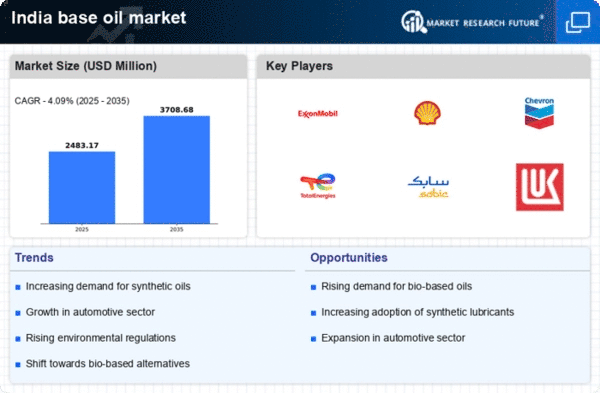
The base oil market in India is characterized by a competitive landscape that is increasingly shaped by innovation, sustainability, and strategic partnerships. Key players such as ExxonMobil (US), Indian Oil Corporation (IN), and Shell (GB) are actively pursuing strategies that emphasize technological advancements and regional expansion. ExxonMobil (US) focuses on enhancing its product portfolio through innovative formulations, while Indian Oil Corporation (IN) is leveraging its extensive distribution network to strengthen its market presence. Shell (GB) appears to be concentrating on sustainability initiatives, which are becoming crucial in shaping consumer preferences and regulatory compliance. Collectively, these strategies contribute to a dynamic competitive environment where differentiation is increasingly based on technological capabilities and sustainability practices.In terms of business tactics, companies are localizing manufacturing to reduce costs and optimize supply chains. The market structure is moderately fragmented, with several players vying for market share. However, the influence of major companies is significant, as they set benchmarks for quality and innovation. This competitive structure allows for a variety of offerings, catering to diverse customer needs while also fostering a climate of continuous improvement among smaller players.
In October ExxonMobil (US) announced a partnership with a local technology firm to develop advanced synthetic base oils aimed at enhancing performance and reducing environmental impact. This strategic move underscores ExxonMobil's commitment to innovation and sustainability, positioning it favorably in a market that increasingly values eco-friendly products. The collaboration is expected to yield new formulations that could capture a larger share of the growing demand for high-performance lubricants.
In September Indian Oil Corporation (IN) launched a new line of bio-based lubricants, reflecting its strategic pivot towards sustainable product offerings. This initiative not only aligns with global trends towards greener alternatives but also enhances Indian Oil's competitive positioning in a market that is progressively leaning towards environmentally responsible solutions. The introduction of these products is likely to attract environmentally conscious consumers and businesses, thereby expanding its market reach.
In August Shell (GB) unveiled its digital platform aimed at optimizing supply chain operations for its base oil products. This platform is designed to enhance transparency and efficiency, allowing customers to track their orders in real-time. By integrating digital solutions into its operations, Shell (GB) is not only improving customer experience but also streamlining its logistics, which could lead to cost savings and improved service delivery.
As of November the competitive trends in the base oil market are increasingly defined by digitalization, sustainability, and the integration of advanced technologies such as AI. Strategic alliances are playing a pivotal role in shaping the landscape, enabling companies to pool resources and expertise to drive innovation. Looking ahead, competitive differentiation is likely to evolve from traditional price-based competition to a focus on technological innovation, sustainability, and supply chain reliability. This shift indicates a growing recognition that long-term success will depend on the ability to adapt to changing market dynamics and consumer preferences.