×
Request Free Sample ×

Kindly complete the form below to receive a free sample of this Report

* Please use a valid business email

Leading companies partner with us for data-driven Insights

clients tt-cursor
Hero Background

India Automatic Content Recognition Market

ID: MRFR/ICT/60238-HCR
200 Pages
Aarti Dhapte
February 2026

India Automatic Content Recognition Market Size, Share and Research Report: By Solution (Audio, Video and Image Recognition, Voice, Real Time Content Analytics), By Service (Professional, Managed), and By End User (IT & Telecommunication, Healthcare)- Industry Forecast to 2035

Share:
Download PDF ×

We do not share your information with anyone. However, we may send you emails based on your report interest from time to time. You may contact us at any time to opt-out.

India Automatic Content Recognition Market Infographic
Purchase Options

India Automatic Content Recognition Market Summary

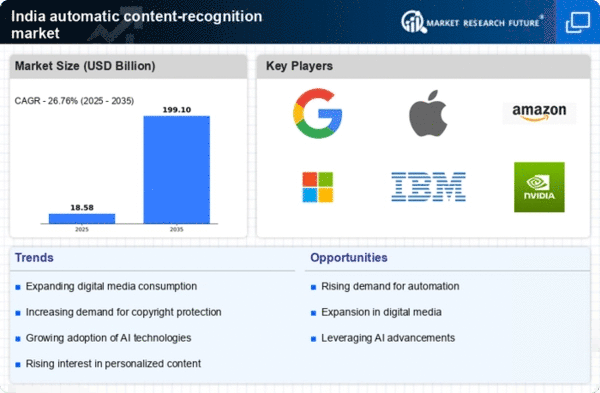
As per Market Research Future analysis, the India Automatic Content Recognition Market size was estimated at 14.66 USD Billion in 2024. The Automatic Content-recognition market is projected to grow from 18.58 USD Billion in 2025 to 199.1 USD Billion by 2035, exhibiting a compound annual growth rate (CAGR) of 26.7% during the forecast period 2025 - 2035

Key Market Trends & Highlights

The India automatic content-recognition market is poised for substantial growth driven by technological advancements and evolving consumer behaviors.

  • The largest segment in the India automatic content-recognition market is content monetization, reflecting a rising demand for effective revenue generation strategies.
  • The fastest-growing segment is integration with artificial intelligence, indicating a shift towards more sophisticated content recognition solutions.
  • The market is experiencing a heightened focus on data privacy and compliance, as stakeholders prioritize regulatory adherence in their operations.
  • Key drivers such as the surge in digital media consumption and the expansion of e-commerce platforms are significantly influencing market dynamics.

Market Size & Forecast

2024 Market Size 14.66 (USD Billion)
2035 Market Size 199.1 (USD Billion)
CAGR (2025 - 2035) 26.76%

Major Players

Google (US), Apple (US), Amazon (US), Microsoft (US), IBM (US), NVIDIA (US), Gracenote (US), Acronym (US), Mediaroom (SE)

Our Impact
Enabled $4.3B Revenue Impact for Fortune 500 and Leading Multinationals
Partnering with 2000+ Global Organizations Each Year
30K+ Citations by Top-Tier Firms in the Industry

India Automatic Content Recognition Market Trends

The India Automatic Content Recognition Market is experiencing notable growth, driven by advancements in technology and increasing demand for efficient content management solutions. In India, the proliferation of digital media and the rise of streaming services have created a fertile environment for the adoption of automatic content-recognition technologies. These innovations enable businesses to identify, manage, and monetize content more effectively, thereby enhancing user experiences and operational efficiencies. As organizations seek to leverage data analytics and improve content delivery, the market is likely to witness further expansion. Moreover, the regulatory landscape in India is evolving, with government initiatives aimed at promoting digital innovation and protecting intellectual property rights. This supportive framework encourages investment in automatic content-recognition technologies, fostering a competitive market. Companies are increasingly focusing on developing solutions that cater to local needs, which may lead to tailored applications that address specific challenges faced by Indian businesses. As the market matures, collaboration between technology providers and content creators is expected to intensify, paving the way for innovative applications and services that enhance content accessibility and user engagement.

Rising Demand for Content Monetization

The automatic content-recognition market is witnessing a surge in demand for monetization solutions. As content creators and distributors seek to maximize revenue streams, technologies that facilitate accurate content identification and rights management are becoming essential. This trend is particularly relevant in India, where the entertainment and media sectors are rapidly evolving.

Integration with Artificial Intelligence

There is a growing trend towards integrating artificial intelligence with automatic content-recognition technologies. This integration enhances the accuracy and efficiency of content identification processes. In India, businesses are increasingly adopting AI-driven solutions to improve user experiences and streamline operations.

Focus on Data Privacy and Compliance

As the automatic content-recognition market expands, there is an increasing emphasis on data privacy and compliance with regulations. Indian companies are prioritizing the development of solutions that adhere to local laws and international standards, ensuring that user data is protected while leveraging content-recognition capabilities.

India Automatic Content Recognition Market Drivers

Expansion of E-commerce Platforms

The automatic content-recognition market is significantly influenced by the expansion of e-commerce platforms in India. As online shopping continues to gain traction, retailers are increasingly utilizing multimedia content to enhance product visibility and customer engagement. The integration of automatic content-recognition technologies allows these platforms to analyze and categorize visual content, improving searchability and user experience. In 2025, the e-commerce sector in India is projected to reach a valuation of $200 billion, creating a fertile ground for the automatic content-recognition market. This growth presents opportunities for businesses to leverage content recognition for targeted marketing and personalized recommendations, thereby driving further adoption of these technologies.

Growth of Social Media Influencers

The rise of social media influencers in India is a notable driver for the automatic content-recognition market. Influencers often utilize various forms of media to engage their audiences, necessitating effective content management solutions. The automatic content-recognition market is likely to benefit from this trend as brands seek to monitor and analyze influencer-generated content for marketing purposes. With an estimated 500 million social media users in India, brands are increasingly investing in technologies that can track and analyze content across platforms. This demand for content recognition tools is expected to grow, as businesses aim to optimize their marketing strategies and enhance brand visibility through influencer collaborations.

Surge in Digital Media Consumption

The automatic content-recognition market in India is experiencing a surge due to the increasing consumption of digital media. With the proliferation of smartphones and affordable internet access, more users are engaging with video and audio content. Reports indicate that the number of internet users in India reached approximately 800 million in 2025, leading to a heightened demand for content recognition technologies. This trend is further fueled by the rise of streaming platforms, which require efficient content identification and management solutions. As a result, businesses are investing in automatic content-recognition technologies to enhance user experience and optimize content delivery. The automatic content-recognition market is thus poised for substantial growth, driven by the need for innovative solutions that cater to the evolving digital landscape.

Regulatory Compliance and Content Monitoring

The automatic content-recognition market in India is also driven by the need for regulatory compliance and content monitoring. As digital content proliferates, there is a growing emphasis on ensuring that content adheres to legal and ethical standards. The automatic content-recognition market plays a crucial role in helping businesses monitor their content for compliance with regulations, such as copyright laws and advertising standards. In 2025, the Indian government is expected to implement stricter regulations regarding digital content, prompting companies to invest in automatic content-recognition technologies to mitigate risks associated with non-compliance. This trend indicates a potential increase in demand for solutions that facilitate effective content monitoring and management.

Technological Advancements in Machine Learning

Technological advancements in machine learning are significantly impacting the automatic content-recognition market in India. As machine learning algorithms become more sophisticated, the accuracy and efficiency of content recognition systems improve. This evolution is likely to enhance the capabilities of automatic content-recognition technologies, making them more appealing to businesses across various sectors. In 2025, the market for machine learning in India is projected to grow at a CAGR of 40%, indicating a robust interest in integrating these technologies into content recognition solutions. The automatic content-recognition market stands to benefit from this trend, as companies seek to leverage advanced machine learning techniques to optimize content analysis and improve user engagement.


Market Segment Insights

By Solution: Audio (Largest) vs. Video and Image Recognition (Fastest-Growing)

The India automatic content-recognition market exhibits a diverse distribution of solutions, with Audio recognized as the largest segment dominating the landscape. This segment holds a significant share due to its widespread applications across various industries, including entertainment and broadcasting. In contrast, Video and Image Recognition is emerging as the fastest-growing segment, driven by technological advancements and increasing demand for visual content analytics among enterprises. Growth trends in this segment are largely influenced by the rising utilization of artificial intelligence and machine learning, enabling more precise recognition capabilities. Additionally, the proliferation of digital content and the need for real-time analytics are propelling the adoption of technologies like Voice and Real-Time Content Analytics. These advancements underscore a shift towards more interactive and immersive user experiences across platforms and devices.

Audio (Dominant) vs. Video and Image Recognition (Emerging)

The Audio segment remains dominant in the India automatic content-recognition market, characterized by established use cases such as in media playback and smart device integration. Its robustness stems from a well-adopted infrastructure and consumer familiarity, making it a preferred choice among both businesses and users. On the other hand, Video and Image Recognition is emerging as a pivotal segment, leveraging cutting-edge technologies to achieve enhanced user engagement and targeted marketing strategies. The increasing ability to analyze visual content in real-time is positioning this segment favorably for organizations aiming to capitalize on the growing digital landscape. Both segments showcase unique advantages, contributing distinctly to the overall market growth.

By Service: Professional (Largest) vs. Managed (Fastest-Growing)

In the India automatic content-recognition market, the service segment is primarily divided into Professional and Managed services. Professional services currently hold the largest share, catering to a wide range of applications that require specialized knowledge and expertise. These services are valued for their ability to tailor solutions that meet specific client needs, making them highly sought after across various industries. Conversely, Managed services are emerging rapidly, characterized by their convenience and efficiency in handling content-recognition needs on behalf of clients. The growing demand for streamlined operations and outsourced solutions is driving this segment's growth. Factors such as cost-effectiveness and the need for continuous support are propelling Managed services to become an increasingly popular choice for businesses looking to enhance their capabilities while minimizing resource expenditure.

Service: Professional (Dominant) vs. Managed (Emerging)

Professional services in the India automatic content-recognition market are renowned for their structured approach that entails expert consultation, system integration, and customized implementations. This segment focuses on delivering high-value solutions tailored to complex requirements, leading to client satisfaction and loyalty. In contrast, Managed services represent an emerging paradigm in the market, offering packaged solutions that allow organizations to outsource their content-recognition tasks. These services are characterized by subscription-based pricing and proactive management, enabling clients to focus on core business operations while benefiting from expert oversight and up-to-date technology. Both segments contribute uniquely to the market, with Professional services ensuring precision and Managed services providing scalability and flexibility.

By End User: IT & Telecommunication (Largest) vs. Healthcare (Fastest-Growing)

The market share distribution in the India automatic content-recognition market reveals that the IT & Telecommunication segment holds a significant portion, dominating over other end-user sectors. This robust sector benefits from increasing digital transformation initiatives and demand for enhanced customer engagement mechanisms. In contrast, the Healthcare segment is witnessing rapid adoption of automatic content-recognition solutions, primarily due to the rising need for efficient patient data management and streamlined operations, thereby capturing a growing niche in the market. Growth trends in these segments are largely driven by technological advancements and evolving consumer expectations. The IT & Telecommunication segment is fueled by the integration of AI and machine learning, enhancing service delivery and operational efficiency. Meanwhile, the Healthcare sector is experiencing an upsurge in demand for digital health solutions, especially post-pandemic, as stakeholders seek innovative ways to optimize healthcare delivery and ensure quality patient care through advanced content-recognition technologies.

IT & Telecommunication: Dominant vs. Healthcare: Emerging

The IT & Telecommunication segment in the India automatic content-recognition market stands as a dominant force, leveraging advanced technologies to provide superior service offerings. Companies within this segment are adopting sophisticated content-recognition tools to enhance data analytics and customer interaction frameworks. On the other hand, the Healthcare segment, characterized as emerging, displays rapid growth potential fueled by increasing investments in health IT and a heightened focus on patient-centric care solutions. This segment is gradually integrating content-recognition systems to improve healthcare delivery, patient engagement, and data management. As the industry adapts to digital changes, both segments show prominence, with IT & Telecommunication leading in market share and Healthcare expanding swiftly.

Get more detailed insights about India Automatic Content Recognition Market

Key Players and Competitive Insights

The automatic content-recognition market in India is characterized by a dynamic competitive landscape, driven by rapid technological advancements and increasing demand for content personalization. Major players such as Google (US), Apple (US), and Amazon (US) are strategically positioned to leverage their extensive technological capabilities and vast data resources. Google (US) focuses on enhancing its machine learning algorithms to improve content recognition accuracy, while Apple (US) emphasizes user privacy and seamless integration across its ecosystem. Amazon (US), on the other hand, is expanding its cloud services to support content recognition applications, indicating a shift towards providing comprehensive solutions that integrate with its existing platforms. Collectively, these strategies foster a competitive environment that prioritizes innovation and user-centric solutions.Key business tactics within this market include localizing manufacturing and optimizing supply chains to enhance operational efficiency. The competitive structure appears moderately fragmented, with several key players vying for market share. This fragmentation is influenced by the diverse needs of consumers and businesses, which encourages companies to adopt tailored approaches to meet specific market demands. The collective influence of these major players shapes the market dynamics, as they continuously adapt to emerging trends and consumer preferences.

In October Google (US) announced a partnership with a leading Indian media company to develop localized content-recognition solutions tailored for regional languages. This strategic move is significant as it not only enhances Google's market presence in India but also addresses the growing demand for content accessibility in diverse linguistic contexts. By focusing on regional customization, Google (US) positions itself as a leader in the market, potentially increasing user engagement and satisfaction.

In September Apple (US) launched an advanced version of its content-recognition software, which integrates augmented reality features aimed at enhancing user interaction with digital content. This development underscores Apple's commitment to innovation and its strategy to differentiate itself through unique user experiences. The integration of augmented reality could potentially redefine how users interact with content, thereby expanding Apple's market reach and reinforcing its competitive edge.

In August Amazon (US) expanded its AWS offerings to include advanced content-recognition tools designed for media companies. This strategic expansion reflects Amazon's focus on providing comprehensive solutions that cater to the evolving needs of the media industry. By enhancing its cloud capabilities, Amazon (US) not only strengthens its position in the market but also fosters deeper relationships with content creators and distributors, which could lead to increased revenue streams.

As of November current competitive trends in the automatic content-recognition market are heavily influenced by digitalization, sustainability, and the integration of artificial intelligence. Strategic alliances among key players are shaping the landscape, as companies seek to combine their strengths to deliver innovative solutions. Looking ahead, competitive differentiation is likely to evolve from traditional price-based competition to a focus on innovation, technological advancements, and supply chain reliability. This shift suggests that companies will increasingly prioritize developing unique capabilities that enhance user experiences and operational efficiencies.

Key Companies in the India Automatic Content Recognition Market include

Industry Developments

AWS Elemental MediaTailor, which facilitates server-side ad insertion and watermarking, was extended to the Asia Pacific (Hyderabad) region by Amazon Web Services in April 2024.

This release allowed local broadcasters and OTT platforms to integrate forensic watermarks and facilitate real-time fingerprint identification procedures via Hyderabad-hosted APIs, even though it was not specifically targeted at the Indian ACR market.These features give Indian media services that use AWS infrastructure in the area the fundamental ACR functionality they need.

In the meantime, Shazam entered the Indian market through its exclusive partnership with JioSaavn in April 2013, further expanding its coverage of music recognition across Indian languages and genres by integrating Saavn's regional music catalog into its global fingerprint database. Even though it was historic, this was the first time Shazam's fingerprinting technology was widely used in India's content ecosystem.

Future Outlook

India Automatic Content Recognition Market Future Outlook

The automatic content-recognition market in India is poised for growth at 26.76% CAGR from 2025 to 2035, driven by technological advancements and increasing demand for content monetization.

New opportunities lie in:

  • Development of AI-driven content analysis tools for media companies.
  • Integration of automatic content-recognition in e-commerce platforms for personalized marketing.
  • Expansion of licensing agreements with streaming services for enhanced content tracking.

By 2035, the market is expected to achieve substantial growth, reflecting its critical role in content management.

Market Segmentation

India Automatic Content Recognition Market Service Outlook

  • Professional
  • Managed

India Automatic Content Recognition Market End User Outlook

  • IT & Telecommunication
  • Healthcare

India Automatic Content Recognition Market Solution Outlook

  • Audio
  • Video and Image Recognition
  • Voice
  • Real-Time Content Analytics

Report Scope

MARKET SIZE 2024 14.66(USD Billion)
MARKET SIZE 2025 18.58(USD Billion)
MARKET SIZE 2035 199.1(USD Billion)
COMPOUND ANNUAL GROWTH RATE (CAGR) 26.76% (2025 - 2035)
REPORT COVERAGE Revenue Forecast, Competitive Landscape, Growth Factors, and Trends
BASE YEAR 2024
Market Forecast Period 2025 - 2035
Historical Data 2019 - 2024
Market Forecast Units USD Billion
Key Companies Profiled Google (US), Apple (US), Amazon (US), Microsoft (US), IBM (US), NVIDIA (US), Gracenote (US), Acronym (US), Mediaroom (SE)
Segments Covered Solution, Service, End User
Key Market Opportunities Integration of artificial intelligence in automatic content-recognition market enhances accuracy and user engagement.
Key Market Dynamics Rising demand for automated media monitoring drives innovation in the automatic content-recognition market.
Countries Covered India
Leave a Comment

FAQs

What is the projected market size of the India Automatic Content Recognition Market in 2024?

The India Automatic Content Recognition Market is projected to be valued at 150.3 million USD in 2024.

What is the expected market value of the India Automatic Content Recognition Market by 2035?

By 2035, the market is expected to reach a valuation of 2066.7 million USD.

What is the expected CAGR for the India Automatic Content Recognition Market from 2025 to 2035?

The market is anticipated to grow at a CAGR of 26.906 percent from 2025 to 2035.

Which segment of the India Automatic Content Recognition Market holds the highest value in 2024?

The Video and Image Recognition segment holds the highest value at 50.0 million USD in 2024.

What is the projected market size of the Voice recognition segment by 2035?

The Voice recognition segment is expected to reach a market size of 620.5 million USD by 2035.

Who are the key players in the India Automatic Content Recognition Market?

Major players in the market include SonicEmotion, Apple, Google, Amazon, and Microsoft.

What is the projected size of the Audio recognition segment in 2024?

The Audio recognition segment is projected to be valued at 30.3 million USD in 2024.

What challenges does the India Automatic Content Recognition Market face?

Challenges include technological advancements and the need for continuous innovation among competitors.

How do market growth rates vary among the segments of the India Automatic Content Recognition Market?

Different segments such as Video, Audio, and Voice are expected to exhibit significant growth during the forecast period.

What opportunities exist for growth in the India Automatic Content Recognition Market?

Growing demand for real-time content analytics and advancements in AI technology present key opportunities for growth.

Download Free Sample

Kindly complete the form below to receive a free sample of this Report

Compare Licence

×
Features License Type
Single User Multiuser License Enterprise User
Price $4,950 $5,950 $7,250
Maximum User Access Limit 1 User Upto 10 Users Unrestricted Access Throughout the Organization
Free Customization
Direct Access to Analyst
Deliverable Format
Platform Access
Discount on Next Purchase 10% 15% 15%
Printable Versions