×
Request Free Sample ×

Kindly complete the form below to receive a free sample of this Report

* Please use a valid business email

Leading companies partner with us for data-driven Insights

clients tt-cursor
Hero Background

India Artificial Tears Market

ID: MRFR/HC/51599-HCR
200 Pages
Rahul Gotadki
February 2026

India Artificial Tears Market Research Report By Type (Polyethylene Glycol, Propylene Glycol, Cellulose, Glycerin, Others), By Delivery Mode (Eye Drops, Ointments, Sprays), By Application (Dry Eye Syndrome, Allergies, Infections, Others), and By Distribution Channel (Hospital Pharmacies, Drug Stores, Retail Pharmacies, Online Pharmacies) - Growth & Industry Forecast 2025 To 2035

Share:
Download PDF ×

We do not share your information with anyone. However, we may send you emails based on your report interest from time to time. You may contact us at any time to opt-out.

India Artificial Tears Market Infographic
Purchase Options

India Artificial Tears Market Summary

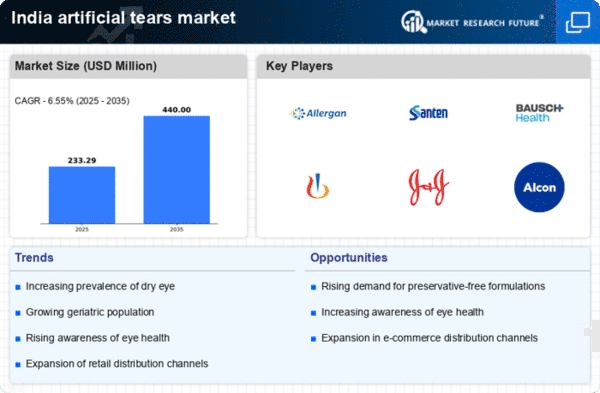
As per Market Research Future analysis, the India Artificial Tears Market size was estimated at 218.95 USD Million in 2024. The Artificial Tears market is projected to grow from 233.29 USD Million in 2025 to 440.0 USD Million by 2035, exhibiting a compound annual growth rate (CAGR) of 6.5% during the forecast period 2025 - 2035

Key Market Trends & Highlights

The India artificial tears market is experiencing robust growth driven by increasing awareness and technological advancements.

  • The market is witnessing a rising incidence of dry eye syndrome, which is propelling demand for artificial tears.
  • Technological advancements in formulations are enhancing product efficacy and consumer satisfaction.
  • There is a notable shift towards over-the-counter products, making them more accessible to consumers.
  • Key market drivers include increasing awareness of eye health and the aging population, which is amplifying eye care needs.

Market Size & Forecast

2024 Market Size 218.95 (USD Million)
2035 Market Size 440.0 (USD Million)
CAGR (2025 - 2035) 6.55%

Major Players

Allergan (US), Santen Pharmaceutical (JP), Bausch Health (CA), Novartis (CH), Johnson & Johnson (US), Alcon (CH), Otsuka Pharmaceutical (JP), Hyaluronic Acid (US)

Our Impact
Enabled $4.3B Revenue Impact for Fortune 500 and Leading Multinationals
Partnering with 2000+ Global Organizations Each Year
30K+ Citations by Top-Tier Firms in the Industry

India Artificial Tears Market Trends

The India Artificial Tears Market is currently experiencing notable growth, driven by an increasing prevalence of dry eye conditions among the population. Factors such as environmental changes, prolonged screen time, and lifestyle choices contribute to the rising incidence of this ailment. As awareness regarding eye health expands, consumers are seeking effective solutions to alleviate discomfort. This trend is further supported by advancements in formulation technologies, which enhance the efficacy and comfort of artificial tears. Consequently, manufacturers are focusing on developing innovative products that cater to diverse consumer needs, including preservative-free options and those with added therapeutic benefits. Moreover, the regulatory landscape in India is evolving, with authorities emphasizing the importance of safety and efficacy in ophthalmic products. This shift encourages companies to invest in research and development, leading to the introduction of new formulations and delivery systems. The growing preference for over-the-counter products also indicates a shift in consumer behavior, as individuals increasingly opt for self-medication. Overall, the artificial tears market is poised for continued expansion, driven by a combination of consumer demand, technological advancements, and regulatory support.

Rising Incidence of Dry Eye Syndrome

The prevalence of dry eye syndrome is increasing, attributed to factors such as urbanization and lifestyle changes. This condition affects a significant portion of the population, leading to heightened demand for artificial tears as a remedy.

Technological Advancements in Formulations

Innovations in formulation technologies are enhancing the effectiveness of artificial tears. New products are being developed with improved viscosity and longer-lasting hydration, catering to the specific needs of consumers.

Shift Towards Over-the-Counter Products

There is a noticeable trend towards the use of over-the-counter artificial tears. Consumers are increasingly opting for self-treatment options, reflecting a growing awareness of eye health and the availability of effective solutions.

India Artificial Tears Market Drivers

Increasing Awareness of Eye Health

The growing awareness regarding eye health in India appears to be a significant driver for the artificial tears market. As more individuals recognize the importance of maintaining eye moisture and comfort, the demand for artificial tears is likely to rise. Educational campaigns and health initiatives by both governmental and non-governmental organizations have contributed to this awareness. Reports indicate that the artificial tears market in India is projected to grow at a CAGR of approximately 8% over the next few years. This trend suggests that consumers are increasingly seeking solutions for dry eyes, thereby expanding the market for artificial tears.

Aging Population and Eye Care Needs

India's demographic shift towards an aging population is likely to impact the artificial tears market positively. As individuals age, they often experience a higher prevalence of dry eye conditions due to various factors, including reduced tear production. The artificial tears market is expected to benefit from this demographic trend, as older adults are more likely to seek relief from dry eye symptoms. Current estimates suggest that by 2030, around 20% of India's population will be over 60 years old, which could significantly increase the demand for artificial tears. This demographic change indicates a growing market potential for eye care products.

Rising Urbanization and Lifestyle Changes

Urbanization in India is contributing to lifestyle changes that may lead to increased eye strain and dryness. Factors such as prolonged screen time, exposure to pollution, and air conditioning are becoming more prevalent in urban settings. These lifestyle changes are likely to drive the demand for artificial tears as individuals seek relief from discomfort caused by dry eyes. The artificial tears market is expected to see a notable increase in sales as urban dwellers become more aware of the need for eye care products. Market analysts suggest that this trend could lead to a growth rate of around 7% in the coming years.

Expansion of Retail and E-commerce Channels

The expansion of retail and e-commerce channels in India is facilitating easier access to artificial tears. With the rise of online shopping platforms, consumers can conveniently purchase eye care products from the comfort of their homes. This accessibility is likely to boost the artificial tears market, as more individuals are inclined to try these products. Additionally, brick-and-mortar pharmacies are increasingly stocking a wider range of artificial tears, catering to diverse consumer needs. The combination of retail growth and e-commerce is expected to enhance market penetration, potentially increasing sales by 10% in the next few years.

Government Initiatives and Healthcare Policies

Government initiatives aimed at improving healthcare access in India may positively influence the artificial tears market. Policies that promote eye health and subsidize eye care products can enhance affordability and availability for consumers. The government's focus on reducing the burden of eye-related ailments is likely to encourage the use of artificial tears among the population. Furthermore, collaborations between the government and healthcare providers to raise awareness about dry eye conditions could lead to increased consumption of artificial tears. This supportive environment may result in a projected market growth of approximately 9% over the next few years.


Market Segment Insights

By Type: Polyethylene Glycol (Largest) vs. Glycerin (Fastest-Growing)

In the India artificial tears market, the segment distribution reveals that Polyethylene Glycol holds the largest market share due to its superior viscosity and moisture-retaining properties, making it a preferred choice among consumers. Following closely are Propylene Glycol and Cellulose, which also contribute significantly to the market. Glycerin, while not leading, has gained traction for its effectiveness in treating dry eye conditions, reflecting a dynamic distribution across these segment values. The growth trends in this segment are indicative of a rising demand for formulations that provide relief from dry eyes, driven by increasing screen time and environmental factors affecting eye health. Glycerin, showing the fastest growth, appeals to a younger demographic seeking effective and convenient solutions. Innovations in product formulations and an emphasis on quality ingredients will likely continue to drive segment growth.

Polyethylene Glycol (Dominant) vs. Glycerin (Emerging)

Polyethylene Glycol remains the dominant component in the India artificial tears market, prized for its effectiveness in providing long-lasting relief from dry eye symptoms. Its unique formulation enables enhanced moisture retention, aiding in user comfort, which is crucial for regular consumers. Conversely, Glycerin has emerged as a compelling alternative, particularly among younger consumers who value innovative and effective solutions for eye care. Though historically overshadowed by Polyethylene Glycol, Glycerin's emerging popularity can be attributed to its compatibility with various formulations and a growing awareness of its moisturizing capabilities. The evolving perception of eye health, driven by lifestyle changes, underscores the importance of both these compounds in shaping market dynamics.

By Delivery Mode: Eye Drops (Largest) vs. Ointments (Fastest-Growing)

In the India artificial tears market, eye drops hold the largest share, dominating the delivery mode segment due to their widespread acceptance and ease of use among consumers. Ointments and sprays, while present, occupy significantly smaller portions of the market. The convenience and familiarity associated with eye drops make them a preferred choice, leading to their substantial market presence. Growth trends indicate that ointments are becoming the fastest-growing delivery mode, driven by an increase in the prevalence of eye-related conditions and a rising demand for long-lasting relief. Sprays are also witnessing rising interest, primarily among younger consumers seeking new alternatives. As awareness about eye health rises, these segments are poised for significant growth in the coming years.

Eye Drops: Dominant vs. Sprays: Emerging

Eye drops serve as the dominant delivery mode in the India artificial tears market, recognized for their effectiveness and user-friendly application. They are designed for quick absorption, providing immediate relief from dryness and irritation. Ointments, although slightly behind in market share, are emerging rapidly due to their therapeutic properties, offering prolonged relief and moisturizing effects. Sprays, while currently in an emerging position, are gaining traction for their innovative delivery method, appealing to consumers who prefer a non-invasive and convenient solution. The differentiation among these delivery modes reflects consumer preferences and highlights the diverse needs within the market, ensuring that various options are available for effective eye care.

By Application: Dry Eye Syndrome (Largest) vs. Allergies And Infections (Fastest-Growing)

In the India artificial tears market, Dry Eye Syndrome holds the largest share among the application segments, signifying its prevalence and the growing awareness of eye health issues. This segment captures the attention of consumers seeking relief from discomfort caused by dry conditions, digital strain, and environmental factors, contributing significantly to the overall market dynamics. In contrast, Allergies and Infections represent a rapidly growing segment, driven by increasing exposure to allergens and infections, particularly in urban areas where pollution and lifestyle factors exacerbate these conditions. Growth trends in the India artificial tears market indicate a rising demand for effective solutions to address the symptoms of Dry Eye Syndrome, influenced by lifestyle changes and prolonged screen exposure. On the other hand, the Allergies and Infections segment is witnessing faster growth due to heightened awareness of eye health and increased marketing efforts by manufacturers. Innovative formulations and delivery methods are further propelling this segment, as consumers look for quick relief and convenience, making it a key area of focus for industry growth.

Dry Eye Syndrome (Dominant) vs. Allergies And Infections (Emerging)

Dry Eye Syndrome is the dominant application in the India artificial tears market, reflecting the significant number of individuals affected by this condition. This segment emphasizes the need for effective moisture retention and symptomatic relief solutions tailored to the lifestyle habits of consumers today. In contrast, the Allergies and Infections segment is emerging rapidly, shaped by increased urbanization and environmental challenges. Consumers are seeking solutions to combat irritation caused by allergens in their surroundings. The growth in this segment is largely driven by a greater awareness of eye health and the development of advanced artificial tear formulations that cater to specific user needs, making it a valuable focus for manufacturers aiming to capture a wider consumer base.

By Distribution Channel: Hospital Pharmacies (Largest) vs. Online Pharmacies (Fastest-Growing)

In the India artificial tears market, distribution channels are critical for ensuring product accessibility. Among these channels, hospital pharmacies hold the largest market share, attributed to the high volume of patients seeking treatment for various ocular conditions. Following closely are retail and drug stores, which serve as convenient points for patients to purchase these essential products. Online pharmacies, although currently a smaller segment, are rising in demand, providing a hassle-free purchasing option for consumers. Looking at growth trends, online pharmacies are becoming the fastest-growing channel in this market. The increasing consumer preference for convenient shopping and the rise of digital health platforms are driving this trend. Moreover, hospital pharmacies continue to thrive due to their established relationships with healthcare providers and the trust they build with patients. As the importance of ocular health grows, the competition among these channels intensifies, indicating a dynamic market landscape ahead.

Hospital Pharmacies: Dominant vs. Online Pharmacies: Emerging

Hospital pharmacies play a dominant role in the India artificial tears market, offering a range of products recommended by healthcare professionals. Their established presence in the healthcare system enables patients to access treatments quickly, which is crucial for effective management of eye health issues. Furthermore, these pharmacies are often equipped to provide professional consultations, ensuring customers receive tailored recommendations. Conversely, online pharmacies are emerging as a significant player, driven by the convenience of e-commerce and the growing trend of telehealth. They offer wider product selections and competitive pricing, appealing to tech-savvy consumers. The shift toward online purchasing is facilitated by improved logistics and trust in digital payment systems, positioning online pharmacies as a formidable challenger in the market.

Get more detailed insights about India Artificial Tears Market

Key Players and Competitive Insights

The artificial tears market in India is characterized by a competitive landscape that is increasingly shaped by innovation, strategic partnerships, and regional expansion. Key players such as Allergan (US), Santen Pharmaceutical (JP), and Bausch Health (CA) are actively pursuing strategies that enhance their market presence and operational efficiency. For instance, Allergan (US) has focused on expanding its product portfolio through innovative formulations that cater to diverse consumer needs, while Santen Pharmaceutical (JP) emphasizes its commitment to research and development, aiming to introduce cutting-edge solutions for dry eye syndrome. Bausch Health (CA) appears to be leveraging strategic partnerships to enhance distribution channels, thereby increasing accessibility to its products across various regions in India. Collectively, these strategies contribute to a dynamic competitive environment, where companies are not only vying for market share but also striving to meet evolving consumer expectations.In terms of business tactics, companies are increasingly localizing manufacturing to reduce costs and improve supply chain efficiency. This approach is particularly relevant in a moderately fragmented market where multiple players vie for dominance. The competitive structure is influenced by the presence of both multinational corporations and local manufacturers, each contributing to a diverse product offering. The collective influence of these key players fosters a competitive atmosphere that encourages innovation and responsiveness to market demands.

In October Johnson & Johnson (US) announced the launch of a new line of preservative-free artificial tears, aimed at addressing the growing consumer preference for safer, more effective eye care solutions. This strategic move is significant as it aligns with the increasing awareness of the potential side effects associated with preservatives in eye drops. By introducing this product line, Johnson & Johnson (US) not only enhances its competitive positioning but also responds to a critical consumer demand, potentially capturing a larger market share.

In September Alcon (CH) unveiled a digital platform designed to facilitate telehealth consultations for patients suffering from dry eye conditions. This initiative reflects a broader trend towards digitalization in healthcare, allowing for more accessible and convenient patient care. The strategic importance of this move lies in its potential to enhance patient engagement and streamline the treatment process, thereby positioning Alcon (CH) as a leader in innovative eye care solutions.

In August Santen Pharmaceutical (JP) entered into a strategic alliance with a local Indian firm to enhance its distribution network across the country. This partnership is indicative of a growing trend where foreign companies seek to leverage local expertise to navigate the complexities of the Indian market. The strategic importance of this alliance lies in its potential to improve market penetration and ensure that Santen's products reach a wider audience, thereby strengthening its competitive foothold in the region.

As of November the competitive trends in the artificial tears market are increasingly defined by digitalization, sustainability, and the integration of artificial intelligence (AI) in product development. Strategic alliances are playing a crucial role in shaping the current landscape, enabling companies to pool resources and expertise. Looking ahead, it is likely that competitive differentiation will evolve, with a pronounced shift from price-based competition to a focus on innovation, technological advancements, and supply chain reliability. This evolution suggests that companies that prioritize these aspects will be better positioned to thrive in an increasingly competitive market.

Key Companies in the India Artificial Tears Market include

Industry Developments

The India Artificial Tears Market has witnessed significant developments recently, particularly with major players like Allergan, Sun Pharmaceutical, Otsuka Pharmaceutical, and Cipla focusing on expanding their product offerings amid increasing demand for eye care solutions.

In October 2023, Dr. Reddy's Laboratories launched a new variant of artificial tears aimed at providing longer-lasting hydration, addressing the growing prevalence of dry eye syndrome in India. In previous years, Johnson and Johnson expanded its product line in May 2022, introducing preservative-free options to cater to a more sensitive consumer demographic.

Recent collaborations include Zydus Cadila and Alcon evaluating joint ventures for innovative eye care technologies. The market is experiencing a shift due to the rising incidence of lifestyle-related eye conditions and increasing awareness about eye health, contributing to market growth and valuation adaptations.

Mylan has been actively seeking partnerships to enhance its research capabilities in artificial tears as well. The regulatory landscape continues to evolve, with the Indian government emphasizing the importance of eye health, further underscoring the market's critical nature within the healthcare segment.

Future Outlook

India Artificial Tears Market Future Outlook

The Artificial Tears Market is projected to grow at a 6.55% CAGR from 2025 to 2035, driven by increasing prevalence of dry eye conditions and rising awareness of eye health.

New opportunities lie in:

  • Development of preservative-free formulations for sensitive users.
  • Expansion of e-commerce platforms for direct-to-consumer sales.
  • Partnerships with ophthalmology clinics for product endorsements.

By 2035, the market is expected to achieve substantial growth, reflecting evolving consumer needs and innovative product offerings.

Market Segmentation

India Artificial Tears Market Type Outlook

  • Polyethylene Glycol
  • Propylene Glycol
  • Cellulose
  • Glycerin
  • Others

India Artificial Tears Market Application Outlook

  • Dry Eye Syndrome
  • Allergies And Infections
  • Others

India Artificial Tears Market Delivery Mode Outlook

  • Eye Drops
  • Ointments
  • Sprays

India Artificial Tears Market Distribution Channel Outlook

  • Hospital Pharmacies
  • Drug Stores
  • Retail Pharmacies
  • Online Pharmacies

Report Scope

MARKET SIZE 2024 218.95(USD Million)
MARKET SIZE 2025 233.29(USD Million)
MARKET SIZE 2035 440.0(USD Million)
COMPOUND ANNUAL GROWTH RATE (CAGR) 6.55% (2025 - 2035)
REPORT COVERAGE Revenue Forecast, Competitive Landscape, Growth Factors, and Trends
BASE YEAR 2024
Market Forecast Period 2025 - 2035
Historical Data 2019 - 2024
Market Forecast Units USD Million
Key Companies Profiled Allergan (US), Santen Pharmaceutical (JP), Bausch Health (CA), Novartis (CH), Johnson & Johnson (US), Alcon (CH), Otsuka Pharmaceutical (JP), Hyaluronic Acid (US)
Segments Covered Type, Delivery Mode, Application, Distribution Channel
Key Market Opportunities Growing demand for innovative formulations addressing dry eye syndrome in the artificial tears market.
Key Market Dynamics Rising consumer awareness and demand for preservative-free artificial tears drive market growth in India.
Countries Covered India
Leave a Comment

FAQs

What is the expected market size of the India Artificial Tears Market in 2024?

The India Artificial Tears Market is expected to be valued at 140.0 million USD in 2024.

What is the projected market size for the India Artificial Tears Market by 2035?

By 2035, the India Artificial Tears Market is anticipated to reach 560.0 million USD.

What is the expected CAGR for the India Artificial Tears Market from 2025 to 2035?

The market is projected to grow at a CAGR of 13.431% from 2025 to 2035.

Which segment is expected to dominate the India Artificial Tears Market by type in 2024?

The Polyethylene Glycol segment is expected to lead the market with a valuation of 30.0 million USD in 2024.

What will be the market value of the Propylene Glycol segment in 2035?

The Propylene Glycol segment is projected to grow to 100.0 million USD by 2035.

Who are the major players in the India Artificial Tears Market?

Key players include Allergan, Sun Pharmaceutical, Otsuka Pharmaceutical, Cipla, and Dr. Reddy's Laboratories.

What is the market value of the Glycerin segment in 2024?

The Glycerin segment is valued at 20.0 million USD in 2024.

What challenges could affect the growth of the India Artificial Tears Market?

Potential challenges could include increased competition and regulatory hurdles impacting product launches.

What is the expected market size for the Cellulose type by 2035?

The Cellulose type is anticipated to reach a market size of 140.0 million USD by 2035.

What are some key growth drivers for the India Artificial Tears Market?

Rising incidences of dry eye syndrome and an aging population are significant growth drivers in the market.

Download Free Sample

Kindly complete the form below to receive a free sample of this Report

Compare Licence

×
Features License Type
Single User Multiuser License Enterprise User
Price $4,950 $5,950 $7,250
Maximum User Access Limit 1 User Upto 10 Users Unrestricted Access Throughout the Organization
Free Customization
Direct Access to Analyst
Deliverable Format
Platform Access
Discount on Next Purchase 10% 15% 15%
Printable Versions