×
Request Free Sample ×

Kindly complete the form below to receive a free sample of this Report

* Please use a valid business email

Leading companies partner with us for data-driven Insights

clients tt-cursor
Hero Background

India AI in Transportation Market

ID: MRFR/ICT/57099-HCR
200 Pages
Aarti Dhapte
February 2026

India AI in Transportation Market Size, Share and Trends Analysis Report By Offering (Hardware, Services, Software), By IoT Communication Technology (Cellular, LPWAN, LoRaWAN, Z-Wave, Zigbee, NFC, Bluetooth, Others), By Application (Autonomous Truck, Semi-autonomous Truck, Truck Platooning, Human-Machine Interface (HMI), Predictive Maintenance, Precision & Mapping, Traffic Detection, Computer Vision-Powered Parking Management, Road Condition Monitoring, Automatic Traffic Incident Detection, Driver Monitoring, Others), and By Machine Learning Technology (Deep Learning, Computer Vision, Natural Language Processing, Context Awareness)- Forecast to 2035

Share:
Download PDF ×

We do not share your information with anyone. However, we may send you emails based on your report interest from time to time. You may contact us at any time to opt-out.

India AI in Transportation Market Infographic
Purchase Options

India AI in Transportation Market Summary

As per Market Research Future analysis, the India AI in Transportation Market size was estimated at 205.92 USD Million in 2024. The AI in Transportation Market is projected to grow. from 225.87 USD Million in 2025 to 569.56 USD Million by 2035, exhibiting a compound annual growth rate (CAGR) of 9.6% during the forecast period 2025 - 2035

Key Market Trends & Highlights

The India AI in Transportation Market is poised for substantial growth. driven by technological advancements and increasing urbanization.

  • The rise of autonomous vehicles is transforming the transportation landscape, indicating a shift towards greater automation.
  • Smart traffic management systems are gaining traction, enhancing efficiency and reducing congestion in urban areas.
  • Predictive maintenance solutions are becoming essential for optimizing fleet operations and minimizing downtime.
  • Government initiatives and policies, alongside rising demand for safety and efficiency, are key drivers propelling market growth.

Market Size & Forecast

2024 Market Size 205.92 (USD Million)
2035 Market Size 569.56 (USD Million)
CAGR (2025 - 2035) 9.69%

Major Players

Waymo (US), Tesla (US), Cruise (US), Aurora (US), Mobileye (IL), Baidu (CN), Nuro (US), Zoox (US), Pony.ai (CN)

Our Impact
Enabled $4.3B Revenue Impact for Fortune 500 and Leading Multinationals
Partnering with 2000+ Global Organizations Each Year
30K+ Citations by Top-Tier Firms in the Industry

India AI in Transportation Market Trends

The India AI in Transportation Market is experiencing notable advancements., driven by the increasing integration of artificial intelligence technologies in various transportation sectors. This market encompasses a wide range of applications, including autonomous vehicles, traffic management systems, and predictive maintenance solutions. The growing emphasis on safety, efficiency, and sustainability is propelling investments in AI-driven innovations. As urbanization accelerates, the demand for smart transportation solutions is likely to rise, leading to enhanced mobility and reduced congestion. Furthermore, government initiatives aimed at promoting smart city projects are expected to further stimulate growth in this sector. In addition, the AI in Transportation Market is witnessing a surge. in collaborations between technology firms and traditional transportation companies. These partnerships are fostering the development of cutting-edge solutions that address the unique challenges faced by the transportation industry. The focus on data analytics and machine learning is becoming increasingly prominent, as stakeholders seek to leverage vast amounts of data for improved decision-making. Overall, the future of the ai in-transportation market appears promising, with ongoing innovations and strategic alliances paving the way for transformative changes in how people and goods are transported.

Rise of Autonomous Vehicles

The ai in-transportation market is seeing a significant shift towards the development and deployment of autonomous vehicles. This trend is driven by advancements in machine learning and computer vision technologies, which enhance vehicle navigation and safety. As regulatory frameworks evolve, the adoption of self-driving cars and trucks is expected to increase, potentially transforming urban mobility and logistics.

Smart Traffic Management Systems

There is a growing emphasis on smart traffic management systems within the ai in-transportation market. These systems utilize AI algorithms to analyze real-time traffic data, optimizing traffic flow and reducing congestion. By integrating AI with existing infrastructure, cities can improve transportation efficiency and enhance the overall commuting experience for residents.

Predictive Maintenance Solutions

Predictive maintenance solutions are gaining traction in the ai in-transportation market, as stakeholders seek to minimize downtime and enhance operational efficiency. By employing AI-driven analytics, transportation companies can anticipate equipment failures and schedule maintenance proactively. This approach not only reduces costs but also improves safety and reliability across various transportation modes.

India AI in Transportation Market Drivers

Technological Advancements

The continuous evolution of technology is a key driver for the ai in-transportation market in India. Innovations in machine learning, computer vision, and data analytics are enabling the development of sophisticated AI applications that enhance transportation efficiency. For instance, advancements in sensor technology and connectivity are facilitating the deployment of AI-driven traffic management systems. The market is witnessing an influx of AI solutions that improve safety and reduce operational costs, with estimates suggesting that AI could reduce transportation costs by up to 30% in the coming years. As technology becomes more accessible, the ai in-transportation market is likely to see increased adoption across various sectors, including logistics, public transport, and personal mobility.

Investment from Private Sector

The private sector is increasingly recognizing the potential of AI in the transportation domain, leading to significant investments in the ai in-transportation market. Major technology firms and startups are channeling funds into developing AI applications that address various transportation challenges. Reports indicate that investments in AI startups in India reached approximately $1.5 billion in 2025, with a substantial portion directed towards transportation-related innovations. This influx of capital is likely to accelerate the development of AI technologies, fostering competition and innovation within the market. As private entities collaborate with government initiatives, the ai in-transportation market is poised for robust growth, driven by a combination of public and private sector efforts.

Urbanization and Population Growth

India is experiencing rapid urbanization, with projections indicating that by 2031, approximately 600 million people will reside in urban areas. This demographic shift is creating an urgent need for efficient transportation solutions, which is likely to propel the ai in-transportation market. As cities expand, traffic congestion and pollution levels are rising, prompting the need for smart transportation systems that leverage AI technologies. The market for AI in transportation is expected to grow at a CAGR of around 20% over the next five years, driven by the demand for innovative solutions to manage urban mobility challenges. AI applications such as traffic prediction and route optimization are becoming essential for urban planners, indicating a strong potential for growth in the ai in-transportation market.

Government Initiatives and Policies

The Indian government is actively promoting the adoption of AI technologies in the transportation sector through various initiatives and policies. Programs such as the National AI Strategy aim to enhance the integration of AI in transportation systems, which is expected to drive innovation and investment in the ai in-transportation market. The government has allocated substantial funding, estimated at over $1 billion, to support research and development in AI applications. This financial backing is likely to encourage startups and established companies to develop AI-driven solutions, thereby expanding the market. Furthermore, regulatory frameworks are being established to ensure safety and efficiency in AI applications, which could further bolster the growth of the ai in-transportation market in India.

Rising Demand for Safety and Efficiency

Safety concerns in transportation are prompting a shift towards AI-driven solutions that enhance operational efficiency. The increasing number of road accidents in India, which reportedly claims over 150,000 lives annually, underscores the urgent need for improved safety measures. AI technologies, such as advanced driver-assistance systems (ADAS), are being integrated into vehicles to mitigate risks and enhance safety. The ai in-transportation market is expected to benefit from this trend, as consumers and businesses alike prioritize safety in their transportation choices. Moreover, the potential for AI to optimize routes and reduce fuel consumption aligns with the growing emphasis on sustainability, further driving the demand for AI solutions in the transportation sector.


Market Segment Insights

By Offering: Software (Largest) vs. Hardware (Fastest-Growing)

In the India ai in-transportation market, the segment values are primarily divided into Software, Hardware, and Services. Software currently holds the largest market share due to its extensive applications in route optimization, predictive maintenance, and real-time analytics. Hardware, while traditionally being a smaller segment, is rapidly gaining traction owing to advancements in sensor technology and the growing demand for autonomous vehicles. Meanwhile, Services encompass integration and consulting, which are crucial for the effective deployment of AI technologies across transportation systems. Looking at growth trends, the emergence of smart transportation solutions and increasing investments in AI technologies are driving the Hardware segment to expand at the fastest rate. The rising focus on enhancing operational efficiency and safety standards in transportation is pushing organizations to adopt innovative hardware solutions. Additionally, with the proliferation of IoT devices, the need for robust hardware infrastructure is becoming increasingly vital. This dynamic landscape indicates a healthy competition among the segments as they evolve to meet the market demands.

Software (Dominant) vs. Hardware (Emerging)

Software solutions in the India ai in-transportation market are characterized by their ability to provide actionable insights and improve decision-making processes. These solutions leverage data analytics and machine learning to address critical issues such as traffic management, fleet optimization, and supply chain efficiency. The dominance of Software is attributed to its versatility and essential role in enhancing the overall transportation ecosystem. In contrast, Hardware is emerging as a key player, with innovations like AI-powered sensors and advanced vehicle technology paving the way for smarter transportation options. Although traditionally seen as supporting elements, Hardware solutions are now recognized for their pivotal contributions, especially in areas like vehicle automation and safety enhancements, allowing for significant growth potential in the market.

By IoT Communication Technology: Cellular (Largest) vs. LPWAN (Fastest-Growing)

The IoT communication technology segment in the India ai in-transportation market is characterized by a diverse range of technologies, each holding significant market share. Cellular technology stands out as the largest segment, tapping into widespread mobile connectivity. Meanwhile, LPWAN is gaining traction rapidly, appealing to industries that require low power, long-range communication solutions. Other segments, such as LoRaWAN, Z-Wave, Zigbee, NFC, and Bluetooth, also contribute to the overall dynamics, but their market shares are comparatively lower. Growth trends in this sector are being heavily influenced by technological advancements and the increasing need for efficient communication systems in transportation. Cellular technology continues to grow due to its established infrastructure, whereas LPWAN is gaining momentum from the proliferation of IoT devices that demand efficient, reliable connectivity. The shift towards smart transportation solutions and real-time data access is hastening the adoption of these technologies, making them critical to the future of the India ai in-transportation market.

Cellular (Dominant) vs. LPWAN (Emerging)

Cellular technology has emerged as the dominant player in the IoT communication sector, benefitting from extensive network coverage and established infrastructure, which supports high-speed connectivity essential for real-time data transmission in transportation. In contrast, LPWAN represents an emerging segment tailored for low-power applications, offering long-range connectivity suitable for remote sensors and devices. This technology is particularly attractive to sectors focused on cost efficiency and minimal energy consumption, which aligns with the growing demand for sustainable solutions. As the transportation industry pivots toward smart systems, both Cellular and LPWAN will play pivotal roles, addressing diverse operational needs while advancing toward greater integration.

By Application: Autonomous Truck (Largest) vs. Predictive Maintenance (Fastest-Growing)

In the India ai in-transportation market, the application segment is diverse, featuring Autonomous Trucks holding a significant market share due to ongoing investments and advancements in driverless technology. Following closely are Predictive Maintenance solutions that leverage AI to enhance vehicle performance and minimize downtime, indicating a shift towards smarter fleet management. Other applications like Traffic Detection and Human-Machine Interfaces also contribute, but with smaller shares, underscoring a rich landscape of innovation in road transport applications. The growth trends in this segment are primarily driven by the rising demand for efficiency and safety in transportation. Autonomous Trucks are gaining traction as logistics companies seek to optimize operations. Conversely, Predictive Maintenance is becoming crucial as operators recognize the importance of data-driven insights in vehicle upkeep. Emerging technologies such as Computer Vision-Powered Parking Management and Traffic Incident Detection further fuel this progress, catering to the evolving needs of urban mobility and infrastructure management.

Autonomous Truck (Dominant) vs. Predictive Maintenance (Emerging)

The Autonomous Truck segment leads in the India ai in-transportation market, characterized by its cutting-edge technology and significant investment from major logistics firms. These trucks optimize delivery processes, reduce operational costs, and enhance safety through advanced sensors and AI algorithms. On the other hand, Predictive Maintenance is rapidly emerging, offering solutions that utilize real-time data analytics to prevent breakdowns and schedule timely maintenance. This proactive approach aligns with industry needs for reliability and cost efficiency. As companies look to integrate AI across their operations, both segments reflect the broader trend towards automation and intelligent systems in transportation.

By Machine Learning Technology: Deep Learning (Largest) vs. Computer Vision (Fastest-Growing)

In the India ai in-transportation market, Deep Learning emerges as the largest segment, capturing significant market share due to its extensive applications in predictive maintenance and modeling complex data patterns. Computer Vision follows closely, showcasing rapid growth driven by advancements in imaging technologies and the increasing need for automated monitoring in transportation systems. This distribution highlights the competitive landscape where Deep Learning holds a strong position while Computer Vision is on the rise. The growth of these segments is propelled by advancements in technology and the growing adoption of AI solutions within various transportation applications. Deep Learning benefits from its ability to process vast amounts of data efficiently, thus enhancing decision-making processes. Computer Vision's rise is attributed to its capacity for improving safety and operational efficiency in logistics and transit through real-time image analysis and interpretation, indicating a clear shift towards more intelligent transportation systems.

Deep Learning (Dominant) vs. Natural Language Processing (Emerging)

Deep Learning serves as the dominant force in the India ai in-transportation market, facilitating innovations that enhance analytical capabilities and data-driven decision-making. Its algorithms are adept at recognizing patterns in extensive datasets, making it invaluable for applications like route optimization and traffic management. On the other hand, Natural Language Processing (NLP) is an emerging segment that is gaining traction, particularly in enhancing user interaction with transportation services through voice-activated systems and customer support chatbots. While still developing, NLP is poised to augment user experience and operational efficiency, providing an essential bridge between technology and user engagement.

Get more detailed insights about India AI in Transportation Market

Key Players and Competitive Insights

The ai in-transportation market is currently characterized by a dynamic competitive landscape, driven by rapid technological advancements and increasing demand for autonomous solutions. Major players such as Waymo (US), Tesla (US), and Mobileye (IL) are at the forefront, each adopting distinct strategies to enhance their market positioning. Waymo (US) focuses on innovation through extensive testing of its autonomous vehicles, while Tesla (US) emphasizes the integration of AI into its existing electric vehicle (EV) ecosystem. Mobileye (IL), on the other hand, is leveraging its expertise in computer vision to develop advanced driver-assistance systems (ADAS), thereby shaping the competitive environment through a blend of innovation and strategic partnerships.The business tactics employed by these companies reflect a concerted effort to localize manufacturing and optimize supply chains, which is crucial in a moderately fragmented market. This competitive structure allows for a diverse range of offerings, with key players influencing market dynamics through their operational strategies. The collective influence of these companies fosters an environment where technological advancements and localized solutions are paramount, thereby enhancing their competitive edge.

In October Waymo (US) announced a partnership with a leading Indian logistics firm to deploy its autonomous delivery vehicles in urban areas. This strategic move not only expands Waymo's operational footprint but also signifies a commitment to localizing its services, which is essential for navigating the unique challenges of the Indian market. The partnership is expected to enhance last-mile delivery efficiency, thereby positioning Waymo as a key player in the logistics sector.

In September Tesla (US) unveiled its latest AI-driven software update, which includes enhanced features for its Full Self-Driving (FSD) system. This update is particularly significant as it aims to improve safety and user experience, potentially increasing consumer trust in autonomous technologies. By continuously innovating its software capabilities, Tesla reinforces its leadership in the EV market while simultaneously advancing its autonomous driving initiatives.

In August Mobileye (IL) launched a new suite of AI-powered safety features aimed at commercial fleets. This initiative is indicative of Mobileye's strategy to penetrate the fleet management sector, where safety and efficiency are critical. By providing advanced safety solutions, Mobileye not only enhances its product offerings but also positions itself as a vital partner for businesses seeking to improve operational safety.

As of November the competitive trends in the ai in-transportation market are increasingly defined by digitalization, sustainability, and the integration of AI technologies. Strategic alliances are becoming more prevalent, as companies recognize the need for collaboration to enhance their technological capabilities. Looking ahead, competitive differentiation is likely to evolve from traditional price-based competition to a focus on innovation, technological advancements, and supply chain reliability. This shift underscores the importance of agility and responsiveness in a rapidly changing market landscape.

Key Companies in the India AI in Transportation Market include

Industry Developments

The 5G Automotive Association and the ITS India Forum collaborated in February 2025 to promote Vehicle-to-Everything (V2X) connection solutions, emphasising the use of AI to improve traffic safety, tolling, and congestion control.

With the launch of its TrackEi onboard train inspection system in April 2025, L&T Technology Services (LTTS) greatly increased rail safety by utilising high-resolution cameras, laser sensors, and NVIDIA Jetson edge computing to identify track flaws in real time at speeds exceeding 100 km/h. Reliance and Qualcomm-backed Netradyne, an AI fleet safety startup, enrolled over 450,000 cars worldwide in May 2025.

The firm uses AI-powered cameras and sensors to track driver behaviour and lower accident rates. With AI-enabled signals, ANPR, and real-time management capabilities, Nagpur Municipal Corporation started implementing its Integrated Intelligent Traffic Management System in August 2024; however, full enforcement is still pending certification.

Furthermore, the Indian Ministry of Road Transport and Highways said in October 2024 that expert committees will be implementing AI-driven solutions for automated penalty enforcement, satellite-based tolling, and traffic monitoring. When taken as a whole, these achievements show a strong push to incorporate AI into India's road, rail, and urban mobility systems.

Future Outlook

India AI in Transportation Market Future Outlook

The AI in Transportation Market in India is projected to grow at a 9.69% CAGR from 2025 to 2035, driven by technological advancements, increased demand for efficiency, and regulatory support.

New opportunities lie in:

  • Development of AI-driven predictive maintenance systems for fleet management.
  • Integration of autonomous delivery drones for last-mile logistics.
  • Implementation of AI-based traffic management solutions to optimize urban mobility.

By 2035, the market is expected to be robust, driven by innovation and strategic investments.

Market Segmentation

India AI in Transportation Market Offering Outlook

  • Hardware
  • Services
  • Software

India AI in Transportation Market Application Outlook

  • Autonomous Truck
  • Semi-autonomous Truck
  • Truck Platooning
  • Human-Machine Interface (HMI)
  • Predictive Maintenance
  • Precision & Mapping
  • Traffic Detection
  • Computer Vision-Powered Parking Management
  • Road Condition Monitoring
  • Automatic Traffic Incident Detection
  • Driver Monitoring
  • Others

India AI in Transportation Market Machine Learning Technology Outlook

  • Deep Learning
  • Computer Vision
  • Natural Language Processing
  • Context Awareness

India AI in Transportation Market IoT Communication Technology Outlook

  • Cellular
  • LPWAN
  • LoRaWAN
  • Z-Wave
  • Zigbee
  • NFC
  • Bluetooth
  • Others

Report Scope

MARKET SIZE 2024 205.92(USD Million)
MARKET SIZE 2025 225.87(USD Million)
MARKET SIZE 2035 569.56(USD Million)
COMPOUND ANNUAL GROWTH RATE (CAGR) 9.69% (2025 - 2035)
REPORT COVERAGE Revenue Forecast, Competitive Landscape, Growth Factors, and Trends
BASE YEAR 2024
Market Forecast Period 2025 - 2035
Historical Data 2019 - 2024
Market Forecast Units USD Million
Key Companies Profiled Waymo (US), Tesla (US), Cruise (US), Aurora (US), Mobileye (IL), Baidu (CN), Nuro (US), Zoox (US), Pony.ai (CN)
Segments Covered Offering, IoT Communication Technology, Application, Machine Learning Technology
Key Market Opportunities Integration of advanced AI algorithms for optimizing traffic management and enhancing autonomous vehicle safety.
Key Market Dynamics Rapid advancements in artificial intelligence are reshaping transportation efficiency and safety standards in India.
Countries Covered India
Leave a Comment

FAQs

What is the expected market size of the India AI in Transportation Market by 2024?

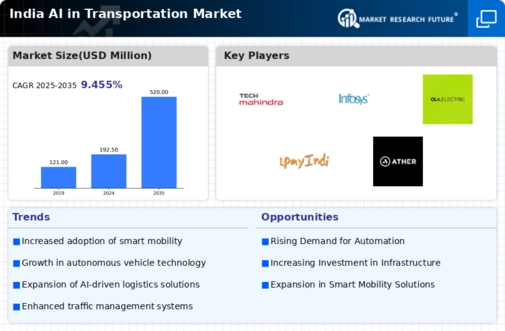
The expected market size of the India AI in Transportation Market by 2024 is valued at 192.5 million USD.

What will the market value be by 2035?

By 2035, the market value of the India AI in Transportation Market is projected to reach 520.0 million USD.

What is the anticipated compound annual growth rate (CAGR) from 2025 to 2035?

The anticipated CAGR for the India AI in Transportation Market from 2025 to 2035 is 9.455 percent.

Which segment of the India AI in Transportation Market is expected to have the highest value by 2035?

The Services segment is expected to have the highest value at 185.0 million USD by 2035.

What are the key players in the India AI in Transportation Market?

Some key players in the India AI in Transportation Market include Mahindra & Mahindra, Tech Mahindra, Ola Electric, and Tata Consultancy Services.

What is the projected market size for the Software segment by 2035?

The projected market size for the Software segment in the India AI in Transportation Market by 2035 is 185.0 million USD.

What are the anticipated growth drivers for the India AI in Transportation Market?

Anticipated growth drivers for the market include the increasing integration of AI technologies in transportation systems and rising demand for intelligent transportation solutions.

How is the Hardware segment valued for the year 2024?

The Hardware segment is valued at 57.5 million USD in the year 2024.

What challenges does the India AI in Transportation Market face?

Challenges faced by the market include infrastructure limitations and regulatory hurdles surrounding AI technologies.

What impact might current global scenarios have on the India AI in Transportation Market?

Current global scenarios could influence supply chain dynamics and innovation rates within the India AI in Transportation Market.

Download Free Sample

Kindly complete the form below to receive a free sample of this Report

Compare Licence

×
Features License Type
Single User Multiuser License Enterprise User
Price $4,950 $5,950 $7,250
Maximum User Access Limit 1 User Upto 10 Users Unrestricted Access Throughout the Organization
Free Customization
Direct Access to Analyst
Deliverable Format
Platform Access
Discount on Next Purchase 10% 15% 15%
Printable Versions