×
Request Free Sample ×

Kindly complete the form below to receive a free sample of this Report

* Please use a valid business email

Leading companies partner with us for data-driven Insights

clients tt-cursor
Hero Background

India AI in Computer Vision Market

ID: MRFR/ICT/57039-HCR
200 Pages
Aarti Dhapte
February 2026

India AI in Computer Vision Market Size, Share and Research Report: By Application (Healthcare, Automotive, Retail, Manufacturing, Security), By Technology (Deep Learning, Machine Learning, Image Processing, Pattern Recognition), By Component (Hardware, Software, Services) and By End Use (Consumer Electronics, Industrial, Aerospace and Defense, Transportation)- Industry Forecast to 2035

Share:
Download PDF ×

We do not share your information with anyone. However, we may send you emails based on your report interest from time to time. You may contact us at any time to opt-out.

India AI in Computer Vision Market Infographic
Purchase Options

India AI in Computer Vision Market Summary

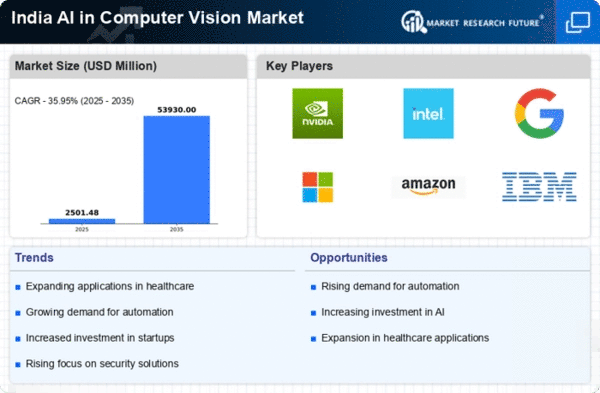
As per Market Research Future analysis, the India AI in Computer Vision Market size was estimated at 1840.0 USD Million in 2024. The Ai In-computer-vision market is projected to grow from 2501.48 USD Million in 2025 to 53930.0 USD Million by 2035, exhibiting a compound annual growth rate (CAGR) of 35.9% during the forecast period 2025 - 2035

Key Market Trends & Highlights

The India AI in computer vision market is poised for substantial growth driven by technological advancements and sector-specific demands.

  • The healthcare segment is witnessing increased adoption of AI in computer vision for diagnostics and patient monitoring.
  • Retail automation is rapidly expanding, with AI-driven solutions enhancing customer experiences and operational efficiency.
  • The autonomous vehicle sector is advancing, leveraging AI in computer vision for improved navigation and safety features.
  • Key market drivers include the rising demand for enhanced security solutions and the expansion of smart city initiatives.

Market Size & Forecast

2024 Market Size 1840.0 (USD Million)
2035 Market Size 53930.0 (USD Million)
CAGR (2025 - 2035) 35.95%

Major Players

NVIDIA (US), Intel (US), Google (US), Microsoft (US), Amazon (US), IBM (US), Qualcomm (US), Apple (US), Samsung (KR)

Our Impact
Enabled $4.3B Revenue Impact for Fortune 500 and Leading Multinationals
Partnering with 2000+ Global Organizations Each Year
30K+ Citations by Top-Tier Firms in the Industry

India AI in Computer Vision Market Trends

The India AI in Computer Vision Market is experiencing notable growth, driven by advancements in technology and increasing applications across various sectors. Industries such as healthcare, automotive, and retail are increasingly adopting computer vision solutions to enhance operational efficiency and improve customer experiences. The integration of artificial intelligence into computer vision systems is enabling more accurate image recognition, object detection, and real-time analysis. This trend is likely to continue as businesses seek innovative ways to leverage visual data for decision-making and automation. Moreover, the demand for smart surveillance systems and automated quality inspection processes is rising, reflecting a shift towards more intelligent and responsive systems. As organizations recognize the potential of ai in-computer-vision technologies, investments in research and development are expected to increase. This focus on innovation may lead to the emergence of new applications and services, further expanding the market's scope. The ongoing digital transformation across industries is likely to fuel the adoption of these technologies, making them integral to future business strategies.

Increased Adoption in Healthcare

The ai in-computer-vision market is witnessing a surge in healthcare applications. Hospitals and clinics are utilizing these technologies for diagnostic imaging, patient monitoring, and surgical assistance. Enhanced image analysis capabilities are improving diagnostic accuracy and patient outcomes.

Growth in Retail Automation

Retailers are increasingly implementing ai in-computer-vision solutions for inventory management, customer behavior analysis, and checkout automation. These technologies are streamlining operations and enhancing the shopping experience, leading to higher customer satisfaction.

Advancements in Autonomous Vehicles

The automotive sector is rapidly adopting ai in-computer-vision technologies for autonomous driving applications. Enhanced object detection and recognition systems are crucial for ensuring safety and efficiency in self-driving vehicles, driving innovation in this field.

India AI in Computer Vision Market Drivers

Expansion of Smart City Initiatives

India's commitment to developing smart cities is a pivotal driver for the ai in-computer-vision market. The Smart Cities Mission aims to create urban spaces that are efficient, sustainable, and technologically advanced. This initiative includes the deployment of AI-powered surveillance and traffic management systems, which leverage computer vision to optimize urban infrastructure. As of 2025, the Indian government has allocated over $1.5 billion for smart city projects, indicating a strong investment in technologies that enhance urban living. The integration of AI in these projects not only improves public services but also fosters economic growth, thereby propelling the ai in-computer-vision market forward.

Growth in E-commerce and Online Retail

The rapid expansion of e-commerce in India is significantly influencing the ai in-computer-vision market. With online retail sales projected to reach $200 billion by 2026, businesses are increasingly adopting AI technologies to enhance customer experience and streamline operations. Computer vision applications, such as automated inventory management and personalized shopping experiences, are becoming essential for retailers. These technologies enable businesses to analyze customer behavior and optimize product placement, ultimately driving sales. As the e-commerce sector continues to flourish, the demand for innovative ai in-computer-vision solutions is expected to rise, further solidifying its role in the retail landscape.

Advancements in Manufacturing Automation

The push towards Industry 4.0 in India is a crucial factor propelling the ai in-computer-vision market. Manufacturers are increasingly adopting AI-driven technologies to enhance production efficiency and quality control. Computer vision systems are utilized for real-time monitoring of production lines, enabling early detection of defects and reducing waste. The Indian manufacturing sector is anticipated to grow to $1 trillion by 2025, with automation playing a key role in this transformation. As companies seek to improve operational efficiency and reduce costs, the integration of ai in-computer-vision solutions is likely to become more prevalent, driving market growth.

Rising Demand for Enhanced Security Solutions

The increasing need for robust security measures across various sectors in India is driving the ai in-computer-vision market. With the rise in urbanization and population density, the demand for surveillance systems has surged. According to recent estimates, the security market in India is projected to reach approximately $20 billion by 2025, with a significant portion attributed to AI-driven technologies. These systems utilize computer vision to enhance threat detection and response capabilities, making them indispensable for public safety. As businesses and government entities invest in advanced security solutions, the ai in-computer-vision market is likely to experience substantial growth, reflecting a broader trend towards integrating AI technologies in security applications.

Increased Investment in Research and Development

Investment in research and development (R&D) within the technology sector is a significant driver for the ai in-computer-vision market in India. The government and private sector are channeling resources into AI research, fostering innovation and the development of cutting-edge applications. In 2025, R&D spending in the technology sector is projected to exceed $10 billion, with a substantial focus on AI and machine learning. This investment is likely to lead to breakthroughs in computer vision technologies, enhancing their applicability across various industries. As new solutions emerge from R&D efforts, the ai in-computer-vision market is expected to expand, reflecting the growing importance of AI in driving technological advancements.


Market Segment Insights

By Application: Healthcare (Largest) vs. Manufacturing (Fastest-Growing)

The application segment in the India ai in-computer-vision market reveals a diverse distribution of market share among five key areas: Healthcare, Automotive, Retail, Manufacturing, and Security. Healthcare stands out as the largest segment, driven by significant investments in medical imaging and diagnostic processes, while Manufacturing represents the fastest-growing sector, benefiting from automation and enhanced operational efficiency. Growth trends within the application segment indicate a strong demand for AI-driven solutions that optimize workflows and enhance productivity. Healthcare continues to lead, propelled by advancements in telemedicine and real-time patient monitoring. Meanwhile, Manufacturing leverages computer vision to improve quality control and reduce waste, showcasing its emerging status in adopting AI technologies for operational excellence and innovation.

Healthcare: Dominant vs. Manufacturing: Emerging

Healthcare, as the dominant segment in the application category of the India ai in-computer-vision market, focuses on leveraging AI technologies for enhanced medical imaging, diagnosis, and patient care. This sector is characterized by its reliance on advanced algorithms that analyze medical data, facilitating timely and accurate treatment decisions. On the other hand, Manufacturing, labeled as the emerging segment, is rapidly adopting AI-based solutions to streamline production processes, improve quality assurance, and enhance supply chain efficiency. The integration of computer vision in this sector is driven by the need for automation and data analytics, positioning it as a key player in the long-term AI adoption landscape.

By Technology: Deep Learning (Largest) vs. Machine Learning (Fastest-Growing)

In the India ai in-computer-vision market, Deep Learning stands out as the largest segment, commanding a significant market share compared to its counterparts. This segment is prevalent across various applications, ranging from facial recognition to autonomous driving, thus driving its dominance. In contrast, Machine Learning, while currently a smaller segment, is emerging rapidly, leveraging advancements in algorithms and computing power to enhance its capabilities in real-time data processing and analysis. Growth trends in this market are strongly influenced by technological advancements and increased investments in AI research. The adoption of Deep Learning continues to grow as businesses recognize its capabilities in tasks requiring high accuracy and efficiency. Moreover, the surge in demand for automation and smart technologies drives the growth of Machine Learning, making it the fastest-growing segment, as industries explore innovative solutions to improve operational efficiencies.

Technology: Deep Learning (Dominant) vs. Machine Learning (Emerging)

Deep Learning serves as the dominant technology in the India ai in-computer-vision market due to its ability to process vast amounts of data and make accurate predictions based on complex patterns. This segment utilizes neural networks and has found significant applications in sectors such as healthcare, automotive, and security. Meanwhile, Machine Learning is considered an emerging force, with its algorithms becoming more refined and capable of handling large datasets for efficient learning. This segment focuses on enabling systems to learn from data inputs without explicit programming, leading to innovative uses in predictive analytics and automation, thus complementing the strengths of Deep Learning.

By Component: Hardware (Largest) vs. Software (Fastest-Growing)

In the India ai in-computer-vision market, the distribution of market share among the component segment values reveals a strong preference for hardware solutions, which hold the largest share. This trend indicates the critical role that physical devices, such as cameras and processors, play in enabling AI functionalities. In contrast, software solutions are rapidly gaining traction, representing an increasingly significant portion of the market. Companies are investing heavily in software capabilities to enhance user experience and deliver innovative applications. Growth trends within this segment are fueled by advancements in machine learning algorithms and the increasing demand for intelligent systems. Hardware remains essential for foundational operations, while software is recognized for its scalability and flexibility. The fast-paced technological evolution, coupled with business automation needs, drives more investments into software solutions, making it the fastest-growing segment in the market.

Hardware (Dominant) vs. Software (Emerging)

The hardware segment is dominant in the India ai in-computer-vision market, characterized by robust sales of cameras, sensors, and processing units essential for AI integration. Leading manufacturers focus on enhancing performance and reliability to meet increasing consumer demands. Conversely, the software segment is emerging rapidly, with a strong emphasis on developing sophisticated algorithms and user-friendly applications that leverage AI capabilities. Businesses are recognizing the potential of AI software to transform operations and increase efficiency, driving higher adoption rates. This dynamic creates a complementary ecosystem where hardware supports software innovations, leading to a balanced growth trajectory for both segments.

By End Use: Consumer Electronics (Largest) vs. Industrial (Fastest-Growing)

In the India ai in-computer-vision market, the distribution of market share reveals that the Consumer Electronics segment holds a substantial share, driven by high demand for smart devices and advanced imaging features. The Industrial segment, while smaller in comparison, is rapidly gaining traction due to the increasing adoption of automation and AI technologies across various sectors. Growth trends indicate a robust expansion in the Industrial segment, fueled by the rise of Industry 4.0 and the need for sophisticated machine vision systems. Concurrently, Consumer Electronics continues to thrive, supported by innovations in smartphone cameras and smart home devices. However, the Industrial segment is predicted to outpace others in growth rate as businesses increasingly invest in AI-driven solutions for operational efficiencies.

Consumer Electronics: Dominant vs. Industrial: Emerging

The Consumer Electronics segment remains the dominant player in the India ai in-computer-vision market, characterized by a broad array of products including smartphones, tablets, and smart home devices equipped with advanced imaging capabilities. This segment's strength lies in the continuous technological innovations that enhance user experience through superior camera functions and image processing. On the other hand, the Industrial segment, while currently labeled as emerging, is witnessing significant growth due to the rising demand for automation and AI technologies in manufacturing processes. Industries are increasingly leveraging computer vision applications for quality control, predictive maintenance, and enhanced operational efficiencies, establishing a strong foothold that promises rapid expansion in the foreseeable future.

Get more detailed insights about India AI in Computer Vision Market

Key Players and Competitive Insights

The ai in-computer-vision market is currently characterized by intense competition and rapid technological advancements. Key growth drivers include the increasing demand for automation across various sectors, the proliferation of smart devices, and the rising need for enhanced security solutions. Major players such as NVIDIA (US), Intel (US), and Google (US) are strategically positioned to leverage their technological prowess and extensive resources. NVIDIA (US) focuses on innovation in graphics processing units (GPUs) that are essential for deep learning applications, while Intel (US) emphasizes its commitment to developing specialized hardware for AI workloads. Google (US), on the other hand, is heavily investing in cloud-based AI solutions, which allows it to integrate computer vision capabilities into its existing services, thereby enhancing its competitive edge.

The market structure appears moderately fragmented, with a mix of established giants and emerging startups. Key players are adopting various business tactics, such as localizing manufacturing to reduce costs and optimize supply chains. This localization strategy not only enhances operational efficiency but also allows companies to respond more swiftly to regional market demands. The collective influence of these major players shapes a competitive environment where innovation and strategic partnerships are paramount.
In October 2025, NVIDIA (US) announced the launch of its latest AI-driven computer vision platform, which integrates advanced machine learning algorithms to enhance real-time image processing capabilities. This strategic move is likely to solidify NVIDIA's position as a leader in the market, as it addresses the growing demand for high-performance computing solutions in sectors such as healthcare and automotive. The introduction of this platform may also foster new partnerships with companies seeking to leverage NVIDIA's technology for their own applications.
In September 2025, Intel (US) unveiled a new initiative aimed at enhancing its AI capabilities through a partnership with several Indian tech startups. This collaboration is expected to accelerate the development of localized AI solutions tailored to the unique needs of the Indian market. By fostering innovation through these partnerships, Intel (US) is likely to strengthen its foothold in the region and enhance its competitive positioning against other global players.
In August 2025, Google (US) expanded its AI offerings by integrating advanced computer vision features into its cloud services, specifically targeting industries such as retail and manufacturing. This strategic enhancement not only broadens Google's service portfolio but also positions it as a key player in the enterprise AI market. The ability to provide scalable and efficient computer vision solutions could attract a diverse range of clients, further solidifying Google's competitive advantage.
As of November 2025, current trends in the ai in-computer-vision market indicate a strong emphasis on digitalization, sustainability, and the integration of AI technologies across various sectors. Strategic alliances are increasingly shaping the competitive landscape, as companies recognize the value of collaboration in driving innovation. Looking ahead, competitive differentiation is likely to evolve from traditional price-based competition to a focus on technological innovation, supply chain reliability, and the ability to deliver customized solutions. This shift underscores the importance of agility and responsiveness in a rapidly changing market.

Key Companies in the India AI in Computer Vision Market include

Industry Developments

In March 2023, Fractal Analytics expanded its capabilities in computer vision, aligning with trends promoting innovation in business processes. Sigtuple reported advancements in AI for healthcare diagnostics in January 2023, showcasing how computer vision is revolutionizing patient care. 

In August 2023, Niramai made strides in early cancer detection technologies, incorporating AI to enhance screening processes. Regarding mergers and acquisitions, in April 2023, Wipro announced a strategic partnership to leverage AI technologies with a focus on computer vision applications, further reinforcing its market position. 

Tata Consultancy Services has also been expanding its service portfolio in recent months by acquiring several smaller firms focusing on AI technologies, including computer vision capabilities. India's investment in AI startups has surged, with the sector's valuation projected to grow, indicating a robust future for AI in Computer Vision, with the government's push for digital transformation catalyzing this growth.


Future Outlook

India AI in Computer Vision Market Future Outlook

The ai in-computer-vision market is projected to grow at a 35.95% CAGR from 2025 to 2035, driven by advancements in AI technology, increased demand for automation, and enhanced data analytics capabilities.

New opportunities lie in:

  • Development of AI-driven surveillance systems for urban safety
  • Integration of computer vision in retail for inventory management
  • Creation of customized AI solutions for healthcare diagnostics

By 2035, the market is expected to achieve substantial growth, positioning itself as a leader in technological innovation.

Market Segmentation

India AI in Computer Vision Market End Use Outlook

  • Consumer Electronics
  • Industrial
  • Aerospace and Defense
  • Transportation

India AI in Computer Vision Market Component Outlook

  • Hardware
  • Software
  • Services

India AI in Computer Vision Market Technology Outlook

  • Deep Learning
  • Machine Learning
  • Image Processing
  • Pattern Recognition

India AI in Computer Vision Market Application Outlook

  • Healthcare
  • Automotive
  • Retail
  • Manufacturing
  • Security

Report Scope

MARKET SIZE 2024 1840.0(USD Million)
MARKET SIZE 2025 2501.48(USD Million)
MARKET SIZE 2035 53930.0(USD Million)
COMPOUND ANNUAL GROWTH RATE (CAGR) 35.95% (2025 - 2035)
REPORT COVERAGE Revenue Forecast, Competitive Landscape, Growth Factors, and Trends
BASE YEAR 2024
Market Forecast Period 2025 - 2035
Historical Data 2019 - 2024
Market Forecast Units USD Million
Key Companies Profiled NVIDIA (US), Intel (US), Google (US), Microsoft (US), Amazon (US), IBM (US), Qualcomm (US), Apple (US), Samsung (KR)
Segments Covered Application, Technology, Component, End Use
Key Market Opportunities Integration of advanced machine learning algorithms enhances real-time image processing capabilities in the ai in-computer-vision market.
Key Market Dynamics Rapid advancements in artificial intelligence drive innovation and competition in the computer vision market.
Countries Covered India
Leave a Comment

FAQs

What is the expected market size of the India AI in Computer Vision Market in 2024?

In 2024, the India AI in Computer Vision Market is expected to be valued at 739.72 USD million.

What is the projected market value for the India AI in Computer Vision Market in 2035?

By 2035, the market is projected to reach a value of 3850.0 USD million.

What is the expected compound annual growth rate (CAGR) for the India AI in Computer Vision Market from 2025 to 2035?

The anticipated CAGR for the market from 2025 to 2035 is 16.179%.

Which application segment has the largest market value in 2024 for the India AI in Computer Vision Market?

The Healthcare application segment leads with a market value of 180.0 USD million in 2024.

What is the market value for the Automotive application segment in 2024?

The Automotive application segment is valued at 150.0 USD million in 2024.

How much is the Security application segment expected to be valued in 2035?

The Security application segment is expected to reach a value of 950.0 USD million by 2035.

Who are the key players in the India AI in Computer Vision Market?

Major players in the market include Ganit, NVIDIA, Qualcomm, Happiest Minds, and others.

What is the market value of the Retail application segment in 2035?

The Retail application segment is projected to be valued at 650.0 USD million in 2035.

What market value does the Manufacturing application segment hold in 2024?

In 2024, the Manufacturing application segment is valued at 120.0 USD million.

What challenges does the India AI in Computer Vision Market face amidst current market trends?

Challenges include rapid technological advancements and the need for continuous innovation in applications.

Download Free Sample

Kindly complete the form below to receive a free sample of this Report

Compare Licence

×
Features License Type
Single User Multiuser License Enterprise User
Price $4,950 $5,950 $7,250
Maximum User Access Limit 1 User Upto 10 Users Unrestricted Access Throughout the Organization
Free Customization
Direct Access to Analyst
Deliverable Format
Platform Access
Discount on Next Purchase 10% 15% 15%
Printable Versions