×
Request Free Sample ×

Kindly complete the form below to receive a free sample of this Report

* Please use a valid business email

Leading companies partner with us for data-driven Insights

clients tt-cursor
Hero Background

India 6G Market

ID: MRFR/ICT/56638-HCR
200 Pages
Aarti Dhapte
February 2026

India 6G Market Research Report By Component (Hardware, Software, Services), By Communication Infrastructure (Wireless, Fixed), By Application (Multisensory XR Applications, Connected Robotics and Autonomous Systems (CRAS), Wireless Brain-Computer Interactions (BCI), Digital Twins, Smart Cities, Internet of Everything (IoE), Blockchain and DLT, Others) and By End User (Government, Consumer, Industrial, Enterprise)-Forecast to 2035

Share:
Download PDF ×

We do not share your information with anyone. However, we may send you emails based on your report interest from time to time. You may contact us at any time to opt-out.

India 6G Market Infographic
Purchase Options

India 6G Market Summary

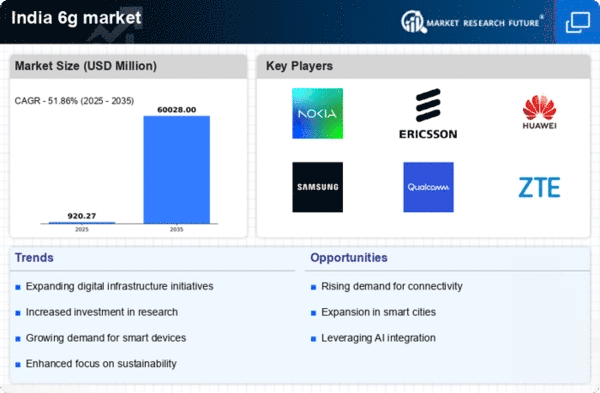
As per Market Research Future analysis, the India 6G Market size was estimated at 606.0 USD Million in 2024. The 6G market is projected to grow from 920.27 USD Million in 2025 to 60028.0 USD Million by 2035, exhibiting a compound annual growth rate (CAGR) of 51.8% during the forecast period 2025 - 2035

Key Market Trends & Highlights

The India 6G Market is poised for substantial growth driven by technological advancements and increasing demand for connectivity.

  • Investment in infrastructure development is accelerating, indicating a robust commitment to future connectivity solutions.
  • The focus on sustainable technologies is becoming more pronounced, reflecting a shift towards environmentally friendly practices.
  • Collaboration for innovation among key stakeholders is fostering a dynamic ecosystem, enhancing the pace of development.
  • Emerging technological advancements and government initiatives are major drivers propelling the demand for high-speed connectivity.

Market Size & Forecast

2024 Market Size 606.0 (USD Million)
2035 Market Size 60028.0 (USD Million)
CAGR (2025 - 2035) 51.86%

Major Players

Nokia (FI), Ericsson (SE), Huawei (CN), Samsung (KR), Qualcomm (US), ZTE (CN), Intel (US), Cisco (US), NEC (JP)

Our Impact
Enabled $4.3B Revenue Impact for Fortune 500 and Leading Multinationals
Partnering with 2000+ Global Organizations Each Year
30K+ Citations by Top-Tier Firms in the Industry

India 6G Market Trends

The India 6G Market is currently undergoing a transformative phase, characterized by rapid advancements in technology and increasing investments from various stakeholders. As the demand for high-speed connectivity continues to rise, the market is witnessing a surge in research and development activities aimed at enhancing network capabilities. This evolution is not merely a continuation of previous generations but represents a paradigm shift towards more integrated and intelligent communication systems. The potential applications of 6g technology are vast, encompassing sectors such as healthcare, transportation, and smart cities, which could redefine how services are delivered and consumed. Moreover, the regulatory landscape is evolving to accommodate the unique challenges posed by this new technology. Government initiatives are likely to play a crucial role in shaping the infrastructure and standards necessary for the successful deployment of 6g networks. Collaboration between public and private sectors appears essential for fostering innovation and ensuring that the benefits of this technology are widely accessible. As the market matures, it may also lead to new business models and revenue streams, further stimulating economic growth and technological advancement.

Investment in Infrastructure Development

There is a noticeable trend towards significant investment in infrastructure development for the 6g market. Stakeholders are focusing on building robust networks that can support the anticipated demands of future applications. This investment is likely to enhance connectivity and facilitate the deployment of advanced technologies.

Focus on Sustainable Technologies

Sustainability is becoming a key consideration in the 6g market. Companies are increasingly exploring eco-friendly technologies and practices to minimize environmental impact. This focus on sustainability may lead to innovations that not only improve efficiency but also contribute to a greener future.

Collaboration for Innovation

Collaboration among various entities is emerging as a vital trend in the 6g market. Partnerships between technology firms, academic institutions, and government bodies are likely to drive research and development efforts. Such collaborations may foster innovation and accelerate the pace of advancements in this field.

India 6G Market Drivers

Growing Ecosystem of Startups

The emergence of a robust ecosystem of startups in India is significantly influencing the 6g market. These startups are focusing on developing innovative solutions that leverage advanced technologies, such as IoT, blockchain, and edge computing. As of November 2025, the Indian startup ecosystem is valued at approximately $100 B, with a substantial portion dedicated to technology and telecommunications. This vibrant environment fosters collaboration and competition, driving the development of new applications and services that can utilize 6g capabilities. The growth of this startup ecosystem is likely to create a dynamic landscape for the 6g market, encouraging investment and attracting talent to the sector.

Emerging Technological Advancements

The 6g market in India is poised for growth due to rapid advancements in technology. Innovations in artificial intelligence, machine learning, and quantum computing are expected to enhance connectivity and data processing capabilities. As per recent estimates, the Indian telecommunications sector is projected to reach a valuation of $100 B by 2025, driven by the demand for faster and more reliable networks. These technological advancements are likely to facilitate the development of new applications, such as augmented reality and smart cities, which will further stimulate the 6g market. The integration of these technologies into everyday life may lead to increased consumer expectations for seamless connectivity, thereby propelling the market forward.

Government Initiatives and Policies

The Indian government plays a crucial role in shaping the 6g market through various initiatives and policies aimed at enhancing digital infrastructure. Programs such as Digital India and Make in India are designed to promote innovation and investment in telecommunications. The government has allocated substantial funds, estimated at $10 B, for the development of next-generation networks, which includes 6g technology. These initiatives not only encourage private sector participation but also aim to bridge the digital divide in rural areas. By fostering a conducive environment for research and development, the government is likely to accelerate the growth of the 6g market, making advanced connectivity accessible to a broader population.

Investment in Research and Development

Investment in research and development (R&D) is a pivotal driver for the 6g market in India. With numerous academic institutions and private companies focusing on next-generation technologies, the R&D landscape is becoming increasingly vibrant. Reports suggest that R&D spending in the telecommunications sector is expected to reach $5 B by 2026, reflecting a commitment to innovation. This investment is likely to lead to breakthroughs in areas such as network architecture, spectrum management, and energy efficiency. As these advancements materialize, they will not only enhance the capabilities of the 6g market but also position India as a leader in the global telecommunications arena.

Increased Demand for High-Speed Connectivity

The demand for high-speed internet connectivity in India is surging, driven by the proliferation of digital services and the growing number of internet users. As of November 2025, India boasts over 800 M internet users, with a significant portion relying on mobile data for their connectivity needs. This increasing demand is expected to push the 6g market towards rapid expansion, as consumers seek faster download and upload speeds, lower latency, and improved reliability. The rise of remote work, online education, and digital entertainment further amplifies this demand, indicating that the 6g market will need to evolve to meet the expectations of a digitally-savvy population.


Market Segment Insights

By Technology: Massive Mimo (Largest) vs. Terahertz Communication (Fastest-Growing)

In the India 6g market, the technology segment is characterized by a competitive distribution of market share among key values, including Terahertz Communication, Massive Mimo, Advanced Antenna Systems, and Optical Wireless Communication. Currently, Massive Mimo dominates the segment with a substantial share, leveraging its advanced capabilities to serve high user demand, while Terahertz Communication is quickly gaining traction due to its potential for high-speed data transfer. Growth trends in this segment are primarily driven by the increasing demand for faster and more reliable communication technologies. Factors such as the proliferation of IoT devices, smart cities, and the need for enhanced mobile broadband are propelling the growth of Terahertz Communication as the fastest-growing segment. Meanwhile, Massive Mimo continues to address the challenges of network congestion and capacity, reaffirming its position as a dominant player in the India 6g market.

Technology: Massive Mimo (Dominant) vs. Terahertz Communication (Emerging)

Massive Mimo is recognized as the dominant technology in the India 6g market, attributed to its ability to significantly boost network capacity and efficiency through spatial multiplexing. This technology facilitates simultaneous connections, thereby addressing high user demands for data-intensive applications. On the other hand, Terahertz Communication represents an emerging value poised for rapid growth, capitalizing on its capacity for ultrahigh-frequency signals. This innovation is crucial for next-generation applications, offering solutions for high-speed data transmission that traditional technologies cannot provide. As both segment values evolve, the interplay between Massive Mimo's established presence and Terahertz Communication's potential will shape the future landscape of communication technologies.

By Application: Healthcare (Largest) vs. Smart Cities (Fastest-Growing)

In the India 6g market, the application segment is witnessing diverse contributions. Healthcare takes a significant lead, driven by the increasing demand for advanced telemedicine and health monitoring solutions. Smart Cities follows closely, capitalizing on the integration of IoT and 6g technology to enhance urban infrastructure and services. Other notable applications include autonomous vehicles, augmented reality, and industrial automation, each playing a crucial role in shaping the market dynamics. Growth trends indicate a robust expansion trajectory for smart cities, which are emerging as a focal point for governmental initiatives and investments. The rise in autonomous vehicles is fueled by advancements in AI and machine learning technologies. Augmented reality is expected to transform the consumer experience, while industrial automation is harnessing 6g to improve efficiency. Collectively, these applications signify a paradigm shift, driven by technological innovations and increasing connectivity demands.

Healthcare (Dominant) vs. Augmented Reality (Emerging)

Healthcare stands as a dominant application in the evolving India 6g market, primarily due to its reliance on real-time data exchange and innovative health solutions. This sector thrives on advanced connectivity to enable telemedicine, remote surgeries, and continuous health monitoring, which enhances patient outcomes and accessibility. In contrast, augmented reality emerges as an exciting new frontier within this market. It offers immersive experiences across various domains, including education and entertainment, thereby attracting tech-savvy consumers. As augmented reality solutions rely on high-speed and low-latency networks, the advancement of 6g will significantly bolster its proliferation, providing a seamless user experience and opening new avenues for growth in both the consumer and enterprise markets.

By End Use: Telecommunications (Largest) vs. Healthcare (Fastest-Growing)

In the India 6g market, the distribution of market share among different end-use segments reveals that telecommunications dominates with the largest share. This segment is pivotal in driving the adoption of 6g technologies, leveraging advancements to enhance connectivity and bandwidth for consumers and businesses alike. Following telecommunications, the transportation and healthcare sectors show noteworthy significance, reflecting their growing reliance on advanced communication technologies. The growth trends indicate that while telecommunications remains the largest segment, healthcare is emerging as the fastest-growing end-use area. This shift is primarily driven by the increasing demand for telemedicine solutions and remote monitoring, fostering innovation in healthcare delivery. Additionally, transportation is evolving through smart logistics and connected vehicles, further propelling the adoption of 6g technologies across sectors.

Telecommunications: Dominant vs. Healthcare: Emerging

Telecommunications serves as the dominant end-use segment in the India 6g market, characterized by its extensive infrastructure and foundational role in advancing network capabilities. This segment enables high-speed internet and improved connectivity across urban and rural areas, thereby enhancing various aspects of daily life and business operations. On the other hand, healthcare is marking its presence as an emerging segment, driven by innovations in digital health solutions like teleconsultations and remote patient monitoring. This sector's growth is influenced by increasing investments in health tech and the need for more efficient healthcare delivery systems. The convergence of telecommunications with healthcare technologies holds significant promise in revolutionizing patient care and health management.

By Network Type: Private Networks (Largest) vs. Public Networks (Fastest-Growing)

The market distribution among the network types shows a clear dominance of Private Networks, which command the largest share in the India 6g market. Public Networks are emerging as the fastest-growing segment, driven by increasing demand for connectivity and accessibility in urban and rural areas alike. Hybrid Networks, while crucial, occupy a smaller niche, balancing the benefits of both Private and Public Networks. The growth trends in the segment indicate a strong shift towards Private Networks, mainly due to enterprises seeking secure and reliable communication infrastructures. Meanwhile, Public Networks are witnessing rapid expansion, fueled by the government's push for digital inclusion and the rising penetration of smart devices. Hybrid Networks, responding to diverse organizational needs, are also anticipated to grow as they combine the reliability of Private Networks with the flexibility of Public Networks. They provide an appealing solution for various business models in the tech-savvy landscape.

Private Networks (Dominant) vs. Hybrid Networks (Emerging)

Private Networks in the India 6g market are characterized by their high level of security and tailored performance for specific enterprises. They are highly coveted in sectors like manufacturing and finance, where data integrity and privacy are paramount. Companies invest in these networks to maintain control over their digital environments, supporting applications like IoT and real-time data analytics. Conversely, Hybrid Networks are carving out their position as an emerging solution, offering flexibility by integrating both Private and Public network features. This approach allows organizations to adapt to varied operational needs and scale efficiently, making Hybrid Networks an attractive choice for businesses looking to leverage both secure internal communications and wider public access.

Get more detailed insights about India 6G Market

Key Players and Competitive Insights

The 6g market exhibits a dynamic competitive landscape characterized by rapid technological advancements and strategic collaborations among key players. Major companies such as Nokia (FI), Ericsson (SE), and Qualcomm (US) are at the forefront, each adopting distinct strategies to enhance their market positioning. Nokia (FI) focuses on innovation through extensive R&D investments, aiming to lead in network infrastructure and services. Meanwhile, Ericsson (SE) emphasizes partnerships with local telecom operators to expand its footprint in emerging markets, thereby enhancing its competitive edge. Qualcomm (US) is leveraging its expertise in semiconductor technology to drive advancements in 6g applications, particularly in IoT and smart city solutions. Collectively, these strategies contribute to a competitive environment that is increasingly driven by technological innovation and strategic alliances.
Key business tactics within the 6g market include localizing manufacturing and optimizing supply chains to enhance operational efficiency. The market structure appears moderately fragmented, with several players vying for dominance. However, the collective influence of major companies like Nokia (FI), Ericsson (SE), and Qualcomm (US) suggests a trend towards consolidation, as these firms seek to leverage their strengths to capture a larger market share.
In October 2025, Nokia (FI) announced a strategic partnership with a leading Indian telecom operator to co-develop 6g solutions tailored for urban environments. This collaboration is poised to enhance Nokia's presence in the Indian market while addressing the unique challenges posed by urbanization. The strategic importance of this partnership lies in its potential to accelerate the deployment of advanced network solutions, thereby positioning Nokia as a key player in the region's digital transformation.
In September 2025, Ericsson (SE) unveiled its new 6g research facility in Bangalore, India, aimed at fostering innovation and collaboration with local startups. This initiative underscores Ericsson's commitment to investing in local ecosystems and harnessing regional talent. The establishment of this facility is strategically significant as it not only enhances Ericsson's R&D capabilities but also strengthens its ties with the Indian telecom sector, facilitating the development of customized solutions for local operators.
In November 2025, Qualcomm (US) launched a new suite of 6g-enabled chipsets designed specifically for smart city applications. This move reflects Qualcomm's strategy to capitalize on the growing demand for advanced connectivity solutions in urban areas. The introduction of these chipsets is likely to enhance Qualcomm's competitive positioning by providing cutting-edge technology that meets the evolving needs of smart city infrastructure.
As of November 2025, current competitive trends in the 6g market are increasingly defined by digitalization, sustainability, and the integration of AI technologies. Strategic alliances among key players are shaping the landscape, fostering innovation and enhancing operational efficiencies. Looking ahead, competitive differentiation is expected to evolve, with a pronounced shift from price-based competition to a focus on technological innovation, reliability in supply chains, and sustainable practices. This transition may redefine how companies compete, emphasizing the importance of advanced solutions and strategic partnerships in navigating the complexities of the 6g market.

Key Companies in the India 6G Market include

Industry Developments

The India 6G Market is witnessing rapid advancements, with various companies such as Reliance Industries, Bharti Airtel, and Tech Mahindra actively participating in research and trials. As of September 2023, the Indian government has initiated a 6G testbed that aims to support startups and promote innovation in this technology.

HCL Technologies and ZTE have been collaborating on developing solutions tailored for the 6G landscape. In terms of market valuation, a notable growth trajectory is observed, driven by investments from Qualcomm and Ericsson to enhance infrastructure capabilities.

Additionally, in July 2023, a strategic partnership was announced between Nokia and Tata Communications to bolster 5G and upcoming 6G initiatives in India, marking a significant development in interoperability.

Companies like Samsung and Huawei are also exploring deployment strategies within the region. It is essential to monitor ongoing collaborations and government initiatives as they play a pivotal role in shaping the 6G ecosystem in India. The focus on interoperability, innovation funding, and technological advancement is expected to further accelerate the Indian 6G market's growth over the coming years.


Future Outlook

India 6G Market Future Outlook

The 6g market in India is projected to grow at a remarkable 51.86% CAGR from 2025 to 2035, driven by advancements in technology, increased connectivity, and demand for high-speed data.

New opportunities lie in:

  • Development of AI-driven network management solutions
  • Investment in smart city infrastructure leveraging 6g
  • Creation of immersive AR/VR applications for enterprises

By 2035, the 6g market in India is expected to be a pivotal driver of technological innovation and economic growth.

Market Segmentation

India 6G Market End Use Outlook

  • Telecommunications
  • Transportation
  • Healthcare
  • Manufacturing

India 6G Market Technology Outlook

  • Terahertz Communication
  • Massive Mimo
  • Advanced Antenna Systems
  • Optical Wireless Communication

India 6G Market Application Outlook

  • Autonomous Vehicles
  • Smart Cities
  • Augmented Reality
  • Healthcare
  • Industrial Automation

India 6G Market Network Type Outlook

  • Private Networks
  • Public Networks
  • Hybrid Networks

Report Scope

MARKET SIZE 2024 606.0(USD Million)
MARKET SIZE 2025 920.27(USD Million)
MARKET SIZE 2035 60028.0(USD Million)
COMPOUND ANNUAL GROWTH RATE (CAGR) 51.86% (2025 - 2035)
REPORT COVERAGE Revenue Forecast, Competitive Landscape, Growth Factors, and Trends
BASE YEAR 2024
Market Forecast Period 2025 - 2035
Historical Data 2019 - 2024
Market Forecast Units USD Million
Key Companies Profiled Nokia (FI), Ericsson (SE), Huawei (CN), Samsung (KR), Qualcomm (US), ZTE (CN), Intel (US), Cisco (US), NEC (JP)
Segments Covered Technology, Application, End Use, Network Type
Key Market Opportunities Advancements in artificial intelligence and machine learning drive innovation in the 6g market.
Key Market Dynamics Intensifying competition among telecom providers drives rapid advancements in 6G technology and infrastructure development.
Countries Covered India
Leave a Comment

FAQs

What is the expected market size of the India 6G Market in 2024?

The India 6G Market is expected to be valued at 167.4 USD Million in 2024.

What is the projected market size of the India 6G Market by 2035?

By 2035, the India 6G Market is projected to reach a valuation of 4460.0 USD Million.

What is the compound annual growth rate (CAGR) for the India 6G Market from 2025 to 2035?

The expected CAGR for the India 6G Market from 2025 to 2035 is 34.772%.

Which segment of the India 6G Market is anticipated to have the highest value in 2035?

The Services segment is expected to have the highest value at 1960.0 USD Million in 2035.

Who are the major players in the India 6G Market?

Key players in the India 6G Market include Microsoft, Cisco, HCL Technologies, and Reliance Industries among others.

What will be the market value of Hardware in the India 6G Market by 2035?

The Hardware sector of the India 6G Market is expected to be valued at 1150.0 USD Million by 2035.

How is the Software segment expected to perform in the India 6G Market by 2035?

The Software segment is projected to reach a valuation of 1350.0 USD Million in 2035.

What are the key applications driving the growth of the India 6G Market?

Key applications driving growth include enhanced mobile broadband, massive machine-type communications, and ultra-reliable low-latency communications.

What challenges might the India 6G Market face from 2025 to 2035?

Challenges may include technological complexities, regulatory hurdles, and the need for substantial investment in infrastructure.

What opportunities exist in the India 6G Market for the upcoming years?

Opportunities include advancements in IoT, AI integration, and expansion into rural connectivity solutions.

Download Free Sample

Kindly complete the form below to receive a free sample of this Report

Compare Licence

×
Features License Type
Single User Multiuser License Enterprise User
Price $4,950 $5,950 $7,250
Maximum User Access Limit 1 User Upto 10 Users Unrestricted Access Throughout the Organization
Free Customization
Direct Access to Analyst
Deliverable Format
Platform Access
Discount on Next Purchase 10% 15% 15%
Printable Versions