×
Request Free Sample ×

Kindly complete the form below to receive a free sample of this Report

* Please use a valid business email

Leading companies partner with us for data-driven Insights

clients tt-cursor
Hero Background
English
Chinese
French
Japanese
Korean
German
Spanish

Idler arm Market Trends

ID: MRFR/AT/7151-HCR
100 Pages
Sejal Akre
October 2025

Idler arm Market Research Report Information by Material (Alloy Steel, Iron, Carbon Steel and others), Sales Channel (OEM and Aftermarket), Vehicle Type (Passenger Car, Light Commercial Vehicle and Heavy Commercial Vehicle) and Region (North America, Europe, Asia-Pacific and the Rest of the World) - Forecast till 2035

Share:
Download PDF ×

We do not share your information with anyone. However, we may send you emails based on your report interest from time to time. You may contact us at any time to opt-out.

Idler arm Market Infographic
Purchase Options

Market Trends

Key Emerging Trends in the Idler arm Market

In the intensely competitive Idler Arm Market, companies pursue various techniques to both access and improve market value proposition. A crucial strategy would be product quality and reliability, where the company concentrates on manufacturing idler arms that meet or exceed the industry standards. Through durability, precision and performance in their products, companies establish a reputation for reliability, garnering customers who value longevity and functionality. Such an approach allows companies to distinguish themselves from competitors and establish a top spot in the market.

Cost leadership is yet another vital approach that companies in the Idler Arm Market apply. Through the optimization of manufacturing processes, sourcing material efficiently and implementation of cost-effective methods of production, a company can offer price competitiveness on its idler arms. This affordability makes their products more alluring to a larger customer base which in turn result in an enlarged market share. The cost leadership is the perfect way to compete for price-sensitive customers and get the advantage in the market.

Strategic partnership and collaboration are the major components of market position in Idler Arm Market. The businesses usually team up with car makers, distributors or suppliers to produce broad solutions. Such partnerships do not only improve the whole proposition of idler arms but they also provide opportunities of wider penetration to networks and customer base. Strategic partnerships help achieve wider geographical presence and can be the gateway to gaining more market share.

Market segmentation is a strategy that concerns many companies and under which they are able to customize their idler arm solutions according to the peculiarities of different vehicles and applications. Distinguishing between passenger cars, commercial vehicles, and off-road vehicles permits firms to address the specific needs of each category in the most effective manner. This targeted approach guarantees that idler arms fulfill diverse automotive applications, making companies the niche expert in servicing numerous customers.

The strategy of geographical expansion is the core of the companies’ plans which aim at increasing their market share in the Idler Arm Market. Exploring new regions and expanding to emerging markets provide businesses with access to the booming new needs. Modifying products accordingly to local requirements and preferences makes it possible for companies to be accepted in different markets, consequently increasing their market share and level of sustainability.

Brand Positioning is a important factor for shaping customer impression and loyalty in the Idler Arm Market. Building a strong and reputable brand is the way to create a trust-relationship between consumers and the quality and performance of their idler arms.

Author
Sejal Akre
Senior Research Analyst

She has over 5 years of rich experience, in market research and consulting providing valuable market insights to client. Hands on expertise in management consulting, and extensive knowledge in domain including ICT, Automotive & Transportation and Aerospace & Defense. She is skilled in Go-to market strategy, industry analysis, market sizing, in depth company profiling, competitive intelligence & benchmarking and value chain amongst others.

Leave a Comment

FAQs

What growth rate can the market expect to achieve during the review period?

The market can register a growth rate of 4.1% during the review period.

What is expected to be the market size by 2032?

The idler arm market was worth USD 5.4 billion in the year 2032 and can maintain its growth pace even during the evaluation period.

Which are the top companies in the global market, as per the report?

The top companies in the global market are Datta Industries (India), Sankei Industry Co., Ltd (Japan), Rare Parts, Inc. (US), High Link Autoparts Co., Ltd (Taiwan), ACDelco (US), GMB Corporation Japan (Japan), Ningbo Motor Industrial Co., Ltd (China), Mevotech (Canada), Chase Steering Parts Co. (Taiwan), Emerson Forge Pvt. Ltd (India), and others.

What are the sales channel mentioned in the report?

The sales channel mentioned in the report are OEM as well as aftermarket.

What are the primary market growth inducers?

Expanding fleet size of automotive vehicles, booming automotive industry and the mounting demand for heavy and light commercial vehicles are the primary market growth inducers.

Market Summary

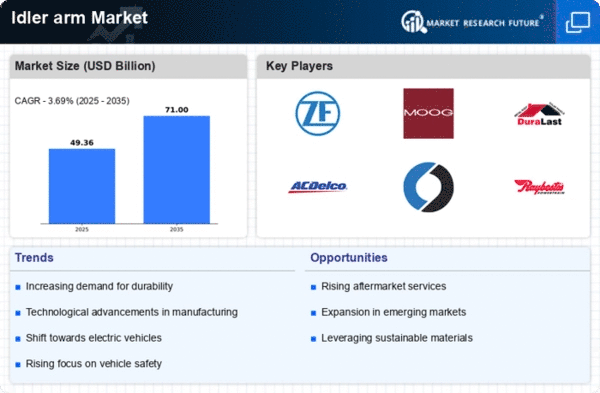
As per MRFR analysis, the Idler arm Market Size was estimated at 47.6 USD Billion in 2024. The Idler arm industry is projected to grow from 49.4 USD Billion in 2025 to 71.0 USD Billion by 2035, exhibiting a compound annual growth rate (CAGR) of 3.69 during the forecast period 2025 - 2035.

Key Market Trends & Highlights

The Idler arm market is poised for growth driven by technological advancements and increasing vehicle production.

  • Technological advancements are enhancing the performance and durability of idler arms, particularly in passenger vehicles. Sustainability initiatives are influencing manufacturers to adopt eco-friendly materials, with composite idler arms gaining traction. The Asia-Pacific region is emerging as the fastest-growing market, driven by rising vehicle production and demand for off-road vehicles. Key market drivers include the expansion of aftermarket services and the growing awareness of vehicle safety, particularly in North America.

Market Size & Forecast

2024 Market Size 47.6 (USD Billion)
2035 Market Size 71.0 (USD Billion)
CAGR (2025 - 2035) 3.69%
Largest Regional Market Share in 2024 North America

Major Players

TRW Automotive (US), Moog Inc. (US), Duralast (US), ACDelco (US), Mevotech (CA), Raybestos (US), Crown Automotive (US), Sachs (DE), Febi Bilstein (DE)

Market Trends

The Idler arm Market is currently experiencing a dynamic phase characterized by evolving consumer preferences and technological advancements. As vehicles become increasingly sophisticated, the demand for high-quality idler arms is on the rise. This component plays a crucial role in maintaining steering stability and overall vehicle performance. Manufacturers are focusing on innovation, integrating advanced materials and designs to enhance durability and efficiency.

Additionally, the growing emphasis on vehicle safety and performance is likely to drive further investments in this sector. Moreover, the Idler arm Market is witnessing a shift towards sustainability, with companies exploring eco-friendly manufacturing processes. This trend aligns with the broader automotive industry's movement towards reducing environmental impact.

As electric vehicles gain traction, the need for reliable idler arms that can withstand different operational conditions becomes paramount. The market appears poised for growth, driven by these multifaceted trends that reflect both consumer demands and industry shifts.

Technological Advancements

The Idler arm Market is increasingly influenced by technological innovations. Manufacturers are adopting advanced materials and production techniques to enhance the performance and longevity of idler arms. This trend not only improves product quality but also aligns with the automotive industry's push for more efficient and reliable components.

Sustainability Initiatives

There is a noticeable shift towards sustainability within the Idler arm Market. Companies are exploring eco-friendly manufacturing processes and materials to reduce their environmental footprint. This trend reflects a broader commitment to sustainability in the automotive sector, as consumers become more environmentally conscious.

Growing Demand for Electric Vehicles

The rise of electric vehicles is reshaping the Idler arm Market. As these vehicles require specialized components to handle unique operational demands, the need for high-quality idler arms is likely to increase. This trend suggests a potential for growth as manufacturers adapt to the evolving landscape of the automotive industry.

Idler arm Market Market Drivers

Growing Aftermarket Segment

The aftermarket segment plays a crucial role in the Global Idler arm Market Industry, as vehicle owners increasingly seek replacement parts to maintain their vehicles. With the average age of vehicles on the road rising, the demand for idler arms in the aftermarket is likely to grow. This trend is supported by the increasing awareness of vehicle maintenance and the importance of using quality parts for safety and performance. As a result, the Global Idler arm Market Industry is expected to see a steady increase in sales from aftermarket sources, contributing to a compound annual growth rate (CAGR) of 4.46% from 2025 to 2035. This growth reflects the ongoing need for reliable steering components in older vehicles.

Increasing Vehicle Production

The Global Idler arm Market Industry experiences growth driven by the rising production of vehicles worldwide. As automotive manufacturers ramp up their output to meet consumer demand, the need for reliable steering components, including idler arms, becomes paramount. In 2024, the market is projected to reach 3.77 USD Billion, reflecting the industry's response to heightened vehicle assembly rates. This trend is particularly evident in emerging economies where automotive production is expanding rapidly. Consequently, the Global Idler arm Market Industry is likely to benefit from this surge in vehicle manufacturing, as idler arms are essential for maintaining vehicle stability and steering precision.

Rising Demand for Electric Vehicles

The shift towards electric vehicles (EVs) is reshaping the Global Idler arm Market Industry. As more consumers opt for EVs, the demand for specialized components, including idler arms, is expected to increase. Electric vehicles require precise steering mechanisms to enhance driving experience and safety, which places additional emphasis on the quality of idler arms. This transition may lead to new opportunities for manufacturers to develop idler arms tailored for electric vehicle applications. As the market evolves, the Global Idler arm Market Industry could witness substantial growth, driven by the projected increase in EV adoption and the need for reliable steering components.

Regulatory Standards and Safety Requirements

Regulatory standards and safety requirements significantly impact the Global Idler arm Market Industry. Governments worldwide are implementing stringent regulations to ensure vehicle safety and performance, which directly influences the demand for high-quality idler arms. Compliance with these regulations necessitates the use of durable and reliable components, prompting manufacturers to invest in better materials and designs. As a result, the Global Idler arm Market Industry is likely to experience growth as manufacturers adapt to these evolving standards. This trend not only enhances vehicle safety but also drives innovation within the industry, ensuring that idler arms meet the latest performance benchmarks.

Technological Advancements in Automotive Components

Technological innovations in automotive components significantly influence the Global Idler arm Market Industry. The introduction of advanced materials and manufacturing techniques enhances the durability and performance of idler arms. For instance, the use of lightweight alloys and composites can improve the overall efficiency of vehicles, aligning with the industry's shift towards sustainability. As manufacturers adopt these technologies, the demand for high-quality idler arms is expected to rise. This trend may contribute to the market's growth, with projections indicating a value of 6.09 USD Billion by 2035. The integration of smart technologies in vehicles further emphasizes the importance of reliable steering components, thereby bolstering the Global Idler arm Market Industry.

Market Segment Insights

By Application: Passenger Vehicle (Largest) vs. Off-Road Vehicle (Fastest-Growing)

In the Idler Arm Market, the application segments exhibit a diverse distribution, with passenger vehicles holding the largest share due to their high demand and extensive use in personal and <a href="https://www.marketresearchfuture.com/reports/family-car-market-30001">family transport</a>. Commercial vehicles also represent a significant segment, driven by the need for reliable performance in logistics and transportation. Heavy-duty vehicles cater to specific industrial applications, while off-road vehicles capture increasing interest in recreational and agricultural sectors, producing a competitive landscape within the market.

Passenger Vehicle (Dominant) vs. Off-Road Vehicle (Emerging)

The passenger vehicle segment is the dominant player in the Idler Arm Market, characterized by its substantial volume and robust manufacturing ecosystem. This segment thrives on the continuous advancements in automotive technology and consumer preferences for comfort and safety. In contrast, the off-road vehicle segment, though emerging, is gaining traction rapidly, driven by rising outdoor activities and agricultural applications. These vehicles require specialized idler arm solutions to withstand rugged conditions. Their growth is propelled by increasing sales in sectors like agriculture and an uptick in recreational vehicle sales, showcasing a shift in consumer interests.

By Material Type: Steel (Largest) vs. Composite (Fastest-Growing)

In the Idler arm market, the material type plays a crucial role in determining the properties and applications of the product. The distribution of market share among steel, aluminum, composite, and plastic reveals that steel holds the largest share due to its durability and strength, making it a preferred choice for heavy-duty applications. Aluminum follows, appreciated for its lightweight yet strong characteristics, while composite and plastic materials cater to niche markets seeking corrosion resistance and lightweight solutions.

Steel (Dominant) vs. Composite (Emerging)

Steel is widely recognized as the dominant material in the Idler arm market, prized for its robust mechanical properties and long-term reliability in various applications, such as automotive and industrial machinery. Its ability to withstand high stress and load conditions positions it as the preferred choice among manufacturers. In contrast, composite materials are gaining traction as an emerging alternative due to their lightweight nature and resistance to corrosion, appealing to sectors focused on efficiency and performance enhancement. As advancements in composite technology reduce costs, their adoption is projected to rise, driven by an increasing demand for energy-efficient solutions across industries.

By End Use: Automotive (Largest) vs. Agricultural Equipment (Fastest-Growing)

In the Idler arm market, the largest segment is the automotive sector, which holds a significant portion of the overall market share. This dominance is attributed to the widespread adoption of various vehicle types that require efficient idler arm components for enhanced performance. Following closely is the agricultural equipment sector, which, while smaller, is rapidly gaining traction due to an increasing demand for mechanization in modern farming practices. Both sectors are essential for the sustained growth of the Idler arm market.

Automotive (Dominant) vs. Agricultural Equipment (Emerging)

The automotive sector represents the dominant force within the Idler arm market, primarily driven by the continual evolution in vehicle design and technology. Idler arms in automotive applications enhance the stability and steering precision of vehicles, which is vital as manufacturers strive for improved performance and safety. Meanwhile, the agricultural equipment sector is emerging, characterized by innovative machinery that integrates advanced idler arm designs to support the growing trend of automation in agriculture. This sector's rise is fueled by the need for greater operational efficiency and reduced labor costs, positioning itself as a vital contributor to advancements in farming.

By Sales Channel: OEM (Largest) vs. Online (Fastest-Growing)

In the idler arm market, the distribution among sales channels reveals that OEM holds a considerable share, cementing its position as the largest segment. This segment benefits from strong relationships with vehicle manufacturers and a consistent demand for original equipment as newer models are introduced. Following closely, aftermarket and retail channels also contribute significantly, but they are overshadowed by the OEM segment's extensive reach and established market presence. Meanwhile, online sales channels have emerged as the fastest-growing segment within the idler arm market. With a significant shift towards digital purchasing, consumers increasingly prefer the convenience of online shopping. This trend is bolstered by the growing number of e-commerce platforms specializing in automotive parts, along with enhanced online marketing strategies that attract a broader audience. As consumer behavior evolves, the online channel is projected to gain a more substantial footprint in the market.

OEM (Dominant) vs. Online (Emerging)

The OEM segment stands as the dominant sales channel in the idler arm market, characterized by its strong connections with automotive manufacturers and a loyalty-driven customer base. OEM parts are often preferred for their quality assurance and compatibility with vehicles. This segment thrives on the need for reliable replacements in new vehicle models. Conversely, the online sales channel is emerging as a vital alternative, appealing to tech-savvy consumers who increasingly seek convenience and variety. It offers competitive pricing and easy accessibility. As the market evolves, online platforms are adapting by enhancing user experiences and product availability, thereby capturing the attention of a younger demographic that values efficiency in purchasing.

By Design Type: Standard Design (Largest) vs. Adjustable Design (Fastest-Growing)

In the Idler Arm Market, the Standard Design currently holds the largest market share, favored for its reliability and cost-effectiveness. This segment is widely adopted in various applications, providing a solid foundation for operations. On the other hand, the Adjustable Design is rapidly gaining traction, driven by its flexibility and adaptability to different machinery, making it a preferred choice for evolving industry needs. The growth trends in this segment are primarily influenced by the increasing demand for customized solutions in machinery design. As industries lean towards automation and precision-engineered components, the Adjustable Design is poised for robust growth. Meanwhile, the Standard Design remains critical due to its established presence and operational efficiency, yet it must innovate consistently to maintain its market position against emerging trends.

Standard Design (Dominant) vs. Adjustable Design (Emerging)

The Standard Design of idler arms is characterized by its sturdy construction and dependable performance, making it the backbone of many machinery applications. This design is commonly used in traditional machinery setups, where consistency and maintenance ease are crucial. Conversely, the Adjustable Design caters to a more dynamic market, allowing users to adapt the idler arm to various specifications and operational requirements. Its versatility is particularly appealing to industries that require frequent modifications or have diverse machinery fleets. The rising emphasis on personalization in equipment design makes the Adjustable Design increasingly attractive, positioning it as an emerging leader in the market.

Get more detailed insights about Idler arm Market Research Report - Global Forecast till 2035

Regional Insights

North America : Market Leader in Idler Arms

North America is poised to maintain its leadership in the idler arm market, holding a significant market share of 24.0 in 2024. The growth is driven by increasing vehicle production, stringent safety regulations, and a rising demand for aftermarket parts. The region's robust automotive industry, coupled with technological advancements, is expected to further propel market expansion. Regulatory support for vehicle safety and emissions standards also plays a crucial role in shaping demand trends. The competitive landscape in North America is characterized by the presence of key players such as TRW Automotive, Moog Inc., and ACDelco. These companies are investing in innovative technologies and expanding their product lines to cater to the growing consumer demand. The U.S. and Canada are the leading countries in this market, with a strong focus on quality and performance. The presence of established distribution networks further enhances market accessibility and growth potential.

Europe : Emerging Market Dynamics

Europe's idler arm market is projected to grow significantly, with a market size of 12.0 in 2025. The growth is fueled by increasing vehicle registrations, a shift towards electric vehicles, and stringent EU regulations on vehicle safety and emissions. The region's commitment to sustainability and innovation is driving demand for high-quality aftermarket parts, which is expected to enhance market dynamics. Regulatory frameworks are encouraging manufacturers to adopt advanced technologies, further boosting market growth. Germany, the UK, and France are the leading countries in the European idler arm market, hosting major players like Sachs and Febi Bilstein. The competitive landscape is marked by a mix of established brands and emerging companies focusing on innovation and sustainability. The presence of a well-developed automotive supply chain and strong consumer demand for quality products are key factors contributing to the market's growth.

Asia-Pacific : Rapid Growth and Innovation

The Asia-Pacific idler arm market is witnessing rapid growth, with a market size of 8.0 in 2025. This growth is driven by increasing vehicle production, rising disposable incomes, and a growing middle class. Countries like China and India are leading the charge, with significant investments in automotive manufacturing and infrastructure. The region's regulatory environment is also evolving, promoting safety and quality standards that are expected to boost demand for idler arms in the coming years. China is the largest market in the region, followed by India and Japan, with a competitive landscape featuring both local and international players. Companies are focusing on innovation and cost-effective solutions to capture market share. The presence of key players such as Mevotech and Duralast is enhancing competition, while the growing trend of electric vehicles is expected to further influence market dynamics in the Asia-Pacific region.

Middle East and Africa : Emerging Market Opportunities

The Middle East and Africa idler arm market is emerging, with a market size of 3.6 in 2025. The growth is driven by increasing vehicle ownership, urbanization, and infrastructure development. The region's automotive sector is expanding, supported by government initiatives aimed at boosting local manufacturing and reducing import dependency. Regulatory frameworks are gradually improving, which is expected to enhance market conditions and attract investments in the automotive parts sector. Countries like South Africa and the UAE are leading the market, with a growing presence of both local and international players. The competitive landscape is characterized by a mix of established brands and new entrants focusing on quality and affordability. The increasing demand for aftermarket parts is creating opportunities for growth, as consumers seek reliable and cost-effective solutions for vehicle maintenance.

Key Players and Competitive Insights

The Idler arm Market is characterized by a competitive landscape that is increasingly shaped by innovation, strategic partnerships, and regional expansion. Key players such as TRW Automotive (US), Moog Inc. (US), and ACDelco (US) are actively pursuing strategies that enhance their market positioning. TRW Automotive (US) focuses on technological advancements in product design, which appears to be a response to the growing demand for high-performance automotive components. Meanwhile, Moog Inc. (US) emphasizes supply chain optimization and local manufacturing, likely to improve responsiveness to market fluctuations. ACDelco (US) is also investing in digital transformation initiatives, which may enhance customer engagement and streamline operations. Collectively, these strategies contribute to a moderately fragmented market structure, where competition is driven by both product innovation and operational efficiency.
In terms of business tactics, companies are increasingly localizing manufacturing to reduce lead times and costs. This approach not only enhances supply chain resilience but also allows for better alignment with regional market demands. The competitive structure of the Idler arm Market is moderately fragmented, with several key players exerting influence through their unique operational strategies. The collective actions of these companies indicate a trend towards greater collaboration and strategic alliances, which may further shape the market dynamics.
In November 2025, Moog Inc. (US) announced a partnership with a leading technology firm to develop advanced sensor technologies for their idler arms. This strategic move is likely to enhance product performance and reliability, positioning Moog as a frontrunner in innovation within the market. The integration of smart technologies into traditional automotive components could potentially redefine customer expectations and set new industry standards.
In October 2025, ACDelco (US) launched a new line of eco-friendly idler arms, reflecting a growing trend towards sustainability in automotive manufacturing. This initiative not only aligns with global environmental goals but also caters to a consumer base that increasingly prioritizes sustainable products. The introduction of these eco-friendly components may provide ACDelco with a competitive edge, appealing to environmentally conscious consumers and businesses alike.
In September 2025, TRW Automotive (US) expanded its manufacturing capabilities in Eastern Europe, aiming to tap into the growing automotive market in that region. This expansion is indicative of a broader strategy to enhance production efficiency and meet rising demand in emerging markets. By establishing a stronger presence in Eastern Europe, TRW Automotive may improve its competitive positioning and operational flexibility.
As of December 2025, the Idler arm Market is witnessing trends that emphasize digitalization, sustainability, and the integration of artificial intelligence (AI) into manufacturing processes. Strategic alliances are becoming increasingly important, as companies seek to leverage complementary strengths to enhance their competitive advantage. The shift from price-based competition to a focus on innovation, technology, and supply chain reliability is evident. Moving forward, companies that prioritize these aspects are likely to differentiate themselves in a crowded marketplace, ensuring long-term success.

Key Companies in the Idler arm Market include

Industry Developments

    • Increasing demand for heavy commercial vehicles and light commercial vehicles during the forecasted period provides various development opportunities for the idler arm market in the global market.

    • Emerging countries of different regions like Mexico, Canada, India, China, South Korea, Japan, Indonesia, Malaysia, Philippines are using innovative techniques and trying to development of electric vehicles which directly leads to the growth of the idler arm market in the global market.

    • With the changing market trend in the global market in the automotive sector, now competitors have to adopt various strategies to sustain in the global market like the study of product width and breadth, company strengths and weakness, and investment in research and development.

    • With the innovation in the idler arm market, it provides comfortable movement of vehicles in hilly and rough regions and avoids shaking of the steering wheel and improper alignment of wheels.

    • The cost-effective features of the idler arm market also provide various development opportunities in the global market during the forecasted period.


Future Outlook

Idler arm Market Future Outlook

The Idler arm Market is projected to grow at a 3.69% CAGR from 2025 to 2035, driven by increasing automotive production and demand for vehicle performance.

New opportunities lie in:

  • Expansion into electric vehicle idler arm components
  • Development of lightweight materials for idler arms
  • Implementation of predictive maintenance technologies for idler arm systems

By 2035, the Idler arm Market is expected to achieve robust growth and innovation.

Market Segmentation

Idler arm Market End Use Outlook

  • Automotive
  • Agricultural Equipment
  • Construction Equipment
  • Industrial Machinery

Idler arm Market Application Outlook

  • Passenger Vehicle
  • Commercial Vehicle
  • Heavy-Duty Vehicle
  • Off-Road Vehicle

Idler arm Market Design Type Outlook

  • Standard Design
  • Heavy-Duty Design
  • Adjustable Design

Idler arm Market Material Type Outlook

  • Steel
  • Aluminum
  • Composite
  • Plastic

Idler arm Market Sales Channel Outlook

  • OEM
  • Aftermarket
  • Retail
  • Online

Report Scope

MARKET SIZE 2024 47.6(USD Billion)
MARKET SIZE 2025 49.4(USD Billion)
MARKET SIZE 2035 71.0(USD Billion)
COMPOUND ANNUAL GROWTH RATE (CAGR) 3.69% (2025 - 2035)
REPORT COVERAGE Revenue Forecast, Competitive Landscape, Growth Factors, and Trends
BASE YEAR 2024
Market Forecast Period 2025 - 2035
Historical Data 2019 - 2024
Market Forecast Units USD Billion
Key Companies Profiled TRW Automotive (US), Moog Inc. (US), Duralast (US), ACDelco (US), Mevotech (CA), Raybestos (US), Crown Automotive (US), Sachs (DE), Febi Bilstein (DE)
Segments Covered Application, Material Type, End Use, Sales Channel, Design Type
Key Market Opportunities Integration of advanced materials and technologies enhances durability and performance in the Idler arm Market.
Key Market Dynamics Rising demand for durable idler arms driven by advancements in automotive technology and increasing vehicle production.
Countries Covered North America, Europe, APAC, South America, MEA

FAQs

What growth rate can the market expect to achieve during the review period?

The market can register a growth rate of 4.1% during the review period.

What is expected to be the market size by 2032?

The idler arm market was worth USD 5.4 billion in the year 2032 and can maintain its growth pace even during the evaluation period.

Which are the top companies in the global market, as per the report?

The top companies in the global market are Datta Industries (India), Sankei Industry Co., Ltd (Japan), Rare Parts, Inc. (US), High Link Autoparts Co., Ltd (Taiwan), ACDelco (US), GMB Corporation Japan (Japan), Ningbo Motor Industrial Co., Ltd (China), Mevotech (Canada), Chase Steering Parts Co. (Taiwan), Emerson Forge Pvt. Ltd (India), and others.

What are the sales channel mentioned in the report?

The sales channel mentioned in the report are OEM as well as aftermarket.

What are the primary market growth inducers?

Expanding fleet size of automotive vehicles, booming automotive industry and the mounting demand for heavy and light commercial vehicles are the primary market growth inducers.

  1. SECTION I: EXECUTIVE SUMMARY AND KEY HIGHLIGHTS
    1. | 1.1 EXECUTIVE SUMMARY
    2. | 1.1.1 Market Overview
    3. | 1.1.2 Key Findings
    4. | 1.1.3 Market Segmentation
    5. | 1.1.4 Competitive Landscape
    6. | 1.1.5 Challenges and Opportunities
    7. | 1.1.6 Future Outlook
  2. SECTION II: SCOPING, METHODOLOGY AND MARKET STRUCTURE
    1. | 2.1 MARKET INTRODUCTION
    2. | 2.1.1 Definition
    3. | 2.1.2 Scope of the study
    4. |-- 2.1.2.1 Research Objective
    5. |-- 2.1.2.2 Assumption
    6. |-- 2.1.2.3 Limitations
    7. | 2.2 RESEARCH METHODOLOGY
    8. | 2.2.1 Overview
    9. | 2.2.2 Data Mining
    10. | 2.2.3 Secondary Research
    11. | 2.2.4 Primary Research
    12. |-- 2.2.4.1 Primary Interviews and Information Gathering Process
    13. |-- 2.2.4.2 Breakdown of Primary Respondents
    14. | 2.2.5 Forecasting Model
    15. | 2.2.6 Market Size Estimation
    16. |-- 2.2.6.1 Bottom-Up Approach
    17. |-- 2.2.6.2 Top-Down Approach
    18. | 2.2.7 Data Triangulation
    19. | 2.2.8 Validation
  3. SECTION III: QUALITATIVE ANALYSIS
    1. | 3.1 MARKET DYNAMICS
    2. | 3.1.1 Overview
    3. | 3.1.2 Drivers
    4. | 3.1.3 Restraints
    5. | 3.1.4 Opportunities
    6. | 3.2 MARKET FACTOR ANALYSIS
    7. | 3.2.1 Value chain Analysis
    8. | 3.2.2 Porter's Five Forces Analysis
    9. |-- 3.2.2.1 Bargaining Power of Suppliers
    10. |-- 3.2.2.2 Bargaining Power of Buyers
    11. |-- 3.2.2.3 Threat of New Entrants
    12. |-- 3.2.2.4 Threat of Substitutes
    13. |-- 3.2.2.5 Intensity of Rivalry
    14. | 3.2.3 COVID-19 Impact Analysis
    15. |-- 3.2.3.1 Market Impact Analysis
    16. |-- 3.2.3.2 Regional Impact
    17. |-- 3.2.3.3 Opportunity and Threat Analysis
  4. SECTION IV: QUANTITATIVE ANALYSIS
    1. | 4.1 Automobile, BY Application (USD Billion)
    2. | 4.1.1 Passenger Vehicle
    3. | 4.1.2 Commercial Vehicle
    4. | 4.1.3 Heavy-Duty Vehicle
    5. | 4.1.4 Off-Road Vehicle
    6. | 4.2 Automobile, BY Material Type (USD Billion)
    7. | 4.2.1 Steel
    8. | 4.2.2 Aluminum
    9. | 4.2.3 Composite
    10. | 4.2.4 Plastic
    11. | 4.3 Automobile, BY End Use (USD Billion)
    12. | 4.3.1 Automotive
    13. | 4.3.2 Agricultural Equipment
    14. | 4.3.3 Construction Equipment
    15. | 4.3.4 Industrial Machinery
    16. | 4.4 Automobile, BY Sales Channel (USD Billion)
    17. | 4.4.1 OEM
    18. | 4.4.2 Aftermarket
    19. | 4.4.3 Retail
    20. | 4.4.4 Online
    21. | 4.5 Automobile, BY Design Type (USD Billion)
    22. | 4.5.1 Standard Design
    23. | 4.5.2 Heavy-Duty Design
    24. | 4.5.3 Adjustable Design
    25. | 4.6 Automobile, BY Region (USD Billion)
    26. | 4.6.1 North America
    27. |-- 4.6.1.1 US
    28. |-- 4.6.1.2 Canada
    29. | 4.6.2 Europe
    30. |-- 4.6.2.1 Germany
    31. |-- 4.6.2.2 UK
    32. |-- 4.6.2.3 France
    33. |-- 4.6.2.4 Russia
    34. |-- 4.6.2.5 Italy
    35. |-- 4.6.2.6 Spain
    36. |-- 4.6.2.7 Rest of Europe
    37. | 4.6.3 APAC
    38. |-- 4.6.3.1 China
    39. |-- 4.6.3.2 India
    40. |-- 4.6.3.3 Japan
    41. |-- 4.6.3.4 South Korea
    42. |-- 4.6.3.5 Malaysia
    43. |-- 4.6.3.6 Thailand
    44. |-- 4.6.3.7 Indonesia
    45. |-- 4.6.3.8 Rest of APAC
    46. | 4.6.4 South America
    47. |-- 4.6.4.1 Brazil
    48. |-- 4.6.4.2 Mexico
    49. |-- 4.6.4.3 Argentina
    50. |-- 4.6.4.4 Rest of South America
    51. | 4.6.5 MEA
    52. |-- 4.6.5.1 GCC Countries
    53. |-- 4.6.5.2 South Africa
    54. |-- 4.6.5.3 Rest of MEA
  5. SECTION V: COMPETITIVE ANALYSIS
    1. | 5.1 Competitive Landscape
    2. | 5.1.1 Overview
    3. | 5.1.2 Competitive Analysis
    4. | 5.1.3 Market share Analysis
    5. | 5.1.4 Major Growth Strategy in the Automobile
    6. | 5.1.5 Competitive Benchmarking
    7. | 5.1.6 Leading Players in Terms of Number of Developments in the Automobile
    8. | 5.1.7 Key developments and growth strategies
    9. |-- 5.1.7.1 New Product Launch/Service Deployment
    10. |-- 5.1.7.2 Merger & Acquisitions
    11. |-- 5.1.7.3 Joint Ventures
    12. | 5.1.8 Major Players Financial Matrix
    13. |-- 5.1.8.1 Sales and Operating Income
    14. |-- 5.1.8.2 Major Players R&D Expenditure. 2023
    15. | 5.2 Company Profiles
    16. | 5.2.1 TRW Automotive (US)
    17. |-- 5.2.1.1 Financial Overview
    18. |-- 5.2.1.2 Products Offered
    19. |-- 5.2.1.3 Key Developments
    20. |-- 5.2.1.4 SWOT Analysis
    21. |-- 5.2.1.5 Key Strategies
    22. | 5.2.2 Moog Inc. (US)
    23. |-- 5.2.2.1 Financial Overview
    24. |-- 5.2.2.2 Products Offered
    25. |-- 5.2.2.3 Key Developments
    26. |-- 5.2.2.4 SWOT Analysis
    27. |-- 5.2.2.5 Key Strategies
    28. | 5.2.3 Duralast (US)
    29. |-- 5.2.3.1 Financial Overview
    30. |-- 5.2.3.2 Products Offered
    31. |-- 5.2.3.3 Key Developments
    32. |-- 5.2.3.4 SWOT Analysis
    33. |-- 5.2.3.5 Key Strategies
    34. | 5.2.4 ACDelco (US)
    35. |-- 5.2.4.1 Financial Overview
    36. |-- 5.2.4.2 Products Offered
    37. |-- 5.2.4.3 Key Developments
    38. |-- 5.2.4.4 SWOT Analysis
    39. |-- 5.2.4.5 Key Strategies
    40. | 5.2.5 Mevotech (CA)
    41. |-- 5.2.5.1 Financial Overview
    42. |-- 5.2.5.2 Products Offered
    43. |-- 5.2.5.3 Key Developments
    44. |-- 5.2.5.4 SWOT Analysis
    45. |-- 5.2.5.5 Key Strategies
    46. | 5.2.6 Raybestos (US)
    47. |-- 5.2.6.1 Financial Overview
    48. |-- 5.2.6.2 Products Offered
    49. |-- 5.2.6.3 Key Developments
    50. |-- 5.2.6.4 SWOT Analysis
    51. |-- 5.2.6.5 Key Strategies
    52. | 5.2.7 Crown Automotive (US)
    53. |-- 5.2.7.1 Financial Overview
    54. |-- 5.2.7.2 Products Offered
    55. |-- 5.2.7.3 Key Developments
    56. |-- 5.2.7.4 SWOT Analysis
    57. |-- 5.2.7.5 Key Strategies
    58. | 5.2.8 Sachs (DE)
    59. |-- 5.2.8.1 Financial Overview
    60. |-- 5.2.8.2 Products Offered
    61. |-- 5.2.8.3 Key Developments
    62. |-- 5.2.8.4 SWOT Analysis
    63. |-- 5.2.8.5 Key Strategies
    64. | 5.2.9 Febi Bilstein (DE)
    65. |-- 5.2.9.1 Financial Overview
    66. |-- 5.2.9.2 Products Offered
    67. |-- 5.2.9.3 Key Developments
    68. |-- 5.2.9.4 SWOT Analysis
    69. |-- 5.2.9.5 Key Strategies
    70. | 5.3 Appendix
    71. | 5.3.1 References
    72. | 5.3.2 Related Reports

Automobile Market Segmentation

Automobile By Application (USD Billion, 2025-2035)

  • Passenger Vehicle
  • Commercial Vehicle
  • Heavy-Duty Vehicle
  • Off-Road Vehicle

Automobile By Material Type (USD Billion, 2025-2035)

  • Steel
  • Aluminum
  • Composite
  • Plastic

Automobile By End Use (USD Billion, 2025-2035)

  • Automotive
  • Agricultural Equipment
  • Construction Equipment
  • Industrial Machinery

Automobile By Sales Channel (USD Billion, 2025-2035)

  • OEM
  • Aftermarket
  • Retail
  • Online

Automobile By Design Type (USD Billion, 2025-2035)

  • Standard Design
  • Heavy-Duty Design
  • Adjustable Design
Infographic

Free Sample Request

Kindly complete the form below to receive a free sample of this Report

Get Free Sample

Customer Strories

Compare Licence

×
Features License Type
Single User Multiuser License Enterprise User
Price $4,950 $5,950 $7,250
Maximum User Access Limit 1 User Upto 10 Users Unrestricted Access Throughout the Organization
Free Customization
Direct Access to Analyst
Deliverable Format
Platform Access
Discount on Next Purchase 10% 15% 15%
Printable Versions