×
Request Free Sample ×

Kindly complete the form below to receive a free sample of this Report

* Please use a valid business email

Leading companies partner with us for data-driven Insights

clients tt-cursor
Hero Background

Hydrodeoxygenation HDO Catalysts Market

ID: MRFR/CnM/38553-HCR
111 Pages
Chitranshi Jaiswal
February 2026

Hydrodeoxygenation HDO Catalysts Market Research Report: By Application (Biofuel Production, Petrochemical Refining, Chemical Synthesis, Waste Oil Management), By Type (Supported Catalysts, Homogeneous Catalysts, Heterogeneous Catalysts), By Process (Batch Process, Continuous Process, Semi-Batch Process), By End Use Industry (Automotive, Aerospace, Chemical Manufacturing, Energy, Agriculture) and By Regional (North America, Europe, South America, Asia Pacific, Middle East and Africa) - Forecast to 2035

Share:
Download PDF ×

We do not share your information with anyone. However, we may send you emails based on your report interest from time to time. You may contact us at any time to opt-out.

Hydrodeoxygenation HDO Catalysts Market Infographic
Purchase Options

Hydrodeoxygenation HDO Catalysts Market Summary

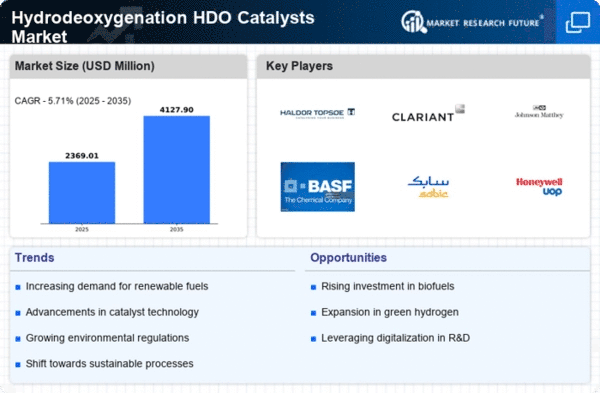
As per MRFR analysis, the Hydrodeoxygenation HDO Catalysts Market Size was estimated at 2241.05 USD Million in 2024. The Hydrodeoxygenation HDO Catalysts industry is projected to grow from 2369.02 USD Million in 2025 to 4127.9 USD Million by 2035, exhibiting a compound annual growth rate (CAGR) of 5.71 during the forecast period 2025 - 2035.

Key Market Trends & Highlights

The Hydrodeoxygenation HDO Catalysts Market is poised for substantial growth driven by technological advancements and increasing demand for sustainable solutions.

  • Advancements in catalyst technology are enhancing the efficiency and selectivity of hydrodeoxygenation processes.
  • North America remains the largest market, while Asia-Pacific is emerging as the fastest-growing region for HDO catalysts.
  • The biofuels segment dominates the market, whereas the biochemicals segment is experiencing rapid growth.
  • Rising demand for renewable fuels and government policies promoting biofuel production are key drivers of market expansion.

Market Size & Forecast

2024 Market Size 2241.05 (USD Million)
2035 Market Size 4127.9 (USD Million)
CAGR (2025 - 2035) 5.71%

Major Players

Haldor Topsoe A/S (DK), Clariant AG (CH), Johnson Matthey PLC (GB), BASF SE (DE), SABIC (SA), Honeywell UOP (US), Axens (FR), W.R. Grace & Co. (US)

Our Impact
Enabled $4.3B Revenue Impact for Fortune 500 and Leading Multinationals
Partnering with 2000+ Global Organizations Each Year
30K+ Citations by Top-Tier Firms in the Industry

Hydrodeoxygenation HDO Catalysts Market Trends

The Hydrodeoxygenation HDO Catalysts Market is currently experiencing a notable transformation, driven by the increasing demand for sustainable energy solutions and the need to reduce greenhouse gas emissions. This market appears to be influenced by advancements in catalyst technology, which enhance the efficiency of biofuel production processes. As industries seek to transition from fossil fuels to renewable energy sources, the role of HDO catalysts becomes increasingly critical. The focus on developing catalysts that can operate under milder conditions while maintaining high activity levels suggests a shift towards more environmentally friendly practices in fuel production. Moreover, the Hydrodeoxygenation HDO Catalysts Market seems to be characterized by a growing interest in optimizing feedstock utilization. This trend indicates that manufacturers are exploring diverse biomass sources to improve the overall yield and quality of biofuels. The integration of innovative catalyst designs and processes may lead to enhanced performance and cost-effectiveness. As regulatory frameworks continue to evolve, the market is likely to adapt, fostering collaboration between research institutions and industry players to drive further advancements in catalyst development. This dynamic landscape suggests a promising future for the Hydrodeoxygenation HDO Catalysts Market, with potential for significant growth and innovation in the coming years.

Advancements in Catalyst Technology

The Hydrodeoxygenation HDO Catalysts Market is witnessing rapid advancements in catalyst technology, which are enhancing the efficiency and effectiveness of biofuel production. Innovations in catalyst formulations and designs are enabling higher activity levels and selectivity, potentially leading to improved yields and reduced processing times.

Focus on Sustainable Feedstocks

There is a growing emphasis on utilizing sustainable feedstocks within the Hydrodeoxygenation HDO Catalysts Market. This trend indicates a shift towards exploring diverse biomass sources, which may enhance the overall quality and yield of biofuels while aligning with environmental sustainability goals.

Regulatory Influence on Market Dynamics

The evolving regulatory landscape appears to significantly influence the Hydrodeoxygenation HDO Catalysts Market. Stricter environmental regulations and policies aimed at reducing carbon emissions are likely to drive demand for more efficient catalysts, fostering innovation and collaboration among industry stakeholders.

Hydrodeoxygenation HDO Catalysts Market Drivers

Market Growth Projections

The Global Hydrodeoxygenation HDO Catalysts Market Industry is projected to experience substantial growth over the next decade. With a market value anticipated to reach 4.13 USD Billion by 2035, the industry is set to benefit from the increasing demand for renewable energy sources. The projected CAGR of 5.95% from 2025 to 2035 underscores the potential for innovation and expansion within the sector. This growth is likely to be driven by advancements in catalyst technology, regulatory support for biofuels, and the ongoing transition towards sustainable energy solutions.

Rising Demand for Renewable Fuels

The Global Hydrodeoxygenation HDO Catalysts Market Industry experiences a notable surge in demand for renewable fuels, driven by the increasing emphasis on sustainability and reducing carbon emissions. Governments worldwide are implementing stringent regulations to promote biofuels as a viable alternative to fossil fuels. This shift is projected to elevate the market value to 2.19 USD Billion in 2024, with expectations of reaching 4.13 USD Billion by 2035. The adoption of HDO catalysts is essential for converting biomass into high-quality renewable diesel, thereby enhancing fuel properties and meeting regulatory standards.

Environmental Regulations and Policies

The implementation of stringent environmental regulations and policies globally is a key driver for the Global Hydrodeoxygenation HDO Catalysts Market Industry. Governments are increasingly mandating the use of cleaner fuels to mitigate environmental impacts associated with traditional fossil fuels. These regulations create a favorable environment for the adoption of HDO catalysts, which facilitate the production of low-emission biofuels. As regulatory frameworks continue to evolve, the market is poised for growth, with stakeholders recognizing the necessity of HDO catalysts in meeting compliance requirements and achieving sustainability goals.

Technological Advancements in Catalysts

Technological innovations in catalyst design and performance significantly influence the Global Hydrodeoxygenation HDO Catalysts Market Industry. Recent advancements in catalyst formulations, including the development of bifunctional catalysts, enhance the efficiency and selectivity of the hydrodeoxygenation process. These improvements not only optimize reaction conditions but also reduce operational costs. As a result, the market is expected to grow at a CAGR of 5.95% from 2025 to 2035, reflecting the industry's commitment to enhancing catalyst performance and sustainability in biofuel production.

Growing Awareness of Sustainable Practices

There is a growing awareness among consumers and industries regarding sustainable practices, which significantly impacts the Global Hydrodeoxygenation HDO Catalysts Market Industry. This heightened consciousness drives the demand for biofuels produced through environmentally friendly processes. As businesses strive to enhance their sustainability profiles, the adoption of HDO catalysts becomes increasingly crucial. The market's trajectory is likely to reflect this shift, as stakeholders prioritize investments in technologies that align with sustainable development goals, thereby fostering a more robust market for HDO catalysts.

Increasing Investment in Biofuel Production

The Global Hydrodeoxygenation HDO Catalysts Market Industry is witnessing a surge in investments aimed at expanding biofuel production capacities. Governments and private entities are channeling funds into research and development initiatives to enhance the efficiency of HDO processes. This influx of capital is likely to accelerate the commercialization of advanced HDO catalysts, thereby driving market growth. With the global biofuel market projected to expand significantly, the demand for effective HDO catalysts is expected to rise, further solidifying the industry's position in the renewable energy sector.


Market Segment Insights

By Application: Biofuels (Largest) vs. Biochemicals (Fastest-Growing)

In the Hydrodeoxygenation HDO Catalysts Market, the application segment is characterized by a significant distribution among four primary categories: Biofuels, Biochemicals, Aromatics, and Alkanes. Biofuels hold the largest market share, driven by the increasing demand for cleaner energy sources and sustainable fuel alternatives. In contrast, Biochemicals are witnessing rapid growth, fueled by innovations in green chemistry and rising consumer preferences for bio-based products. Aromatics and Alkanes also play a role, though their market presence is relatively smaller compared to the leading segments.

Biofuels (Dominant) vs. Biochemicals (Emerging)

Biofuels represent the dominant application in the Hydrodeoxygenation HDO Catalysts Market, primarily due to their pivotal role in the transition to renewable energy sources. Their extensive use in transportation fuels aims to reduce greenhouse gas emissions, aligning with global sustainability goals. On the other hand, Biochemicals are an emerging segment, gaining traction as companies strive for eco-friendly production methods. This sector benefits from regulatory support and a shift towards bio-based products, indicating a promising growth trajectory. Both segments exhibit unique characteristics: Biofuels are large-scale applications focused on energy, while Biochemicals are driving innovation and diversification within the market.

By Catalyst Type: Supported Catalysts (Largest) vs. Heterogeneous Catalysts (Fastest-Growing)

In the Hydrodeoxygenation (HDO) Catalysts Market, Supported Catalysts currently dominate the market share, owing to their widespread application in various catalytic processes. They are preferred for their versatility and effectiveness in enhancing reaction rates, leading to their significant share compared to Homogeneous and Heterogeneous Catalysts. Heterogeneous Catalysts, while slightly lower in market share, play a crucial role in specific applications due to their unique benefits, including easier separation from the reaction mixture.

Catalyst Type: Supported Catalysts (Dominant) vs. Heterogeneous Catalysts (Emerging)

Supported Catalysts are recognized as the dominant force within the Hydrodeoxygenation HDO Catalysts Market, offering significant advantages such as improved stability and reusability. Typically composed of a solid support material that dispenses the active catalytic component, these catalysts optimize the reaction process for efficiency. On the other hand, Heterogeneous Catalysts are emerging rapidly, driven by industry demands for more effective catalytic solutions. Their ability to operate under milder conditions and facilitate easier recycling is compelling, making them an attractive choice for future development in the HDO process.

By Feedstock Type: Vegetable Oils (Largest) vs. Waste Oils (Fastest-Growing)

In the Hydrodeoxygenation (HDO) Catalysts Market, the feedstock type plays a crucial role in determining the efficiency and yield of the catalytic process. Among the various feedstocks, vegetable oils comprise the largest share due to their high availability and favorable properties, which cater to the needs of HDO processes. Animal fats and algal oils also contribute significantly but remain secondary in market share. Meanwhile, waste oils are rapidly gaining traction, driven by the increasing focus on sustainability and circular economy principles.

Vegetable Oils (Dominant) vs. Waste Oils (Emerging)

Vegetable oils stand as the dominant feedstock in the Hydrodeoxygenation HDO Catalysts Market. Their wide availability and consistent quality make them a preferred choice for many manufacturers. Moreover, they provide a renewable source of energy, aligning with the industry's push for sustainability. On the other hand, waste oils are emerging as a significant alternative feedstock, owing to their potential for reducing waste and lowering production costs. This segment is particularly attractive to players seeking to minimize their environmental impact while capitalizing on the rapidly evolving regulatory landscape that favors the use of recycled materials.

By Process Type: Batch Process (Largest) vs. Continuous Process (Fastest-Growing)

In the Hydrodeoxygenation (HDO) Catalysts Market, the distribution of market share among process types reveals the dominance of Batch Process, which holds the largest share of the overall market. This method benefits from simplicity and flexibility, allowing for better control of the reaction conditions. However, Continuous Process is emerging as a strong competitor, particularly favored for its operational efficiency and productivity, making it an attractive option for large-scale applications.

Batch Process (Dominant) vs. Continuous Process (Emerging)

The Batch Process segment continues to dominate the Hydrodeoxygenation (HDO) Catalysts Market, primarily due to its established technology and effectiveness in handling diverse feedstocks. This process is ideal for smaller-scale applications where specific and varied reactions are required. On the other hand, the Continuous Process segment is rapidly gaining traction due to its ability to offer higher throughput and reduced downtime. This method is particularly appealing in industrial settings aiming for streamlined operations and cost-effectiveness, positioning it as the emerging trend in the market.

By End Use Industry: Transportation (Largest) vs. Energy Production (Fastest-Growing)

The Hydrodeoxygenation HDO Catalysts Market exhibits a diverse distribution among key end-use industries. Transportation emerges as the largest segment, driven by the demand for cleaner fuel alternatives in the automotive sector. In comparison, the Chemical Manufacturing industry holds a significant share, leveraging HDO catalysts to enhance the quality of various chemicals. Energy Production, while currently smaller in market share, is rapidly gaining momentum as organizations focus on developing sustainable energy solutions.

Transportation (Dominant) vs. Energy Production (Emerging)

The Transportation sector is the dominant player in the Hydrodeoxygenation HDO Catalysts Market, primarily due to the shift towards low-emission and renewable fuel sources. HDO catalysts play a crucial role in processing biomass and waste oils into high-quality biodiesel, aligning with global sustainability goals. Conversely, Energy Production represents an emerging segment as industry stakeholders increasingly adopt HDO technology to improve the efficiency and output of biofuels. This segment is characterized by innovative approaches to energy generation and the integration of HDO processes in traditional energy systems, highlighting its potential for rapid growth.

Get more detailed insights about Hydrodeoxygenation HDO Catalysts Market

Regional Insights

North America : Market Leader in HDO Catalysts

North America is poised to maintain its leadership in the Hydrodeoxygenation (HDO) catalysts market, with a market size of $1120.52 million in 2025. The region's growth is driven by increasing demand for renewable fuels and stringent environmental regulations promoting cleaner energy solutions. The presence of advanced research facilities and significant investments in green technologies further bolster market expansion. The United States stands out as the primary market, hosting key players such as Honeywell UOP and W.R. Grace & Co. The competitive landscape is characterized by innovation and strategic partnerships among leading firms like Haldor Topsoe A/S and Clariant AG. This dynamic environment fosters advancements in catalyst technologies, ensuring North America's continued dominance in the global market.

Europe : Emerging Hub for Sustainable Solutions

Europe is emerging as a significant player in the Hydrodeoxygenation (HDO) catalysts market, with a market size of €670.63 million in 2025. The region's growth is propelled by robust regulatory frameworks aimed at reducing carbon emissions and promoting sustainable energy sources. Initiatives like the European Green Deal are pivotal in driving demand for advanced catalysts that facilitate cleaner fuel production. Leading countries such as Germany, France, and the Netherlands are at the forefront of this market, supported by key players like BASF SE and Clariant AG. The competitive landscape is marked by innovation and collaboration among industry leaders, enhancing the development of efficient HDO catalysts. This synergy between regulatory support and market demand positions Europe as a vital hub for sustainable energy solutions.

Asia-Pacific : Rapid Growth in Emerging Markets

Asia-Pacific is witnessing rapid growth in the Hydrodeoxygenation (HDO) catalysts market, with a projected market size of $360.42 million in 2025. The region's expansion is fueled by increasing energy demands and a shift towards cleaner fuel alternatives. Countries are implementing policies to enhance energy efficiency and reduce emissions, creating a favorable environment for HDO catalyst adoption. China and India are leading the charge, with significant investments in renewable energy projects. The competitive landscape features key players like Johnson Matthey PLC and Axens, who are actively developing innovative catalyst solutions. This growing focus on sustainability and energy transition positions Asia-Pacific as a promising market for HDO catalysts in the coming years.

Middle East and Africa : Emerging Market with Growth Potential

The Middle East and Africa region is gradually emerging in the Hydrodeoxygenation (HDO) catalysts market, with a market size of $89.48 million in 2025. The growth is driven by increasing investments in renewable energy and a shift towards sustainable fuel production. Governments are recognizing the importance of energy transition initiatives, which are expected to enhance the demand for HDO catalysts in the region. Countries like Saudi Arabia and South Africa are leading the way, with initiatives aimed at diversifying energy sources. The competitive landscape is evolving, with key players such as SABIC and Honeywell UOP focusing on developing advanced catalyst technologies. This strategic focus on sustainability positions the Middle East and Africa as a region with significant growth potential in the HDO catalysts market.

Key Players and Competitive Insights

The Hydrodeoxygenation HDO Catalysts Market is currently characterized by a dynamic competitive landscape, driven by the increasing demand for sustainable fuel alternatives and the need for efficient biomass conversion technologies. Key players such as Haldor Topsoe A/S (DK), Clariant AG (CH), and Johnson Matthey PLC (GB) are strategically positioned to leverage their technological expertise and innovation capabilities. Haldor Topsoe A/S (DK) focuses on enhancing catalyst performance through continuous research and development, while Clariant AG (CH) emphasizes sustainable solutions and partnerships to expand its market reach. Johnson Matthey PLC (GB) is actively pursuing digital transformation initiatives to optimize its operations and improve customer engagement, collectively shaping a competitive environment that prioritizes innovation and sustainability.In terms of business tactics, companies are increasingly localizing manufacturing to reduce supply chain vulnerabilities and enhance responsiveness to regional market demands. The Hydrodeoxygenation HDO Catalysts Market appears moderately fragmented, with a mix of established players and emerging companies. The collective influence of these key players is significant, as they drive technological advancements and set industry standards, thereby shaping the overall market structure.

In November Haldor Topsoe A/S (DK) announced a strategic partnership with a leading biofuel producer to develop next-generation catalysts aimed at improving the efficiency of renewable diesel production. This collaboration is expected to enhance Haldor Topsoe's competitive edge by integrating advanced catalyst technologies with practical applications in the biofuel sector, potentially leading to increased market share and revenue growth.

In October Clariant AG (CH) launched a new line of HDO catalysts designed specifically for the conversion of lignocellulosic biomass into high-quality fuels. This product introduction not only underscores Clariant's commitment to sustainability but also positions the company as a frontrunner in the development of innovative solutions that meet the evolving needs of the energy sector. The strategic importance of this launch lies in its potential to capture a larger share of the growing market for renewable energy sources.

In September Johnson Matthey PLC (GB) unveiled a digital platform aimed at optimizing catalyst performance monitoring for its clients. This initiative reflects the company's focus on integrating digital technologies into its operations, enhancing customer service, and providing real-time insights into catalyst efficiency. The strategic significance of this move is evident in its potential to strengthen customer relationships and foster long-term loyalty in a competitive market.

As of December current competitive trends in the Hydrodeoxygenation HDO Catalysts Market are increasingly defined by digitalization, sustainability, and the integration of artificial intelligence (AI) into operational processes. Strategic alliances among key players are shaping the landscape, facilitating knowledge sharing and resource optimization. Looking ahead, competitive differentiation is likely to evolve from traditional price-based competition to a focus on innovation, technological advancements, and supply chain reliability, as companies strive to meet the growing demand for sustainable energy solutions.

Key Companies in the Hydrodeoxygenation HDO Catalysts Market include

Industry Developments

The Hydrodeoxygenation (HDO) Catalysts Market has seen notable developments recently, with key players such as Shell Catalysts and Technologies, Haldor Topsoe and Johnson Matthey advancing their catalyst technologies to enhance biofuel production efficiency. Notably, Clariant is investing in research initiatives focused on improving catalyst longevity and performance, which is expected to drive market growth.

Recycling Technologies has been actively exploring partnerships to extend its capabilities in waste-to-fuel technologies, while BASF has announced plans for expanding its production facilities to meet increasing demand. In terms of mergers and acquisitions, there have been discussions around potential collaborations among Axens and Noble Group that aim to combine strengths in catalyst innovation and market reach, although the details are still under exploration. Evonik Industries and Honeywell UOP are also considering joint ventures to capitalize on synergies in product offerings.

The consistent growth in the demand for renewable energy sources is impacting market valuations positively, pushing companies like Albemarle and W R Grace to accelerate their innovations in HDO catalysts, reflecting a strong competitive landscape influenced by technological advancements and market requirements for cleaner fuel alternatives.

Future Outlook

Hydrodeoxygenation HDO Catalysts Market Future Outlook

The Hydrodeoxygenation HDO Catalysts Market is projected to grow at a 5.71% CAGR from 2025 to 2035, driven by increasing demand for renewable fuels and stringent environmental regulations.

New opportunities lie in:

  • Development of advanced catalyst formulations for biofuel production.
  • Expansion into emerging markets with tailored catalyst solutions.
  • Partnerships with renewable energy firms for integrated HDO systems.

By 2035, the Hydrodeoxygenation HDO Catalysts Market is expected to be robust, reflecting significant advancements and strategic growth.

Market Segmentation

Hydrodeoxygenation HDO Catalysts Market Application Outlook

  • Biofuels
  • Biochemicals
  • Aromatics
  • Alkanes

Hydrodeoxygenation HDO Catalysts Market Process Type Outlook

  • Batch Process
  • Continuous Process
  • Semi-Continuous Process

Hydrodeoxygenation HDO Catalysts Market Catalyst Type Outlook

  • Supported Catalysts
  • Homogeneous Catalysts
  • Heterogeneous Catalysts

Hydrodeoxygenation HDO Catalysts Market Feedstock Type Outlook

  • Vegetable Oils
  • Animal Fats
  • Algal Oils
  • Waste Oils

Hydrodeoxygenation HDO Catalysts Market End Use Industry Outlook

  • Transportation
  • Chemical Manufacturing
  • Energy Production

Report Scope

MARKET SIZE 20242241.05(USD Million)
MARKET SIZE 20252369.02(USD Million)
MARKET SIZE 20354127.9(USD Million)
COMPOUND ANNUAL GROWTH RATE (CAGR)5.71% (2025 - 2035)
REPORT COVERAGERevenue Forecast, Competitive Landscape, Growth Factors, and Trends
BASE YEAR2024
Market Forecast Period2025 - 2035
Historical Data2019 - 2024
Market Forecast UnitsUSD Million
Key Companies ProfiledHaldor Topsoe A/S (DK), Clariant AG (CH), Johnson Matthey PLC (GB), BASF SE (DE), SABIC (SA), Honeywell UOP (US), Axens (FR), W.R. Grace & Co. (US)
Segments CoveredApplication, Catalyst Type, Feedstock Type, Process Type, End Use Industry
Key Market OpportunitiesAdvancements in biofuel production technologies drive demand for Hydrodeoxygenation HDO Catalysts Market.
Key Market DynamicsRising demand for sustainable fuels drives innovation and competition in Hydrodeoxygenation HDO Catalysts market.
Countries CoveredNorth America, Europe, APAC, South America, MEA
Leave a Comment

FAQs

What is the expected market size of the Hydrodeoxygenation HDO Catalysts Market by 2035?

The expected market size of the Hydrodeoxygenation HDO Catalysts Market by 2035 is 3.5 USD billion.

What is the projected Compound Annual Growth Rate (CAGR) for the Hydrodeoxygenation HDO Catalysts Market from 2024 to 2035?

The projected CAGR for the Hydrodeoxygenation HDO Catalysts Market from 2025-2035 is 5.71%.

Which application segment is anticipated to have the highest market value by 2035?

The Biofuel Production application segment is anticipated to have the highest market value at 1.4 USD billion by 2035.

What is the market size for Petrochemical Refining in 2035?

The market size for Petrochemical Refining is projected to reach 1.1 USD billion by 2035.

Which region is expected to dominate the Hydrodeoxygenation HDO Catalysts Market by 2035?

North America is expected to dominate the Hydrodeoxygenation HDO Catalysts Market with a valuation of 1.25 USD billion by 2035.

What is the anticipated market size for the Chemical Synthesis application segment by 2035?

The anticipated market size for the Chemical Synthesis application segment by 2035 is 0.7 USD billion.

Who are the major players in the Hydrodeoxygenation HDO Catalysts Market?

Major players in the market include Recycling Technologies, Noble Group, Axens and W R Grace.

What is the expected market size for the Waste Oil Management application by 2035?

The expected market size for the Waste Oil Management application is projected to be 0.3 USD billion by 2035.

What is the market value of the Hydrodeoxygenation HDO Catalysts Market in the APAC region by 2035?

The market value of the Hydrodeoxygenation HDO Catalysts Market in the APAC region is anticipated to be 0.75 USD billion by 2035.

What is the market size in Europe for the Hydrodeoxygenation HDO Catalysts Market by 2035?

The market size in Europe for the Hydrodeoxygenation HDO Catalysts Market is projected to be 1.0 USD billion by 2035.

Download Free Sample

Kindly complete the form below to receive a free sample of this Report

Compare Licence

×
Features License Type
Single User Multiuser License Enterprise User
Price $4,950 $5,950 $7,250
Maximum User Access Limit 1 User Upto 10 Users Unrestricted Access Throughout the Organization
Free Customization
Direct Access to Analyst
Deliverable Format
Platform Access
Discount on Next Purchase 10% 15% 15%
Printable Versions