×
Request Free Sample ×

Kindly complete the form below to receive a free sample of this Report

* Please use a valid business email

Leading companies partner with us for data-driven Insights

clients tt-cursor
Hero Background

Hydrocarbon Resin Market

ID: MRFR/CnM/34397-HCR
100 Pages
Sejal Akre
February 2026

Hydrocarbon Resin Market Research Report By Application (Adhesives, Coatings, Inks, Rubber, Sealants), By Type (C9 Hydrocarbon Resin, C5 Hydrocarbon Resin, DCPD Hydrocarbon Resin, Polyterpene Resin), By End Use Industry (Automotive, Construction, Packaging, Electronics, Personal Care), By Form (Solid, Liquid, Powder) and By Regional (North America, Europe, South America, Asia Pacific, Middle East and Africa) - Forecast to 2035

Share:
Download PDF ×

We do not share your information with anyone. However, we may send you emails based on your report interest from time to time. You may contact us at any time to opt-out.

Hydrocarbon Resin Market Infographic
Purchase Options

Hydrocarbon Resin Market Summary

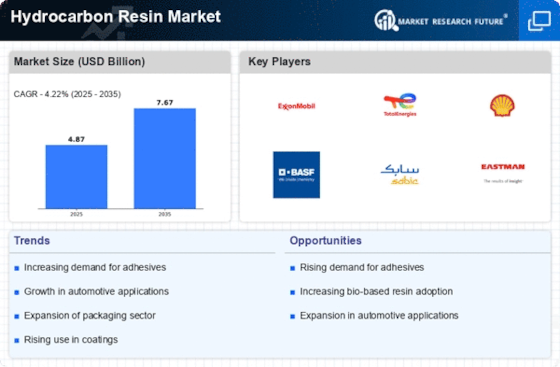
As per Market Research Future analysis, the Hydrocarbon Resin Market Size was estimated at 4.868 USD Billion in 2024. The Hydrocarbon Resin industry is projected to grow from 5.073 USD Billion in 2025 to 7.672 USD Billion by 2035, exhibiting a compound annual growth rate (CAGR) of 4.22% during the forecast period 2025 - 2035

Key Market Trends & Highlights

The Hydrocarbon Resin Market is poised for robust growth driven by sustainability and technological advancements.

  • North America remains the largest market for hydrocarbon resins, primarily due to its established industrial base.
  • The Asia-Pacific region is emerging as the fastest-growing market, fueled by increasing manufacturing activities and urbanization.
  • The adhesives segment dominates the market, while the coatings segment is experiencing rapid growth due to rising demand for innovative applications.
  • Key market drivers include the rising demand from adhesives and sealants, alongside technological innovations in resin production.

Market Size & Forecast

2024 Market Size 4.868 (USD Billion)
2035 Market Size 7.672 (USD Billion)
CAGR (2025 - 2035) 4.22%

Major Players

ExxonMobil (US), TotalEnergies (FR), Shell (GB), BASF (DE), SABIC (SA), Eastman Chemical (US), Kraton Corporation (US), Mitsui Chemicals (JP), DOW (US)

Our Impact
Enabled $4.3B Revenue Impact for Fortune 500 and Leading Multinationals
Partnering with 2000+ Global Organizations Each Year
30K+ Citations by Top-Tier Firms in the Industry

Hydrocarbon Resin Market Trends

The Hydrocarbon Resin Market is currently experiencing a dynamic phase characterized by evolving consumer preferences and technological advancements. The demand for hydrocarbon resins is driven by their versatile applications across various industries, including adhesives, coatings, and inks. As manufacturers seek to enhance product performance and sustainability, innovations in resin formulations are becoming increasingly prevalent. This shift towards eco-friendly solutions appears to be influencing market dynamics, as companies strive to meet regulatory requirements and consumer expectations for greener products. Furthermore, the expansion of the automotive and construction sectors is likely to bolster the demand for hydrocarbon resins, as these materials are integral to the production of high-performance adhesives and sealants. In addition, the Hydrocarbon Resin Market is witnessing a trend towards customization and specialization. Manufacturers are focusing on developing tailored solutions that cater to specific industry needs, which may enhance their competitive edge. The rise of emerging economies is also contributing to market growth, as increased industrialization and urbanization create new opportunities for hydrocarbon resin applications. Overall, the Hydrocarbon Resin Market appears poised for continued growth, driven by innovation, sustainability, and the increasing demand for high-quality materials across diverse sectors.

Sustainability Initiatives

The Hydrocarbon Resin Market is increasingly influenced by sustainability initiatives. Manufacturers are exploring bio-based and recycled materials to reduce environmental impact. This trend reflects a broader commitment to eco-friendly practices, aligning with consumer preferences for greener products.

Technological Advancements

Technological advancements are reshaping the Hydrocarbon Resin Market. Innovations in resin formulations and production processes are enhancing performance characteristics. These developments may lead to improved adhesion, durability, and versatility, catering to diverse industrial applications.

Customization and Specialization

Customization and specialization are becoming prominent trends within the Hydrocarbon Resin Market. Companies are focusing on developing tailored solutions to meet specific industry requirements. This approach may enhance competitiveness and foster stronger relationships with clients.

Hydrocarbon Resin Market Drivers

Growth in the Coatings Sector

The coatings sector is a pivotal driver for the Hydrocarbon Resin Market, as these resins are integral to formulating high-quality paints and coatings. The increasing focus on aesthetic appeal and durability in various applications, including automotive and industrial coatings, is propelling the demand for hydrocarbon resins. In 2025, the coatings segment is expected to witness a considerable uptick, with hydrocarbon resins providing essential properties such as gloss, adhesion, and resistance to environmental factors. Additionally, the trend towards low-VOC and environmentally friendly coatings is likely to influence the market, as manufacturers seek resins that align with regulatory standards. This dynamic landscape suggests that the hydrocarbon resin market will continue to thrive, driven by innovations in the coatings sector.

Expansion of the Printing Inks Market

The Hydrocarbon Resin Market is significantly influenced by the expansion of the printing inks market. Hydrocarbon resins are crucial in formulating inks that offer superior performance, including excellent adhesion and color vibrancy. As the demand for high-quality printed materials continues to rise, particularly in packaging and labeling, the need for effective printing inks is becoming increasingly pronounced. In 2025, the printing inks segment is anticipated to grow, driven by advancements in digital printing technologies and the need for sustainable ink solutions. The integration of hydrocarbon resins in ink formulations is likely to enhance the overall quality and performance of printed products, thereby reinforcing the position of hydrocarbon resins as a vital component in the printing industry.

Increasing Use in Rubber Applications

The Hydrocarbon Resin Market is witnessing a growing utilization of hydrocarbon resins in rubber applications. These resins are essential in enhancing the performance characteristics of rubber products, including tires, seals, and gaskets. The automotive sector, in particular, is a significant contributor to this trend, as manufacturers seek to improve the durability and performance of rubber components. In 2025, the demand for hydrocarbon resins in rubber applications is expected to rise, driven by the ongoing advancements in rubber technology and the need for high-performance materials. This trend indicates a robust future for the hydrocarbon resin market, as the integration of these resins in rubber formulations continues to evolve.

Rising Demand from Adhesives and Sealants

The Hydrocarbon Resin Market is experiencing a notable surge in demand from the adhesives and sealants sector. This growth is primarily driven by the increasing application of adhesives in construction, automotive, and packaging industries. In 2025, the adhesives segment is projected to account for a substantial share of the hydrocarbon resin consumption, reflecting a trend towards enhanced bonding solutions. The versatility of hydrocarbon resins in formulating high-performance adhesives is a key factor contributing to this demand. Furthermore, the shift towards eco-friendly adhesives is likely to bolster the market, as manufacturers seek resins that meet sustainability criteria while maintaining performance. As a result, the hydrocarbon resin market is poised for significant expansion, driven by the evolving needs of the adhesives and sealants industry.

Technological Innovations in Resin Production

Technological innovations in resin production are emerging as a critical driver for the Hydrocarbon Resin Market. Advances in production techniques, such as improved polymerization processes and the development of new resin formulations, are enhancing the efficiency and performance of hydrocarbon resins. These innovations are likely to lead to the introduction of novel products that cater to specific industry needs, thereby expanding the market. In 2025, the impact of these technological advancements is expected to be profound, as manufacturers strive to meet the evolving demands of various applications, including adhesives, coatings, and rubber products. This continuous evolution in resin production technology suggests a promising outlook for the hydrocarbon resin market.


Market Segment Insights

By Application: Adhesives (Largest) vs. Coatings (Fastest-Growing)

The hydrocarbon resin market showcases a diverse application base, prominently featuring adhesives that capture the largest market share. This segment leverages the unique properties of hydrocarbon resins to enhance the bonding qualities and durability of various substrates. Coatings follow closely, leveraging resins to provide protective and decorative finishes across multiple industries. Other notable applications include inks, rubber, and sealants, each contributing significantly to the overall market dynamics, though at a comparatively smaller scale. In terms of growth trends, the demand for coatings is rapidly increasing, driven by the booming construction industry and a rising focus on sustainability. Meanwhile, adhesives remain integral due to their extensive usage in packaging, automotive, and electronics. The market is further influenced by technological advancements and the need for high-performance materials, positioning both adhesives and coatings as pivotal sectors in the hydrocarbon resin landscape.

Adhesives (Dominant) vs. Sealants (Emerging)

Adhesives dominate the hydrocarbon resin application segment, due to their unparalleled bonding capabilities and versatility across numerous sectors, including packaging, automotive, and consumer goods. They are preferred for their performance characteristics, such as heat resistance and flexibility. On the other hand, sealants represent an emerging segment, gaining traction in the construction and automotive industries. They provide essential solutions for gap filling and moisture resistance, which are crucial in many applications. With innovation driving the development of advanced sealant formulations, this segment is witnessing a robust uptick in demand as industries seek improved durability and performance from their materials. Despite their current position, sealants are expected to capture a larger market share in the coming years as building regulations and consumer specifications evolve.

By Type: C9 Hydrocarbon Resin Market (Largest) vs. C5 Hydrocarbon Resin Market (Fastest-Growing)

In the Hydrocarbon Resin Market, the C9 Hydrocarbon Resin Market holds the largest share due to its widespread application across adhesives, coatings, and inks. This segment is favored for its excellent thermal stability and compatibility with various formulations, making it a preferred choice among manufacturers. Conversely, the C5 Hydrocarbon Resin Market is emerging rapidly, driven by its cost-effectiveness and growing usage in hot-melt adhesives.

C9 Hydrocarbon Resin Market (Dominant) vs. C5 Hydrocarbon Resin Market (Emerging)

C9 Hydrocarbon Resin Market is renowned for its exceptional performance properties, including high adhesive strength and compatibility with a variety of materials. This resin is predominantly used in industrial adhesives and coatings, giving it a dominant market position. In contrast, C5 Hydrocarbon Resin Market is recognized for its versatility and affordability, making it a preferred choice for various applications, particularly in the packaging and automotive industries. Its flexibility and rapid curing times are driving its emergence as a vital product in the market.

By End Use Industry: Packaging (Largest) vs. Automotive (Fastest-Growing)

The Hydrocarbon Resin Market is characterized by distinctive segments, with Packaging holding the largest share due to its widespread adoption in various sectors. Other significant segments include Automotive, Construction, Electronics, and Personal Care, each contributing uniquely to the market landscape. As businesses continue to innovate, the allocation of hydrocarbon resins across these end-use industries evolves, reflecting changing consumer demands and technological advancements.

Packaging (Dominant) vs. Automotive (Emerging)

In the Hydrocarbon Resin Market, the Packaging segment is dominant, leveraging its extensive applications in adhesives, coatings, and sealants to meet the growing demand for flexible and sustainable materials. The shift towards eco-friendly packaging solutions enhances its market position. Conversely, the Automotive segment is emerging rapidly, driven by increasing automotive production and a shift towards lightweight materials to enhance fuel efficiency. Its demand for high-performance resins in adhesive and composite applications is growing. As both segments develop, technological advancements will play a critical role in shaping their futures.

By Form: Solid (Largest) vs. Liquid (Fastest-Growing)

In the Hydrocarbon Resin Market, the 'Form' segment reveals a distinct distribution among solid, liquid, and powder resins. Solid resins remain the largest category, as they are favored for their stability and versatility across various applications, including adhesives and coatings. Liquid resins, however, are gaining traction due to their ease of use and applications in formulations that require quick curing and high flexibility. Powder resins, while smaller in share, serve niche markets and offer unique properties suitable for specific applications.

Solid (Dominant) vs. Liquid (Emerging)

Solid hydrocarbon resins dominate the market due to their extensive applicability in industries such as adhesives, paints, and inks. These resins offer excellent thermal stability and durability, making them suitable for demanding environments. In contrast, liquid hydrocarbon resins are emerging rapidly, driven by their adaptability in formulations that necessitate quicker processing and lower environmental impact. The shift towards environmentally friendly products has motivated manufacturers to innovate and produce liquid variants that meet stringent regulations while maintaining performance. As industries increasingly prioritize sustainability, liquid resins are projected to expand their footprint significantly.

Get more detailed insights about Hydrocarbon Resin Market

Regional Insights

North America : Innovation and Demand Growth

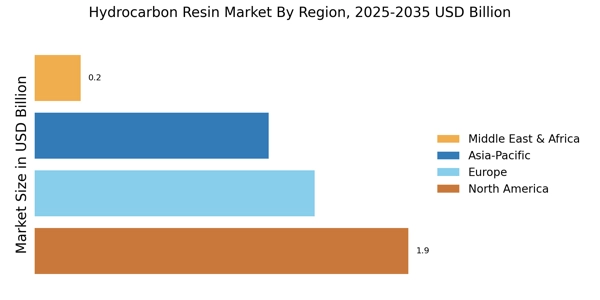
North America is witnessing significant growth in the hydrocarbon resin market, driven by increasing demand from the adhesives and coatings sectors. The region holds approximately 40% of the global market share, making it the largest market. Regulatory support for sustainable materials and innovations in resin formulations are key growth catalysts. The U.S. is the primary contributor, with Canada following closely behind, contributing to the overall market expansion. The competitive landscape in North America is dominated by major players such as ExxonMobil, Eastman Chemical, and DOW. These companies are investing heavily in R&D to develop advanced hydrocarbon resins that meet stringent environmental regulations. The presence of a robust manufacturing base and a strong distribution network further enhances market dynamics, positioning North America as a leader in hydrocarbon resin production.

Europe : Sustainability and Innovation Focus

Europe is emerging as a significant player in the hydrocarbon resin market, driven by stringent environmental regulations and a strong push for sustainable products. The region accounts for approximately 30% of the global market share, making it the second-largest market. Regulatory frameworks such as REACH are catalyzing innovation in eco-friendly resin formulations, aligning with the EU's sustainability goals. This regulatory environment is fostering demand for bio-based and recycled resins, further propelling market growth. Leading countries in Europe include Germany, France, and the UK, with key players like BASF and TotalEnergies leading the charge in innovation. The competitive landscape is characterized by a mix of established companies and emerging startups focused on sustainable solutions. Collaborative efforts between industry and academia are also enhancing research and development, ensuring that Europe remains at the forefront of hydrocarbon resin technology.

Asia-Pacific : Rapid Industrialization and Growth

The Asia-Pacific region is experiencing rapid growth in the hydrocarbon resin market, fueled by industrialization and increasing demand from various end-use industries such as automotive and construction. This region holds approximately 25% of the global market share, with China and India being the largest contributors. The growing population and urbanization are driving demand for adhesives and coatings, which are essential in these sectors, thus acting as significant growth drivers for the market. China is the leading country in this region, with a strong presence of local manufacturers and international players like Mitsui Chemicals. The competitive landscape is evolving, with companies focusing on innovation and cost-effective production methods. Additionally, government initiatives aimed at boosting manufacturing capabilities are further enhancing the market dynamics, making Asia-Pacific a key player in the hydrocarbon resin industry.

Middle East and Africa : Emerging Markets and Opportunities

The Middle East and Africa region is witnessing a gradual but steady growth in the hydrocarbon resin market, driven by increasing industrial activities and infrastructure development. This region holds approximately 5% of the global market share, with countries like Saudi Arabia and South Africa leading the charge. The availability of raw materials and government initiatives to diversify economies are acting as catalysts for market growth, particularly in the construction and automotive sectors. Saudi Arabia is emerging as a key player, with significant investments in petrochemical projects. The competitive landscape is characterized by a mix of local and international companies, including SABIC, which is a major contributor to the market. As the region continues to develop its industrial base, the demand for hydrocarbon resins is expected to rise, presenting new opportunities for growth and investment.

Hydrocarbon Resin Market Regional Image

Key Players and Competitive Insights

The Hydrocarbon Resin Market is currently characterized by a dynamic competitive landscape, driven by increasing demand across various applications such as adhesives, coatings, and sealants. Key players are actively engaging in strategies that emphasize innovation, sustainability, and regional expansion to enhance their market positions. Companies like ExxonMobil (US) and BASF (DE) are focusing on developing advanced hydrocarbon resin formulations that cater to specific industry needs, thereby reinforcing their competitive edge. Meanwhile, TotalEnergies (FR) and DOW (US) are pursuing strategic partnerships and collaborations to leverage technological advancements and optimize their product offerings, which collectively shapes a competitive environment that is both collaborative and competitive.In terms of business tactics, companies are increasingly localizing manufacturing to reduce lead times and enhance supply chain efficiency. This approach appears to be particularly effective in a moderately fragmented market where several players vie for market share. The collective influence of these key players is significant, as they not only drive innovation but also set industry standards that smaller competitors may strive to meet.

In August ExxonMobil (US) announced the launch of a new line of bio-based hydrocarbon resins aimed at reducing carbon footprints in the adhesive sector. This strategic move underscores the company's commitment to sustainability and positions it favorably in a market that is increasingly prioritizing eco-friendly solutions. The introduction of these products is likely to attract environmentally conscious customers and enhance ExxonMobil's reputation as a leader in sustainable practices.

In September BASF (DE) revealed a partnership with a leading technology firm to develop AI-driven solutions for optimizing resin production processes. This collaboration is expected to enhance operational efficiency and reduce production costs, thereby allowing BASF to offer competitive pricing without compromising on quality. The integration of AI into their operations may also lead to innovations in product development, further solidifying BASF's market position.Additionally, in July 2025, DOW (US) expanded its manufacturing capabilities in Asia by investing in a new facility dedicated to producing high-performance hydrocarbon resins. This expansion not only reflects DOW's commitment to meeting the growing demand in the Asia-Pacific region but also indicates a strategic shift towards enhancing supply chain reliability. By increasing local production, DOW aims to mitigate risks associated with global supply chain disruptions and improve service levels for its customers.

As of October the Hydrocarbon Resin Market is witnessing trends that emphasize digitalization, sustainability, and the integration of advanced technologies. Strategic alliances are becoming increasingly prevalent, as companies recognize the value of collaboration in driving innovation and enhancing competitive differentiation. The competitive landscape is likely to evolve from a focus on price-based competition to one that prioritizes technological advancements, product innovation, and supply chain resilience, suggesting that companies that can effectively leverage these trends will emerge as leaders in the market.

Key Companies in the Hydrocarbon Resin Market include

Industry Developments

In recent developments within the Hydrocarbon Resin Market, companies such as Repsol, TotalEnergies, and BASF SE are experiencing growth driven by increasing demand across various applications like adhesives, coatings, and plastics.

Kraton Corporation and Dow Chemical Company have reported substantial market valuation increases, highlighting the robust nature of this sector. Notably, Hexpol AB announced a strategic partnership to innovate sustainable resin solutions, which reflects a growing trend towards eco-friendly products.

Disruptions in supply chains due to geopolitical tensions have led to fluctuating raw material costs, impacting profit margins and prompting ExxonMobil Chemical and SABIC to explore alternative sourcing strategies.

In the context of mergers and acquisitions, there have been no significant recent announcements involving major players like Mitsui Chemicals and Yankuang Lunan Chemical, though the landscape remains dynamic as companies seek consolidation to enhance their competitive edge.

The ongoing focus on research and development within the hydrocarbon resin space is anticipated to drive technological advancements, further shaping the market trajectory. This evolving situation illustrates the complexities and opportunities present in the hydrocarbon resin sector.

Future Outlook

Hydrocarbon Resin Market Future Outlook

The Hydrocarbon Resin Market is projected to grow at a 4.22% CAGR from 2025 to 2035, driven by increasing demand in adhesives, coatings, and automotive applications.

New opportunities lie in:

  • Expansion into bio-based hydrocarbon resins for sustainable product lines.
  • Development of customized resin formulations for specific industrial applications.
  • Investment in advanced manufacturing technologies to enhance production efficiency.

By 2035, the Hydrocarbon Resin Market is expected to achieve robust growth, reflecting evolving industry needs.

Market Segmentation

Hydrocarbon Resin Market Form Outlook

  • Solid
  • Liquid
  • Powder

Hydrocarbon Resin Market Type Outlook

  • C9 Hydrocarbon Resin
  • C5 Hydrocarbon Resin
  • DCPD Hydrocarbon Resin
  • Polyterpene Resin

Hydrocarbon Resin Market Application Outlook

  • Adhesives
  • Coatings
  • Inks
  • Rubber
  • Sealants

Hydrocarbon Resin Market End Use Industry Outlook

  • Automotive
  • Construction
  • Packaging
  • Electronics
  • Personal Care

Report Scope

MARKET SIZE 20244.868(USD Billion)
MARKET SIZE 20255.073(USD Billion)
MARKET SIZE 20357.672(USD Billion)
COMPOUND ANNUAL GROWTH RATE (CAGR)4.22% (2025 - 2035)
REPORT COVERAGERevenue Forecast, Competitive Landscape, Growth Factors, and Trends
BASE YEAR2024
Market Forecast Period2025 - 2035
Historical Data2019 - 2024
Market Forecast UnitsUSD Billion
Key Companies ProfiledExxonMobil (US), TotalEnergies (FR), Shell (GB), BASF (DE), SABIC (SA), Eastman Chemical (US), Kraton Corporation (US), Mitsui Chemicals (JP), DOW (US)
Segments CoveredApplication, Type, End Use Industry, Form, Regional
Key Market OpportunitiesGrowing demand for eco-friendly adhesives and coatings in the Hydrocarbon Resin Market presents significant opportunities.
Key Market DynamicsRising demand for eco-friendly adhesives drives innovation and competition in the Hydrocarbon Resin Market.
Countries CoveredNorth America, Europe, APAC, South America, MEA
Leave a Comment

FAQs

What is the projected market valuation of the Hydrocarbon Resin Market by 2035?

The Hydrocarbon Resin Market is projected to reach a valuation of 7.672 USD Billion by 2035.

What was the market valuation of the Hydrocarbon Resin Market in 2024?

In 2024, the Hydrocarbon Resin Market was valued at 4.868 USD Billion.

What is the expected CAGR for the Hydrocarbon Resin Market during the forecast period 2025 - 2035?

The expected CAGR for the Hydrocarbon Resin Market during the forecast period 2025 - 2035 is 4.22%.

Which application segment had the highest valuation in 2024?

In 2024, the Coatings application segment had the highest valuation at 1.4602 USD Billion.

What are the projected values for the Adhesives segment by 2035?

The Adhesives segment is projected to reach a value of 1.5168 USD Billion by 2035.

Which type of hydrocarbon resin is expected to grow the most by 2035?

The C9 Hydrocarbon Resin is expected to grow the most, reaching a projected value of 2.4 USD Billion by 2035.

What was the valuation of the Rubber segment in 2024?

The Rubber segment was valued at 1.2134 USD Billion in 2024.

Which end-use industry is projected to have the highest growth by 2035?

The Packaging end-use industry is projected to grow to 2.5 USD Billion by 2035.

What is the projected value of the Liquid form of hydrocarbon resin by 2035?

The Liquid form of hydrocarbon resin is projected to reach a value of 2.8 USD Billion by 2035.

Who are the key players in the Hydrocarbon Resin Market?

Key players in the Hydrocarbon Resin Market include ExxonMobil, TotalEnergies, Shell, BASF, SABIC, Eastman Chemical, Kraton Corporation, Mitsui Chemicals, and DOW.

Download Free Sample

Kindly complete the form below to receive a free sample of this Report

Compare Licence

×
Features License Type
Single User Multiuser License Enterprise User
Price $4,950 $5,950 $7,250
Maximum User Access Limit 1 User Upto 10 Users Unrestricted Access Throughout the Organization
Free Customization
Direct Access to Analyst
Deliverable Format
Platform Access
Discount on Next Purchase 10% 15% 15%
Printable Versions