×
Request Free Sample ×

Kindly complete the form below to receive a free sample of this Report

* Please use a valid business email

Leading companies partner with us for data-driven Insights

clients tt-cursor
Hero Background
English
Chinese
French
Japanese
Korean
German
Spanish

Host Cell Contaminant Testing Market Size

ID: MRFR/LS/9226-HCR
120 Pages
Rahul Gotadki
February 2026

Host Cell Contaminant Testing Market Research Report Information By Type (Host Cell Protein Assay, Host Cell DNA Assay), By End User (Biopharmaceutical Companies,Contract Research Organizations, Contract Manufacturing Organizations, Academic & Research Institutes) Forecast till 2035

Share:
Download PDF ×

We do not share your information with anyone. However, we may send you emails based on your report interest from time to time. You may contact us at any time to opt-out.

Host Cell Contaminant Testing Market Infographic
Purchase Options

Host Cell Contaminant Testing Size

Host Cell Contaminant Testing Market Growth Projections and Opportunities

The host cell contaminant testing market is experiencing robust growth, propelled by the expanding biopharmaceutical industry. As biopharmaceuticals turn out to be increasingly necessary for medical remedies, the need for rigorous host cell contamination testing is paramount to ensure the protection and efficacy of those superior therapeutics. Stringent regulatory necessities set by the fitness government globally are a major source of pressure for the host cell contamination testing market. Regulatory bodies, along with the FDA and EMA, mandate complete checking out to perceive and quantify Host Cell Contaminants and ensure the purity and safety of biopharmaceutical products. The consciousness of first-rate products inside the biopharmaceutical quarter is a giant issue influencing the host cell contamination testing market. Biopharmaceutical agencies prioritize testing for host cell contaminants to fulfill the very best standards in product fines, stopping detrimental results on sufferers and safeguarding the popularity of their products. Ongoing technological advancements in trying out methods, including polymerase chain reaction (PCR) and mass spectrometry, contribute to the growth of the host cell contaminants testing market. These innovations beautify the sensitivity and specificity of trying out, presenting greater accurate and green identification of Host Cell Contaminants. Host cell contamination testing Biopharmaceutical organizations operating on an international scale are trying to find standardized services to comply with diverse regulatory requirements throughout specific areas. The emphasis on threat mitigation strategies in biopharmaceutical manufacturing is boosting the host cell contamination testing market. Companies prioritize thoroughly trying to perceive and mitigate the dangers associated with Host Cell Contaminants and ensure the reliability and protection of their biopharmaceutical merchandise. Educational initiatives and schooling packages within the biopharmaceutical enterprise play a critical function in the marketplace boom. The awareness of the importance of host cell contamination testing is heightened via educational programs, encouraging biopharmaceutical specialists to adhere to rigorous checking-out protocols. Cost concerns in biopharmaceutical development have an impact on the host cell contamination testing marketplace. Companies are searching for value-effective testing answers that do not compromise on exceptional, leading to a demand for efficient testing offerings that strike a balance between affordability and reliability.
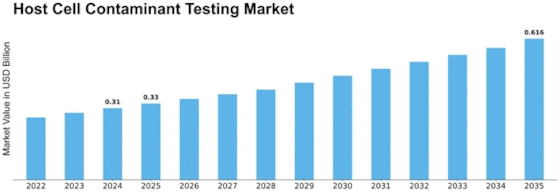
Host Cell Contaminant Testing Market Size Graph
Author
Rahul Gotadki
Research Manager

He holds an experience of about 9+ years in Market Research and Business Consulting, working under the spectrum of Life Sciences and Healthcare domains. Rahul conceptualizes and implements a scalable business strategy and provides strategic leadership to the clients. His expertise lies in market estimation, competitive intelligence, pipeline analysis, customer assessment, etc.

Leave a Comment

FAQs

What is the current valuation of the Host Cell Contaminant Testing Market?

<p>The market valuation was 0.3088 USD Billion in 2024.</p>

What is the projected market size for the Host Cell Contaminant Testing Market by 2035?

<p>The market is projected to reach 0.616 USD Billion by 2035.</p>

What is the expected CAGR for the Host Cell Contaminant Testing Market during the forecast period?

<p>The expected CAGR for the market from 2025 to 2035 is 6.48%.</p>

Which companies are considered key players in the Host Cell Contaminant Testing Market?

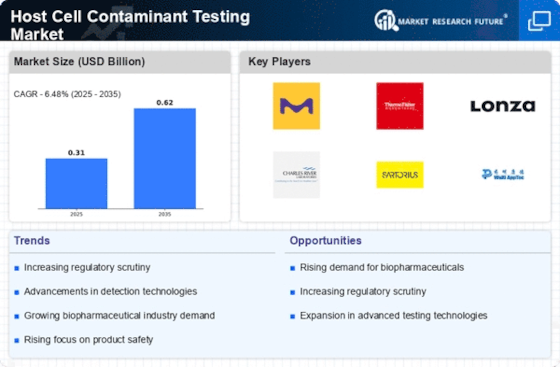
<p>Key players include Merck KGaA, Thermo Fisher Scientific Inc., and Lonza Group AG.</p>

What are the primary segments of the Host Cell Contaminant Testing Market?

<p>The primary segments include Host Cell Protein Assays and Host Cell DNA Assays.</p>

How did the Host Cell Protein Assays segment perform in 2024?

The Host Cell Protein Assays segment was valued at 0.1544 USD Billion in 2024.

What is the market valuation for Contract Research Organizations in 2024?

Contract Research Organizations were valued at 0.0772 USD Billion in 2024.

What is the expected growth trend for Academic & Research Institutes in the Host Cell Contaminant Testing Market?

The segment for Academic &amp; Research Institutes is projected to grow from 0.0154 USD Billion in 2024.

How does the Host Cell Contaminant Testing Market support biopharmaceutical companies?

Biopharmaceutical companies accounted for 0.1544 USD Billion in 2024, indicating their reliance on testing services.

What role do Contract Manufacturing Organizations play in the Host Cell Contaminant Testing Market?

Contract Manufacturing Organizations were valued at 0.0618 USD Billion in 2024, highlighting their involvement in the market.

Market Summary

As per Market Research Future analysis, the Host Cell Contaminant Testing Market Size was estimated at 0.3088 USD Billion in 2024. The Host Cell Contaminant Testing industry is projected to grow from USD 0.3288 Billion in 2025 to USD 0.616 Billion by 2035, exhibiting a compound annual growth rate (CAGR) of 6.48% during the forecast period 2025 - 2035

Key Market Trends & Highlights

The Host Cell Contaminant Testing Market is experiencing robust growth driven by technological advancements and increasing regulatory compliance.

  • Technological advancements in testing methods are enhancing the accuracy and efficiency of host cell contaminant detection. North America remains the largest market, while the Asia-Pacific region is emerging as the fastest-growing area for host cell contaminant testing. Host Cell Protein Assays dominate the market, whereas Host Cell DNA Assays are witnessing the fastest growth due to rising demand. Key market drivers include regulatory pressures and the growing awareness of contamination risks, which are propelling investments in biopharmaceutical research.

Market Size & Forecast

2024 Market Size 0.3088 (USD Billion)
2035 Market Size 0.616 (USD Billion)
CAGR (2025 - 2035) 6.48%
Largest Regional Market Share in 2024 North America

Major Players

<p>Merck KGaA (DE), Thermo Fisher Scientific Inc. (US), <a title="Lonza Group" href="https://bioscience.lonza.com/lonza_bs/IN/en/mycoplasma-contamination-in-cell-culture" target="_blank" rel="noopener">Lonza Group</a> AG (CH), Charles River Laboratories International Inc. (US), Sartorius AG (DE), WuXi AppTec (CN), Bio-Rad Laboratories Inc. (US), Genomatix Software GmbH (DE), Boehringer Ingelheim GmbH (DE)</p>

Market Trends

The Host Cell Contaminant Testing Market is currently experiencing a notable evolution, driven by the increasing demand for biopharmaceuticals and the necessity for stringent quality control measures. As the biopharmaceutical sector expands, the need for reliable testing methods to detect host cell contaminants becomes paramount. This market appears to be influenced by advancements in analytical technologies, which enhance the sensitivity and specificity of testing procedures. Furthermore, regulatory bodies are imposing more rigorous guidelines, compelling manufacturers to adopt comprehensive testing protocols to ensure product safety and efficacy. In addition, the growing awareness of the potential risks associated with host cell contaminants is prompting stakeholders to invest in innovative solutions. The emergence of novel testing methodologies, such as next-generation sequencing and advanced chromatography techniques, suggests a shift towards more efficient and accurate detection processes. This trend may lead to a more competitive landscape, as companies strive to differentiate their offerings through enhanced testing capabilities. Overall, the Host Cell Contaminant Testing Market is poised for growth, driven by technological advancements and an increasing emphasis on quality assurance in biopharmaceutical production.

Technological Advancements in Testing Methods

The Host Cell Contaminant Testing Market is witnessing a surge in the adoption of advanced testing technologies. Innovations such as next-generation sequencing and high-performance liquid chromatography are enhancing the accuracy and efficiency of contaminant detection. These advancements enable quicker turnaround times and more reliable results, which are crucial for maintaining product integrity.

Regulatory Compliance and Quality Assurance

As regulatory agencies tighten their standards, the emphasis on compliance within the Host Cell Contaminant Testing Market intensifies. Companies are increasingly required to implement rigorous testing protocols to meet these evolving regulations. This trend underscores the importance of quality assurance in biopharmaceutical production, driving demand for comprehensive testing solutions.

Growing Awareness of Contamination Risks

There is a rising awareness among stakeholders regarding the potential risks posed by host cell contaminants. This heightened consciousness is prompting biopharmaceutical companies to prioritize testing and invest in innovative solutions. As the industry recognizes the implications of contamination on product safety, the demand for effective testing methodologies is likely to increase.

Host Cell Contaminant Testing Market Market Drivers

Increased Focus on Quality Control

Quality control remains a pivotal aspect of the Host Cell Contaminant Testing Market, as companies strive to maintain high standards in their biopharmaceutical products. The emphasis on quality assurance has intensified due to the rising expectations from consumers and regulatory bodies alike. Companies are increasingly adopting stringent quality control measures, which include comprehensive testing for host cell contaminants. This focus on quality is expected to propel the market forward, with a projected growth rate of around 7% over the next few years. As organizations prioritize quality in their production processes, the demand for reliable testing solutions will likely increase, thereby enhancing the Host Cell Contaminant Testing Market.

Growing Awareness of Contamination Risks

The Host Cell Contaminant Testing Market is witnessing a heightened awareness of contamination risks associated with biopharmaceutical products. As the industry expands, stakeholders are becoming increasingly cognizant of the potential health risks posed by contaminants. This awareness is driving the demand for effective testing solutions to mitigate these risks. Educational initiatives and industry collaborations are playing a crucial role in disseminating information about contamination risks and the importance of rigorous testing. Consequently, the market is expected to grow as companies invest in advanced testing technologies to address these concerns. The increasing focus on contamination risk management is likely to shape the future landscape of the Host Cell Contaminant Testing Market.

Regulatory Pressures and Compliance Standards

The Host Cell Contaminant Testing Market is significantly influenced by stringent regulatory pressures and compliance standards imposed by health authorities. Regulatory bodies, such as the FDA and EMA, have established rigorous guidelines for the testing of biopharmaceutical products. These regulations necessitate comprehensive testing for host cell contaminants to ensure patient safety and product efficacy. As a consequence, pharmaceutical companies are compelled to adopt robust testing protocols, leading to an increased demand for testing services and technologies. The market is expected to expand as companies strive to meet these regulatory requirements, with an estimated growth rate of 8% annually. This trend underscores the critical role of compliance in shaping the Host Cell Contaminant Testing Market.

Rising Investment in Biopharmaceutical Research

The Host Cell Contaminant Testing Market is benefiting from a notable increase in investment directed towards biopharmaceutical research and development. As the biopharmaceutical sector continues to evolve, there is a growing emphasis on the development of novel therapeutics, including monoclonal antibodies and gene therapies. This surge in research activities necessitates rigorous testing for host cell contaminants to ensure the safety and efficacy of new products. Market analysts project that the investment in biopharmaceutical R&D will reach approximately 200 billion dollars by 2026, further driving the demand for host cell contaminant testing services. Consequently, this trend is likely to bolster the Host Cell Contaminant Testing Market as companies seek to validate their products through comprehensive testing.

Technological Innovations in Host Cell Contaminant Testing

The Host Cell Contaminant Testing Market is experiencing a surge in technological innovations that enhance testing accuracy and efficiency. Advanced methodologies, such as next-generation sequencing and mass spectrometry, are being integrated into testing protocols. These innovations not only improve the detection of contaminants but also reduce the time required for testing. The market for these advanced testing technologies is projected to grow at a compound annual growth rate of approximately 10% over the next five years. This growth is driven by the increasing demand for high-quality biopharmaceuticals and the need for stringent testing to ensure product safety. As a result, companies are investing heavily in research and development to stay competitive in the Host Cell Contaminant Testing Market.

Market Segment Insights

By Type: Host Cell Protein Assays (Largest) vs. Host Cell DNA Assays (Fastest-Growing)

<p>In the Host Cell Contaminant Testing Market, Host Cell Protein Assays currently dominate the segment, accounting for a substantial portion of the market share. These assays play a critical role in ensuring the safety and efficacy of biopharmaceuticals by detecting proteins originating from the production cells. Conversely, Host Cell DNA Assays have emerged as rapidly growing alternatives, driven by increasing regulatory demands and advancements in detection technologies, further enhancing their relevance in the market.</p>

<p>Assay Type: Host Cell Protein Assays (Dominant) vs. Host Cell DNA Assays (Emerging)</p>

<p>Host Cell Protein Assays represent the dominant force in the Host Cell Contaminant Testing Market, widely recognized for their effectiveness in identifying impurities in biopharmaceutical products. These assays are essential in the bioproduction process, ensuring compliance with stringent regulatory standards. On the other hand, Host Cell DNA Assays are emerging as a significant component of the market due to heightened awareness of product safety and the advancements in molecular techniques. While they may currently hold a smaller market share, their rapid adoption is indicative of shifting preferences driven by the need for comprehensive contaminant testing and the push for improved safety profiles in therapeutic agents.</p>

By End User: Biopharmaceutical Companies (Largest) vs. Contract Research Organizations (Fastest-Growing)

<p>In the Host Cell Contaminant Testing Market, Biopharmaceutical Companies represent the largest share, as they heavily rely on rigorous testing to ensure product safety and efficacy. This segment's prominence stems from the increasing number of biologics and advanced therapies in development, necessitating extensive contaminant analysis. Contract Research Organizations (CROs), on the other hand, are gaining traction due to their flexibility and capacity to handle diverse testing needs for various clients, thus marking an upward trend in market presence. The growth trends within the segment are spurred by both regulatory requirements and increased investments in biopharmaceutical R&amp;D. Biopharmaceutical Companies continue to prioritize robust testing protocols to mitigate contamination risks, while CROs are expanding their service offerings to meet the growing demands. The collaborative nature between these end-users facilitates a comprehensive approach towards achieving regulatory compliance and market readiness, driving innovation and efficiency in testing methodologies.</p>

<p>Biopharmaceutical Companies (Dominant) vs. Contract Manufacturing Organizations (Emerging)</p>

<p>Biopharmaceutical Companies are the dominant force in the Host Cell Contaminant Testing Market, as they invest significantly in ensuring that their products are free from contaminants, which is crucial for regulatory compliance. Their established infrastructure and expertise in testing methodologies position them favorably against emerging segments. In contrast, Contract Manufacturing Organizations (CMOs) are becoming increasingly important as they streamline production processes for biopharmaceuticals. Despite being newer to the forefront of testing, CMOs are quickly adopting advanced testing practices to bolster their service offerings. They leverage partnerships with CROs and technology providers to enhance their capabilities, thus serving a critical need in the market. The collaboration between these segments reflects a growing trend towards integrated solutions in the biopharmaceutical supply chain.</p>

Get more detailed insights about Host Cell Contaminant Testing Market Research Report—Global Forecast till 2035

Regional Insights

North America : Leading Innovation and Demand

North America is the largest market for host cell contaminant testing, holding approximately 45% of the global share. The region's growth is driven by stringent regulatory requirements, increasing biopharmaceutical production, and a rising focus on quality assurance. The demand for advanced testing methods is further fueled by the growing prevalence of chronic diseases and the need for effective therapeutics. The United States is the primary contributor, with significant investments in biotechnology and pharmaceutical sectors. Key players such as Thermo Fisher Scientific and Charles River Laboratories are headquartered here, enhancing competitive dynamics. Canada also plays a vital role, with increasing collaborations between research institutions and industry leaders, further solidifying North America's position in the market.

Europe : Regulatory Framework and Growth

Europe is the second-largest market for host cell contaminant testing, accounting for around 30% of the global market share. The region benefits from robust regulatory frameworks, such as the European Medicines Agency guidelines, which mandate rigorous testing protocols. The increasing focus on biopharmaceuticals and personalized medicine is driving demand for advanced testing solutions. Germany and the United Kingdom are leading countries in this market, with a strong presence of key players like Merck KGaA and Sartorius AG. The competitive landscape is characterized by innovation and strategic partnerships among companies to enhance testing capabilities. The European market is also witnessing a rise in collaborations between academia and industry, fostering advancements in testing methodologies.

Asia-Pacific : Emerging Market Potential

Asia-Pacific is an emerging powerhouse in the host cell contaminant testing market, holding approximately 20% of the global share. The region's growth is driven by increasing investments in biotechnology and pharmaceuticals, coupled with a rising demand for advanced testing solutions. Countries like China and India are witnessing rapid advancements in their healthcare infrastructure, which is further propelling market growth. China is the largest market in the region, supported by government initiatives to boost biopharmaceutical production. Key players such as WuXi AppTec are expanding their operations to meet the growing demand. The competitive landscape is evolving, with local companies increasingly collaborating with The Host Cell Contaminant Testing Market reach, positioning Asia-Pacific as a significant player in the global market.

Middle East and Africa : Untapped Market Opportunities

The Middle East and Africa region is gradually emerging in the host cell contaminant testing market, currently holding about 5% of the global share. The growth is primarily driven by increasing investments in healthcare infrastructure and a rising focus on biopharmaceuticals. Regulatory bodies are beginning to establish guidelines that promote the adoption of advanced testing methods, which is expected to catalyze market growth in the coming years. Countries like South Africa and the UAE are leading the way, with growing interest from international players looking to enter this untapped market. The competitive landscape is characterized by a mix of local and global companies, with increasing collaborations aimed at enhancing testing capabilities. As the region continues to develop, it presents significant opportunities for growth in the host cell contaminant testing market.

Key Players and Competitive Insights

The Host Cell Contaminant Testing Market is characterized by a dynamic competitive landscape, driven by increasing demand for biopharmaceuticals and stringent regulatory requirements. Key players such as Merck KGaA (DE), Thermo Fisher Scientific Inc. (US), and Lonza Group AG (CH) are strategically positioned to leverage their extensive portfolios and technological advancements. Merck KGaA (DE) focuses on innovation in testing methodologies, while Thermo Fisher Scientific Inc. (US) emphasizes partnerships to enhance its service offerings. Lonza Group AG (CH) is actively pursuing regional expansion to tap into emerging markets, collectively shaping a competitive environment that is increasingly reliant on technological sophistication and strategic collaborations.

In terms of business tactics, companies are localizing manufacturing and optimizing supply chains to enhance operational efficiency. The market appears moderately fragmented, with a mix of established players and emerging firms. This structure allows for a diverse range of offerings, yet the influence of major players remains significant, as they set industry standards and drive innovation.

In August 2025, Thermo Fisher Scientific Inc. (US) announced the launch of a new suite of host cell protein detection kits, aimed at improving the accuracy and speed of contaminant testing. This strategic move is likely to enhance their competitive edge by addressing the growing need for rapid testing solutions in biopharmaceutical development. The introduction of these kits not only reinforces Thermo Fisher's commitment to innovation but also positions them favorably against competitors who may not have similar capabilities.

In September 2025, Lonza Group AG (CH) entered into a strategic partnership with a leading biotechnology firm to co-develop advanced testing solutions for host cell contaminants. This collaboration is indicative of a broader trend towards strategic alliances in the market, as companies seek to combine expertise and resources to accelerate product development. Such partnerships may enhance Lonza's market position by expanding its technological capabilities and access to new customer segments.

In July 2025, Merck KGaA (DE) expanded its global footprint by acquiring a smaller firm specializing in bioanalytical testing services. This acquisition is expected to bolster Merck's service offerings and enhance its ability to provide comprehensive solutions to clients. By integrating these capabilities, Merck KGaA (DE) is likely to strengthen its competitive position and respond more effectively to the evolving needs of the biopharmaceutical industry.

As of October 2025, the competitive trends in the Host Cell Contaminant Testing Market are increasingly defined by digitalization, sustainability, and the integration of artificial intelligence. Strategic alliances are becoming more prevalent, as companies recognize the value of collaboration in driving innovation. The competitive differentiation is shifting from price-based strategies to a focus on technological advancement, reliability in supply chains, and the ability to deliver innovative solutions that meet regulatory demands. This evolution suggests that companies that prioritize innovation and strategic partnerships will likely emerge as leaders in the market.

Key Companies in the Host Cell Contaminant Testing Market include

Industry Developments

  • In June 2021, Bio-Rad Laboratories, Inc. (US) announced a partnership with Seegene, Inc. (South Korea), a global leader in multiplex molecular diagnostics, for the clinical development and commercialization of infectious disease molecular diagnostic products.
  • In February 2021, Thermo Fisher Scientific Inc.(US) announced the acquisition of Mesa Biotech, Inc. (US), a privately held point-of-care molecular diagnostic company.


Future Outlook

Host Cell Contaminant Testing Market Future Outlook

<p>The Host Cell Contaminant Testing Market is projected to grow at a 6.48% CAGR from 2025 to 2035, driven by increasing biopharmaceutical production and stringent regulatory requirements.</p>

New opportunities lie in:

  • <p>Development of rapid testing kits for real-time analysis Expansion of testing services in emerging markets Integration of AI for enhanced data analysis and reporting</p>

<p>By 2035, the market is expected to achieve robust growth, positioning itself as a critical component in biopharmaceutical quality assurance.</p>

Market Segmentation

Host Cell Contaminant Testing Market Type Outlook

  • Host Cell Protein Assays
  • Host Cell DNA Assays

Host Cell Contaminant Testing Market End User Outlook

  • Biopharmaceutical Companies
  • Contract Research Organizations
  • Contract Manufacturing Organizations
  • Academic & Research Institutes

Report Scope

MARKET SIZE 2024 0.3088(USD Billion)
MARKET SIZE 2025 0.3288(USD Billion)
MARKET SIZE 2035 0.616(USD Billion)
COMPOUND ANNUAL GROWTH RATE (CAGR) 6.48% (2025 - 2035)
REPORT COVERAGE Revenue Forecast, Competitive Landscape, Growth Factors, and Trends
BASE YEAR 2024
Market Forecast Period 2025 - 2035
Historical Data 2019 - 2024
Market Forecast Units USD Billion
Key Companies Profiled Merck KGaA (DE), Thermo Fisher Scientific Inc. (US), Lonza Group AG (CH), Charles River Laboratories International Inc. (US), Sartorius AG (DE), WuXi AppTec (CN), Bio-Rad Laboratories Inc. (US), Genomatix Software GmbH (DE), Boehringer Ingelheim GmbH (DE)
Segments Covered Type, End User
Key Market Opportunities Advancements in molecular techniques enhance accuracy in the Host Cell Contaminant Testing Market.
Key Market Dynamics Rising regulatory scrutiny drives demand for advanced host cell contaminant testing solutions in biopharmaceutical development.
Countries Covered North America, Europe, APAC, South America, MEA

FAQs

What is the current valuation of the Host Cell Contaminant Testing Market?

<p>The market valuation was 0.3088 USD Billion in 2024.</p>

What is the projected market size for the Host Cell Contaminant Testing Market by 2035?

<p>The market is projected to reach 0.616 USD Billion by 2035.</p>

What is the expected CAGR for the Host Cell Contaminant Testing Market during the forecast period?

<p>The expected CAGR for the market from 2025 to 2035 is 6.48%.</p>

Which companies are considered key players in the Host Cell Contaminant Testing Market?

<p>Key players include Merck KGaA, Thermo Fisher Scientific Inc., and Lonza Group AG.</p>

What are the primary segments of the Host Cell Contaminant Testing Market?

<p>The primary segments include Host Cell Protein Assays and Host Cell DNA Assays.</p>

How did the Host Cell Protein Assays segment perform in 2024?

The Host Cell Protein Assays segment was valued at 0.1544 USD Billion in 2024.

What is the market valuation for Contract Research Organizations in 2024?

Contract Research Organizations were valued at 0.0772 USD Billion in 2024.

What is the expected growth trend for Academic & Research Institutes in the Host Cell Contaminant Testing Market?

The segment for Academic &amp; Research Institutes is projected to grow from 0.0154 USD Billion in 2024.

How does the Host Cell Contaminant Testing Market support biopharmaceutical companies?

Biopharmaceutical companies accounted for 0.1544 USD Billion in 2024, indicating their reliance on testing services.

What role do Contract Manufacturing Organizations play in the Host Cell Contaminant Testing Market?

Contract Manufacturing Organizations were valued at 0.0618 USD Billion in 2024, highlighting their involvement in the market.

  1. SECTION I: EXECUTIVE SUMMARY AND KEY HIGHLIGHTS
    1. | 1.1 EXECUTIVE SUMMARY
    2. | | 1.1.1 Market Overview
    3. | | 1.1.2 Key Findings
    4. | | 1.1.3 Market Segmentation
    5. | | 1.1.4 Competitive Landscape
    6. | | 1.1.5 Challenges and Opportunities
    7. | | 1.1.6 Future Outlook
  2. SECTION II: SCOPING, METHODOLOGY AND MARKET STRUCTURE
    1. | 2.1 MARKET INTRODUCTION
    2. | | 2.1.1 Definition
    3. | | 2.1.2 Scope of the study
    4. | | | 2.1.2.1 Research Objective
    5. | | | 2.1.2.2 Assumption
    6. | | | 2.1.2.3 Limitations
    7. | 2.2 RESEARCH METHODOLOGY
    8. | | 2.2.1 Overview
    9. | | 2.2.2 Data Mining
    10. | | 2.2.3 Secondary Research
    11. | | 2.2.4 Primary Research
    12. | | | 2.2.4.1 Primary Interviews and Information Gathering Process
    13. | | | 2.2.4.2 Breakdown of Primary Respondents
    14. | | 2.2.5 Forecasting Model
    15. | | 2.2.6 Market Size Estimation
    16. | | | 2.2.6.1 Bottom-Up Approach
    17. | | | 2.2.6.2 Top-Down Approach
    18. | | 2.2.7 Data Triangulation
    19. | | 2.2.8 Validation
  3. SECTION III: QUALITATIVE ANALYSIS
    1. | 3.1 MARKET DYNAMICS
    2. | | 3.1.1 Overview
    3. | | 3.1.2 Drivers
    4. | | 3.1.3 Restraints
    5. | | 3.1.4 Opportunities
    6. | 3.2 MARKET FACTOR ANALYSIS
    7. | | 3.2.1 Value chain Analysis
    8. | | 3.2.2 Porter's Five Forces Analysis
    9. | | | 3.2.2.1 Bargaining Power of Suppliers
    10. | | | 3.2.2.2 Bargaining Power of Buyers
    11. | | | 3.2.2.3 Threat of New Entrants
    12. | | | 3.2.2.4 Threat of Substitutes
    13. | | | 3.2.2.5 Intensity of Rivalry
    14. | | 3.2.3 COVID-19 Impact Analysis
    15. | | | 3.2.3.1 Market Impact Analysis
    16. | | | 3.2.3.2 Regional Impact
    17. | | | 3.2.3.3 Opportunity and Threat Analysis
  4. SECTION IV: QUANTITATIVE ANALYSIS
    1. | 4.1 Healthcare, BY Type (USD Billion)
    2. | | 4.1.1 Host Cell Protein Assays
    3. | | 4.1.2 Host Cell DNA Assays
    4. | 4.2 Healthcare, BY End User (USD Billion)
    5. | | 4.2.1 Biopharmaceutical Companies
    6. | | 4.2.2 Contract Research Organizations
    7. | | 4.2.3 Contract Manufacturing Organizations
    8. | | 4.2.4 Academic & Research Institutes
    9. | 4.3 Healthcare, BY Region (USD Billion)
    10. | | 4.3.1 North America
    11. | | | 4.3.1.1 US
    12. | | | 4.3.1.2 Canada
    13. | | 4.3.2 Europe
    14. | | | 4.3.2.1 Germany
    15. | | | 4.3.2.2 UK
    16. | | | 4.3.2.3 France
    17. | | | 4.3.2.4 Russia
    18. | | | 4.3.2.5 Italy
    19. | | | 4.3.2.6 Spain
    20. | | | 4.3.2.7 Rest of Europe
    21. | | 4.3.3 APAC
    22. | | | 4.3.3.1 China
    23. | | | 4.3.3.2 India
    24. | | | 4.3.3.3 Japan
    25. | | | 4.3.3.4 South Korea
    26. | | | 4.3.3.5 Malaysia
    27. | | | 4.3.3.6 Thailand
    28. | | | 4.3.3.7 Indonesia
    29. | | | 4.3.3.8 Rest of APAC
    30. | | 4.3.4 South America
    31. | | | 4.3.4.1 Brazil
    32. | | | 4.3.4.2 Mexico
    33. | | | 4.3.4.3 Argentina
    34. | | | 4.3.4.4 Rest of South America
    35. | | 4.3.5 MEA
    36. | | | 4.3.5.1 GCC Countries
    37. | | | 4.3.5.2 South Africa
    38. | | | 4.3.5.3 Rest of MEA
  5. SECTION V: COMPETITIVE ANALYSIS
    1. | 5.1 Competitive Landscape
    2. | | 5.1.1 Overview
    3. | | 5.1.2 Competitive Analysis
    4. | | 5.1.3 Market share Analysis
    5. | | 5.1.4 Major Growth Strategy in the Healthcare
    6. | | 5.1.5 Competitive Benchmarking
    7. | | 5.1.6 Leading Players in Terms of Number of Developments in the Healthcare
    8. | | 5.1.7 Key developments and growth strategies
    9. | | | 5.1.7.1 New Product Launch/Service Deployment
    10. | | | 5.1.7.2 Merger & Acquisitions
    11. | | | 5.1.7.3 Joint Ventures
    12. | | 5.1.8 Major Players Financial Matrix
    13. | | | 5.1.8.1 Sales and Operating Income
    14. | | | 5.1.8.2 Major Players R&D Expenditure. 2023
    15. | 5.2 Company Profiles
    16. | | 5.2.1 Merck KGaA (DE)
    17. | | | 5.2.1.1 Financial Overview
    18. | | | 5.2.1.2 Products Offered
    19. | | | 5.2.1.3 Key Developments
    20. | | | 5.2.1.4 SWOT Analysis
    21. | | | 5.2.1.5 Key Strategies
    22. | | 5.2.2 Thermo Fisher Scientific Inc. (US)
    23. | | | 5.2.2.1 Financial Overview
    24. | | | 5.2.2.2 Products Offered
    25. | | | 5.2.2.3 Key Developments
    26. | | | 5.2.2.4 SWOT Analysis
    27. | | | 5.2.2.5 Key Strategies
    28. | | 5.2.3 Lonza Group AG (CH)
    29. | | | 5.2.3.1 Financial Overview
    30. | | | 5.2.3.2 Products Offered
    31. | | | 5.2.3.3 Key Developments
    32. | | | 5.2.3.4 SWOT Analysis
    33. | | | 5.2.3.5 Key Strategies
    34. | | 5.2.4 Charles River Laboratories International Inc. (US)
    35. | | | 5.2.4.1 Financial Overview
    36. | | | 5.2.4.2 Products Offered
    37. | | | 5.2.4.3 Key Developments
    38. | | | 5.2.4.4 SWOT Analysis
    39. | | | 5.2.4.5 Key Strategies
    40. | | 5.2.5 Sartorius AG (DE)
    41. | | | 5.2.5.1 Financial Overview
    42. | | | 5.2.5.2 Products Offered
    43. | | | 5.2.5.3 Key Developments
    44. | | | 5.2.5.4 SWOT Analysis
    45. | | | 5.2.5.5 Key Strategies
    46. | | 5.2.6 WuXi AppTec (CN)
    47. | | | 5.2.6.1 Financial Overview
    48. | | | 5.2.6.2 Products Offered
    49. | | | 5.2.6.3 Key Developments
    50. | | | 5.2.6.4 SWOT Analysis
    51. | | | 5.2.6.5 Key Strategies
    52. | | 5.2.7 Bio-Rad Laboratories Inc. (US)
    53. | | | 5.2.7.1 Financial Overview
    54. | | | 5.2.7.2 Products Offered
    55. | | | 5.2.7.3 Key Developments
    56. | | | 5.2.7.4 SWOT Analysis
    57. | | | 5.2.7.5 Key Strategies
    58. | | 5.2.8 Genomatix Software GmbH (DE)
    59. | | | 5.2.8.1 Financial Overview
    60. | | | 5.2.8.2 Products Offered
    61. | | | 5.2.8.3 Key Developments
    62. | | | 5.2.8.4 SWOT Analysis
    63. | | | 5.2.8.5 Key Strategies
    64. | | 5.2.9 Boehringer Ingelheim GmbH (DE)
    65. | | | 5.2.9.1 Financial Overview
    66. | | | 5.2.9.2 Products Offered
    67. | | | 5.2.9.3 Key Developments
    68. | | | 5.2.9.4 SWOT Analysis
    69. | | | 5.2.9.5 Key Strategies
    70. | 5.3 Appendix
    71. | | 5.3.1 References
    72. | | 5.3.2 Related Reports
  6. LIST OF FIGURES
    1. | 6.1 MARKET SYNOPSIS
    2. | 6.2 NORTH AMERICA MARKET ANALYSIS
    3. | 6.3 US MARKET ANALYSIS BY TYPE
    4. | 6.4 US MARKET ANALYSIS BY END USER
    5. | 6.5 CANADA MARKET ANALYSIS BY TYPE
    6. | 6.6 CANADA MARKET ANALYSIS BY END USER
    7. | 6.7 EUROPE MARKET ANALYSIS
    8. | 6.8 GERMANY MARKET ANALYSIS BY TYPE
    9. | 6.9 GERMANY MARKET ANALYSIS BY END USER
    10. | 6.10 UK MARKET ANALYSIS BY TYPE
    11. | 6.11 UK MARKET ANALYSIS BY END USER
    12. | 6.12 FRANCE MARKET ANALYSIS BY TYPE
    13. | 6.13 FRANCE MARKET ANALYSIS BY END USER
    14. | 6.14 RUSSIA MARKET ANALYSIS BY TYPE
    15. | 6.15 RUSSIA MARKET ANALYSIS BY END USER
    16. | 6.16 ITALY MARKET ANALYSIS BY TYPE
    17. | 6.17 ITALY MARKET ANALYSIS BY END USER
    18. | 6.18 SPAIN MARKET ANALYSIS BY TYPE
    19. | 6.19 SPAIN MARKET ANALYSIS BY END USER
    20. | 6.20 REST OF EUROPE MARKET ANALYSIS BY TYPE
    21. | 6.21 REST OF EUROPE MARKET ANALYSIS BY END USER
    22. | 6.22 APAC MARKET ANALYSIS
    23. | 6.23 CHINA MARKET ANALYSIS BY TYPE
    24. | 6.24 CHINA MARKET ANALYSIS BY END USER
    25. | 6.25 INDIA MARKET ANALYSIS BY TYPE
    26. | 6.26 INDIA MARKET ANALYSIS BY END USER
    27. | 6.27 JAPAN MARKET ANALYSIS BY TYPE
    28. | 6.28 JAPAN MARKET ANALYSIS BY END USER
    29. | 6.29 SOUTH KOREA MARKET ANALYSIS BY TYPE
    30. | 6.30 SOUTH KOREA MARKET ANALYSIS BY END USER
    31. | 6.31 MALAYSIA MARKET ANALYSIS BY TYPE
    32. | 6.32 MALAYSIA MARKET ANALYSIS BY END USER
    33. | 6.33 THAILAND MARKET ANALYSIS BY TYPE
    34. | 6.34 THAILAND MARKET ANALYSIS BY END USER
    35. | 6.35 INDONESIA MARKET ANALYSIS BY TYPE
    36. | 6.36 INDONESIA MARKET ANALYSIS BY END USER
    37. | 6.37 REST OF APAC MARKET ANALYSIS BY TYPE
    38. | 6.38 REST OF APAC MARKET ANALYSIS BY END USER
    39. | 6.39 SOUTH AMERICA MARKET ANALYSIS
    40. | 6.40 BRAZIL MARKET ANALYSIS BY TYPE
    41. | 6.41 BRAZIL MARKET ANALYSIS BY END USER
    42. | 6.42 MEXICO MARKET ANALYSIS BY TYPE
    43. | 6.43 MEXICO MARKET ANALYSIS BY END USER
    44. | 6.44 ARGENTINA MARKET ANALYSIS BY TYPE
    45. | 6.45 ARGENTINA MARKET ANALYSIS BY END USER
    46. | 6.46 REST OF SOUTH AMERICA MARKET ANALYSIS BY TYPE
    47. | 6.47 REST OF SOUTH AMERICA MARKET ANALYSIS BY END USER
    48. | 6.48 MEA MARKET ANALYSIS
    49. | 6.49 GCC COUNTRIES MARKET ANALYSIS BY TYPE
    50. | 6.50 GCC COUNTRIES MARKET ANALYSIS BY END USER
    51. | 6.51 SOUTH AFRICA MARKET ANALYSIS BY TYPE
    52. | 6.52 SOUTH AFRICA MARKET ANALYSIS BY END USER
    53. | 6.53 REST OF MEA MARKET ANALYSIS BY TYPE
    54. | 6.54 REST OF MEA MARKET ANALYSIS BY END USER
    55. | 6.55 KEY BUYING CRITERIA OF HEALTHCARE
    56. | 6.56 RESEARCH PROCESS OF MRFR
    57. | 6.57 DRO ANALYSIS OF HEALTHCARE
    58. | 6.58 DRIVERS IMPACT ANALYSIS: HEALTHCARE
    59. | 6.59 RESTRAINTS IMPACT ANALYSIS: HEALTHCARE
    60. | 6.60 SUPPLY / VALUE CHAIN: HEALTHCARE
    61. | 6.61 HEALTHCARE, BY TYPE, 2024 (% SHARE)
    62. | 6.62 HEALTHCARE, BY TYPE, 2024 TO 2035 (USD Billion)
    63. | 6.63 HEALTHCARE, BY END USER, 2024 (% SHARE)
    64. | 6.64 HEALTHCARE, BY END USER, 2024 TO 2035 (USD Billion)
    65. | 6.65 BENCHMARKING OF MAJOR COMPETITORS
  7. LIST OF TABLES
    1. | 7.1 LIST OF ASSUMPTIONS
    2. | | 7.1.1
    3. | 7.2 North America MARKET SIZE ESTIMATES; FORECAST
    4. | | 7.2.1 BY TYPE, 2025-2035 (USD Billion)
    5. | | 7.2.2 BY END USER, 2025-2035 (USD Billion)
    6. | 7.3 US MARKET SIZE ESTIMATES; FORECAST
    7. | | 7.3.1 BY TYPE, 2025-2035 (USD Billion)
    8. | | 7.3.2 BY END USER, 2025-2035 (USD Billion)
    9. | 7.4 Canada MARKET SIZE ESTIMATES; FORECAST
    10. | | 7.4.1 BY TYPE, 2025-2035 (USD Billion)
    11. | | 7.4.2 BY END USER, 2025-2035 (USD Billion)
    12. | 7.5 Europe MARKET SIZE ESTIMATES; FORECAST
    13. | | 7.5.1 BY TYPE, 2025-2035 (USD Billion)
    14. | | 7.5.2 BY END USER, 2025-2035 (USD Billion)
    15. | 7.6 Germany MARKET SIZE ESTIMATES; FORECAST
    16. | | 7.6.1 BY TYPE, 2025-2035 (USD Billion)
    17. | | 7.6.2 BY END USER, 2025-2035 (USD Billion)
    18. | 7.7 UK MARKET SIZE ESTIMATES; FORECAST
    19. | | 7.7.1 BY TYPE, 2025-2035 (USD Billion)
    20. | | 7.7.2 BY END USER, 2025-2035 (USD Billion)
    21. | 7.8 France MARKET SIZE ESTIMATES; FORECAST
    22. | | 7.8.1 BY TYPE, 2025-2035 (USD Billion)
    23. | | 7.8.2 BY END USER, 2025-2035 (USD Billion)
    24. | 7.9 Russia MARKET SIZE ESTIMATES; FORECAST
    25. | | 7.9.1 BY TYPE, 2025-2035 (USD Billion)
    26. | | 7.9.2 BY END USER, 2025-2035 (USD Billion)
    27. | 7.10 Italy MARKET SIZE ESTIMATES; FORECAST
    28. | | 7.10.1 BY TYPE, 2025-2035 (USD Billion)
    29. | | 7.10.2 BY END USER, 2025-2035 (USD Billion)
    30. | 7.11 Spain MARKET SIZE ESTIMATES; FORECAST
    31. | | 7.11.1 BY TYPE, 2025-2035 (USD Billion)
    32. | | 7.11.2 BY END USER, 2025-2035 (USD Billion)
    33. | 7.12 Rest of Europe MARKET SIZE ESTIMATES; FORECAST
    34. | | 7.12.1 BY TYPE, 2025-2035 (USD Billion)
    35. | | 7.12.2 BY END USER, 2025-2035 (USD Billion)
    36. | 7.13 APAC MARKET SIZE ESTIMATES; FORECAST
    37. | | 7.13.1 BY TYPE, 2025-2035 (USD Billion)
    38. | | 7.13.2 BY END USER, 2025-2035 (USD Billion)
    39. | 7.14 China MARKET SIZE ESTIMATES; FORECAST
    40. | | 7.14.1 BY TYPE, 2025-2035 (USD Billion)
    41. | | 7.14.2 BY END USER, 2025-2035 (USD Billion)
    42. | 7.15 India MARKET SIZE ESTIMATES; FORECAST
    43. | | 7.15.1 BY TYPE, 2025-2035 (USD Billion)
    44. | | 7.15.2 BY END USER, 2025-2035 (USD Billion)
    45. | 7.16 Japan MARKET SIZE ESTIMATES; FORECAST
    46. | | 7.16.1 BY TYPE, 2025-2035 (USD Billion)
    47. | | 7.16.2 BY END USER, 2025-2035 (USD Billion)
    48. | 7.17 South Korea MARKET SIZE ESTIMATES; FORECAST
    49. | | 7.17.1 BY TYPE, 2025-2035 (USD Billion)
    50. | | 7.17.2 BY END USER, 2025-2035 (USD Billion)
    51. | 7.18 Malaysia MARKET SIZE ESTIMATES; FORECAST
    52. | | 7.18.1 BY TYPE, 2025-2035 (USD Billion)
    53. | | 7.18.2 BY END USER, 2025-2035 (USD Billion)
    54. | 7.19 Thailand MARKET SIZE ESTIMATES; FORECAST
    55. | | 7.19.1 BY TYPE, 2025-2035 (USD Billion)
    56. | | 7.19.2 BY END USER, 2025-2035 (USD Billion)
    57. | 7.20 Indonesia MARKET SIZE ESTIMATES; FORECAST
    58. | | 7.20.1 BY TYPE, 2025-2035 (USD Billion)
    59. | | 7.20.2 BY END USER, 2025-2035 (USD Billion)
    60. | 7.21 Rest of APAC MARKET SIZE ESTIMATES; FORECAST
    61. | | 7.21.1 BY TYPE, 2025-2035 (USD Billion)
    62. | | 7.21.2 BY END USER, 2025-2035 (USD Billion)
    63. | 7.22 South America MARKET SIZE ESTIMATES; FORECAST
    64. | | 7.22.1 BY TYPE, 2025-2035 (USD Billion)
    65. | | 7.22.2 BY END USER, 2025-2035 (USD Billion)
    66. | 7.23 Brazil MARKET SIZE ESTIMATES; FORECAST
    67. | | 7.23.1 BY TYPE, 2025-2035 (USD Billion)
    68. | | 7.23.2 BY END USER, 2025-2035 (USD Billion)
    69. | 7.24 Mexico MARKET SIZE ESTIMATES; FORECAST
    70. | | 7.24.1 BY TYPE, 2025-2035 (USD Billion)
    71. | | 7.24.2 BY END USER, 2025-2035 (USD Billion)
    72. | 7.25 Argentina MARKET SIZE ESTIMATES; FORECAST
    73. | | 7.25.1 BY TYPE, 2025-2035 (USD Billion)
    74. | | 7.25.2 BY END USER, 2025-2035 (USD Billion)
    75. | 7.26 Rest of South America MARKET SIZE ESTIMATES; FORECAST
    76. | | 7.26.1 BY TYPE, 2025-2035 (USD Billion)
    77. | | 7.26.2 BY END USER, 2025-2035 (USD Billion)
    78. | 7.27 MEA MARKET SIZE ESTIMATES; FORECAST
    79. | | 7.27.1 BY TYPE, 2025-2035 (USD Billion)
    80. | | 7.27.2 BY END USER, 2025-2035 (USD Billion)
    81. | 7.28 GCC Countries MARKET SIZE ESTIMATES; FORECAST
    82. | | 7.28.1 BY TYPE, 2025-2035 (USD Billion)
    83. | | 7.28.2 BY END USER, 2025-2035 (USD Billion)
    84. | 7.29 South Africa MARKET SIZE ESTIMATES; FORECAST
    85. | | 7.29.1 BY TYPE, 2025-2035 (USD Billion)
    86. | | 7.29.2 BY END USER, 2025-2035 (USD Billion)
    87. | 7.30 Rest of MEA MARKET SIZE ESTIMATES; FORECAST
    88. | | 7.30.1 BY TYPE, 2025-2035 (USD Billion)
    89. | | 7.30.2 BY END USER, 2025-2035 (USD Billion)
    90. | 7.31 PRODUCT LAUNCH/PRODUCT DEVELOPMENT/APPROVAL
    91. | | 7.31.1
    92. | 7.32 ACQUISITION/PARTNERSHIP
    93. | | 7.32.1

Healthcare Market Segmentation

Healthcare By Type (USD Billion, 2025-2035)

  • Host Cell Protein Assays
  • Host Cell DNA Assays

Healthcare By End User (USD Billion, 2025-2035)

  • Biopharmaceutical Companies
  • Contract Research Organizations
  • Contract Manufacturing Organizations
  • Academic & Research Institutes
Infographic

Free Sample Request

Kindly complete the form below to receive a free sample of this Report

Get Free Sample

Customer Strories

Compare Licence

×
Features License Type
Single User Multiuser License Enterprise User
Price $4,950 $5,950 $7,250
Maximum User Access Limit 1 User Upto 10 Users Unrestricted Access Throughout the Organization
Free Customization
Direct Access to Analyst
Deliverable Format
Platform Access
Discount on Next Purchase 10% 15% 15%
Printable Versions