×
Request Free Sample ×

Kindly complete the form below to receive a free sample of this Report

* Please use a valid business email

Leading companies partner with us for data-driven Insights

clients tt-cursor
Hero Background
English
Chinese
French
Japanese
Korean
German
Spanish

Hard Coatings Market Trends

ID: MRFR/CnM/3991-HCR
140 Pages
Priya Nagrale
October 2025

Hard Coatings Market Size, Share & Industry Analysis Research Report by Material Type (borides, nitrides), Deposition Technique (PVD, CVD), Applications (cutting tools, decorative coatings), End-Use Industry (general manufacturing, transportation, aerospace & defense,) and Region- Forecast till 2035

Share:
Download PDF ×

We do not share your information with anyone. However, we may send you emails based on your report interest from time to time. You may contact us at any time to opt-out.

Hard Coatings Market Infographic
×
Hard Coatings Market Infographic Full View
Purchase Options

Market Trends

Key Emerging Trends in the Hard Coatings Market

The Hard Coatings industry is currently experiencing shifting trends that are reshaping the industry landscape. These trends are caused by numerous factors, such as technological advancements, increasing demand from end-user industries, and the move towards sustainable and environmentally friendly coating solutions. One key trend within the Hard Coatings segment involves a focus on nanotechnology. Furthermore, there has been an increasing inclination toward eco-friendly hard coatings lately. Manufacturers and consumers are now emphasizing sustainability; hence, there is a growing demand for coatings that minimize environmental harm but do not compromise on effectiveness. Waterborne and solvent-free formulations have gained significance due to low volatile organic compound emissions (VOCs) consistent with strict environmental policies. The influence of the automotive sector on the Hard Coatings market cannot be underestimated. The growth of electric vehicles (EVs), coupled with the adoption of lightweight materials aimed at improving fuel efficiency, necessitate advanced hard coatings capable of protecting against corrosion, wear, and scratches, among others. Another important trend in this regard refers to an increased need for functional coatings with specific characteristics like anti-reflective coatings found in electronic & optic sectors today. As electronic devices continue to increase, so does the demand for display-enhancing coats that reduce glare besides being fingerprint resistant. Similarly, the solar energy sector has led to a high demand for anti-reflective coatings on solar panels to enhance energy efficiency. Hard Coatings market trends are also influenced by globalization and the expansion of manufacturing activities into emerging economies. This is because industries are venturing into different parts of the world, hence requiring coatings that can withstand differing environmental conditions while providing long-lasting safeguards. Competition among key players has intensified in the market, resulting in increased innovation and product development. In addition, market trends have been influenced by the COVID-19 pandemic, which has brought about the need for resilient and antimicrobial coatings. For instance, there is an increased need to create a coating with microbicidal properties in hospitals and public spaces in general where bacteria and viruses thrive. There has been an increasing desire to develop antimicrobial coatings, which has necessitated researchers to venture into hard coatings.
Author
Priya Nagrale
Senior Research Analyst

With an experience of over five years in market research industry (Chemicals & Materials domain), I gather and analyze market data from diverse sources to produce results, which are then presented back to a client. Also, provide recommendations based on the findings. As a Senior Research Analyst, I perform quality checks (QC) for market estimations, QC for reports, and handle queries and work extensively on client customizations. Also, handle the responsibilities of client proposals, report planning, report finalization, and execution

Leave a Comment

FAQs

What valuation can the hard coatings market achieve by 2035?

The hard coatings market can grow up to a valuation of USD 1,481.02 million by 2035.

Which region is expected to propel maximum growth for the hard coatings market?

The global hard coatings market to get dominated by Asia Pacific region.

Which players are expected to make an impact on the hard coatings market?

Players like OC Oerlikon Corporation AG (Switzerland), Sulzer Ltd. (Switzerland), PLATIT AG All (Switzerland), Momentive (U.S.), ZEISS International (Germany), CemeCon AG (Germany), IHI Ionbond AG (Switzerland), SDC Technologies (the U.S.), ASB Industries, Inc. (the U.S), and Hardcoatings, Inc. (U.S.) can make an impact on the hard coatings market.

What strategies the top players are going to take for the hard coatings market?

Mergers, collaborations, product launch, innovation, hike in R&D spending, marketing strategies, brand positioning are some of the prominent strategies that the hard coatings market players would employ.

What factors to drive the hard coatings market ahead?

The hard coatings market is expecting growth with increasing application in ball bearings, tools, equipment, industrial coatings, gear and pneumatic components, which would ensure easy permeation across several industries.

Market Summary

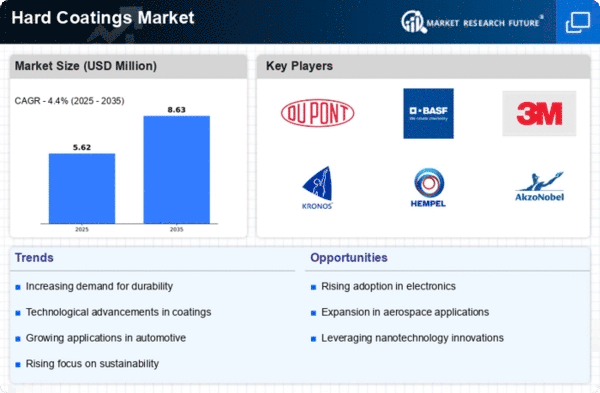
As per MRFR analysis, the Hard Coatings Market Size was estimated at 5.38 USD Million in 2024. The Hard Coatings industry is projected to grow from 5.61 in 2025 to 8.63 by 2035, exhibiting a compound annual growth rate (CAGR) of 4.4 during the forecast period 2025 - 2035.

Key Market Trends & Highlights

The Hard Coatings Market is poised for substantial growth driven by technological advancements and increasing application areas.

  • Technological advancements are enhancing the performance and durability of hard coatings across various industries.
  • The automotive sector remains the largest market segment, reflecting a robust demand for high-performance coatings.
  • Asia-Pacific is currently the fastest-growing region, driven by rapid industrialization and increasing manufacturing activities.
  • Rising demand in the automotive sector and growth in electronics applications are key drivers propelling the hard coatings market forward.

Market Size & Forecast

2024 Market Size 5.38 (USD Million)
2035 Market Size 8.63 (USD Million)
CAGR (2025 - 2035) 4.4%
Largest Regional Market Share in 2024 North America

Major Players

DuPont (US), BASF (DE), 3M (US), Kronos Worldwide (US), Hempel (DK), AkzoNobel (NL), PPG Industries (US), Nippon Paint (JP), Sherwin-Williams (US)

Market Trends

The Hard Coatings Market is currently experiencing a dynamic evolution, driven by advancements in technology and increasing demand across various industries. The application of hard coatings is becoming more prevalent in sectors such as automotive, aerospace, and electronics, where durability and resistance to wear are paramount. As manufacturers seek to enhance the performance and longevity of their products, the adoption of innovative coating solutions appears to be on the rise. Furthermore, environmental considerations are influencing the development of eco-friendly hard coatings, which may offer sustainable alternatives to traditional options. This shift towards greener solutions suggests a potential transformation in the market landscape, as companies strive to meet regulatory requirements and consumer preferences for environmentally responsible products. In addition, the Hard Coatings Market is likely to witness a surge in research and development activities aimed at improving coating properties and expanding application areas. The integration of nanotechnology and advanced materials into hard coatings could lead to enhanced performance characteristics, such as increased hardness, improved adhesion, and superior corrosion resistance. As industries continue to evolve, the demand for high-performance coatings that can withstand extreme conditions is expected to grow. Overall, the Hard Coatings Market appears poised for significant growth, driven by technological advancements and a shift towards sustainable practices.

Technological Advancements

The Hard Coatings Market is witnessing a notable impact from technological innovations. New methods of application and formulation are enhancing the performance of coatings, making them more effective in various industrial applications. This trend indicates a continuous push towards improving the durability and functionality of hard coatings.

Sustainability Focus

There is a growing emphasis on sustainability within the Hard Coatings Market. Manufacturers are increasingly developing eco-friendly coatings that minimize environmental impact. This trend reflects a broader industry shift towards greener practices, aligning with consumer demand for sustainable products.

Expanding Application Areas

The Hard Coatings Market is diversifying as new application areas emerge. Industries such as medical devices, renewable energy, and consumer electronics are exploring the benefits of hard coatings. This expansion suggests a potential for increased market penetration and the development of specialized coatings tailored to specific needs.

Hard Coatings Market Market Drivers

Market Growth Projections

The Global Hard Coating Market Industry is projected to experience substantial growth in the coming years. With a market value of 185.4 USD Million in 2024, the industry is expected to expand significantly, reaching an estimated 2196.3 USD Million by 2035. This growth trajectory indicates a compound annual growth rate of 25.2% from 2025 to 2035. The increasing adoption of hard coatings across various sectors, driven by technological advancements and rising demand for durable products, underpins these projections. As industries continue to prioritize performance and sustainability, the hard coating market is likely to thrive, reflecting broader trends in manufacturing and product development.

Expansion of End-Use Industries

The expansion of end-use industries significantly influences the Global Hard Coating Market Industry. Sectors such as electronics, automotive, and medical devices are experiencing rapid growth, driving the demand for hard coatings. In the electronics industry, the need for protective coatings on components is increasing due to the rising complexity of devices. Additionally, the automotive sector's shift towards electric vehicles necessitates advanced coatings to enhance battery performance and longevity. This expansion is expected to contribute to the market's growth, with forecasts indicating a substantial increase in market value, reaching 2196.3 USD Million by 2035. The interplay between industry growth and hard coating applications presents a promising outlook.

Growing Focus on Energy Efficiency

The Global Hard Coating Market Industry is witnessing a growing focus on energy efficiency, particularly in manufacturing processes. Hard coatings contribute to energy savings by reducing friction and wear in machinery, leading to lower energy consumption. Industries are increasingly recognizing the economic benefits of implementing hard coatings, as they not only enhance product performance but also reduce operational costs. For example, in the aerospace sector, the use of hard coatings on turbine components has demonstrated significant energy savings. This trend aligns with global initiatives aimed at promoting sustainability and reducing carbon footprints, further propelling the demand for hard coatings.

Rising Demand for Durable Coatings

The Global Hard Coating Market Industry experiences a notable increase in demand for durable coatings across various sectors, including automotive, aerospace, and electronics. As industries seek to enhance the longevity and performance of their products, hard coatings provide a viable solution. For instance, the automotive sector is increasingly adopting hard coatings to improve scratch resistance and reduce wear on components. This trend is expected to contribute to the market's growth, with projections indicating a market value of 185.4 USD Million in 2024. The emphasis on durability aligns with the industry's shift towards sustainable practices, further driving the adoption of hard coatings.

Regulatory Support for Advanced Coatings

Regulatory support for advanced coatings is emerging as a key driver in the Global Hard Coating Market Industry. Governments worldwide are implementing regulations that encourage the use of environmentally friendly and high-performance coatings. This support fosters innovation and investment in hard coating technologies, as manufacturers seek to comply with stringent environmental standards. For instance, regulations promoting the use of low-VOC coatings are likely to drive the development of hard coatings that meet these criteria. As a result, the market is poised for growth, with stakeholders increasingly recognizing the importance of regulatory compliance in enhancing product offerings.

Technological Advancements in Coating Processes

Technological advancements play a crucial role in shaping the Global Hard Coating Market Industry. Innovations in coating processes, such as physical vapor deposition and chemical vapor deposition, enhance the efficiency and effectiveness of hard coatings. These technologies allow for the application of coatings with superior properties, including increased hardness and improved adhesion. As manufacturers adopt these advanced techniques, the quality of hard coatings improves, leading to broader applications in industries such as medical devices and tooling. The ongoing evolution of coating technologies is likely to sustain the market's growth trajectory, with a projected compound annual growth rate of 25.2% from 2025 to 2035.

Market Segment Insights

By Application: Automotive (Largest) vs. Aerospace (Fastest-Growing)

In the Hard Coatings Market, the automotive sector holds the largest share, benefiting from the demand for durable and high-performance coatings that enhance the lifecycle of automotive components. Following automotive, the aerospace sector is witnessing rapid growth due to the increasing emphasis on lightweight materials and advanced surface protection technologies. Medical, industrial, and electronics applications follow, with varying degrees of market penetration, shaped by unique regulatory requirements and performance expectations within each sector. The growth in the aerospace segment is propelled by innovations and the increasing production rates of commercial and military aircraft. As advancements in technology foster the development of high-performance coatings, the demand for such solutions is set to rise. The need for specialized coatings in the medical and electronics sectors is also increasing, driven by evolving consumer preferences and stricter quality assurance regulations.

Aerospace: Fastest-Growing vs. Medical: Emerging

The aerospace sector is characterized by its rigorous demands for high-performance coatings, which are critical for maintaining safety and performance standards. This sector’s coatings must endure extreme weather conditions and resist corrosion, making them essential for aircraft components. Conversely, the medical sector is emerging with specialized coatings that enhance biocompatibility and sterilization processes. While aerospace represents maturity and robust investment in innovation, the medical industry is progressively adopting hard coatings to improve product durability and safety. As these two segments evolve, their trajectories will significantly impact the overall growth dynamics of the Hard Coatings Market.

By Material Type: Ceramic (Largest) vs. Metallic (Fastest-Growing)

In the Hard Coatings Market, the material type segment showcases a diverse range of options, with ceramic coatings being the largest contributor due to their superior hardness and wear resistance. This segment dominates the market share due to its widespread applicability in industries such as aerospace and automotive. Following closely, metallic coatings hold a significant position and are recognized for their excellent thermal properties. As industries continue to demand advanced solutions, these material types show a clear distribution in preference based on their performance characteristics.

Ceramic (Dominant) vs. Metallic (Emerging)

Ceramic coatings stand out as the dominant players in the Hard Coatings Market, characterized by their exceptional hardness, thermal stability, and corrosion resistance, making them ideal for a variety of applications, including tooling and surface protection. The overall market position of ceramic coatings is strong as they cater to high-performance needs in sectors like automotive and manufacturing. On the other hand, metallic coatings are emerging rapidly, driven by innovations in alloy compositions and their ability to offer robust performance under extreme conditions. This emerging segment is attracting interest for applications where both aesthetics and resistance to wear are desired, suggesting a promising growth trajectory for metallic materials in the coming years.

By End Use Industry: Manufacturing (Largest) vs. Healthcare (Fastest-Growing)

The Hard Coatings Market is primarily driven by the manufacturing sector, which holds the largest share due to its extensive use of hard coatings in enhancing the durability and performance of tools and components. This sector benefits from the ongoing advancements in technology, leading to increased efficiency and productivity. On the other hand, healthcare is emerging as a vital segment due to the growing need for specialized coatings in medical devices and equipment, particularly as the industry focuses on improving safety and longevity. Growth trends indicate a robust expansion in the healthcare sector, driven by innovations in medical technology and an increasing emphasis on infection control. The construction and energy sectors are also significant contributors but are experiencing moderate growth compared to healthcare. As sustainability becomes a priority, the demand for hard coatings that improve energy efficiency and reduce maintenance in construction and energy applications is expected to grow, further supporting the market's expansion in these areas.

Manufacturing: (Dominant) vs. Healthcare (Emerging)

In the Hard Coatings Market, the manufacturing sector stands as the dominant player, utilizing hard coatings to enhance tooling, machinery, and components’ lifespan and performance. The reliance on high-performance coatings in manufacturing processes underscores their importance in achieving operational efficiency and reliability. Meanwhile, healthcare emerges as a rapidly growing segment, driven by the increasing need for hard coatings in devices and implants that demand high biocompatibility and wear resistance. The focus on innovation in healthcare technology propels this sector forward, suggesting significant opportunities for hard coatings designed specifically for medical applications. As the market evolves, both sectors will continue to adapt and benefit from advancements in coating technologies.

Get more detailed insights about Hard Coatings Market Research Report Forecast till 2035

Regional Insights

North America : Market Leader in Hard Coatings

North America is poised to maintain its leadership in the hard coatings market, holding a significant share of 2.15 billion in 2024. The region's growth is driven by robust demand from the automotive and aerospace sectors, alongside stringent regulations promoting advanced coating technologies. The increasing focus on sustainability and eco-friendly products further catalyzes market expansion, as manufacturers seek to comply with environmental standards. The competitive landscape in North America is characterized by the presence of major players such as DuPont, 3M, and PPG Industries. These companies are investing heavily in R&D to innovate and enhance product offerings. The U.S. remains the largest market, supported by a strong manufacturing base and technological advancements. The region's strategic initiatives and investments in infrastructure are expected to bolster the hard coatings market further.

Europe : Emerging Innovations and Regulations

Europe's hard coatings market is valued at 1.5 billion, driven by a combination of innovative technologies and stringent regulatory frameworks. The region's commitment to sustainability and environmental protection is pushing manufacturers to adopt advanced coating solutions that meet EU regulations. This focus on eco-friendly products is expected to enhance market growth, as industries increasingly prioritize compliance with environmental standards. Leading countries in Europe, such as Germany and France, are home to key players like BASF and AkzoNobel, who are at the forefront of innovation in hard coatings. The competitive landscape is marked by collaborations and partnerships aimed at developing cutting-edge solutions. The European market is also witnessing a rise in demand from the automotive and construction sectors, further solidifying its position in The Hard Coatings.

Asia-Pacific : Rapid Growth and Demand Surge

The Asia-Pacific region, with a market size of 1.4 billion, is experiencing rapid growth in the hard coatings sector, driven by increasing industrialization and urbanization. Countries like China and India are witnessing a surge in demand for hard coatings, particularly in automotive and electronics applications. The region's growth is further supported by favorable government policies and investments in infrastructure, which are expected to enhance market dynamics significantly. China stands out as a leading country in the Asia-Pacific hard coatings market, with major players like Nippon Paint and Hempel expanding their operations. The competitive landscape is evolving, with local manufacturers gaining traction alongside established global brands. As the region continues to develop, the demand for innovative and high-performance coatings is anticipated to rise, positioning Asia-Pacific as a key player in the global market.

Middle East and Africa : Emerging Market with Potential

The Middle East and Africa region, valued at 0.33 billion, presents emerging opportunities in the hard coatings market. The growth is primarily driven by increasing construction activities and a rising demand for durable coatings in various industries. Governments in the region are investing in infrastructure projects, which is expected to boost the demand for hard coatings significantly. Additionally, the focus on sustainability is encouraging manufacturers to innovate and develop eco-friendly products. Countries like South Africa and the UAE are leading the market, with a growing presence of international players. The competitive landscape is characterized by collaborations between local and global companies, aiming to enhance product offerings. As the region continues to develop, the hard coatings market is expected to witness substantial growth, driven by both industrial and consumer demand.

Key Players and Competitive Insights

The Hard Coatings Market is currently characterized by a dynamic competitive landscape, driven by technological advancements and increasing demand for durable and high-performance coatings across various industries. Key players such as DuPont (US), BASF (DE), and 3M (US) are strategically positioned to leverage innovation and sustainability as core components of their operational focus. DuPont (US) emphasizes its commitment to developing eco-friendly coatings, while BASF (DE) invests heavily in research and development to enhance product performance. 3M (US) appears to be focusing on digital transformation and smart coatings, which collectively shape a competitive environment that prioritizes innovation and sustainability.In terms of business tactics, companies are increasingly localizing manufacturing to reduce lead times and optimize supply chains. The market structure is moderately fragmented, with several key players exerting influence over specific segments. This fragmentation allows for niche players to thrive, while larger corporations consolidate their market share through strategic partnerships and acquisitions, thereby enhancing their competitive positioning.

In November DuPont (US) announced the launch of a new line of bio-based hard coatings aimed at reducing environmental impact. This strategic move not only aligns with global sustainability trends but also positions DuPont (US) as a leader in eco-friendly solutions, potentially attracting environmentally conscious consumers and industries.

In October BASF (DE) expanded its production capacity for hard coatings in Asia, reflecting a strategic focus on regional growth. This expansion is likely to enhance BASF's (DE) ability to meet the rising demand in the Asia-Pacific region, which is experiencing rapid industrialization and urbanization, thus solidifying its competitive edge in a key market.

In September 3M (US) unveiled a new digital platform designed to optimize the application of its hard coatings. This initiative not only demonstrates 3M's (US) commitment to innovation but also highlights the growing trend of integrating digital solutions into traditional manufacturing processes, potentially improving efficiency and customer satisfaction.

As of December current competitive trends in the Hard Coatings Market indicate a strong shift towards digitalization, sustainability, and AI integration. Strategic alliances are increasingly shaping the landscape, allowing companies to pool resources and expertise. Looking ahead, competitive differentiation is likely to evolve from price-based competition to a focus on innovation, technology, and supply chain reliability, as companies strive to meet the demands of a more discerning customer base.

Key Companies in the Hard Coatings Market include

Industry Developments

April 2022: One of the leading market players, HPL had developed a novel hard coating technology, called WECOUR that helps the rotors in achieving a longer lifetime and resist corrosion; additionally, the technology also helps in reducing the harmful dust emissions. The organization claim that this novel technology and specialized brake pads offer industry-leading performance and durability for the industry.

March 2022: The engineers at the University of Illinois which is based in Chicago had developed a long-lasting coating that is considered the most efficient ice immune product in the industry that offers environmental sustainability and was designed after the careful research on the nature of chemicals leaching out into the environment under non-freezing and slippery conditions.

In 2021: The hard coatings market was anticipated to surpass a valuation of U.S. $ 200 million in the field of medical devices and equipment sector.

Report Overview 

The overall report of the hard coatings market shows the immense growth in the historic market for the upcoming period. The market reports cover the ongoing forecast period and the existing factors. Every necessary factor is deeply characteristic and explained in the report.

The segmentation analysis and regional reports were also shown the growth and segments. The report also covers the COVID-19 pandemic report and how the market deals with the growth. This report also covers the competitive analysis and recent growth developments in the hard coatings market.

Key Industrial Segments 

By material

    • Nitrides
    • Borides
    • Multi-component coatings
    • Carbon-based oxides,

By Deposition

    • Physical vapor deposition 
    • Chemical vapor deposition.

By application

    • Cutting tools
    • Gears
    • Decorative coatings
    • Bearings
    • Cylinders
    • Optics
    • Pneumatic coatings

By end-user industries

    • Manufacturing
    • Building & construction
    • Transportation
    • Aerospace & defense
    • Sports
    • Medical
    • Food manufacturing equipment

By End-User

    • Manufacturing
    • Building & construction
    • Transportation
    • Aerospace & defense
    • Sports
    • Medical
    • Food manufacturing equipment

By region:

    • The Asia Pacific
    • Europe
    • North America
    • Latin America,
    • Middle East & Africa.
    • the U.K.
    • Germany
    • France
    • Italy
    • Poland

Future Outlook

Hard Coatings Market Future Outlook

The Hard Coatings Market is projected to grow at a 4.4% CAGR from 2025 to 2035, driven by advancements in technology, increasing demand for durable materials, and expanding applications across industries.

New opportunities lie in:

  • Development of eco-friendly hard coating formulations
  • Expansion into emerging markets with tailored solutions
  • Integration of smart coatings for enhanced functionality

By 2035, the Hard Coatings Market is expected to achieve robust growth, reflecting evolving industry needs.

Market Segmentation

Hard Coatings Market Application Outlook

  • Automotive
  • Aerospace
  • Medical
  • Industrial
  • Electronics

Hard Coatings Market Material Type Outlook

  • Ceramic
  • Metallic
  • Polymer
  • Composite
  • Diamond

Hard Coatings Market End Use Industry Outlook

  • Manufacturing
  • Construction
  • Energy
  • Healthcare
  • Telecommunications

Report Scope

MARKET SIZE 20245.38(USD Million)
MARKET SIZE 20255.61(USD Million)
MARKET SIZE 20358.63(USD Million)
COMPOUND ANNUAL GROWTH RATE (CAGR)4.4% (2025 - 2035)
REPORT COVERAGERevenue Forecast, Competitive Landscape, Growth Factors, and Trends
BASE YEAR2024
Market Forecast Period2025 - 2035
Historical Data2019 - 2024
Market Forecast UnitsUSD Million
Key Companies ProfiledDuPont (US), BASF (DE), 3M (US), Kronos Worldwide (US), Hempel (DK), AkzoNobel (NL), PPG Industries (US), Nippon Paint (JP), Sherwin-Williams (US)
Segments CoveredApplication, Material Type, End Use Industry
Key Market OpportunitiesAdvancements in nanotechnology enhance performance and durability in the Hard Coatings Market.
Key Market DynamicsRising demand for durable surfaces drives innovation in hard coatings technology and competitive market dynamics.
Countries CoveredNorth America, Europe, APAC, South America, MEA

FAQs

What valuation can the hard coatings market achieve by 2035?

The hard coatings market can grow up to a valuation of USD 1,481.02 million by 2035.

Which region is expected to propel maximum growth for the hard coatings market?

The global hard coatings market to get dominated by Asia Pacific region.

Which players are expected to make an impact on the hard coatings market?

Players like OC Oerlikon Corporation AG (Switzerland), Sulzer Ltd. (Switzerland), PLATIT AG All (Switzerland), Momentive (U.S.), ZEISS International (Germany), CemeCon AG (Germany), IHI Ionbond AG (Switzerland), SDC Technologies (the U.S.), ASB Industries, Inc. (the U.S), and Hardcoatings, Inc. (U.S.) can make an impact on the hard coatings market.

What strategies the top players are going to take for the hard coatings market?

Mergers, collaborations, product launch, innovation, hike in R&D spending, marketing strategies, brand positioning are some of the prominent strategies that the hard coatings market players would employ.

What factors to drive the hard coatings market ahead?

The hard coatings market is expecting growth with increasing application in ball bearings, tools, equipment, industrial coatings, gear and pneumatic components, which would ensure easy permeation across several industries.

  1. SECTION I: EXECUTIVE SUMMARY AND KEY HIGHLIGHTS
    1. | 1.1 EXECUTIVE SUMMARY
    2. | 1.1.1 Market Overview
    3. | 1.1.2 Key Findings
    4. | 1.1.3 Market Segmentation
    5. | 1.1.4 Competitive Landscape
    6. | 1.1.5 Challenges and Opportunities
    7. | 1.1.6 Future Outlook
  2. SECTION II: SCOPING, METHODOLOGY AND MARKET STRUCTURE
    1. | 2.1 MARKET INTRODUCTION
    2. | 2.1.1 Definition
    3. | 2.1.2 Scope of the study
    4. |-- 2.1.2.1 Research Objective
    5. |-- 2.1.2.2 Assumption
    6. |-- 2.1.2.3 Limitations
    7. | 2.2 RESEARCH METHODOLOGY
    8. | 2.2.1 Overview
    9. | 2.2.2 Data Mining
    10. | 2.2.3 Secondary Research
    11. | 2.2.4 Primary Research
    12. |-- 2.2.4.1 Primary Interviews and Information Gathering Process
    13. |-- 2.2.4.2 Breakdown of Primary Respondents
    14. | 2.2.5 Forecasting Model
    15. | 2.2.6 Market Size Estimation
    16. |-- 2.2.6.1 Bottom-Up Approach
    17. |-- 2.2.6.2 Top-Down Approach
    18. | 2.2.7 Data Triangulation
    19. | 2.2.8 Validation
  3. SECTION III: QUALITATIVE ANALYSIS
    1. | 3.1 MARKET DYNAMICS
    2. | 3.1.1 Overview
    3. | 3.1.2 Drivers
    4. | 3.1.3 Restraints
    5. | 3.1.4 Opportunities
    6. | 3.2 MARKET FACTOR ANALYSIS
    7. | 3.2.1 Value chain Analysis
    8. | 3.2.2 Porter's Five Forces Analysis
    9. |-- 3.2.2.1 Bargaining Power of Suppliers
    10. |-- 3.2.2.2 Bargaining Power of Buyers
    11. |-- 3.2.2.3 Threat of New Entrants
    12. |-- 3.2.2.4 Threat of Substitutes
    13. |-- 3.2.2.5 Intensity of Rivalry
    14. | 3.2.3 COVID-19 Impact Analysis
    15. |-- 3.2.3.1 Market Impact Analysis
    16. |-- 3.2.3.2 Regional Impact
    17. |-- 3.2.3.3 Opportunity and Threat Analysis
  4. SECTION IV: QUANTITATIVE ANALYSIS
    1. | 4.1 Chemicals and Materials, BY Application (USD Million)
    2. | 4.1.1 Automotive
    3. | 4.1.2 Aerospace
    4. | 4.1.3 Medical
    5. | 4.1.4 Industrial
    6. | 4.1.5 Electronics
    7. | 4.2 Chemicals and Materials, BY Material Type (USD Million)
    8. | 4.2.1 Ceramic
    9. | 4.2.2 Metallic
    10. | 4.2.3 Polymer
    11. | 4.2.4 Composite
    12. | 4.2.5 Diamond
    13. | 4.3 Chemicals and Materials, BY End Use Industry (USD Million)
    14. | 4.3.1 Manufacturing
    15. | 4.3.2 Construction
    16. | 4.3.3 Energy
    17. | 4.3.4 Healthcare
    18. | 4.3.5 Telecommunications
    19. | 4.4 Chemicals and Materials, BY Region (USD Million)
    20. | 4.4.1 North America
    21. |-- 4.4.1.1 US
    22. |-- 4.4.1.2 Canada
    23. | 4.4.2 Europe
    24. |-- 4.4.2.1 Germany
    25. |-- 4.4.2.2 UK
    26. |-- 4.4.2.3 France
    27. |-- 4.4.2.4 Russia
    28. |-- 4.4.2.5 Italy
    29. |-- 4.4.2.6 Spain
    30. |-- 4.4.2.7 Rest of Europe
    31. | 4.4.3 APAC
    32. |-- 4.4.3.1 China
    33. |-- 4.4.3.2 India
    34. |-- 4.4.3.3 Japan
    35. |-- 4.4.3.4 South Korea
    36. |-- 4.4.3.5 Malaysia
    37. |-- 4.4.3.6 Thailand
    38. |-- 4.4.3.7 Indonesia
    39. |-- 4.4.3.8 Rest of APAC
    40. | 4.4.4 South America
    41. |-- 4.4.4.1 Brazil
    42. |-- 4.4.4.2 Mexico
    43. |-- 4.4.4.3 Argentina
    44. |-- 4.4.4.4 Rest of South America
    45. | 4.4.5 MEA
    46. |-- 4.4.5.1 GCC Countries
    47. |-- 4.4.5.2 South Africa
    48. |-- 4.4.5.3 Rest of MEA
  5. SECTION V: COMPETITIVE ANALYSIS
    1. | 5.1 Competitive Landscape
    2. | 5.1.1 Overview
    3. | 5.1.2 Competitive Analysis
    4. | 5.1.3 Market share Analysis
    5. | 5.1.4 Major Growth Strategy in the Chemicals and Materials
    6. | 5.1.5 Competitive Benchmarking
    7. | 5.1.6 Leading Players in Terms of Number of Developments in the Chemicals and Materials
    8. | 5.1.7 Key developments and growth strategies
    9. |-- 5.1.7.1 New Product Launch/Service Deployment
    10. |-- 5.1.7.2 Merger & Acquisitions
    11. |-- 5.1.7.3 Joint Ventures
    12. | 5.1.8 Major Players Financial Matrix
    13. |-- 5.1.8.1 Sales and Operating Income
    14. |-- 5.1.8.2 Major Players R&D Expenditure. 2023
    15. | 5.2 Company Profiles
    16. | 5.2.1 DuPont (US)
    17. |-- 5.2.1.1 Financial Overview
    18. |-- 5.2.1.2 Products Offered
    19. |-- 5.2.1.3 Key Developments
    20. |-- 5.2.1.4 SWOT Analysis
    21. |-- 5.2.1.5 Key Strategies
    22. | 5.2.2 BASF (DE)
    23. |-- 5.2.2.1 Financial Overview
    24. |-- 5.2.2.2 Products Offered
    25. |-- 5.2.2.3 Key Developments
    26. |-- 5.2.2.4 SWOT Analysis
    27. |-- 5.2.2.5 Key Strategies
    28. | 5.2.3 3M (US)
    29. |-- 5.2.3.1 Financial Overview
    30. |-- 5.2.3.2 Products Offered
    31. |-- 5.2.3.3 Key Developments
    32. |-- 5.2.3.4 SWOT Analysis
    33. |-- 5.2.3.5 Key Strategies
    34. | 5.2.4 Kronos Worldwide (US)
    35. |-- 5.2.4.1 Financial Overview
    36. |-- 5.2.4.2 Products Offered
    37. |-- 5.2.4.3 Key Developments
    38. |-- 5.2.4.4 SWOT Analysis
    39. |-- 5.2.4.5 Key Strategies
    40. | 5.2.5 Hempel (DK)
    41. |-- 5.2.5.1 Financial Overview
    42. |-- 5.2.5.2 Products Offered
    43. |-- 5.2.5.3 Key Developments
    44. |-- 5.2.5.4 SWOT Analysis
    45. |-- 5.2.5.5 Key Strategies
    46. | 5.2.6 AkzoNobel (NL)
    47. |-- 5.2.6.1 Financial Overview
    48. |-- 5.2.6.2 Products Offered
    49. |-- 5.2.6.3 Key Developments
    50. |-- 5.2.6.4 SWOT Analysis
    51. |-- 5.2.6.5 Key Strategies
    52. | 5.2.7 PPG Industries (US)
    53. |-- 5.2.7.1 Financial Overview
    54. |-- 5.2.7.2 Products Offered
    55. |-- 5.2.7.3 Key Developments
    56. |-- 5.2.7.4 SWOT Analysis
    57. |-- 5.2.7.5 Key Strategies
    58. | 5.2.8 Nippon Paint (JP)
    59. |-- 5.2.8.1 Financial Overview
    60. |-- 5.2.8.2 Products Offered
    61. |-- 5.2.8.3 Key Developments
    62. |-- 5.2.8.4 SWOT Analysis
    63. |-- 5.2.8.5 Key Strategies
    64. | 5.2.9 Sherwin-Williams (US)
    65. |-- 5.2.9.1 Financial Overview
    66. |-- 5.2.9.2 Products Offered
    67. |-- 5.2.9.3 Key Developments
    68. |-- 5.2.9.4 SWOT Analysis
    69. |-- 5.2.9.5 Key Strategies
    70. | 5.3 Appendix
    71. | 5.3.1 References
    72. | 5.3.2 Related Reports

Chemicals and Materials Market Segmentation

Chemicals and Materials By Application (USD Million, 2025-2035)

  • Automotive
  • Aerospace
  • Medical
  • Industrial
  • Electronics

Chemicals and Materials By Material Type (USD Million, 2025-2035)

  • Ceramic
  • Metallic
  • Polymer
  • Composite
  • Diamond

Chemicals and Materials By End Use Industry (USD Million, 2025-2035)

  • Manufacturing
  • Construction
  • Energy
  • Healthcare
  • Telecommunications
Infographic

Free Sample Request

Kindly complete the form below to receive a free sample of this Report

Get Free Sample

Customer Strories

Compare Licence

×
Features License Type
Single User Multiuser License Enterprise User
Price $4,950 $5,950 $7,250
Maximum User Access Limit 1 User Upto 10 Users Unrestricted Access Throughout the Organization
Free Customization
Direct Access to Analyst
Deliverable Format
Platform Access
Discount on Next Purchase 10% 15% 15%
Printable Versions