×
Request Free Sample ×

Kindly complete the form below to receive a free sample of this Report

* Please use a valid business email

Leading companies partner with us for data-driven Insights

clients tt-cursor
Hero Background

Global PET Packaging Market

ID: MRFR/PCM/0722-HCR
115 Pages
Sakshi Gupta
February 2026

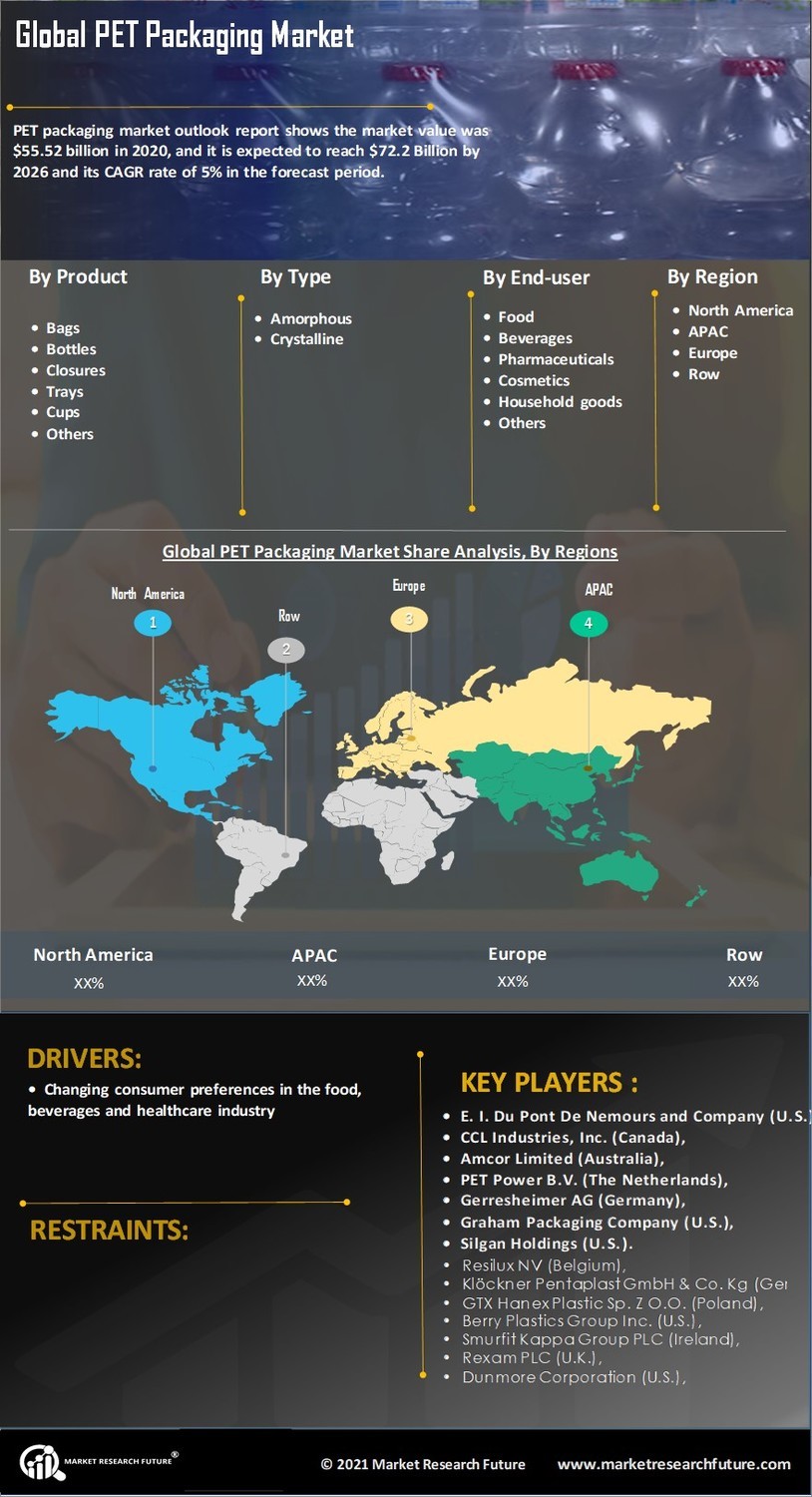
PET Packaging Market Research Report Information Report by End-user Industry (Food, Beverages, Pharmaceuticals, Cosmetics, Household goods and others), by Product (Bags, Bottles, Closures, Trays, Cups and others), by Type (Amorphous and Crystalline) and by Region - Forecast 2030

Share:
Download PDF ×

We do not share your information with anyone. However, we may send you emails based on your report interest from time to time. You may contact us at any time to opt-out.

Global PET Packaging Market Infographic
Purchase Options

Global PET Packaging Market Summary

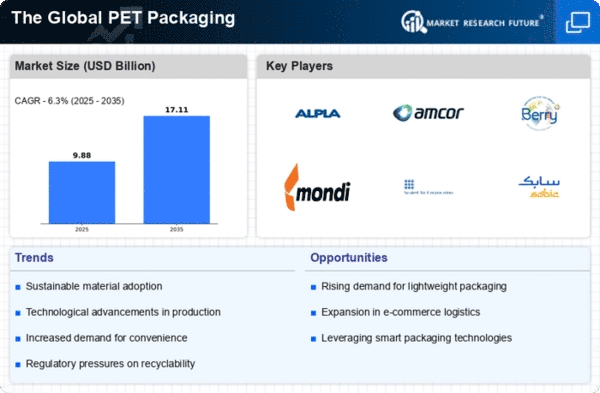
As per MRFR analysis, The Global PET Packaging Size was estimated at 9.29 USD Billion in 2024. The PET packaging industry is projected to grow from 9.88 USD Billion in 2025 to 17.11 USD Billion by 2035, exhibiting a compound annual growth rate (CAGR) of 6.3 during the forecast period 2025 - 2035.

Key Market Trends & Highlights

The Global PET Packaging is poised for robust growth driven by sustainability and technological advancements.

  • North America remains the largest market for PET packaging, driven by high consumer demand and established infrastructure.
  • Asia-Pacific is the fastest-growing region, reflecting increasing urbanization and rising disposable incomes.
  • Bottles dominate the PET packaging segment, while films are emerging as the fastest-growing category due to their versatility.
  • Sustainability initiatives and regulatory compliance are key drivers propelling the market forward, particularly in the food and beverage sector.

Market Size & Forecast

2024 Market Size 9.29 (USD Billion)
2035 Market Size 17.11 (USD Billion)
CAGR (2025 - 2035) 6.3%

Major Players

Alpla Werke Alwin Lehner GmbH & Co KG (AT), Amcor plc (GB), Berry Global Inc. (US), Mondi Group plc (GB), Sealed Air Corporation (US), SABIC (SA), Plastipak Holdings, Inc. (US), Krones AG (DE), Constantia Flexibles Group GmbH (AT)

Our Impact
Enabled $4.3B Revenue Impact for Fortune 500 and Leading Multinationals
Partnering with 2000+ Global Organizations Each Year
30K+ Citations by Top-Tier Firms in the Industry

Global PET Packaging Market Trends

The Global PET Packaging is currently experiencing a dynamic evolution, driven by various factors that influence consumer preferences and industry practices. The increasing emphasis on sustainability appears to be a pivotal force, as manufacturers and brands strive to adopt eco-friendly materials and practices. This shift is likely to enhance the appeal of PET packaging, which is recognized for its recyclability and lightweight properties. Furthermore, the growing demand for convenience in packaging solutions suggests that PET's versatility in design and functionality will continue to attract diverse sectors, including food and beverage, personal care, and pharmaceuticals. In addition, technological advancements in production processes and recycling methods may further bolster the market's growth. Innovations in PET recycling technologies could lead to higher recovery rates and improved quality of recycled materials, thereby addressing environmental concerns. As consumers become increasingly aware of their ecological footprint, The Global PET Packaging is poised to adapt and thrive, potentially leading to new opportunities for growth and collaboration among stakeholders. The interplay of these trends indicates a promising future for PET packaging, as it aligns with both market demands and sustainability goals.

Sustainability Initiatives

The focus on sustainability is reshaping The Global PET Packaging. Companies are increasingly adopting eco-friendly practices, such as using recycled materials and reducing carbon footprints. This trend reflects a broader commitment to environmental responsibility, appealing to consumers who prioritize sustainable products.

Technological Advancements

Innovations in production and recycling technologies are transforming the landscape of The Global PET Packaging. Enhanced recycling processes and new manufacturing techniques are likely to improve efficiency and reduce waste, making PET packaging more attractive to various industries.

Consumer Demand for Convenience

The rising consumer preference for convenience is influencing packaging choices across sectors. The lightweight and versatile nature of PET packaging aligns well with this demand, as it offers easy handling and storage solutions, thereby enhancing the overall user experience.

Global PET Packaging Market Drivers

Sustainability Initiatives

The Global PET Packaging Market Industry is increasingly driven by sustainability initiatives as consumers and manufacturers alike prioritize eco-friendly solutions. The demand for recyclable and biodegradable materials is rising, with PET being a frontrunner due to its recyclability. In 2024, the market is valued at 63.1 USD Billion, reflecting a growing preference for sustainable packaging options. Companies are investing in advanced recycling technologies and circular economy practices, which not only reduce environmental impact but also enhance brand loyalty. This shift towards sustainability is likely to propel the market further, as regulations and consumer expectations evolve.

Market Segment Insights

By Application: Bottles (Largest) vs. Films (Fastest-Growing)

In The Global PET Packaging, the application segment showcases a diverse range of products, with bottles leading the market share significantly. Bottles account for a substantial portion of the market due to their extensive use in beverage packaging and other consumables. Following closely are containers and films, playing crucial roles in food packaging, yet their shares are comparatively lower. Trays and labels, while essential, hold a minor portion of the overall market share, reflecting their specific applications.

Bottles (Dominant) vs. Films (Emerging)

Bottles emerge as the dominant force in the PET packaging segment, owing to their versatility and widespread adoption in the beverage industry. Characterized by lightweight, durability, and excellent barrier properties, PET bottles are preferred for various applications, from carbonated drinks to personal care products. Conversely, films represent the fastest-growing segment, driven by increasing demand for flexible and lightweight packaging solutions. As environmentally conscious consumers seek sustainable options, the innovation in biodegradable and recyclable PET films is expected to surge, bridging the gap between convenience and environmental responsibility. This dual trend highlights the evolving landscape of PET packaging, where both segments cater to distinct yet overlapping consumer needs.

By End Use: Food and Beverage (Largest) vs. Pharmaceuticals (Fastest-Growing)

In The Global PET Packaging, the major share is held by the Food and Beverage sector, reflecting the high demand for effective packaging solutions that ensure product safety and extend shelf life. Followed closely by Personal Care and Household Products, these segments leverage PET's lightweight, strength, and recyclability. Pharmaceuticals, although smaller in share, are rapidly gaining traction due to increasing health awareness and demand for secure packaging solutions. The growth trends in this market segment are significantly influenced by the rising consumption of packaged foods and beverages. Additionally, the personal care sector is amplifying its utilization of PET through innovative designs. The pharmaceutical segment is witnessing robust growth driven by an increase in health-related products, demanding high-quality packaging solutions for safety and compliance.

Food and Beverage (Dominant) vs. Pharmaceuticals (Emerging)

In The Global PET Packaging, the Food and Beverage sector stands as the dominant force, characterized by its extensive use of PET due to its lightweight and strong barrier properties that preserve product quality. This segment benefits from a continuous influx of new product launches and innovative packaging designs aimed at enhancing consumer convenience and sustainability. Conversely, the Pharmaceuticals segment is emerging prominently, characterized by stringent regulations and the necessity for secure packaging solutions that protect sensitive substances. This segment's growth is propelled by rising health consciousness and the need for tamper-proof packaging. Both segments highlight the versatility of PET, catering to the evolving demands of industries focused on safety, sustainability, and consumer appeal.

By Material Type: Recycled PET (Largest) vs. Virgin PET (Fastest-Growing)

In The Global PET Packaging, the material type segment is primarily dominated by Recycled PET, accounting for a significant share due to increasing sustainability initiatives among brands and consumers. The market is witnessing a notable preference for sustainable packaging solutions, which is driving the demand for Recycled PET. Virgin PET, while traditionally popular for its purity and clarity, is now being challenged by these sustainability trends, impacting its market share length.

Recycled PET (Dominant) vs. Virgin PET (Emerging)

Recycled PET has established itself as the dominant material in The Global PET Packaging due to rising environmental concerns and regulatory pressures to reduce plastic waste. Its benefits include lower carbon footprint and promoting circular economy practices. On the other hand, Virgin PET is recognized for its superior quality and performance for products requiring high clarity and durability. However, the shift towards sustainability has positioned Virgin PET as an emerging segment, facing challenges in rising consumer expectations for eco-friendly alternatives and the pressure on manufacturers to innovate.

By Production Process: Blow Molding (Largest) vs. Stretch Blow Molding (Fastest-Growing)

In The Global PET Packaging, the production process segment showcases a diverse range of techniques, with Blow Molding holding the largest market share. This method is extensively utilized for creating various PET containers, where its efficiency in producing large volumes at low costs makes it highly desirable. Other processes like Injection Molding, Thermoforming, and Extrusion also contribute significantly but are comparatively smaller in terms of market share. Growth trends in this segment are largely driven by the increasing demand for sustainable packaging solutions and technological advancements in manufacturing processes. Stretch Blow Molding is emerging as the fastest-growing method due to its capability to produce lightweight and strong PET bottles, aligning with consumer preferences for eco-friendly packaging alternatives. Furthermore, innovations in Blow Molding techniques are enhancing production efficiency and quality, fueling its prominence in the market.

Blow Molding (Dominant) vs. Thermoforming (Emerging)

Blow Molding is the dominant production process in The Global PET Packaging, known for its high production rates and cost efficiency, making it the go-to choice for manufacturers producing wide-scale plastic bottles and containers. Its capacity to create lightweight products also caters well to the increasing consumer demands for sustainable packaging solutions. On the other hand, Thermoforming is an emerging player, offering versatility in creating intricate designs and custom shapes in PET packaging. While still gaining traction compared to Blow Molding, its ability to meet niche market needs for specific applications is driving its adoption. As companies increasingly focus on product differentiation and sustainable practices, Thermoforming is expected to gain more prominence in the PET packaging landscape.

By Distribution Channel: Supermarkets (Largest) vs. Online Retail (Fastest-Growing)

In The Global PET Packaging, the distribution channels play a crucial role in product accessibility and consumer choice. Supermarkets have emerged as the largest segment, holding a significant share due to their extensive reach and established consumer trust. Following closely, Online Retail has become an increasingly preferred channel, particularly among younger audiences seeking convenience and variety in their shopping experience, highlighting a notable market shift towards digital platforms.

Supermarkets (Dominant) vs. Online Retail (Emerging)

Supermarkets stand as the dominant distribution channel in the PET packaging market, thanks to their widespread presence and ability to offer diverse product ranges under one roof. They benefit from high foot traffic and brand visibility, which significantly boost the sales of packaged goods. In contrast, Online Retail is the emerging force, experiencing rapid growth driven by changing consumer behavior towards digital purchasing. It offers convenience and often lower prices, appealing to tech-savvy customers. This growing inclination for online shopping indicates a paradigm shift in how consumers access packaging products, with Online Retail expanding rapidly as a viable alternative to traditional shopping.

Get more detailed insights about Global PET Packaging Market

Regional Insights

North America : Innovation and Sustainability Focus

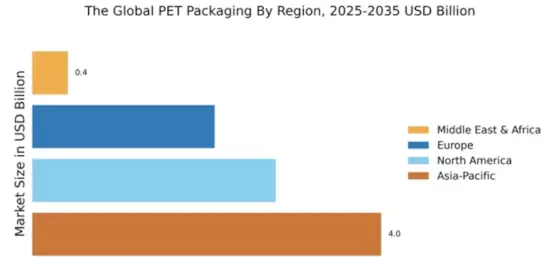
The North American PET packaging market, valued at $2.79B, is driven by increasing demand for sustainable packaging solutions and innovations in recycling technologies. Regulatory initiatives aimed at reducing plastic waste are catalyzing growth, with companies investing in eco-friendly materials and processes. The region's focus on sustainability aligns with consumer preferences, further boosting market potential. Leading countries like the US and Canada dominate the market, with key players such as Amcor plc and Berry Global Inc. driving competition. The presence of established manufacturers and a robust supply chain enhances market dynamics. As companies innovate and adapt to regulatory changes, the competitive landscape is expected to evolve, fostering further growth in the sector.

Europe : Sustainability and Regulatory Compliance

Europe's PET packaging market, valued at $2.09B, is characterized by stringent regulations promoting sustainability and recycling. The European Union's directives on plastic waste management are significant growth drivers, pushing companies to adopt eco-friendly practices. The region's commitment to reducing plastic pollution is evident in its market dynamics, with a growing emphasis on circular economy principles. Germany, France, and the UK are leading countries in this market, with major players like Mondi Group plc and Constantia Flexibles Group GmbH at the forefront. The competitive landscape is marked by innovation and collaboration among companies to meet regulatory standards. As the market evolves, the focus on sustainable packaging solutions is expected to strengthen, aligning with consumer demand for environmentally responsible products.

Asia-Pacific : Rapid Growth and Market Leadership

The Asia-Pacific region leads The Global PET Packaging with a valuation of $4.0B, driven by rapid industrialization and urbanization. The increasing demand for packaged food and beverages, coupled with rising disposable incomes, fuels market growth. Regulatory support for sustainable packaging practices is also a key driver, as governments encourage eco-friendly initiatives to combat plastic waste. Countries like China, India, and Japan are pivotal in this market, with significant contributions from key players such as Alpla Werke Alwin Lehner GmbH and Plastipak Holdings, Inc. The competitive landscape is vibrant, with numerous local and international companies vying for market share. As the region continues to expand, innovation in packaging solutions will play a crucial role in maintaining its market leadership.

Middle East and Africa : Emerging Market with Growth Potential

The Middle East and Africa (MEA) PET packaging market, valued at $0.41B, is an emerging segment with significant growth potential. Factors such as increasing urbanization, population growth, and rising consumer awareness about sustainable packaging are driving demand. Regulatory frameworks are gradually evolving to support eco-friendly practices, which is expected to further enhance market growth in the coming years. Countries like South Africa and the UAE are leading the market, with a growing presence of key players such as Sealed Air Corporation and SABIC. The competitive landscape is characterized by a mix of local and international companies, focusing on innovation and sustainability. As the region develops, the PET packaging market is poised for substantial growth, driven by changing consumer preferences and regulatory support.

Global PET Packaging Market Regional Image

Key Players and Competitive Insights

The Global PET Packaging is characterized by a dynamic competitive landscape, driven by increasing demand for sustainable packaging solutions and innovations in material technology. Key players such as Amcor plc (GB), Berry Global Inc. (US), and SABIC (SA) are strategically positioned to leverage these trends. Amcor plc (GB) focuses on enhancing its product portfolio through sustainable practices, while Berry Global Inc. (US) emphasizes innovation in lightweight packaging solutions. SABIC (SA) is actively investing in advanced recycling technologies, which collectively shape a competitive environment that prioritizes sustainability and innovation.In terms of business tactics, companies are increasingly localizing manufacturing to reduce lead times and optimize supply chains. The market structure appears moderately fragmented, with several key players exerting influence over pricing and product offerings. This fragmentation allows for niche players to thrive, while larger corporations consolidate their market share through strategic partnerships and acquisitions.

In November Amcor plc (GB) announced a partnership with a leading beverage company to develop a fully recyclable PET bottle, which underscores its commitment to sustainability. This collaboration not only enhances Amcor's product offerings but also aligns with the growing consumer demand for environmentally friendly packaging solutions. The strategic importance of this partnership lies in its potential to set industry standards for recyclability and sustainability.

In October Berry Global Inc. (US) launched a new line of biodegradable PET packaging aimed at the food and beverage sector. This initiative reflects the company's focus on innovation and responsiveness to market demands for sustainable alternatives. The introduction of biodegradable options may position Berry Global as a leader in eco-friendly packaging, potentially attracting environmentally conscious consumers and businesses alike.

In September SABIC (SA) unveiled a new technology for producing PET from renewable feedstocks, marking a significant advancement in sustainable packaging. This development not only enhances SABIC's product portfolio but also aligns with global sustainability goals. The strategic importance of this innovation lies in its potential to reduce the carbon footprint associated with traditional PET production, thereby appealing to a growing segment of environmentally aware consumers.

As of December current competitive trends in The Global PET Packaging are increasingly defined by digitalization, sustainability, and the integration of AI technologies. Strategic alliances among key players are shaping the landscape, fostering innovation and enhancing supply chain efficiencies. The competitive differentiation is likely to evolve from traditional price-based competition to a focus on innovation, technology, and reliability in supply chains, as companies strive to meet the demands of a more environmentally conscious market.

Key Companies in the Global PET Packaging Market include

Industry Developments

Berry has teamed up with TotalEnergies in January 2022 so as to minimize the amount of rubbish going into landfills and make food packaging more circular. Berry will be supplied with certified circular polymers by TotalEnergies; these products are produced from post-consumer waste, typically considered challenging to recycle using current methods. Consequently, Berry will be able to include more recycled content in its packages for foods, beverages and healthcare products. 

Future Outlook

Global PET Packaging Market Future Outlook

The Global PET Packaging is projected to grow at a 6.3% CAGR from 2025 to 2035, driven by sustainability initiatives, technological advancements, and increasing demand in various sectors.

New opportunities lie in:

  • Expansion into biodegradable PET alternatives
  • Investment in advanced recycling technologies
  • Development of smart packaging solutions for enhanced consumer engagement

By 2035, the market is expected to achieve robust growth, driven by innovation and sustainability.

Market Segmentation

Global PET Packaging Market End Use Outlook

  • Food and Beverage
  • Personal Care
  • Pharmaceuticals
  • Household Products
  • Industrial

Global PET Packaging Market Application Outlook

  • Bottles
  • Containers
  • Films
  • Trays
  • Labels

Global PET Packaging Market Material Type Outlook

  • Recycled PET
  • Virgin PET
  • Biodegradable PET
  • Multi-layer PET
  • Coated PET

Global PET Packaging Market Production Process Outlook

  • Injection Molding
  • Blow Molding
  • Thermoforming
  • Extrusion
  • Stretch Blow Molding

Global PET Packaging Market Distribution Channel Outlook

  • Online Retail
  • Supermarkets
  • Convenience Stores
  • Wholesale Distributors
  • Direct Sales

Report Scope

MARKET SIZE 20249.29(USD Billion)
MARKET SIZE 20259.88(USD Billion)
MARKET SIZE 203517.11(USD Billion)
COMPOUND ANNUAL GROWTH RATE (CAGR)6.3% (2025 - 2035)
REPORT COVERAGERevenue Forecast, Competitive Landscape, Growth Factors, and Trends
BASE YEAR2024
Market Forecast Period2025 - 2035
Historical Data2019 - 2024
Market Forecast UnitsUSD Billion
Key Companies ProfiledAlpla Werke Alwin Lehner GmbH & Co KG (AT), Amcor plc (GB), Berry Global Inc. (US), Mondi Group plc (GB), Sealed Air Corporation (US), SABIC (SA), Plastipak Holdings, Inc. (US), Krones AG (DE), Constantia Flexibles Group GmbH (AT)
Segments CoveredApplication, End Use, Material Type, Production Process, Distribution Channel
Key Market OpportunitiesGrowing demand for sustainable packaging solutions drives innovation in The Global PET Packaging.
Key Market DynamicsRising demand for sustainable packaging solutions drives innovation and competition in the PET packaging sector.
Countries CoveredNorth America, Europe, APAC, South America, MEA

Market Highlights

Author
Sakshi Gupta
Research Analyst Level II

I have about two years of experience working in the consumer goods and retail industries and I am a biotech graduate.A tech-savvy analytically focused professional with a strong capabilities in identification, concept generation, and strategy evaluation. I can produce data-driven solutions while fusing unusual viewpoints with original concepts. I have been extensively working on business case studies, competitive & comparative analyses, and strategic reports. My primary areas of experience include client management, financial analysis, supply chain evaluation, market entry strategy evaluation, and estimating and forecasting market size.

Leave a Comment

FAQs

What are the major types of PET packaging?

Major types of PET packaging include amorphous and crystalline PET.

What is the expected value of the market in the forecast period?

The market is expected to reach $72.2 billion in the forecast period.

What is the major driver for the PET packaging market?

The high resistance of PET packaging to moisture and temperature is the major driver for the PET packaging market.

Which region holds the highest share in the market?

Which region holds the highest share in the market? North America holds the highest share in the market.

Who are the major key players in the PET packaging market?

The major key players in the PET packaging market are Resilux NV (Belgium), E. I. Du Pont De Nemours and Company (U.S.), CCL Industries, Inc. (Canada), Amcor Limited (Australia), Smurfit Kappa Group PLC (Ireland), Rexam PLC (U.K.), Gerresheimer AG (Germany), Graham Packaging Company (U.S).

Download Free Sample

Kindly complete the form below to receive a free sample of this Report

Compare Licence

×
Features License Type
Single User Multiuser License Enterprise User
Price $4,950 $5,950 $7,250
Maximum User Access Limit 1 User Upto 10 Users Unrestricted Access Throughout the Organization
Free Customization
Direct Access to Analyst
Deliverable Format
Platform Access
Discount on Next Purchase 10% 15% 15%
Printable Versions