×
Request Free Sample ×

Kindly complete the form below to receive a free sample of this Report

* Please use a valid business email

Leading companies partner with us for data-driven Insights

clients tt-cursor
Hero Background

Germany Voice Prosthesis Devices Market

ID: MRFR/MED/48685-HCR
200 Pages
Rahul Gotadki
February 2026

Germany Voice Prosthesis Devices Market Research Report By Product Type (Indwelling, Non-Dwelling Voice Prosthesis Devices), By Valve Type (Blom-Singer, Provox, Groningen Valve) and By End User (Hospitals, Clinics) - Growth & Industry Forecast 2025 To 2035

Share:
Download PDF ×

We do not share your information with anyone. However, we may send you emails based on your report interest from time to time. You may contact us at any time to opt-out.

Germany Voice Prosthesis Devices Market Infographic
Purchase Options

Germany Voice Prosthesis Devices Market Summary

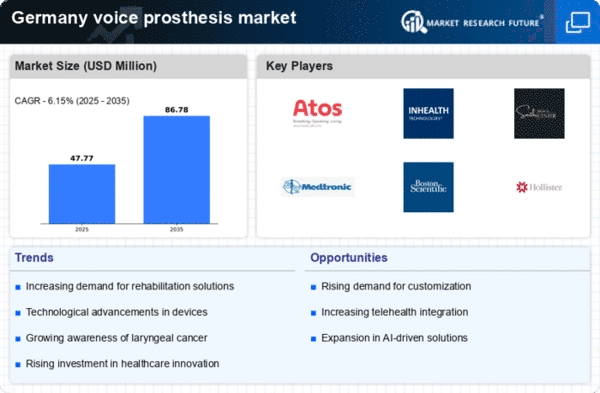
As per Market Research Future analysis, the Germany voice prosthesis-devices market Size was estimated at 45.0 USD Million in 2024. The Germany voice prosthesis-devices market is projected to grow from 47.77 USD Million in 2025 to 86.78 USD Million by 2035, exhibiting a compound annual growth rate (CAGR) of 6.1% during the forecast period 2025 - 2035

Key Market Trends & Highlights

The Germany voice prosthesis-devices market is poised for growth driven by technological advancements and increasing healthcare needs.

  • Technological advancements are enhancing the functionality and user experience of voice prosthesis devices.
  • The largest segment in the market is expected to be the traditional voice prosthesis devices, while the fastest-growing segment may be personalized solutions.
  • Regulatory support is fostering innovation and ensuring safety in the development of voice prosthesis devices.
  • Rising incidence of laryngeal cancer and an aging population are key drivers propelling market growth.

Market Size & Forecast

2024 Market Size 45.0 (USD Million)
2035 Market Size 86.78 (USD Million)
CAGR (2025 - 2035) 6.15%

Major Players

Atos Medical (SE), InHealth Technologies (US), Smiths Medical (US), Medtronic (US), Boston Scientific (US), Hollister Incorporated (US), Civco Medical Solutions (US), Bard Medical (US)

Our Impact
Enabled $4.3B Revenue Impact for Fortune 500 and Leading Multinationals
Partnering with 2000+ Global Organizations Each Year
30K+ Citations by Top-Tier Firms in the Industry

Germany Voice Prosthesis Devices Market Trends

The voice prosthesis-devices market is currently experiencing notable advancements, driven by increasing awareness of laryngeal cancer and the subsequent demand for effective communication solutions. In Germany, the healthcare system is adapting to the needs of patients who have undergone laryngectomy, leading to a rise in the adoption of innovative voice prosthesis technologies. These devices are designed to restore speech, thereby enhancing the quality of life for individuals affected by voice loss. Furthermore, the integration of digital technologies into these devices is becoming more prevalent, suggesting a shift towards more user-friendly and efficient solutions. Moreover, the regulatory environment in Germany appears to be supportive of new product developments, with stringent quality standards ensuring that only the most effective devices reach the market. This regulatory framework, combined with a growing emphasis on personalized healthcare, indicates a promising future for the voice prosthesis-devices market. As healthcare providers increasingly recognize the importance of tailored solutions, the market is likely to see a surge in demand for customized voice prosthesis options that cater to individual patient needs. Overall, the landscape is evolving, with a focus on innovation and patient-centric approaches that could redefine communication for those affected by voice loss.

Technological Advancements

Recent innovations in voice prosthesis-devices are enhancing functionality and user experience. The incorporation of smart technologies allows for better integration with mobile applications, enabling users to monitor device performance and receive real-time feedback. This trend indicates a shift towards more interactive and responsive solutions that cater to the needs of patients.

Regulatory Support

The regulatory framework in Germany is fostering the development of new voice prosthesis-devices. Stringent quality standards ensure that only the most effective products are approved for use, which may lead to increased consumer confidence. This supportive environment encourages manufacturers to invest in research and development, potentially resulting in more advanced solutions.

Personalized Solutions

There is a growing trend towards personalized voice prosthesis-devices that cater to individual patient requirements. Healthcare providers are increasingly recognizing the importance of tailored solutions, which may enhance user satisfaction and improve communication outcomes. This focus on customization could drive innovation and expand the market.

Germany Voice Prosthesis Devices Market Drivers

Advancements in Material Science

Innovations in material science are playing a pivotal role in the evolution of the voice prosthesis-devices market. The development of biocompatible materials has led to the creation of more durable and effective voice prosthesis devices. These advancements not only improve the functionality of the devices but also enhance patient comfort and satisfaction. The voice prosthesis-devices market is likely to experience growth as manufacturers invest in research and development to create cutting-edge products. Furthermore, the introduction of lightweight and flexible materials may attract a broader range of users, potentially increasing market penetration and adoption rates.

Increased Awareness and Education

Raising awareness about voice disorders and the availability of prosthetic solutions is crucial for the voice prosthesis-devices market. Educational initiatives aimed at both healthcare professionals and the general public can lead to earlier diagnosis and treatment of voice-related issues. As awareness grows, more patients may seek out voice prosthesis devices, thereby driving market demand. The voice prosthesis-devices market stands to benefit from campaigns that inform individuals about the options available for voice restoration. This increased knowledge may also encourage healthcare providers to recommend these devices more frequently, further propelling market growth.

Rising Incidence of Laryngeal Cancer

The increasing incidence of laryngeal cancer in Germany is a critical driver for the voice prosthesis-devices market. According to recent health statistics, laryngeal cancer cases have shown a notable rise, prompting a greater demand for effective voice restoration solutions. This trend is likely to propel the market forward as healthcare providers seek advanced prosthetic devices to aid patients in regaining their vocal capabilities. The voice prosthesis-devices market is expected to benefit from this growing patient population, as more individuals require these devices for improved quality of life. Furthermore, the emphasis on early diagnosis and treatment may lead to an increase in the adoption of voice prosthesis devices, thereby enhancing market growth in the coming years.

Technological Integration in Healthcare

The integration of advanced technologies in healthcare is significantly influencing the voice prosthesis-devices market. Innovations such as telemedicine and digital health platforms are facilitating better access to voice restoration services. Patients can now consult specialists remotely, leading to timely interventions and increased adoption of voice prosthesis devices. The voice prosthesis-devices market is likely to see a surge in demand as these technologies become more prevalent. Additionally, the incorporation of smart features in prosthetic devices may enhance user experience, making them more appealing to potential users and healthcare providers alike.

Aging Population and Increased Healthcare Needs

Germany's aging population is another significant driver impacting the voice prosthesis-devices market. As the demographic shifts towards an older age group, the prevalence of voice-related disorders is likely to increase. Older adults often face various health challenges, including those affecting their vocal cords, which can lead to a higher demand for voice prosthesis devices. The voice prosthesis-devices market is poised to expand as healthcare systems adapt to meet the needs of this demographic. With an estimated 22% of the population projected to be over 65 by 2030, the market could see substantial growth as more elderly individuals seek solutions for voice restoration and enhancement.


Market Segment Insights

By Product Type: Indwelling (Largest) vs. Non-Dwelling (Fastest-Growing)

In the Germany voice prosthesis-devices market, Indwelling devices currently hold the largest market share due to their established usage and effectiveness among patients needing long-term assistance. Non-Dwelling devices, while trending upwards, represent a smaller portion of the market but are gaining traction as advancements in technology make them more viable and user-friendly for patients who prefer a temporary solution. The growth trends indicate a shift towards Non-Dwelling devices as patient preferences evolve and healthcare providers emphasize ease of use and comfort. Factors contributing to this growth include increasing awareness about voice prosthesis options, innovations enhancing device functionality, and a growing geriatric population seeking solutions for voice restoration. These dynamics create a competitive environment, pushing both segments to enhance their offerings.

Product Type: Indwelling (Dominant) vs. Non-Dwelling (Emerging)

Indwelling devices are characterized by their permanent placement and are often preferred for patients with chronic conditions requiring continuous voice support. These devices have a long track record within the market, providing reliable performance and patient satisfaction. Conversely, Non-Dwelling devices are emerging as a viable alternative, appealing particularly to those seeking flexibility and temporary solutions. This segment is witnessing rapid innovation, with new designs and functionalities aimed at improving usability and comfort. Manufacturers are focusing on lightweight materials and user-friendly interfaces to capture a growing audience, particularly younger patients or those who value discretion and ease of use.

By Valve Type: Blom-Singer (Largest) vs. Provox (Fastest-Growing)

The market share distribution among the valve types in the Germany voice prosthesis-devices market reveals that Blom-Singer holds the largest share due to its long-standing reputation and widespread acceptance among practitioners and patients alike. Following closely is Provox, which is experiencing notable growth as it introduces innovative features that enhance usability and comfort. Groningen, while still relevant, is currently the smallest player among the three, lacking the same market penetration and brand recognition as its competitors. Growth trends within this segment are primarily driven by increasing awareness and advancements in medical technology. The growing demand for effective voice restoration solutions fuels competition among brands, particularly in the Provox segment, which is gaining traction through tailored offerings that cater to specific patient needs. Furthermore, the emphasis on improving patient experience and outcomes functions as a catalyst for continuous innovation across all valve types, ensuring their adoption continues to rise.

Blom-Singer (Dominant) vs. Groningen (Emerging)

Blom-Singer is recognized as the dominant force in the valve type segment, characterized by its robust design and user-friendly functionality, which have made it a preferred choice among healthcare professionals. Its established history in the market has built significant trust, contributing to its large share. In contrast, Groningen represents an emerging competitor, focusing on niche innovations tailored to specific user requirements. While it currently holds a smaller market share, Groningen’s commitment to research and development positions it uniquely to capture attention and grow its footprint, appealing to customers looking for alternative solutions. The dynamics between these two highlight the competitive landscape and potential for future developments as user needs evolve.

By End User: Clinics (Largest) vs. Hospitals (Fastest-Growing)

In the Germany voice prosthesis-devices market, clinics hold the largest share due to their accessibility and focus on outpatient services. This segment serves a diverse patient population, providing essential voice restoration solutions that cater to both new patients and those seeking replacements. The substantial presence of clinics enables them to dominate market distribution, as they are often the first point of contact for individuals needing voice prostheses. On the other hand, hospitals represent the fastest-growing segment. This growth can be attributed to the increasing awareness of advanced surgical techniques and technologies that improve patient outcomes. Additionally, the rise in multidisciplinary treatment approaches in hospitals enhances the overall effectiveness of voice prostheses, leading to a higher adoption rate among healthcare providers in this setting.

Clinics (Dominant) vs. Hospitals (Emerging)

Clinics dominate the Germany voice prosthesis-devices market due to their ability to offer specialized, patient-centered care that enables quicker and more efficient service delivery. These facilities typically operate with lower overhead costs, allowing them to provide competitive pricing and better access for patients. In contrast, hospitals, while currently emerging, are increasingly adopting voice prosthesis technologies as they expand their ENT services. The emphasis on comprehensive care and advancements in surgical procedures in hospitals is creating a fertile environment for increased adoption of these devices, positioning them well for future growth.

Get more detailed insights about Germany Voice Prosthesis Devices Market

Key Players and Competitive Insights

The voice prosthesis-devices market in Germany is characterized by a competitive landscape that is increasingly shaped by innovation and strategic partnerships. Key players such as Atos Medical (SE), Medtronic (US), and Hollister Incorporated (US) are actively pursuing strategies that emphasize technological advancements and regional expansion. Atos Medical (SE), for instance, focuses on enhancing patient outcomes through innovative product development, while Medtronic (US) leverages its extensive research capabilities to introduce cutting-edge solutions. Hollister Incorporated (US) appears to be concentrating on building strategic alliances to enhance its market presence, thereby collectively influencing the competitive dynamics of the market.The market structure is moderately fragmented, with several players vying for market share. Key business tactics include localizing manufacturing to reduce costs and optimize supply chains, which is particularly relevant in the context of rising operational expenses. The collective influence of these major players fosters a competitive environment where innovation and efficiency are paramount, allowing them to respond effectively to evolving consumer needs and regulatory requirements.

In September Atos Medical (SE) announced the launch of a new voice prosthesis device designed to improve user comfort and ease of use. This strategic move is significant as it not only enhances Atos Medical's product portfolio but also positions the company as a leader in user-centric design, potentially attracting a broader customer base. The introduction of this device reflects a growing trend towards personalization in medical devices, which is likely to resonate well with patients seeking tailored solutions.

In October Medtronic (US) unveiled a partnership with a leading technology firm to integrate AI capabilities into its voice prosthesis devices. This collaboration is indicative of a broader trend towards digital transformation within the industry, suggesting that Medtronic is keen on leveraging advanced technologies to enhance device functionality and patient experience. The integration of AI could lead to more adaptive and responsive devices, thereby improving patient outcomes and satisfaction.

In August Hollister Incorporated (US) expanded its distribution network in Germany through a strategic alliance with local healthcare providers. This move is crucial as it not only enhances Hollister's market reach but also facilitates better access to its products for patients and healthcare professionals. By strengthening its distribution channels, Hollister is likely to improve its competitive positioning in a market that values accessibility and reliability.

As of November the competitive trends in the voice prosthesis-devices market are increasingly defined by digitalization, sustainability, and the integration of AI technologies. Strategic alliances are playing a pivotal role in shaping the current landscape, enabling companies to pool resources and expertise. Looking ahead, competitive differentiation is expected to evolve from traditional price-based competition towards a focus on innovation, technological advancements, and supply chain reliability. This shift underscores the importance of adaptability and forward-thinking strategies in maintaining a competitive edge in the market.

Key Companies in the Germany Voice Prosthesis Devices Market include

Industry Developments

The Germany Voice Prosthesis Devices Market has seen significant developments recently, particularly with the growing emphasis on innovative technologies in hearing solutions. Companies such as Sonova and Amplifon are focusing on expanding their product lines and enhancing user experience through advanced features. Notably, in September 2022, Johnson and Johnson's acquisition of a small device company contributed to their portfolio in the audiology sector. 

Growth in the market valuation is evident, as market leaders like Demant and Phonak are witnessing increased demand for voice prosthesis devices, significantly impacting sales positively. The implementation of Telehealth services has also emerged as a vital trend, enabling remote consultations and expanding access to voice prosthesis solutions. Additionally, changes in healthcare regulations in Germany have encouraged investment in voice prosthesis technologies, with support from the German Medical Devices Act facilitating quicker routes to market for innovative solutions. 

Over the past two years, from 2021 to 2023, the introduction of new generations of voice prosthesis devices has illustrated the commitment of firms like Gaes and WS Audiology to improve life quality for individuals with vocal impairments, making significant strides in the sector.

Future Outlook

Germany Voice Prosthesis Devices Market Future Outlook

The Voice Prosthesis Devices Market is projected to grow at a 6.15% CAGR from 2025 to 2035, driven by technological advancements and increasing patient demand.

New opportunities lie in:

  • Development of customizable voice prosthesis solutions for diverse patient needs.
  • Expansion of telehealth services for remote voice rehabilitation.
  • Partnerships with healthcare providers for integrated voice therapy programs.

By 2035, the market is expected to achieve substantial growth, reflecting evolving patient needs and technological innovations.

Market Segmentation

Germany Voice Prosthesis Devices Market End User Outlook

  • Hospitals
  • Clinics

Germany Voice Prosthesis Devices Market Valve Type Outlook

  • Blom-Singer
  • Provox
  • Groningen

Germany Voice Prosthesis Devices Market Product Type Outlook

  • Indwelling
  • Non-Dwelling

Report Scope

MARKET SIZE 2024 45.0(USD Million)
MARKET SIZE 2025 47.77(USD Million)
MARKET SIZE 2035 86.78(USD Million)
COMPOUND ANNUAL GROWTH RATE (CAGR) 6.15% (2025 - 2035)
REPORT COVERAGE Revenue Forecast, Competitive Landscape, Growth Factors, and Trends
BASE YEAR 2024
Market Forecast Period 2025 - 2035
Historical Data 2019 - 2024
Market Forecast Units USD Million
Key Companies Profiled Atos Medical (SE), InHealth Technologies (US), Smiths Medical (US), Medtronic (US), Boston Scientific (US), Hollister Incorporated (US), Civco Medical Solutions (US), Bard Medical (US)
Segments Covered Product Type, Valve Type, End User
Key Market Opportunities Advancements in artificial intelligence enhance personalization in the voice prosthesis-devices market.
Key Market Dynamics Technological advancements and regulatory changes drive innovation in the voice prosthesis-devices market.
Countries Covered Germany
Leave a Comment

FAQs

What is the expected market size of the Germany Voice Prosthesis Devices Market in 2024?

The Germany Voice Prosthesis Devices Market is expected to be valued at 45.0 million USD in 2024.

What is the projected market value for the Germany Voice Prosthesis Devices Market by 2035?

By 2035, the market is projected to reach a value of 86.0 million USD.

What is the expected CAGR for the Germany Voice Prosthesis Devices Market from 2025 to 2035?

The expected CAGR for the Germany Voice Prosthesis Devices Market from 2025 to 2035 is 6.065%.

What was the market value of Indwelling Voice Prosthesis Devices in 2024?

The market value of Indwelling Voice Prosthesis Devices in 2024 is 25.0 million USD.

What is the forecasted market size for Non-Dwelling Voice Prosthesis Devices in 2035?

The forecasted market size for Non-Dwelling Voice Prosthesis Devices in 2035 is 36.0 million USD.

Who are the major competitors in the Germany Voice Prosthesis Devices Market?

Major players in the market include Gaes, Amplifon, Johnson & Johnson, Sonova, and Demant.

How will the market growth rate for the Germany Voice Prosthesis Devices Market evolve from 2025 to 2035?

The market is expected to grow at a rate of 6.065% from 2025 to 2035.

What are the expected applications for voice prosthesis devices in the German market?

Voice prosthesis devices are primarily used for individuals with laryngeal cancer or voice disorders.

What market value will Indwelling Voice Prosthesis Devices reach by 2035?

Indwelling Voice Prosthesis Devices are expected to reach a value of 50.0 million USD by 2035.

What challenges might the Germany Voice Prosthesis Devices Market face in the coming years?

Challenges may include regulatory changes and competition from alternative voice restoration solutions.

Download Free Sample

Kindly complete the form below to receive a free sample of this Report

Compare Licence

×
Features License Type
Single User Multiuser License Enterprise User
Price $4,950 $5,950 $7,250
Maximum User Access Limit 1 User Upto 10 Users Unrestricted Access Throughout the Organization
Free Customization
Direct Access to Analyst
Deliverable Format
Platform Access
Discount on Next Purchase 10% 15% 15%
Printable Versions