×
Request Free Sample ×

Kindly complete the form below to receive a free sample of this Report

* Please use a valid business email

Leading companies partner with us for data-driven Insights

clients tt-cursor
Hero Background

Germany Video Conferencing Market

ID: MRFR/ICT/61159-HCR
200 Pages
Aarti Dhapte
February 2026

Germany Video Conferencing Market Size, Share and Research Report: By Component (Hardware, Software), By Conference Type (Telepresence System, Integrated System, Desktop System, Service-based System), By Deployment (Cloud, On-premises), By Enterprise Type (Small and Medium Enterprises, Large Enterprises), By Application (Small Room, Huddle Rooms, Middle Rooms, Large Rooms) and By Industry (IT & Telecom, Government, Healthcare, Manufacturing, BFSI, Education, Media & Entertainment, Others)- Industry Forecast to 2035

Share:
Download PDF ×

We do not share your information with anyone. However, we may send you emails based on your report interest from time to time. You may contact us at any time to opt-out.

Germany Video Conferencing Market Infographic
Purchase Options

Germany Video Conferencing Market Summary

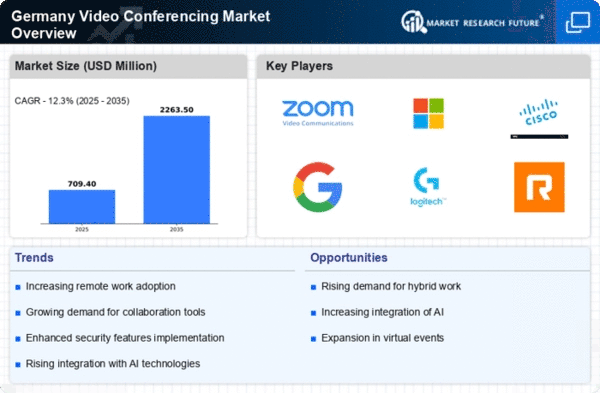
As per Market Research Future analysis, the Germany video conferencing market Size was estimated at 631.7 USD Million in 2024. The Germany video conferencing market is projected to grow from 709.4 USD Million in 2025 to 2263.5 USD Million by 2035, exhibiting a compound annual growth rate (CAGR) of 12% during the forecast period 2025 - 2035

Key Market Trends & Highlights

The Germany video conferencing market is experiencing robust growth driven by technological advancements and evolving workplace dynamics.

  • The market is witnessing increased adoption of cloud-based solutions, enhancing accessibility and flexibility for users.
  • Security and compliance have become focal points as organizations prioritize data protection in their communication tools.
  • Integration of advanced features is on the rise, with users seeking more comprehensive functionalities in video conferencing platforms.
  • The growing demand for remote work solutions and emphasis on cost-effectiveness are key drivers propelling market expansion.

Market Size & Forecast

2024 Market Size 631.7 (USD Million)
2035 Market Size 2263.5 (USD Million)
CAGR (2025 - 2035) 12.3%

Major Players

Zoom Video Communications (US), Microsoft (US), Cisco Systems (US), Google (US), Logitech (CH), RingCentral (US), BlueJeans Network (US), Lifesize (US), Pexip (NO), 8x8 (US)

Our Impact
Enabled $4.3B Revenue Impact for Fortune 500 and Leading Multinationals
Partnering with 2000+ Global Organizations Each Year
30K+ Citations by Top-Tier Firms in the Industry

Germany Video Conferencing Market Trends

The video conferencing market in Germany is currently experiencing a notable evolution, driven by advancements in technology and changing communication preferences. As organizations increasingly adopt remote work practices, the demand for reliable and efficient video conferencing solutions has surged. This shift is not merely a response to external pressures but reflects a broader transformation in how businesses operate. Enhanced connectivity and improved user experiences are becoming essential, as companies seek to maintain productivity and collaboration across dispersed teams. Furthermore, the integration of artificial intelligence and machine learning into video conferencing tools is likely to enhance functionalities, making meetings more interactive and efficient. In addition, the regulatory landscape in Germany plays a crucial role in shaping the video conferencing market. Data protection laws, particularly the General Data Protection Regulation (GDPR), impose strict requirements on how companies manage and store data. This regulatory framework influences the choice of video conferencing solutions, as organizations prioritize platforms that ensure compliance and security. As the market continues to mature, it appears that the focus will shift towards solutions that not only facilitate communication but also adhere to stringent data protection standards. Overall, the video conferencing market is poised for growth, with innovations and regulatory considerations driving its trajectory.

Increased Adoption of Cloud-Based Solutions

There is a growing trend towards cloud-based video conferencing solutions, as organizations in Germany seek flexibility and scalability. These platforms offer enhanced accessibility, allowing users to connect from various devices and locations. This shift is likely to streamline operations and reduce costs associated with traditional on-premises systems.

Focus on Security and Compliance

With stringent data protection regulations in place, there is a heightened emphasis on security features within video conferencing tools. Companies are increasingly prioritizing solutions that offer end-to-end encryption and robust compliance measures to safeguard sensitive information during virtual meetings.

Integration of Advanced Features

The video conferencing market is witnessing the integration of advanced features such as virtual reality and augmented reality capabilities. These innovations aim to create immersive meeting experiences, enhancing engagement and collaboration among participants, which may lead to improved outcomes for businesses.

Germany Video Conferencing Market Drivers

Emphasis on Cost-Effectiveness

Cost-effectiveness remains a pivotal driver for the video conferencing market in Germany. Organizations are increasingly recognizing the financial benefits of utilizing video conferencing solutions over traditional in-person meetings. In 2025, it is estimated that companies save an average of €2000 per month by adopting video conferencing tools, which significantly reduces travel expenses and associated costs. This financial incentive encourages businesses to invest in video conferencing technology, thereby driving market growth. The video conferencing market is likely to see a rise in demand for affordable yet high-quality solutions that cater to small and medium-sized enterprises. As cost considerations become more pronounced, the market is expected to evolve, offering competitive pricing models and subscription plans that appeal to a wider audience.

Rising Demand for Remote Work Solutions

The video conferencing market in Germany experiences a notable surge in demand for remote work solutions. As organizations increasingly adopt flexible work arrangements, the need for effective communication tools becomes paramount. In 2025, approximately 60% of companies in Germany report utilizing video conferencing platforms to facilitate remote collaboration. This trend indicates a shift in workplace dynamics, where employees seek seamless connectivity regardless of location. The video conferencing market is thus positioned to benefit from this evolving landscape, as businesses prioritize tools that enhance productivity and foster teamwork. Furthermore, the integration of user-friendly interfaces and mobile accessibility in video conferencing solutions is likely to attract a broader user base, further driving market growth. As remote work becomes a staple in corporate culture, the demand for reliable video conferencing tools is expected to remain robust in the coming years.

Growing Importance of Collaboration Tools

The video conferencing market in Germany is witnessing a growing importance of collaboration tools as businesses strive for enhanced teamwork and communication. The integration of video conferencing with project management and collaboration software is becoming increasingly prevalent. In 2025, approximately 55% of organizations report using video conferencing in conjunction with other collaborative platforms, indicating a trend towards holistic communication solutions. This integration not only streamlines workflows but also fosters a culture of collaboration among teams, regardless of geographical barriers. The video conferencing market is thus likely to benefit from this trend, as companies seek comprehensive solutions that facilitate seamless interaction. As the demand for collaborative tools continues to rise, the video conferencing market is expected to expand its offerings to meet the evolving needs of businesses.

Increased Focus on Training and Development

The video conferencing market in Germany is significantly influenced by the growing emphasis on training and development within organizations. Companies are increasingly leveraging video conferencing tools to conduct training sessions, workshops, and seminars, allowing for greater flexibility and accessibility. In 2025, it is estimated that around 40% of training programs utilize video conferencing platforms, reflecting a shift towards digital learning environments. This trend not only enhances employee engagement but also reduces costs associated with traditional training methods. The video conferencing market is thus poised to capitalize on this demand, as organizations seek efficient ways to upskill their workforce. Furthermore, the ability to record and archive training sessions for future reference adds value to video conferencing solutions, making them an integral part of corporate training strategies.

Technological Advancements in Communication Tools

Technological advancements play a crucial role in shaping the video conferencing market in Germany. Innovations such as high-definition video, artificial intelligence, and virtual reality are transforming the way individuals and organizations communicate. In 2025, the market witnesses a 25% increase in the adoption of AI-driven features, such as real-time translation and automated meeting summaries. These enhancements not only improve user experience but also expand the potential applications of video conferencing tools across various sectors. The video conferencing market is thus likely to see a diversification of its offerings, catering to specific needs of different industries, including education, healthcare, and corporate sectors. As technology continues to evolve, the demand for sophisticated video conferencing solutions is expected to rise, positioning the market for sustained growth in the future.


Market Segment Insights

By Component: Software (Largest) vs. Hardware (Fastest-Growing)

In the Germany video conferencing market, the software component represents the largest share, driven by the increasing reliance on digital communication tools across various sectors. The popularity of cloud-based solutions has significantly enhanced its market presence, allowing for seamless integration and user-friendly interfaces. On the other hand, the hardware segment is recognized as the fastest-growing component, fueled by the demand for high-quality audio-visual equipment and accessories that enhance the video conferencing experience. Growth trends indicate a robust shift towards hybrid working models, prompting organizations to invest in both software licenses and hardware upgrades. The need for high-definition cameras, microphones, and other peripherals is becoming imperative as enterprises seek to improve virtual interactions. Moreover, advancements in technology are encouraging companies to adopt sophisticated video conferencing systems, further propelling growth in the hardware segment as it adapts to meet new user expectations.

Software (Dominant) vs. Hardware (Emerging)

The software segment in the Germany video conferencing market stands out as the dominant value, characterized by robust functionalities that cater to diverse business needs. It encompasses various applications, from simple meeting tools to comprehensive platforms that support collaboration, sharing, and scheduling. This segment is highly competitive, with major players continually innovating to enhance user experiences and integrate advanced features. Conversely, the hardware segment, while emerging, is gaining momentum with the introduction of next-generation devices designed for optimal performance. This includes cameras with advanced tracking capabilities, high-fidelity audio systems, and integrated solutions that simplify the setup process. As companies prioritize quality in their virtual communications, hardware is poised for accelerated growth, complementing the established software systems.

By Conference Type: Telepresence System (Largest) vs. Desktop System (Fastest-Growing)

In the Germany video conferencing market, the distribution of market share among various conference types reveals that the Telepresence System holds the largest share, as organizations increasingly invest in high-quality, immersive experiences for remote meetings. Conversely, Desktop Systems, while smaller in share, are gaining traction as remote work becomes more prevalent, appealing to individuals and smaller businesses due to their affordability and ease of use. Growth trends in this segment are largely driven by advancements in technology and increasing demand for seamless virtual collaboration. The shift toward remote and hybrid working models has accelerated the adoption of both Telepresence and Desktop Systems, showcasing the need for robust, reliable solutions. As companies seek to enhance communication and productivity, we can expect these trends to continue influencing the market dynamics in the coming years.

Telepresence System (Dominant) vs. Desktop System (Emerging)

The Telepresence System is recognized as the dominant force in the Germany video conferencing market, primarily due to its ability to replicate in-person meetings through high-definition video and audio, creating an immersive experience. This system is favored by large enterprises that require superior quality and impactful presentations. In contrast, the Desktop System is an emerging player, appealing mainly to remote workers and small to medium-sized enterprises. Its user-friendly interface and cost-effectiveness make it an attractive choice for those seeking simple, effective solutions for virtual meetings. As the demand for flexible working solutions grows, the Desktop System is positioned to capture an increasing share of the market, complementing the high-end offerings of Telepresence.

By Deployment: Cloud (Largest) vs. On-premises (Fastest-Growing)

In the Germany video conferencing market, Cloud deployment currently holds the largest market share, driven by its flexibility and ease of use. On-premises solutions, while traditionally preferred by enterprises requiring enhanced security, are witnessing a resurgence due to the need for higher control over data and operations, attracting attention from various sectors looking for tailored solutions. Growth trends indicate a robust rise in the adoption of Cloud solutions, fueled by the increasing shift towards remote working and collaboration. On the other hand, the preference for On-premises solutions is accelerating as organizations invest in customized setups that meet their specific requirements. Factors such as data privacy concerns and regulatory compliance are also propelling the interest in On-premises deployments as businesses seek reliable and secure communication channels.

Deployment: Cloud (Dominant) vs. On-premises (Emerging)

The Cloud segment in the Germany video conferencing market is characterized by its dominant position, providing users with scalable and accessible solutions that facilitate seamless communication. Designed for flexibility, Cloud platforms often include advanced features like integration with other business tools and mobile accessibility, making them attractive for a wide range of users including small businesses and large enterprises. Conversely, the On-premises segment is emerging, appealing to organizations that prioritize control and security. Unlike Cloud solutions, On-premises deployments require considerable upfront investment and management but offer customized setups that align with specific operational needs. This emerging trend is particularly prevalent among enterprises in industries with stringent data privacy regulations, as they seek to safeguard their communication infrastructures while ensuring compliance.

By Enterprise Type: Small and Medium Enterprises (Largest) vs. Large Enterprises (Fastest-Growing)

In the Germany video conferencing market, the distribution of market share reveals that Small and Medium Enterprises hold the largest portion, driven by their increasing need for remote collaboration tools and budget-friendly solutions. These enterprises make up a significant percentage of the overall users, reflecting a trend towards decentralization and flexibility in work environments. Conversely, Large Enterprises are identified as the fastest-growing segment, primarily fueled by their robust investments in technology and the push for comprehensive digital transformation initiatives. As these larger organizations strive for seamless connectivity and collaboration across global teams, the adoption of advanced video conferencing solutions is accelerating, allowing them to maintain effective communication despite geographical barriers.

Small and Medium Enterprises (Dominant) vs. Large Enterprises (Emerging)

Small and Medium Enterprises in the Germany video conferencing market are characterized by their agility and adaptive strategies, leveraging scalable solutions to enhance productivity and reduce operational costs. Their prioritization of user-friendly platforms allows for quick implementation, making them well-positioned in the market. On the other hand, Large Enterprises, despite their higher complexity, are emerging rapidly due to significant investments in infrastructure and platforms that cater to extensive user needs. Their focus is on integrating cutting-edge technologies, which enhances the overall user experience, thereby fostering a surge in adoption rates. Both segments play crucial roles in shaping the dynamics of the video conferencing landscape.

By Application: Small Room (Largest) vs. Huddle Rooms (Fastest-Growing)

In the Germany video conferencing market, the application segment is primarily dominated by Small Rooms, which capture the largest share due to their widespread adoption among SMEs and remote teams. Following closely are Huddle Rooms, which are rapidly increasing in popularity as organizations focus on creating collaborative spaces that cater to smaller teams. Middle Rooms and Large Rooms hold a smaller market share but are also significant for larger enterprises that require more sophisticated solutions. Growth trends indicate that Huddle Rooms are emerging as the fastest-growing segment, driven by the rise of remote work and the need for flexible meeting solutions. The demand for seamless connectivity and user-friendly interfaces is propelling the advancement of video conferencing tools in these spaces. Additionally, enterprises are investing more in technology that enhances collaboration, thereby facilitating greater productivity in both Small and Huddle Rooms.

Small Room (Dominant) vs. Huddle Rooms (Emerging)

Small Rooms are characterized by their strategic use in smaller office settings or home workplaces, making them highly efficient for quick meetings and collaborations. They support essential video conferencing features and are preferred for their convenience and cost-effectiveness. On the other hand, Huddle Rooms represent an emerging trend that caters to informal, casual meetings, encouraging spontaneous collaboration among team members. These spaces are increasingly integrated with advanced technology to enhance the user experience, making video conferencing more accessible. As remote work trends continue to solidify, both Small Rooms and Huddle Rooms are effectively transforming the way teams communicate, positioning themselves as essential components in the Germany video conferencing market.

By Industry: IT & Telecom (Largest) vs. Healthcare (Fastest-Growing)

In the Germany video conferencing market, the distribution of market share among various industry sectors is notably varied. The IT & Telecom sector commands the largest share, reflecting the industry's heavy reliance on virtual communication tools for remote work and collaboration. Other sectors, such as Education and BFSI, also hold significant portions of the market, driven by their increasing adoption of digital platforms. However, sectors like Healthcare have emerged as critical points of growth, particularly in recent times with the need for telemedicine and remote consultations. Growth trends in the Germany video conferencing market are driven by several key factors. The push towards digital transformation across industries has solidified the demand for effective video conferencing solutions, facilitating seamless communication regardless of physical location. Additionally, factors such as regulatory support for remote healthcare services and the increasing demand for flexible learning environments in education have accelerated the adoption of video conferencing tools. These trends indicate a robust future for sectors focusing on virtual communication solutions, particularly for industries that are adapting swiftly to these new dynamics.

IT & Telecom: Largest vs. Healthcare: Emerging

The IT & Telecom sector stands out as the largest segment in the Germany video conferencing market, characterized by its extensive use of advanced technologies to enhance communication and collaboration. Companies in this sector are not just using video conferencing for internal meetings but are also providing platforms that support diverse functions, including webinars and customer engagement. On the other hand, the Healthcare sector is emerging rapidly, fueled by the increasing acceptance of telehealth services. This segment is recognizing the importance of video conferencing in patient care, consultations, and collaborative treatments among medical professionals. As both segments continue to evolve, their distinctive needs are shaping the landscape of communication solutions.

Get more detailed insights about Germany Video Conferencing Market

Key Players and Competitive Insights

The video conferencing market in Germany is characterized by a dynamic competitive landscape, driven by rapid technological advancements and an increasing demand for remote collaboration solutions. Major players such as Zoom Video Communications (US), Microsoft (US), and Cisco Systems (US) are at the forefront, each adopting distinct strategies to enhance their market presence. Zoom Video Communications (US) focuses on user experience and scalability, continually innovating its platform to cater to diverse business needs. Microsoft (US), leveraging its extensive ecosystem, integrates video conferencing capabilities into its Office 365 suite, thereby enhancing user engagement and retention. Cisco Systems (US) emphasizes security and reliability, positioning its Webex platform as a trusted solution for enterprises, particularly in regulated industries. Collectively, these strategies contribute to a competitive environment that is increasingly centered around user-centric innovations and integrated solutions.In terms of business tactics, companies are increasingly localizing their operations to better serve the German market. This includes optimizing supply chains and establishing regional partnerships to enhance service delivery. The market structure appears moderately fragmented, with a mix of established players and emerging startups vying for market share. The collective influence of these key players shapes the competitive dynamics, as they continuously adapt to evolving customer preferences and technological trends.

In October Zoom Video Communications (US) announced a strategic partnership with a leading German telecommunications provider to enhance its service offerings in the region. This collaboration aims to improve network reliability and provide localized support, which is crucial for maintaining customer satisfaction in a competitive market. The strategic importance of this partnership lies in its potential to solidify Zoom's position in Germany, allowing it to leverage local expertise while expanding its user base.

In September Microsoft (US) launched a new AI-driven feature within its Teams platform, designed to enhance virtual meeting experiences by providing real-time transcription and translation services. This innovation not only caters to the diverse linguistic landscape of Germany but also positions Microsoft as a leader in integrating AI into video conferencing solutions. The strategic significance of this move is evident in its potential to attract multinational corporations seeking seamless communication across language barriers.

In August Cisco Systems (US) unveiled a new security framework for its Webex platform, aimed at addressing growing concerns over data privacy and cybersecurity. This initiative underscores Cisco's commitment to providing secure communication solutions, which is particularly relevant in the context of increasing regulatory scrutiny in Europe. The strategic importance of this development lies in its ability to enhance customer trust and differentiate Cisco from competitors who may not prioritize security to the same extent.

As of November current trends in the video conferencing market include a strong emphasis on digitalization, sustainability, and the integration of AI technologies. Strategic alliances are increasingly shaping the competitive landscape, as companies seek to combine strengths to deliver comprehensive solutions. Looking ahead, competitive differentiation is likely to evolve from traditional price-based competition towards a focus on innovation, technological advancements, and supply chain reliability. This shift suggests that companies that prioritize these aspects will be better positioned to thrive in an increasingly competitive environment.

Key Companies in the Germany Video Conferencing Market include

Industry Developments

In July 2024, Zoom implemented improved data privacy tools for EEA users. These tools include a self-service portal for data subject access, new alternatives for storing meeting, webinar, and messaging data within the EEA, and a dedicated EU-based support team. Zoom's compliance with local data protection standards under GDPR was further bolstered by its acquisition of the BSI C5 attestation in Germany.In March 2025, Cisco introduced its most recent Webex AI Agent and AI Assistant for Webex Contact Center, which are intended to revolutionize hybrid collaboration. 

The new features include real-time transcription, 24/7 self-service, suggested responses, and customer service automation tools, as well as new AI workspace enhancements.Microsoft has expanded access to integrated hardware solutions for collaboration and conferencing environments by making Teams Room Store devices available for purchase directly in Germany (among other countries) since early 2025.

Future Outlook

Germany Video Conferencing Market Future Outlook

The Video Conferencing Market in Germany is projected to grow at a 12.3% CAGR from 2025 to 2035, driven by technological advancements and increasing remote collaboration needs.

New opportunities lie in:

  • Development of AI-driven analytics tools for user engagement insights.
  • Integration of virtual reality features for immersive meetings.
  • Expansion of subscription-based models for small businesses and startups.

By 2035, the market is expected to be robust, reflecting substantial growth and innovation.

Market Segmentation

Germany Video Conferencing Market Industry Outlook

  • IT & Telecom
  • Government
  • Healthcare
  • Manufacturing
  • BFSI
  • Education
  • Media & Entertainment
  • Others

Germany Video Conferencing Market Component Outlook

  • Hardware
  • Software

Germany Video Conferencing Market Deployment Outlook

  • Cloud
  • On-premises

Germany Video Conferencing Market Application Outlook

  • Small Room
  • Huddle Rooms
  • Middle Rooms
  • Large Rooms

Germany Video Conferencing Market Conference Type Outlook

  • Telepresence System
  • Integrated System
  • Desktop System
  • Service-based System
  • Others

Germany Video Conferencing Market Enterprise Type Outlook

  • Small and Medium Enterprises
  • Large Enterprises

Report Scope

MARKET SIZE 2024 631.7(USD Million)
MARKET SIZE 2025 709.4(USD Million)
MARKET SIZE 2035 2263.5(USD Million)
COMPOUND ANNUAL GROWTH RATE (CAGR) 12.3% (2025 - 2035)
REPORT COVERAGE Revenue Forecast, Competitive Landscape, Growth Factors, and Trends
BASE YEAR 2024
Market Forecast Period 2025 - 2035
Historical Data 2019 - 2024
Market Forecast Units USD Million
Key Companies Profiled Zoom Video Communications (US), Microsoft (US), Cisco Systems (US), Google (US), Logitech (CH), RingCentral (US), BlueJeans Network (US), Lifesize (US), Pexip (NO), 8x8 (US)
Segments Covered Component, Conference Type, Deployment, Enterprise Type, Application, Industry
Key Market Opportunities Integration of artificial intelligence to enhance user experience in the video conferencing market.
Key Market Dynamics Rising demand for secure video conferencing solutions drives innovation and competition among local providers in Germany.
Countries Covered Germany
Leave a Comment

FAQs

What is the expected market value of the Germany Video Conferencing Market in 2024?

The Germany Video Conferencing Market is expected to be valued at 419.0 million USD in 2024.

What will be the projected market value by 2035?

By 2035, the Germany Video Conferencing Market is anticipated to reach 1072.0 million USD.

What is the expected CAGR for the Germany Video Conferencing Market from 2025 to 2035?

The market is expected to grow at a CAGR of 8.915% from 2025 to 2035.

What are the major components of the Germany Video Conferencing Market?

The market is divided into two main components: Hardware and Software.

What is the estimated market value for the Hardware segment in 2024?

The Hardware segment of the Germany Video Conferencing Market is valued at 160.0 million USD in 2024.

What is the projected market value for the Software segment by 2035?

The Software segment is expected to reach 678.0 million USD by 2035.

Who are the key players in the Germany Video Conferencing Market?

Major players in the market include Skype, Pexip, Cisco, Zoom, and Microsoft.

What challenges are currently affecting the Germany Video Conferencing Market?

Challenges include increasing competition and the need for ongoing innovation to meet user demands.

What key applications are driving growth in the Germany Video Conferencing Market?

Key applications include remote work collaboration, virtual meetings, and online education.

How is the current global scenario impacting the Germany Video Conferencing Market?

The global shift towards remote work and digital communication continues to bolster demand in the market.

Download Free Sample

Kindly complete the form below to receive a free sample of this Report

Compare Licence

×
Features License Type
Single User Multiuser License Enterprise User
Price $4,950 $5,950 $7,250
Maximum User Access Limit 1 User Upto 10 Users Unrestricted Access Throughout the Organization
Free Customization
Direct Access to Analyst
Deliverable Format
Platform Access
Discount on Next Purchase 10% 15% 15%
Printable Versions