×
Request Free Sample ×

Kindly complete the form below to receive a free sample of this Report

* Please use a valid business email

Leading companies partner with us for data-driven Insights

clients tt-cursor
Hero Background

Germany Video As A Service Market

ID: MRFR/ICT/61142-HCR
200 Pages
Aarti Dhapte
February 2026

Germany Video as a Service Market Size, Share and Research Report: By Application (Corporate Communications, Training & Development, Marketing & Client Engagement), By Cloud Deployment (Public, Private, Hybrid) and By Vertical (BFSI, IT & Telecommunications, Healthcare, Media & Entertainment, Government, Others)- Industry Forecast to 2035

Share:
Download PDF ×

We do not share your information with anyone. However, we may send you emails based on your report interest from time to time. You may contact us at any time to opt-out.

Germany Video As A Service Market Infographic
Purchase Options

Germany Video As A Service Market Summary

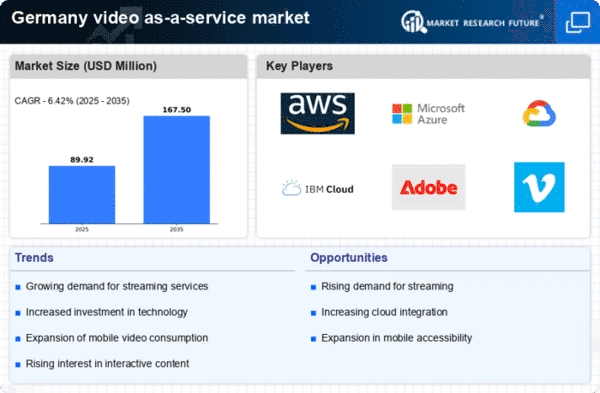
As per Market Research Future analysis, the Germany video as-a-service market Size was estimated at 84.5 USD Million in 2024. The Germany video as-a-service market is projected to grow from 89.92 USD Million in 2025 to 167.5 USD Million by 2035, exhibiting a compound annual growth rate (CAGR) of 6.4% during the forecast period 2025 - 2035

Key Market Trends & Highlights

The Germany video as-a-service market is experiencing robust growth driven by technological advancements and changing consumer preferences.

  • The market is witnessing increased adoption of cloud-based solutions, enhancing scalability and flexibility for users.
  • A focus on enhanced user experience is becoming paramount, as providers strive to meet evolving consumer expectations.
  • Integration with emerging technologies, such as AI and VR, is shaping the future of video services, offering innovative content delivery methods.
  • Key market drivers include the growing demand for streaming services and advancements in video quality and technology.

Market Size & Forecast

2024 Market Size 84.5 (USD Million)
2035 Market Size 167.5 (USD Million)
CAGR (2025 - 2035) 6.42%

Major Players

Amazon Web Services (US), Microsoft Azure (US), Google Cloud (US), IBM Cloud (US), Adobe (US), Vimeo (US), Brightcove (US), Kaltura (US), Dacast (US)

Our Impact
Enabled $4.3B Revenue Impact for Fortune 500 and Leading Multinationals
Partnering with 2000+ Global Organizations Each Year
30K+ Citations by Top-Tier Firms in the Industry

Germany Video As A Service Market Trends

The video as-a-service market is experiencing notable growth, driven by increasing demand for flexible and scalable solutions. Businesses across various sectors are adopting these services to enhance their digital presence and improve customer engagement. The rise of remote work and the need for effective communication tools have further accelerated this trend. Companies are increasingly recognizing the value of video content in marketing strategies, leading to a surge in investments in video technologies. This shift is not only transforming how organizations operate but also influencing consumer behavior, as audiences gravitate towards video-rich experiences. In addition, advancements in technology are enabling more sophisticated video solutions. Innovations in artificial intelligence and machine learning are enhancing video analytics, allowing businesses to gain deeper insights into viewer behavior. This data-driven approach is likely to shape future strategies in the video as-a-service market. Furthermore, the regulatory environment in Germany is evolving, with policies aimed at promoting digital transformation. As a result, organizations are encouraged to adopt video solutions that comply with local regulations, ensuring a secure and efficient transition to digital platforms.

Increased Adoption of Cloud-Based Solutions

Organizations are increasingly shifting towards cloud-based video services, which offer flexibility and scalability. This trend allows businesses to manage their video content more efficiently while reducing infrastructure costs. The ability to access video services from anywhere enhances collaboration and communication among teams.

Focus on Enhanced User Experience

There is a growing emphasis on providing superior user experiences in the video as-a-service market. Companies are investing in technologies that improve video quality, reduce latency, and offer interactive features. This focus on user satisfaction is likely to drive customer loyalty and retention.

Integration with Emerging Technologies

The integration of video services with emerging technologies such as augmented reality and virtual reality is becoming more prevalent. This trend suggests that businesses are exploring innovative ways to engage their audiences, creating immersive experiences that go beyond traditional video content.

Germany Video As A Service Market Drivers

Rising Popularity of Mobile Viewing

The trend towards mobile viewing is significantly influencing the video as-a-service market in Germany. With the proliferation of smartphones and tablets, consumers are increasingly accessing video content on-the-go. As of 2025, it is estimated that over 60% of video consumption occurs on mobile devices, highlighting a shift in how audiences engage with content. This trend is prompting service providers to optimize their platforms for mobile use, ensuring that users have a seamless experience regardless of the device. Furthermore, the rise of mobile data plans with generous allowances is facilitating this shift, as consumers are less constrained by data limits. The video as-a-service market is thus likely to see continued growth as mobile viewing becomes the norm, driving demand for flexible and accessible content.

Growing Demand for Streaming Services

The video as-a-service market in Germany is experiencing a notable surge in demand for streaming services. This trend is driven by the increasing consumption of video content across various platforms, including social media, online education, and entertainment. As of 2025, approximately 70% of German households subscribe to at least one streaming service, indicating a shift in viewing habits. This growing appetite for on-demand content is compelling service providers to enhance their offerings, thereby expanding the video as-a-service market. Furthermore, the rise of mobile devices and high-speed internet access facilitates seamless streaming experiences, which is likely to further boost market growth. The video as-a-service market is thus positioned to capitalize on this trend, as consumers increasingly prefer flexible viewing options that cater to their schedules.

Regulatory Support for Digital Services

The regulatory environment in Germany is increasingly supportive of digital services, which positively impacts the video as-a-service market. Recent policies aimed at promoting digital innovation and protecting consumer rights are fostering a conducive atmosphere for service providers. For instance, the German government has implemented measures to enhance broadband infrastructure, ensuring that more consumers have access to high-speed internet. This is crucial for the video as-a-service market, as reliable internet connectivity is a prerequisite for seamless streaming experiences. Additionally, regulations that encourage fair competition among service providers are likely to lead to more diverse offerings for consumers. The video as-a-service market stands to benefit from this regulatory support, as it enables growth and expansion opportunities for both established and emerging players.

Increased Investment in Content Creation

The video as-a-service market in Germany is witnessing a substantial increase in investment directed towards content creation. Major players are allocating significant budgets to produce original content, which is essential for attracting and retaining subscribers. In 2025, it is projected that spending on original programming will exceed €1 billion, reflecting a commitment to high-quality content that resonates with local audiences. This trend is particularly important as consumers are becoming more discerning about the content they consume, often favoring platforms that offer unique and exclusive programming. The video as-a-service market is thus likely to see a competitive landscape where content quality becomes a key differentiator among service providers, driving further growth and innovation.

Advancements in Video Quality and Technology

Technological advancements play a crucial role in shaping the video as-a-service market in Germany. Innovations such as 4K and 8K video streaming, along with improved compression algorithms, are enhancing the quality of video content delivered to consumers. As of 2025, it is estimated that over 50% of video content streamed in Germany is available in high definition, which significantly elevates user experience. Additionally, the integration of artificial intelligence and machine learning in content delivery networks is optimizing streaming performance and reducing latency. These advancements not only attract more users but also encourage existing customers to upgrade their subscriptions. The video as-a-service market is thus likely to benefit from these technological improvements, as they create a more engaging and satisfying viewing experience for consumers.


Market Segment Insights

By Application: Corporate Communications (Largest) vs. Training & Development (Fastest-Growing)

In the Germany video as-a-service market, the application segment comprises Corporate Communications, Training & Development, and Marketing & Client Engagement. Corporate Communications holds the largest market share, driven by an increasing need for efficient internal communication within organizations. Training & Development follows closely, attracting significant investments as companies prioritize employee skill enhancement and onboarding processes. Marketing & Client Engagement also contributes, albeit at a smaller scale, as businesses explore innovative ways to reach clients through video content. Growth trends within this segment reveal a robust shift towards digital transformation, with Training & Development emerging as the fastest-growing application. Organizations increasingly recognize the importance of video for remote training and interactive sessions, leading to a surge in demand. Moreover, the rise of remote work practices has amplified the need for effective Corporate Communications, solidifying its position as a staple in corporate strategy, while Marketing & Client Engagement continues to evolve as businesses seek to leverage video content to enhance customer relationships and engagement.

Corporate Communications: Dominant vs. Training & Development: Emerging

Corporate Communications serves as the dominant application within the Germany video as-a-service market, focusing on enhancing clarity and efficiency in internal messaging across organizations. This segment benefits from extensive utilization in virtual meetings, webinars, and internal training sessions, allowing businesses to maintain connectivity and engagement among teams. On the other hand, Training & Development stands as an emerging application, rapidly gaining traction as organizations invest in video tools to facilitate ongoing education and skills development. The trend towards personalized and scalable training solutions reflects the modern workforce's demand for flexible learning. Both segments are essential for fostering a culture of continuous improvement and adaptability within businesses, highlighting their strategic importance in today's corporate landscape.

By Cloud Deployment: Public (Largest) vs. Private (Fastest-Growing)

In the Germany video as-a-service market, the Public cloud deployment segment holds the largest share, reflecting a strong preference among enterprises for scalability and cost-effectiveness. This segment benefits from lower operational costs as resources are shared among multiple users, making it an attractive option for businesses looking to optimize their expenditures while enjoying robust services. Conversely, the Private cloud segment is recognized as the fastest-growing in the sector. Driven by increasing concerns over data security and compliance, more organizations are opting for private solutions that allow for greater control over their resources. The trend towards hybrid models, which combine elements of both public and private, further fuels interest in the private deployment as companies seek tailored solutions that meet specific regulatory and operational requirements.

Cloud Deployment: Public (Dominant) vs. Private (Emerging)

The Public cloud deployment in the Germany video as-a-service market is characterized by its scalability, accessibility, and cost efficiency, making it the dominant choice for businesses of all sizes. Public clouds are managed by third-party providers, which allows companies to focus on their core operations without worrying about infrastructure management. On the other hand, the Private cloud segment is emerging strongly, favored by enterprises that prioritize enhanced security, compliance, and control over their data. This segment caters specifically to industries with stringent regulatory requirements, providing tailored solutions that align with their operational needs. The hybrid approach, which integrates both public and private deployments, is increasingly appealing, as organizations strive for flexibility while ensuring data protection.

By Vertical: Media & Entertainment (Largest) vs. BFSI (Fastest-Growing)

In the Germany video as-a-service market, the Media & Entertainment segment holds the largest share among verticals, driving a significant portion of revenue and engagement. Following closely are the BFSI and IT & Telecommunications segments, which also contribute meaningfully to the market's overall dynamics. This competitive landscape showcases a vibrant blend of industries vying for dominance, but Media & Entertainment clearly stands out as the leader in terms of market share. Growth trends indicate that while Media & Entertainment maintains its stronghold, the BFSI sector is rapidly gaining traction, identified as the fastest-growing segment. Factors such as increasing digital adoption, enhanced security measures, and the demand for innovative customer engagement solutions are propelling this growth. Additionally, sectors like Healthcare and Government are also experiencing growth, fueled by the need for efficient and scalable video solutions in remote services and communication.

Media & Entertainment (Dominant) vs. BFSI (Emerging)

The Media & Entertainment segment is characterized by its robust infrastructure and extensive content library, catering to a diverse audience with on-demand services. This established vertical benefits from high consumer engagement and investment in content creation and delivery platforms. In contrast, the BFSI sector, while currently emerging, showcases remarkable growth potential driven by technological advancements and increasing user demand for secure transactional video services. Both segments reflect significant shifts in user behavior and content consumption preferences, with Media & Entertainment solidifying its position as a long-term leader while BFSI adapts to meet the challenges of a digital-first environment.

Get more detailed insights about Germany Video As A Service Market

Key Players and Competitive Insights

The video as-a-service market in Germany is characterized by a dynamic competitive landscape, driven by rapid technological advancements and increasing demand for scalable video solutions. Major players such as Amazon Web Services (US), Microsoft Azure (US), and Google Cloud (US) are at the forefront, leveraging their extensive cloud infrastructures to offer robust video services. These companies focus on innovation and strategic partnerships to enhance their service offerings, thereby shaping a competitive environment that emphasizes quality and reliability. The collective strategies of these firms indicate a trend towards integrated solutions that cater to diverse customer needs, fostering a more interconnected market.Key business tactics employed by these companies include localizing services to better meet regional demands and optimizing supply chains for efficiency. The market structure appears moderately fragmented, with a mix of established giants and emerging players. This fragmentation allows for a variety of service offerings, yet the influence of key players remains substantial, as they set benchmarks for quality and service delivery.

In October Amazon Web Services (US) announced the launch of a new video analytics tool designed to enhance user engagement through AI-driven insights. This strategic move is likely to position AWS as a leader in providing actionable data to content creators, thereby enhancing their ability to tailor content to audience preferences. Such innovations not only strengthen AWS's market position but also push competitors to enhance their analytics capabilities.

In September Microsoft Azure (US) expanded its partnership with a leading European media company to deliver customized video solutions for live events. This collaboration underscores Azure's commitment to regional expansion and its focus on providing tailored services that meet specific market demands. By aligning with local media entities, Microsoft Azure enhances its visibility and relevance in the German market, potentially increasing its market share.

In August Google Cloud (US) introduced a new pricing model aimed at making its video services more accessible to small and medium-sized enterprises. This strategic adjustment reflects a growing trend towards democratizing access to advanced video technologies, allowing smaller players to compete more effectively. By lowering barriers to entry, Google Cloud may stimulate innovation and competition within the market, fostering a more diverse ecosystem.

As of November current trends in the video as-a-service market include a pronounced shift towards digitalization, sustainability, and the integration of AI technologies. Strategic alliances are increasingly shaping the competitive landscape, as companies recognize the value of collaboration in enhancing service offerings. Looking ahead, competitive differentiation is likely to evolve from traditional price-based competition to a focus on innovation, technological advancements, and supply chain reliability. This shift suggests that companies will need to invest in cutting-edge solutions and partnerships to maintain a competitive edge in an ever-evolving market.

Key Companies in the Germany Video As A Service Market include

Industry Developments

Brightcove expanded its European presence in 2023 by establishing an office in Germany and collaborating with media companies such as OMS and Gruner + Jahr to distribute video platforms and ad-supported content across German publications.AWS established a Direct Connect location in Hamburg in March 2023, which provides secure, low-latency private connectivity. 

This service streamlines video workflows and enhances streaming performance for German-based services.In 2024, ProSiebenSat.1 Media continued to enhance its streaming platform Joyn, which experienced a 30% increase in its monthly video user base, reaching 6.3 million users by the fourth quarter of 2023. This increase is indicative of consolidation trends in Germany's streaming market.

Future Outlook

Germany Video As A Service Market Future Outlook

The Video as a Service Market is projected to grow at a 6.42% CAGR from 2025 to 2035, driven by increasing demand for streaming services and technological advancements.

New opportunities lie in:

  • Development of AI-driven content personalization tools
  • Expansion of subscription-based pricing models for niche markets
  • Integration of augmented reality features in video platforms

By 2035, the market is expected to achieve substantial growth, driven by innovation and evolving consumer preferences.

Market Segmentation

Germany Video As A Service Market Vertical Outlook

  • BFSI
  • IT & Telecommunications
  • Healthcare
  • Media & Entertainment
  • Government
  • Others

Germany Video As A Service Market Application Outlook

  • Corporate Communications
  • Training & Development
  • Marketing & Client Engagement

Germany Video As A Service Market Cloud Deployment Outlook

  • Public
  • Private
  • Hybrid

Report Scope

MARKET SIZE 2024 84.5(USD Million)
MARKET SIZE 2025 89.92(USD Million)
MARKET SIZE 2035 167.5(USD Million)
COMPOUND ANNUAL GROWTH RATE (CAGR) 6.42% (2025 - 2035)
REPORT COVERAGE Revenue Forecast, Competitive Landscape, Growth Factors, and Trends
BASE YEAR 2024
Market Forecast Period 2025 - 2035
Historical Data 2019 - 2024
Market Forecast Units USD Million
Key Companies Profiled Amazon Web Services (US), Microsoft Azure (US), Google Cloud (US), IBM Cloud (US), Adobe (US), Vimeo (US), Brightcove (US), Kaltura (US), Dacast (US)
Segments Covered Application, Cloud Deployment, Vertical
Key Market Opportunities Integration of advanced analytics and AI-driven personalization in the video as-a-service market.
Key Market Dynamics Growing demand for cloud-based solutions drives innovation and competition in the video as-a-service market.
Countries Covered Germany
Leave a Comment

FAQs

What is the expected market size of the Germany Video as a Service Market in 2024?

The expected market size of the Germany Video as a Service Market in 2024 is valued at 111.54 million USD.

What is the projected market size for the Germany Video as a Service Market by 2035?

By 2035, the Germany Video as a Service Market is projected to be valued at 198.8 million USD.

What is the expected compound annual growth rate (CAGR) for the Germany Video as a Service Market from 2025 to 2035?

The expected CAGR for the Germany Video as a Service Market from 2025 to 2035 is 5.394%.

Which application segment holds the largest value in the Germany Video as a Service Market in 2024?

In 2024, the Corporate Communications segment holds the largest value at 35.0 million USD.

What will be the estimated value of the Training & Development segment in the Germany Video as a Service Market by 2035?

By 2035, the Training & Development segment is estimated to be valued at 70.0 million USD.

Who are the key players in the Germany Video as a Service Market?

Key players in the Germany Video as a Service Market include Brightcove, Vimeo, Kaltura, and Adobe.

How large is the Marketing & Client Engagement segment projected to be in 2035?

The Marketing & Client Engagement segment is projected to reach 63.8 million USD by 2035.

What are some key growth drivers for the Germany Video as a Service Market?

Key growth drivers for the market include increasing demand for video content in corporate communications and marketing strategies.

How has the competitive landscape evolved in the Germany Video as a Service Market?

The competitive landscape has evolved with many players adopting innovative technologies and partnerships to enhance service offerings.

What challenges are impacting the growth of the Germany Video as a Service Market?

Challenges impacting growth include increasing competition and the need for continuous technological advancements.

Download Free Sample

Kindly complete the form below to receive a free sample of this Report

Compare Licence

×
Features License Type
Single User Multiuser License Enterprise User
Price $4,950 $5,950 $7,250
Maximum User Access Limit 1 User Upto 10 Users Unrestricted Access Throughout the Organization
Free Customization
Direct Access to Analyst
Deliverable Format
Platform Access
Discount on Next Purchase 10% 15% 15%
Printable Versions