×
Request Free Sample ×

Kindly complete the form below to receive a free sample of this Report

* Please use a valid business email

Leading companies partner with us for data-driven Insights

clients tt-cursor
Hero Background

Germany Vaccine Technologies Market

ID: MRFR/Pharma/50284-HCR
200 Pages
Rahul Gotadki
February 2026

Germany Vaccine Technologies Market Research Report: Size, Share, Trend Analysis By Types (Recombinant, Conjugate, Subunit, Inactivated, Live Attenuated, Toxoid), By Route of Administration (Parenteral, Oral), By Disease Indication (Viral Diseases, Bacterial Diseases), By Age Group (Pediatric, Adults) and By Distribution Channel (Hospital & Retail Pharmacies, Government Suppliers, Others) - Growth Outlook & Industry Forecast 2025 To 2035

Share:
Download PDF ×

We do not share your information with anyone. However, we may send you emails based on your report interest from time to time. You may contact us at any time to opt-out.

Germany Vaccine Technologies Market Infographic
Purchase Options

Germany Vaccine Technologies Market Summary

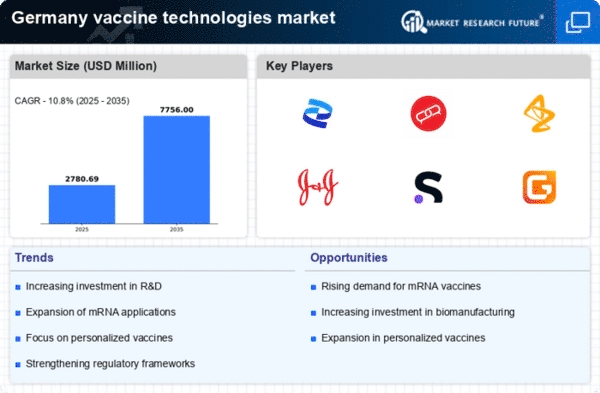
As per Market Research Future analysis, the Germany vaccine technologies market size was estimated at 2509.65 $ Million in 2024. The Germany vaccine technologies market is projected to grow from 2780.69 $ Million in 2025 to 7756.0 $ Million by 2035, exhibiting a compound annual growth rate (CAGR) of 10% during the forecast period 2025 - 2035

Key Market Trends & Highlights

The Germany vaccine technologies market is experiencing robust growth driven by innovative technologies and increasing demand for vaccination.

  • The emergence of mRNA technologies is reshaping the landscape of vaccine development in Germany.
  • Public-private partnerships are on the rise, fostering collaboration and accelerating vaccine innovation.
  • Personalized vaccination strategies are gaining traction, reflecting a shift towards tailored healthcare solutions.
  • Rising demand for vaccination and government support initiatives are key drivers propelling market expansion.

Market Size & Forecast

2024 Market Size 2509.65 (USD Million)
2035 Market Size 7756.0 (USD Million)
CAGR (2025 - 2035) 10.8%

Major Players

Pfizer (US), Moderna (US), AstraZeneca (GB), Johnson & Johnson (US), Sanofi (FR), GSK (GB), Novavax (US), Merck (US), Bharat Biotech (IN)

Our Impact
Enabled $4.3B Revenue Impact for Fortune 500 and Leading Multinationals
Partnering with 2000+ Global Organizations Each Year
30K+ Citations by Top-Tier Firms in the Industry

Germany Vaccine Technologies Market Trends

The vaccine technologies market is currently experiencing a dynamic evolution, driven by advancements in research and development, regulatory frameworks, and public health initiatives. In Germany, the emphasis on innovative vaccine platforms, such as mRNA and viral vector technologies, appears to be gaining traction. This shift is likely influenced by the increasing demand for rapid response capabilities to emerging infectious diseases. Furthermore, collaboration between public and private sectors seems to foster a conducive environment for innovation, potentially leading to enhanced vaccine efficacy and safety profiles. Moreover, the regulatory landscape in Germany is adapting to accommodate novel vaccine technologies, which may streamline approval processes and encourage investment. The focus on personalized medicine and targeted therapies indicates a trend towards more tailored vaccination strategies, which could improve patient outcomes. As the vaccine technologies market continues to evolve, the interplay between scientific advancements and regulatory support will likely shape its future trajectory, ensuring that Germany remains at the forefront of vaccine innovation.

Emergence of mRNA Technologies

The rise of mRNA technologies is transforming the vaccine landscape, offering rapid development and adaptability. This platform allows for swift modifications in response to new pathogens, which may enhance Germany's preparedness for future health crises.

Increased Public-Private Partnerships

Collaborations between governmental bodies and private enterprises are becoming more prevalent. These partnerships may facilitate resource sharing and accelerate the development of innovative vaccine solutions, thereby strengthening the overall vaccine ecosystem.

Focus on Personalized Vaccination Strategies

There is a growing emphasis on personalized vaccination approaches, which aim to tailor immunization based on individual health profiles. This trend could lead to improved efficacy and patient compliance, potentially reshaping vaccination practices in Germany.

Germany Vaccine Technologies Market Drivers

Rising Demand for Vaccination

The vaccine technologies market in Germany is experiencing a notable increase in demand for vaccination solutions. This surge is driven by heightened awareness of infectious diseases and the importance of immunization. According to recent data, vaccination rates in Germany have reached approximately 95% for certain childhood vaccines, indicating a strong public commitment to preventive healthcare. The growing population, coupled with an aging demographic, further amplifies the need for innovative vaccine technologies. As the healthcare system adapts to these demands, investments in research and development are likely to rise, fostering advancements in vaccine efficacy and delivery methods. This trend suggests that the vaccine technologies market will continue to expand, supported by both public health initiatives and private sector innovations.

Emerging Infectious Disease Threats

The vaccine technologies market in Germany is increasingly influenced by the emergence of infectious disease threats. The rise of new pathogens and variants necessitates rapid vaccine development and deployment strategies. Recent data indicates that the incidence of certain infectious diseases has increased by 15% in the past year, prompting urgent action from health authorities. This situation underscores the need for innovative vaccine technologies capable of addressing these evolving threats. As a response, research institutions and pharmaceutical companies are prioritizing the development of versatile vaccine platforms that can be adapted quickly to new pathogens. This proactive approach is likely to drive growth in the vaccine technologies market, as stakeholders recognize the importance of preparedness in safeguarding public health.

Government Support and Funding Initiatives

The German government is actively supporting the vaccine technologies market through various funding initiatives and policy frameworks. In recent years, substantial investments have been allocated to enhance vaccine research and development, with funding exceeding €500 million in 2025 alone. This financial backing aims to bolster domestic production capabilities and ensure rapid response to public health challenges. Additionally, the government is fostering collaborations between academic institutions and private companies, creating a conducive environment for innovation. Such support not only accelerates the development of new vaccines but also strengthens the overall infrastructure of the vaccine technologies market. As a result, Germany is likely to see a robust growth trajectory in this sector, driven by strategic government interventions.

Increased Focus on Vaccine Safety and Efficacy

In the vaccine technologies market, there is an increasing emphasis on ensuring vaccine safety and efficacy. This focus is largely driven by public demand for transparency and accountability in vaccine development processes. Regulatory bodies in Germany are implementing stricter guidelines and protocols to ensure that vaccines meet high safety standards before approval. Recent surveys indicate that over 80% of the population prioritizes vaccine safety, influencing market dynamics. Consequently, companies are investing in comprehensive clinical trials and post-marketing surveillance to build public trust. This trend suggests that the vaccine technologies market will continue to evolve, with a strong emphasis on maintaining high safety and efficacy standards, ultimately benefiting public health.

Technological Advancements in Vaccine Development

Technological innovations are significantly shaping the vaccine technologies market in Germany. The integration of advanced biotechnologies, such as recombinant DNA technology and nanoparticle-based vaccines, is enhancing the efficiency and effectiveness of vaccine production. Recent reports indicate that the market for vaccine technologies is projected to grow at a CAGR of 8% over the next five years, driven by these advancements. Furthermore, the adoption of automation and artificial intelligence in vaccine research is streamlining processes, reducing time-to-market for new vaccines. This evolution in technology not only improves vaccine safety and efficacy but also positions Germany as a leader in the global vaccine landscape. As these technologies continue to evolve, they are expected to play a crucial role in addressing emerging health threats.


Market Segment Insights

By Type: Recombinant/Conjugate (Largest) vs. Live Attenuated (Fastest-Growing)

In the Germany vaccine technologies market, the segment distribution shows that Recombinant/Conjugate vaccines hold the largest share due to their effectiveness and widespread adoption. Following this, the Inactivated and Toxoid categories also have considerable portions, but Live Attenuated vaccines are gaining traction rapidly as healthcare providers and researchers explore their potential benefits. This growth in interest reflects a shift towards innovative therapies that promise efficacy and safety. The growth trends in this segment are robust, driven by advancements in biotechnology and increasing investments in vaccine research and development. Live Attenuated vaccines are emerging as the fastest-growing segment, with evidence of their effectiveness in eliciting strong immune responses. Factors such as rising healthcare awareness and proactive vaccination campaigns in Germany further bolster the demand for these technologies, showcasing the dynamic nature of the market.

Recombinant/Conjugate (Dominant) vs. Live Attenuated (Emerging)

Recombinant/Conjugate vaccines serve as the dominant force in the Germany vaccine technologies market, characterized by their ability to combine safety with strong immunogenic responses. These vaccines are recognized for their effectiveness against targeted diseases, often leading to better market penetration and trust among healthcare providers. Conversely, Live Attenuated vaccines are emerging as a strong player, inspiring interest due to their historical success and ongoing research enhancements. Their unique method of mimicking natural infection stimulates comprehensive immunity, making them a compelling choice for various pathogens. Overall, both segments exhibit diverse characteristics that cater to different immunization needs and are poised for future developments.

By Route of Administration: Parenteral (Largest) vs. Oral (Fastest-Growing)

In the Germany vaccine technologies market, the parenteral route of administration holds a dominant position, significantly contributing to the overall market share due to its widespread acceptance and established efficacy. Conversely, the oral route, while currently smaller in market share, is quickly gaining attention for its convenience and ease of administration, particularly among patient populations that prefer non-invasiveness. The contrast between these two routes illustrates a diverse approach in vaccine delivery strategies within the region. Growth trends for the routes of administration highlight an increasing shift towards oral vaccines, driven by advancements in formulation technologies that enhance stability and bioavailability. The desire for user-friendly vaccine options is propelling the oral route, especially in pediatric demographics. On the other hand, parenteral vaccines continue to thrive thanks to robust supply chains and established protocols, although they face scrutiny over discomfort and safety perceptions. This dynamic emphasizes the trend towards enhancing patient compliance across the board.

Administration Method: Parenteral (Dominant) vs. Oral (Emerging)

The parenteral route of administration is characterized by its significant market presence and reliability, commonly utilized in delivering a wide array of vaccines that require precise dosage and rapid immune response. This method is favored for its effectiveness in achieving higher bioavailability of active ingredients, resulting in robust immunogenicity. In contrast, the oral route is emerging as a favorable alternative, primarily targeting vaccine acceptability and adherence. Oral vaccines are uniquely positioned to offer painless delivery, thus appealing to anxiety-prone demographics and encouraging wider vaccination uptake. As the market evolves, the competition between these routes will likely center around developments in formulation and delivery technologies, shaping future healthcare paradigms.

By Disease Indication: Viral Diseases (Largest) vs. Bacterial Diseases (Fastest-Growing)

The Germany vaccine technologies market exhibits a diverse landscape when analyzing disease indications. Among the notable segments, viral diseases hold the largest market share, driven by a robust demand for vaccines targeting prevalent viral infections such as influenza and COVID-19. Meanwhile, bacterial diseases, albeit smaller in comparison, are gaining traction due to increased investments in developing new vaccines and a rising awareness of antibiotic resistance, driving innovation within this sector. Growth trends within the Germany vaccine technologies market reveal that viral diseases will likely continue to dominate the market, supported by ongoing public health initiatives and vaccination campaigns. Conversely, the bacterial disease segment is marked as the fastest-growing, propelled by advancements in technology, regulatory support, and partnerships between biotech firms and governmental health organizations. This growth trend is indicative of a shifting focus toward addressing bacterial pathogens more effectively, reflecting the need for comprehensive healthcare strategies.

Diseases: Viral (Dominant) vs. Bacterial (Emerging)

Viral diseases represent the dominant segment within the Germany vaccine technologies market, primarily due to the significant uptake of vaccines against high-impact viruses. This segment's strength lies in its established market presence, technology advancements, and continuous funding for vaccine research and development. In contrast, bacterial diseases have emerged as a focal point in recent years, driven by concerns over antibiotic resistance and the need for new vaccines. This emerging segment is characterized by innovative approaches to vaccine development, including conjugate and protein-based vaccines, making it a key area for growth and investment. With increasing healthcare demands, both segments play crucial roles in shaping the future of vaccination strategies.

By Age Group: Pediatric (Largest) vs. Adults (Fastest-Growing)

In the segment distribution, Pediatric vaccines hold the largest share, largely due to the consistent demand for childhood immunizations and the implementation of national vaccination programs. This segment reflects strong market presence as healthcare policies prioritize vaccine accessibility for children to combat preventable diseases. On the other hand, Adult vaccinations are gaining traction, especially with the rise in awareness surrounding seasonal diseases and the necessity for booster doses, showcasing a significant shift in medical focus towards adult immunization and preventive care. Growth trends indicate a booming market for Pediatric vaccines, driven by rising birth rates and government initiatives aimed at enhancing childhood health. The Adult segment is marked as the fastest-growing, with increasing vaccination campaigns targeting adult populations, fostering engagement in preventative health measures. Factors such as aging demographics and widespread health awareness campaigns play crucial roles in accelerating adoption within this segment, thereby shaping the future landscape of the Germany vaccine technologies market.

Pediatric (Dominant) vs. Adults (Emerging)

The Pediatric segment remains dominant in the Germany vaccine technologies market, characterized by a well-established infrastructure supporting childhood immunization and a strong focus on preventive healthcare for younger populations. This segment benefits from robust governmental backing and public trust, ensuring high vaccine uptake. In contrast, the Adults segment is emerging, driven by growing recognition of vaccine importance for older populations and adults in general. Developments in adult vaccine formulations and marketing initiatives aim to increase awareness and acceptance. As a result, while Pediatric vaccines continue to lead in terms of market share, the Adults segment is expected to witness the most rapid growth, fueled by changing lifestyle patterns and increased healthcare focus on preventive measures for all age groups.

By Distribution Channel: Hospital & Retail Pharmacies (Largest) vs. Government Suppliers (Fastest-Growing)

In the Germany vaccine technologies market, the distribution of market share reveals that Hospital & Retail Pharmacies hold the largest segment, significantly influencing the overall distribution landscape. Government Suppliers follow closely, proving to be a competitive segment, while Others capture a smaller portion. This distribution indicates a robust reliance on pharmacies for vaccine accessibility, crucial for public health initiatives. Growth trends within this segment are primarily driven by increasing vaccine demand and strategic initiatives by government entities. The emphasis on immunization drives and public health campaigns has led to a surge in government supplier involvement. This dynamic underscores the growing importance of both Hospital & Retail Pharmacies, which are essential for immediate vaccine delivery, and Government Suppliers, who respond swiftly to emerging health challenges.

Hospital & Retail Pharmacies (Dominant) vs. Government Suppliers (Emerging)

Hospital & Retail Pharmacies play a dominant role in the Germany vaccine technologies market, serving as primary access points for the general population. Their extensive reach and established trust with consumers position them as vital in health service delivery and vaccination efforts. In contrast, Government Suppliers represent an emerging segment, gaining traction through initiatives aimed at enhancing vaccine distribution and availability, particularly during health crises. They benefit from government support and increased investment, allowing for rapid adaptation and responsiveness to public health needs. Both segments are essential yet serve different facets of the vaccination process, from direct consumer access to logistical support.

Get more detailed insights about Germany Vaccine Technologies Market

Key Players and Competitive Insights

The vaccine technologies market in Germany is characterized by a dynamic competitive landscape, driven by innovation, strategic partnerships, and a focus on regional expansion. Major players such as Pfizer (US), Moderna (US), and AstraZeneca (GB) are at the forefront, each employing distinct strategies to enhance their market presence. Pfizer (US) has been particularly focused on expanding its mRNA technology capabilities, while Moderna (US) continues to innovate in vaccine development, emphasizing rapid response to emerging pathogens. AstraZeneca (GB), on the other hand, has been pursuing strategic collaborations to enhance its vaccine portfolio, indicating a trend towards cooperative innovation in the sector.
Key business tactics within this market include localizing manufacturing and optimizing supply chains to ensure efficiency and responsiveness to market demands. The competitive structure appears moderately fragmented, with several key players exerting influence over market dynamics. This fragmentation allows for a variety of approaches to vaccine development and distribution, fostering an environment where innovation can thrive alongside established practices.
In October 2025, Pfizer (US) announced a significant investment in a new manufacturing facility in Germany, aimed at increasing its production capacity for mRNA vaccines. This move is likely to enhance supply chain reliability and reduce lead times for vaccine distribution, positioning Pfizer (US) as a more formidable competitor in the region. The strategic importance of this investment lies in its potential to meet growing demand while also reinforcing local economic ties.
In September 2025, Moderna (US) unveiled a partnership with a leading German biotech firm to co-develop next-generation vaccines targeting respiratory viruses. This collaboration not only expands Moderna's research capabilities but also signifies a shift towards more localized innovation, which may enhance the speed and efficacy of vaccine development. The implications of this partnership could be profound, as it may lead to breakthroughs that address both current and future public health challenges.
In August 2025, AstraZeneca (GB) entered into a strategic alliance with a European health organization to enhance vaccine accessibility across underserved regions in Germany. This initiative reflects a growing trend towards corporate social responsibility within the vaccine sector, as companies recognize the importance of equitable access to healthcare solutions. Such alliances may reshape competitive dynamics by prioritizing public health outcomes alongside traditional profit motives.
As of November 2025, current trends in the vaccine technologies market are increasingly defined by digitalization, sustainability, and the integration of artificial intelligence (AI) in research and development processes. Strategic alliances are becoming more prevalent, shaping a landscape where collaboration is essential for innovation. Looking ahead, competitive differentiation is likely to evolve from price-based strategies to a focus on technological advancement, supply chain reliability, and sustainable practices, indicating a transformative shift in how companies position themselves in the market.

Key Companies in the Germany Vaccine Technologies Market include

Industry Developments

Recent developments in the Germany Vaccine Technologies Market have been marked by significant advancements and collaborations among major pharmaceutical companies. BioNTech announced in September 2023 a partnership with Roche for developing mRNA-based vaccines targeting infectious diseases, indicating strong momentum in innovative vaccine solutions. Additionally, Bayer has been actively involved in expanding its vaccine initiatives, focusing on monoclonal antibodies and adjuvants, while Novartis is making strides in gene therapy that contributes to vaccine development strategies.

In terms of mergers and acquisitions, AstraZeneca confirmed on October 5, 2023, its acquisition of a small biotech firm specializing in vaccine research, bolstering its portfolio in this sector. Growth in market valuations is evident, with companies like Moderna and Pfizer reporting increased revenues due to booster shots and global contracts. Over the past two to three years, the German Vaccine Technologies Market has witnessed heightened activity, particularly in April 2021 when Germany coordinated with the European Union for vaccine distribution, reinforcing its position in the global vaccine arena.

The German government continues to support vaccine R&D through funding and partnerships with institutions, ensuring sustained innovation and public health preparedness.


Future Outlook

Germany Vaccine Technologies Market Future Outlook

The Vaccine Technologies Market in Germany is projected to grow at a 10.8% CAGR from 2025 to 2035, driven by innovation, increased healthcare investments, and rising demand for preventive healthcare solutions.

New opportunities lie in:

  • Development of mRNA vaccine platforms for rapid response to emerging pathogens.
  • Expansion of telehealth services for vaccine consultations and follow-ups.
  • Investment in cold chain logistics to enhance vaccine distribution efficiency.

By 2035, the market is expected to achieve substantial growth, positioning itself as a leader in innovative healthcare solutions.

Market Segmentation

Germany Vaccine Technologies Market Type Outlook

  • Recombinant/Conjugate/Subunit
  • Inactivated
  • Live Attenuated
  • Toxoid

Germany Vaccine Technologies Market Age Group Outlook

  • Pediatric
  • Adults

Germany Vaccine Technologies Market Disease Indication Outlook

  • Viral Diseases
  • Bacterial Diseases

Germany Vaccine Technologies Market Distribution Channel Outlook

  • Hospital & Retail Pharmacies
  • Government Suppliers
  • Others

Germany Vaccine Technologies Market Route of Administration Outlook

  • Parenteral
  • Oral

Report Scope

MARKET SIZE 2024 2509.65(USD Million)
MARKET SIZE 2025 2780.69(USD Million)
MARKET SIZE 2035 7756.0(USD Million)
COMPOUND ANNUAL GROWTH RATE (CAGR) 10.8% (2025 - 2035)
REPORT COVERAGE Revenue Forecast, Competitive Landscape, Growth Factors, and Trends
BASE YEAR 2024
Market Forecast Period 2025 - 2035
Historical Data 2019 - 2024
Market Forecast Units USD Million
Key Companies Profiled Pfizer (US), Moderna (US), AstraZeneca (GB), Johnson & Johnson (US), Sanofi (FR), GSK (GB), Novavax (US), Merck (US), Bharat Biotech (IN)
Segments Covered Type, Route of Administration, Disease Indication, Age Group, Distribution Channel
Key Market Opportunities Advancements in mRNA technology enhance vaccine efficacy and adaptability in the vaccine technologies market.
Key Market Dynamics Regulatory changes and technological advancements drive innovation in the vaccine technologies market, enhancing competitive dynamics.
Countries Covered Germany
Leave a Comment

FAQs

What is the projected market size of the Germany Vaccine Technologies Market in 2024?

The Germany Vaccine Technologies Market is expected to be valued at 2.51 USD Billion in 2024.

How much is the Germany Vaccine Technologies Market expected to grow by 2035?

By 2035, the market is projected to reach a value of 8.99 USD Billion.

What is the expected compound annual growth rate (CAGR) for the Germany Vaccine Technologies Market from 2025 to 2035?

The market is expected to grow at a CAGR of 12.3% from 2025 to 2035.

Which segment is anticipated to dominate the Germany Vaccine Technologies Market by 2035?

The Recombinant segment is expected to dominate with a projected value of 2.71 USD Billion by 2035.

What will be the market size of the Conjugate segment by 2035?

The Conjugate segment is expected to reach a valuation of 1.84 USD Billion by 2035.

Who are the major players in the Germany Vaccine Technologies Market?

Key players include Biontech, Bayer, Novartis, AstraZeneca, Moderna, and more.

What market size is expected for the Subunit segment by 2035?

The Subunit segment is projected to be valued at 1.49 USD Billion by 2035.

How will the Inactivated segment perform by 2035 in terms of market size?

The Inactivated segment is anticipated to reach 2.08 USD Billion by 2035.

What is the expected size of the Live Attenuated segment by 2035?

The Live Attenuated segment is forecasted to be valued at 1.87 USD Billion by 2035.

What opportunities exist for growth in the Germany Vaccine Technologies Market?

The market is expected to benefit from advancements in vaccine research and increasing vaccine demand.

Download Free Sample

Kindly complete the form below to receive a free sample of this Report

Compare Licence

×
Features License Type
Single User Multiuser License Enterprise User
Price $4,950 $5,950 $7,250
Maximum User Access Limit 1 User Upto 10 Users Unrestricted Access Throughout the Organization
Free Customization
Direct Access to Analyst
Deliverable Format
Platform Access
Discount on Next Purchase 10% 15% 15%
Printable Versions