×
Request Free Sample ×

Kindly complete the form below to receive a free sample of this Report

* Please use a valid business email

Leading companies partner with us for data-driven Insights

clients tt-cursor
Hero Background

Germany Time Sensitive Networking Market

ID: MRFR/ICT/61183-HCR
200 Pages
Aarti Dhapte
February 2026

Germany Time Sensitive Networking Market Size, Share and Research Report: By Application (Industrial Automation, Automotive, Aerospace, Smart Grids), By Network Protocol (IEEE 802.1Qbv, IEEE 802.1Qci, IEEE 1588), By End Use (Manufacturing, Transportation, Telecommunications), and By Component (Switches, Routers, Software) - Industry Forecast to 2035

Share:
Download PDF ×

We do not share your information with anyone. However, we may send you emails based on your report interest from time to time. You may contact us at any time to opt-out.

Germany Time Sensitive Networking Market Infographic
Purchase Options

Germany Time Sensitive Networking Market Summary

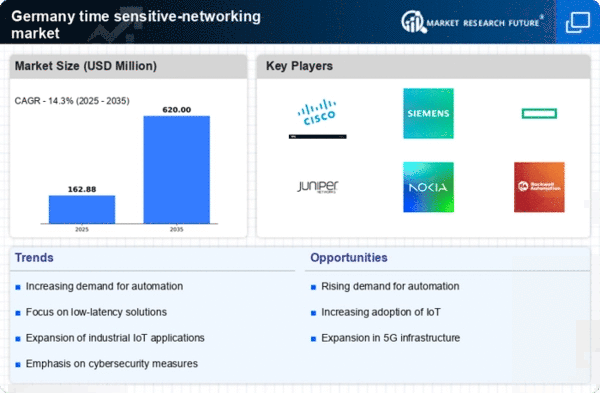
As per Market Research Future analysis, the Germany Time Sensitive Networking Market size was estimated at 142.5 USD Million in 2024. The Time Sensitive-networking market is projected to grow from 162.88 USD Million in 2025 to 620.0 USD Million by 2035, exhibiting a compound annual growth rate (CAGR) of 14% during the forecast period 2025 - 2035

Key Market Trends & Highlights

The Germany time sensitive-networking market is experiencing robust growth driven by technological advancements and increasing demand for real-time data processing.

  • The largest segment in the Germany time sensitive-networking market is industrial automation, reflecting a strong trend towards increased adoption.
  • Smart transportation solutions are emerging as the fastest-growing segment, indicating a shift towards innovative mobility solutions.
  • Standardization and interoperability are becoming focal points, suggesting a collective effort to enhance network efficiency across various applications.
  • Key market drivers include the growing demand for real-time data processing and advancements in network infrastructure, which are pivotal for market expansion.

Market Size & Forecast

2024 Market Size 142.5 (USD Million)
2035 Market Size 620.0 (USD Million)
CAGR (2025 - 2035) 14.3%

Major Players

Cisco Systems (US), Siemens (DE), Hewlett Packard Enterprise (US), Juniper Networks (US), Nokia (FI), Rockwell Automation (US), Moxa (TW), Belden (US)

Our Impact
Enabled $4.3B Revenue Impact for Fortune 500 and Leading Multinationals
Partnering with 2000+ Global Organizations Each Year
30K+ Citations by Top-Tier Firms in the Industry

Germany Time Sensitive Networking Market Trends

The Germany Time Sensitive Networking Market is currently experiencing notable growth, driven by the increasing demand for real-time data transmission across various sectors. Industries such as manufacturing, automotive, and telecommunications are adopting this technology to enhance operational efficiency and reduce latency. The integration of time sensitive networking into existing infrastructures appears to be a priority for many organizations, as they seek to leverage its capabilities for improved performance. Furthermore, advancements in network protocols and standards are likely to facilitate broader adoption, enabling seamless communication between devices and systems. As a result, the market is poised for expansion, with stakeholders investing in research and development to innovate and refine their offerings. In addition, the regulatory environment in Germany is evolving to support the growth of the time sensitive-networking market. Government initiatives aimed at fostering technological innovation and digital transformation are likely to create a conducive atmosphere for market players. Collaboration between public and private sectors may enhance the development of standards and best practices, ensuring interoperability and security. This collaborative approach could potentially accelerate the deployment of time sensitive networking solutions, positioning Germany as a leader in this domain. Overall, the market's trajectory suggests a promising future, characterized by continuous advancements and increasing adoption across various industries.

Increased Adoption in Industrial Automation

The The time sensitive-networking market is experiencing a surge in adoption within the industrial automation sector. Companies are increasingly implementing this technology to streamline operations, enhance machine-to-machine communication, and improve overall productivity. The ability to transmit data with minimal delay is crucial for automated processes, making time sensitive networking an attractive solution for manufacturers.

Focus on Standardization and Interoperability

Standardization efforts are gaining momentum in the time sensitive-networking market, as stakeholders recognize the importance of interoperability among devices and systems. Collaborative initiatives among industry players and regulatory bodies aim to establish common protocols and frameworks, which could facilitate smoother integration and deployment of time sensitive networking solutions.

Emergence of Smart Transportation Solutions

The time sensitive-networking market is increasingly influencing the development of smart transportation systems. As cities strive to enhance traffic management and improve public safety, the integration of time sensitive networking technologies is becoming essential. This trend suggests a growing recognition of the role that real-time data communication plays in optimizing transportation networks.

Germany Time Sensitive Networking Market Drivers

Rising Adoption of IoT Devices

The proliferation of Internet of Things (IoT) devices in Germany significantly impacts the time sensitive-networking market. With an estimated 30 million IoT devices expected to be operational by 2026, the demand for efficient networking solutions becomes paramount. These devices require low-latency communication to function effectively, which aligns with the capabilities offered by time sensitive networking technologies. As industries such as healthcare, transportation, and smart cities increasingly integrate IoT solutions, the time sensitive-networking market is positioned to grow substantially. This trend suggests a shift towards more interconnected systems, where timely data exchange is critical for operational success.

Advancements in Network Infrastructure

In Germany, advancements in network infrastructure significantly influence the time sensitive-networking market. The deployment of high-speed fiber optic networks and 5G technology enhances connectivity and reduces latency, which is crucial for time-sensitive applications. Reports indicate that investments in network infrastructure are expected to reach €10 billion by 2026, reflecting the commitment to improving communication networks. These enhancements enable industries to implement more sophisticated time sensitive networking solutions, thereby fostering innovation and efficiency. As the demand for reliable and fast communication grows, These infrastructural developments are likely to benefit the time sensitive-networking market.

Increased Focus on Cybersecurity Measures

The time sensitive-networking market in Germany is increasingly shaped by the heightened focus on cybersecurity measures. As industries adopt more interconnected systems, the risk of cyber threats escalates, prompting organizations to invest in robust security protocols. It is estimated that cybersecurity spending in Germany will exceed €6 billion by 2025, indicating a strong commitment to safeguarding network integrity. This emphasis on security not only protects sensitive data but also ensures the reliability of time sensitive networking applications. Consequently, the time sensitive-networking market must adapt to these security demands, integrating advanced cybersecurity features into their solutions.

Growing Demand for Real-Time Data Processing

The time sensitive-networking market in Germany is experiencing a notable surge in demand for real-time data processing capabilities. Industries such as manufacturing and telecommunications increasingly rely on instantaneous data transmission to enhance operational efficiency. This trend is evidenced by a projected growth rate of approximately 15% annually in sectors utilizing time sensitive networking solutions. The ability to process data in real-time allows organizations to make informed decisions swiftly, thereby improving productivity and reducing downtime. As companies seek to optimize their processes, the time sensitive-networking market becomes integral to their strategies, facilitating seamless communication and data flow across various applications.

Regulatory Support for Technological Innovation

Regulatory frameworks in Germany play a pivotal role in shaping the time sensitive-networking market. The government actively promotes technological innovation through various initiatives and funding programs aimed at enhancing digital infrastructure. For instance, the Digital Strategy 2025 outlines plans to invest €12 billion in digital transformation, which includes support for time sensitive networking technologies. This regulatory support encourages companies to adopt advanced networking solutions, fostering a conducive environment for growth. As regulations evolve to accommodate emerging technologies, the time sensitive-networking market is likely to expand, driven by both public and private sector investments.


Market Segment Insights

By Application: Industrial Automation (Largest) vs. Automotive (Fastest-Growing)

In the Germany time sensitive-networking market, the application segment showcases diverse distribution among key players. Industrial Automation takes the lead as the largest contributor, driven by the escalating demand for advanced manufacturing solutions and smart factories. Conversely, the Automotive sector is rapidly gaining traction, signaling a transition toward more connected and autonomous vehicles, thus enhancing its share within the market. Growth trends in the application segment reveal a dynamic landscape fueled by technological advancements and evolving industry needs. The surge in Industrial Automation is primarily propelled by Industry 4.0 initiatives, which emphasize automation and data exchange. Meanwhile, the Automotive sector is seeing accelerated growth due to increasing investments in electric and autonomous vehicles, pushing manufacturers to adopt time-sensitive networking solutions to improve communication and efficiency.

Industrial Automation (Dominant) vs. Automotive (Emerging)

Industrial Automation stands as the dominant force in the Germany time sensitive-networking market, characterized by robust integration of networking technologies to enhance operational efficiencies. This segment encompasses a range of applications from robotics to smart manufacturing, facilitating seamless communication and data transfer. On the other hand, the Automotive segment is emerging rapidly, primarily driven by the shift towards electric vehicles (EVs) and increased connectivity demands. Automotive applications now require real-time data processing and low-latency networking for enhanced vehicle-to-everything (V2X) communication. This growing emphasis on autonomous driving technologies positions the automotive segment as a vital contributor to the market's evolution, making it a key area for future investment and development.

By Network Protocol: IEEE 1588 (Largest) vs. IEEE 802.1Qbv (Fastest-Growing)

In the Germany time sensitive-networking market, IEEE 1588 holds the largest share, which is primarily driven by its capability to provide precise time synchronization critical for industrial applications. In contrast, IEEE 802.1Qbv is gaining traction due to the increasing demand for time-sensitive networking in various sectors, positioning itself as a rapidly growing component in this competitive landscape. The overall distribution reflects a clear preference for precision-based protocols. The growth trends in this segment are largely influenced by the rising adoption of IoT devices and the need for reliable communication in automation technologies. This market is also experiencing a shift as organizations strive for greater efficiency and lower latency, making protocols like IEEE 802.1Qci prominent by addressing emerging needs in network traffic management. As companies increasingly implement digital transformation initiatives, the importance of these protocols is set to surge in the near future.

IEEE 1588 (Dominant) vs. IEEE 802.1Qbv (Emerging)

IEEE 1588 is recognized as the dominant time synchronization protocol, well-established in various industries due to its ability to achieve high accuracy in time-sensitive applications. Its robustness has made it a preferred choice for sectors such as telecommunications and manufacturing, where timing is crucial. Conversely, IEEE 802.1Qbv is emerging as a significant player in the market, driven by its innovative approach to managing scheduled traffic in data networks. This protocol is increasingly adopted in environments where prioritized data flow is essential for operational efficiency. Both protocols, thus, cater to distinct needs: while IEEE 1588 ensures high precision, IEEE 802.1Qbv addresses the newer demands for dynamic control of network traffic.

By End Use: Manufacturing (Largest) vs. Telecommunications (Fastest-Growing)

In the Germany time sensitive-networking market, the distribution of market share across the end-use segments reveals that Manufacturing holds a substantial portion. This sector is primarily driven by the increasing demand for automation and Industry 4.0 initiatives, which are pushing the need for efficient networking solutions. Telecommunications, while smaller in market share, is experiencing significant growth as the need for faster and more reliable communication technologies expands, particularly with the rollout of 5G infrastructure. The growth trends within these segments indicate that Manufacturing is likely to maintain its dominant position due to ongoing investments in smart manufacturing solutions. Conversely, Telecommunications is emerging as a fast-growing sector thanks to heightened connectivity demands and advancements in technology. Factors such as increased mobile data consumption, the rise of Internet of Things (IoT) applications, and the expansion of cloud services are propelling growth in this segment, marking it as a key area to watch in the evolving market landscape.

Manufacturing: Dominant vs. Telecommunications: Emerging

Manufacturing stands out as the dominant segment in the Germany time sensitive-networking market, characterized by its robust emphasis on automation and efficiency. This segment benefits from a well-established infrastructure and significant investments in smart technology, which streamline operations and enhance productivity. In comparison, Telecommunications is recognized as an emerging segment, fueled by demands for advanced communication solutions and the integration of next-generation technologies. As organizations seek reliable networks to support IoT and high-speed connectivity, this segment is rapidly adapting to meet these needs. Both segments play crucial roles in the market, but their approaches and growth trajectories differ significantly.

By Component: Switches (Largest) vs. Software (Fastest-Growing)

In the component segment of the Germany time sensitive-networking market, switches dominate the landscape, capturing the largest share. Routers, while significant, follow behind, with software solutions emerging rapidly. The market's distribution reflects a strong preference for switches, essential for performance optimization and reliable connectivity. Meanwhile, increasing reliance on advanced software applications is driving the shift towards more integrated networking solutions. Growth trends indicate robust expansion in software, fueled by demands for automation and centralized network management. Organizations are increasingly adopting intelligent software solutions to enhance operational efficiency. Switches remain vital due to their ability to support higher bandwidth, while routers are evolving to handle advanced routing protocols. The convergence of these technologies is reshaping the competitive dynamics of the segment.

Switches (Dominant) vs. Software (Emerging)

Switches serve as the backbone of the component segment, delivering high-speed data transmission and connectivity essential for efficient network operations. Their status as the dominant component is attributed to their capability to handle substantial data loads with low latency. Conversely, software is emerging as a critical component, driven by the need for sophisticated network management tools. Its growth is supported by the increasing use of cloud computing and virtualization techniques within organizations. The juxtaposition of these two segment values illustrates a market in transition, where traditional hardware is complemented by innovative software solutions, enabling more adaptable and scalable networking environments.

Get more detailed insights about Germany Time Sensitive Networking Market

Key Players and Competitive Insights

The time sensitive-networking market in Germany is characterized by a dynamic competitive landscape, driven by the increasing demand for real-time data processing and low-latency communication across various sectors, including manufacturing, transportation, and telecommunications. Key players such as Cisco Systems (US), Siemens (DE), and Nokia (FI) are strategically positioned to leverage their technological expertise and extensive portfolios. Cisco Systems (US) focuses on innovation through its advanced networking solutions, while Siemens (DE) emphasizes digital transformation and smart manufacturing. Nokia (FI) is enhancing its offerings through partnerships and collaborations, particularly in 5G technology, which is crucial for time-sensitive applications. Collectively, these strategies contribute to a competitive environment that is increasingly focused on technological advancement and customer-centric solutions.In terms of business tactics, companies are localizing manufacturing and optimizing supply chains to enhance operational efficiency and responsiveness to market demands. The market structure appears moderately fragmented, with several key players exerting influence over specific segments. This fragmentation allows for niche players to emerge, yet the collective strength of major companies shapes the overall competitive dynamics, fostering innovation and collaboration.

In October Cisco Systems (US) announced a strategic partnership with a leading German automotive manufacturer to develop next-generation networking solutions tailored for autonomous vehicles. This collaboration is significant as it positions Cisco at the forefront of the automotive sector's digital transformation, potentially enhancing its market share in a rapidly evolving industry.

In September Siemens (DE) launched a new suite of time-sensitive networking solutions aimed at optimizing industrial automation processes. This initiative underscores Siemens' commitment to integrating advanced networking capabilities into its existing product lines, thereby reinforcing its competitive edge in the manufacturing sector. The launch is expected to drive increased adoption of smart factory technologies, aligning with global trends towards Industry 4.0.

In August Nokia (FI) expanded its partnership with a major telecommunications provider in Germany to enhance 5G network capabilities. This strategic move is likely to bolster Nokia's position in the telecommunications market, facilitating the deployment of time-sensitive applications that require ultra-reliable low-latency communication. Such advancements are crucial for sectors like healthcare and smart cities, where real-time data transmission is paramount.

As of November current competitive trends in the time sensitive-networking market include a pronounced focus on digitalization, sustainability, and the integration of artificial intelligence (AI) into networking solutions. Strategic alliances are increasingly shaping the landscape, enabling companies to pool resources and expertise to address complex challenges. Looking ahead, competitive differentiation is expected to evolve, with a shift from price-based competition towards innovation, technology, and supply chain reliability becoming paramount. This transition suggests that companies that prioritize technological advancements and sustainable practices will likely emerge as leaders in the market.

Key Companies in the Germany Time Sensitive Networking Market include

Industry Developments

The Germany Time Sensitive Networking Market has been experiencing notable developments in recent months.

Siemens introduced an advanced industrial automation platform that is TSN-enabled in March 2025. This platform is intended to enhance the efficacy of manufacturing and improve real-time data communication in German factories. Hirschmann (Belden) collaborated with a prominent German automotive manufacturer in May 2025 to establish a networking infrastructure that is capable of supporting TSN. 

This infrastructure will facilitate the automation of vehicle production and the coordination of operations. New TSN-compliant switches with enhanced latency and reliability features were introduced by Cisco Systems in July 2025, with an emphasis on the industrial and smart infrastructure sectors of Germany.

Future Outlook

Germany Time Sensitive Networking Market Future Outlook

The time sensitive-networking market in Germany is projected to grow at a 14.3% CAGR from 2025 to 2035, driven by technological advancements and increasing demand for real-time data processing.

New opportunities lie in:

  • Development of low-latency communication solutions for industrial automation.
  • Integration of AI-driven analytics in network management systems.
  • Expansion of time-sensitive applications in smart transportation systems.

By 2035, the market is expected to achieve substantial growth, positioning itself as a leader in real-time networking solutions.

Market Segmentation

Germany Time Sensitive Networking Market End Use Outlook

  • Manufacturing
  • Transportation
  • Telecommunications

Germany Time Sensitive Networking Market Component Outlook

  • Switches
  • Routers
  • Software

Germany Time Sensitive Networking Market Application Outlook

  • Industrial Automation
  • Automotive
  • Aerospace
  • Smart Grids

Germany Time Sensitive Networking Market Network Protocol Outlook

  • IEEE 802.1Qbv
  • IEEE 802.1Qci
  • IEEE 1588

Report Scope

MARKET SIZE 2024 142.5(USD Million)
MARKET SIZE 2025 162.88(USD Million)
MARKET SIZE 2035 620.0(USD Million)
COMPOUND ANNUAL GROWTH RATE (CAGR) 14.3% (2025 - 2035)
REPORT COVERAGE Revenue Forecast, Competitive Landscape, Growth Factors, and Trends
BASE YEAR 2024
Market Forecast Period 2025 - 2035
Historical Data 2019 - 2024
Market Forecast Units USD Million
Key Companies Profiled Cisco Systems (US), Siemens (DE), Hewlett Packard Enterprise (US), Juniper Networks (US), Nokia (FI), Rockwell Automation (US), Moxa (TW), Belden (US)
Segments Covered Application, Network Protocol, End Use, Component
Key Market Opportunities Integration of advanced automation in time sensitive-networking market enhances operational efficiency and reduces latency.
Key Market Dynamics Growing demand for low-latency applications drives innovation in time sensitive-networking technologies and solutions.
Countries Covered Germany
Leave a Comment

FAQs

What is the expected market size of the Germany Time Sensitive Networking Market in 2024?

The Germany Time Sensitive Networking Market is expected to be valued at 114.0 million USD in 2024.

How much is the Germany Time Sensitive Networking Market projected to grow by 2035?

By 2035, the Germany Time Sensitive Networking Market is anticipated to reach a value of 500.0 million USD.

What is the expected CAGR for the Germany Time Sensitive Networking Market from 2025 to 2035?

The expected CAGR for the Germany Time Sensitive Networking Market from 2025 to 2035 is 14.385%.

Which application segment is anticipated to dominate the market by 2035?

The Industrial Automation segment is projected to dominate the market, valued at 140.0 million USD in 2035.

What is the market value for the Automotive application in 2024 and 2035?

The Automotive application is valued at 25.0 million USD in 2024 and is expected to reach 110.0 million USD by 2035.

Which key players are currently operating in the Germany Time Sensitive Networking Market?

Major players include Hirschmann, Belden, Cisco, Hewlett Packard Enterprise, and Siemens.

What are the expected market values for the Aerospace application segment in 2024 and 2035?

The Aerospace application is valued at 20.0 million USD in 2024 and is projected to be 90.0 million USD in 2035.

How much is the Smart Grids application segment expected to grow by 2035?

The Smart Grids application is forecasted to grow from 39.0 million USD in 2024 to 160.0 million USD in 2035.

What is the growth trend expected for the Germany Time Sensitive Networking Market?

The market is expected to experience robust growth driven by increased demand for automation and connectivity.

What challenges does the Germany Time Sensitive Networking Market face in its growth?

Challenges include evolving technology standards and integration issues within existing infrastructure.

Download Free Sample

Kindly complete the form below to receive a free sample of this Report

Compare Licence

×
Features License Type
Single User Multiuser License Enterprise User
Price $4,950 $5,950 $7,250
Maximum User Access Limit 1 User Upto 10 Users Unrestricted Access Throughout the Organization
Free Customization
Direct Access to Analyst
Deliverable Format
Platform Access
Discount on Next Purchase 10% 15% 15%
Printable Versions