×
Request Free Sample ×

Kindly complete the form below to receive a free sample of this Report

* Please use a valid business email

Leading companies partner with us for data-driven Insights

clients tt-cursor
Hero Background

Germany Text To Speech Market

ID: MRFR/ICT/61573-HCR
200 Pages
Aarti Dhapte
February 2026

Germany Text to Speech Market Size, Share and Trends Analysis Report By Type (Non-Neural, Neural, Custom), By Component (Software/Solution, Services), By Language (English, Spanish, Arabic, Chinese, Others), By Deployment Mode (Cloud based, On-Premise), By Organization (Small, Medium Enterprise, Large Enterprise) and By End-Use (Consumer, Healthcare, Automotive & Transportation, Education, BFSI, Assistant tool for visually impaired or disabilities, Travel and Hospitality, Retail, Enterprise)- Forecast to 2035

Share:
Download PDF ×

We do not share your information with anyone. However, we may send you emails based on your report interest from time to time. You may contact us at any time to opt-out.

Germany Text To Speech Market Infographic
Purchase Options

Germany Text To Speech Market Summary

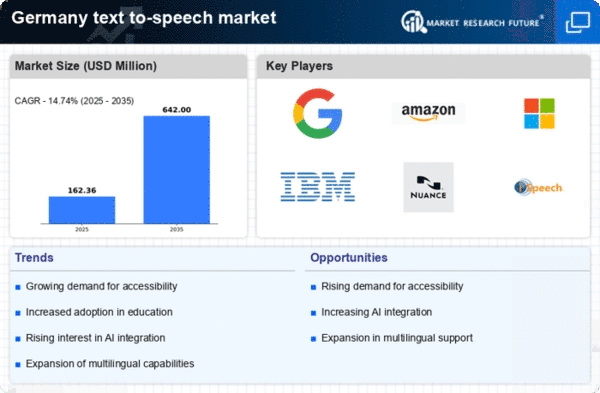
As per Market Research Future analysis, the Germany text to-speech market size was estimated at 141.5 USD Million in 2024. The Germany text to-speech market is projected to grow from 162.36 USD Million in 2025 to 642.0 USD Million by 2035, exhibiting a compound annual growth rate (CAGR) of 14.7% during the forecast period 2025 - 2035

Key Market Trends & Highlights

The Germany text to-speech market is experiencing robust growth driven by technological advancements and increasing demand for accessibility.

  • The largest segment in the Germany text to-speech market is the e-learning sector, which is witnessing heightened adoption rates.
  • Integration with smart technologies is becoming a prominent trend, enhancing user interaction and engagement.
  • The fastest-growing segment is the voice-activated applications, reflecting a shift towards more intuitive user experiences.
  • Market drivers include the rising adoption of e-learning platforms and advancements in AI and machine learning, which are propelling market expansion.

Market Size & Forecast

2024 Market Size 141.5 (USD Million)
2035 Market Size 642.0 (USD Million)
CAGR (2025 - 2035) 14.74%

Major Players

Google (US), Amazon (US), Microsoft (US), IBM (US), Nuance Communications (US), iSpeech (US), Acapela Group (BE), Cepstral (US), ReadSpeaker (NL)

Our Impact
Enabled $4.3B Revenue Impact for Fortune 500 and Leading Multinationals
Partnering with 2000+ Global Organizations Each Year
30K+ Citations by Top-Tier Firms in the Industry

Germany Text To Speech Market Trends

The text to-speech market is experiencing notable growth, driven by advancements in artificial intelligence and machine learning technologies. In Germany, the demand for voice synthesis solutions is increasing across various sectors, including education, healthcare, and entertainment. This trend is largely attributed to the rising need for accessibility features, enabling individuals with visual impairments or reading difficulties to engage with digital content more effectively. Furthermore, the integration of text to-speech capabilities into smart devices and applications is enhancing user experiences, making technology more intuitive and user-friendly. Moreover, the regulatory landscape in Germany is evolving to support the adoption of text to-speech technologies. Government initiatives aimed at promoting digital inclusion are likely to bolster the market further. As organizations recognize the importance of providing accessible content, investments in text to-speech solutions are expected to rise. This shift not only aligns with societal needs but also presents opportunities for innovation within the industry. Overall, the text to-speech market appears poised for continued expansion, reflecting broader trends in technology and accessibility.

Increased Demand for Accessibility Solutions

The text to-speech market is witnessing a surge in demand for accessibility solutions. This trend is particularly relevant in Germany, where organizations are prioritizing inclusivity. The need for tools that assist individuals with disabilities is driving investments in voice synthesis technologies, ensuring that digital content is accessible to all.

Integration with Smart Technologies

There is a growing trend of integrating text to-speech functionalities into smart technologies. In Germany, this integration enhances user interaction with devices, making them more responsive and user-friendly. As smart home devices and applications become commonplace, the role of text to-speech in facilitating communication is becoming increasingly vital.

Focus on Multilingual Capabilities

The text to-speech market is shifting towards multilingual capabilities, reflecting Germany's diverse linguistic landscape. Companies are recognizing the importance of catering to various language speakers, which is likely to enhance user engagement and broaden market reach. This focus on multilingualism may lead to the development of more sophisticated voice synthesis solutions.

Germany Text To Speech Market Drivers

Growth in Voice-Activated Applications

The proliferation of voice-activated applications in Germany is significantly influencing the text to-speech market. As consumers increasingly prefer hands-free interactions with devices, businesses are integrating text to-speech functionalities into their applications. This trend is particularly evident in sectors such as customer service, where automated responses enhance user experience. The market for voice-activated applications is expected to grow at a CAGR of around 20% through 2025, suggesting a strong inclination towards voice technology. Consequently, the text to-speech market is likely to see heightened demand as companies strive to improve user engagement and streamline operations through voice-enabled solutions.

Increased Focus on Customer Experience

In Germany, there is a growing emphasis on enhancing customer experience across various industries, which is driving the text to-speech market. Companies are recognizing the importance of providing seamless interactions with customers, and text to-speech technology plays a crucial role in achieving this goal. By integrating this technology into customer service platforms, businesses can offer personalized and efficient responses, thereby improving satisfaction rates. As customer experience becomes a key differentiator in competitive markets, the text to-speech market is likely to see increased investments and innovations aimed at enhancing user interactions and engagement.

Advancements in AI and Machine Learning

Technological advancements in artificial intelligence (AI) and machine learning are reshaping the text to-speech market in Germany. These innovations enable the development of more natural-sounding voices and improved pronunciation, enhancing user experience. As AI continues to evolve, the capabilities of text to speech systems are expanding, allowing for greater customization and personalization. The investment in AI technologies in Germany is projected to exceed €10 billion by 2025, indicating a strong commitment to innovation. This growth in AI is likely to propel the text to-speech market forward, as businesses seek to leverage these advancements to create more engaging and effective communication tools.

Rising Adoption of E-Learning Platforms

The text to-speech market in Germany is experiencing a notable surge due to the increasing adoption of e-learning platforms. Educational institutions are integrating text to-speech technology to enhance learning experiences for students, particularly those with learning disabilities. This technology allows for the conversion of written content into spoken words, making educational materials more accessible. In 2025, the e-learning market in Germany is projected to reach approximately €7 billion, indicating a robust growth trajectory. As educational institutions prioritize inclusivity, the demand for text to-speech solutions is likely to rise, thereby driving the market forward. The text to-speech market is poised to benefit from this trend as more educational entities seek to implement these technologies to cater to diverse learning needs.

Regulatory Support for Accessibility Initiatives

The text to-speech market in Germany is benefiting from regulatory support aimed at promoting accessibility initiatives. Government policies are increasingly mandating that digital content be accessible to individuals with disabilities, which includes the implementation of text to-speech technologies. This regulatory environment encourages businesses to adopt solutions that comply with accessibility standards, thereby expanding the market. In 2025, it is anticipated that compliance-related investments in accessibility technologies will reach €1 billion in Germany. As organizations strive to meet these regulations, the text to-speech market is likely to experience significant growth, driven by the need for compliant and inclusive solutions.


Market Segment Insights

By Type: Neural (Largest) vs. Custom (Fastest-Growing)

In the Germany text to-speech market, the distribution of market share among segment values reveals a strong preference for neural technologies, which are driving the majority of revenue in this space. Non-neural solutions, while still relevant, are seeing a decline as more users shift towards the enhanced capabilities of neural systems that provide more natural-sounding speech. Custom solutions are gaining traction as businesses seek tailored voice solutions to meet specific branding and customer engagement needs. Growth trends in this segment are predominantly shaped by the increasing demand for more realistic and personalized TTS applications. As AI technologies evolve, neural TTS is becoming more sophisticated, expanding its use in various sectors including education, gaming, and customer support. Meanwhile, the custom TTS segment is witnessing rapid adoption as companies recognize the value of unique voice branding, making it an emerging focus area within the industry.

Neural (Dominant) vs. Custom (Emerging)

Neural TTS stands as the dominant force in the German market, characterized by its ability to produce human-like speech patterns and emotional intonations. This technology leverages deep learning models that adapt to various linguistic nuances, making it invaluable for applications requiring high-quality voice output. On the other hand, custom TTS solutions are emerging as a crucial segment for businesses looking to differentiate their services. By offering proprietary voice options tailored to specific brand identities, companies engage their customers on a more personal level. The synergy between the established neural technologies and the innovative custom solutions showcases a dynamic market landscape, where flexibility and quality are paramount.

By Component: Services (Largest) vs. Software/Solution (Fastest-Growing)

In the Germany text to-speech market, the segment is primarily divided between services and software/solution offerings. Services currently hold a significant majority of the market share due to their established presence and high demand from various industries requiring customized solutions. Conversely, software/solution offerings are emerging strongly, capturing interest for their scalability and versatility, making them a notable competitor in this space. The growth trends indicate that while services remain dominant, software/solution offerings are rapidly gaining traction, especially among tech-savvy businesses seeking automation and enhanced user experiences. Factors such as advancements in AI technology, increasing use of digital platforms, and the ongoing shift towards remote work are propelling the growth of software/solution segments. This trend shows a promising shift in how enterprises utilize text-to-speech technologies.

Services (Dominant) vs. Software/Solution (Emerging)

The services segment in the Germany text to-speech market is characterized by its strong reputation and a wide array of customizable solutions, making it the prominent choice for organizations looking for tailored integrations. Businesses often leverage service offerings to ensure compatibility with existing systems and to meet specific user requirements. On the other hand, the software/solution segment is viewed as an emerging player with a rapid growth trajectory, appealing particularly to startups and tech-minded enterprises. This segment thrives on innovation, offering user-friendly interfaces and cloud-based solutions that facilitate ease of access and integration. As the market evolves, both segments are expected to coexist, appealing to different customer needs and preferences.

By Language: English (Largest) vs. Spanish (Fastest-Growing)

The Germany text to-speech market showcases a diverse language segmentation, with English leading the market share significantly. Following English, Spanish has increasingly gained traction among users, complemented by Arabic and Chinese, which represent niche yet growing segments. The 'Others' category also captures various languages, contributing to the overall richness and complexity of this market. The growth of the language segment has been significantly influenced by the expansion of digital content and increasing user demand for multilingual capabilities. English, being the dominant language, continues to receive substantial investment. Meanwhile, Spanish stands out as the fastest-growing language, driven by increasing Spanish-speaking populations and globalization trends, making it a focal point for TTS development in the near future.

English (Dominant) vs. Arabic (Emerging)

In the Germany text to-speech market, English remains the dominant language, primarily due to its widespread use in business and media. Its established position ensures a robust user base and consistent advancements in TTS technology tailored to its nuances. On the other hand, Arabic is emerging as a significant player in the market, largely fueled by the growing number of Arabic-speaking individuals in various sectors. This shift reflects an increasing demand for TTS solutions that accommodate diverse linguistic needs, enhancing accessibility and user experiences across different platforms. As developers focus on refining Arabic TTS capabilities, the market dynamics continue to evolve.

By Deployment Mode: Cloud Based (Largest) vs. On-Premise (Fastest-Growing)

In the Germany text to-speech market, the distribution of deployment mode reveals a clear preference for cloud-based solutions, which hold the largest market share. This preference is driven by the increased availability of high-speed internet and the flexibility offered by cloud services. On-premise solutions, while smaller in share, are gaining traction among enterprises needing stringent data security or integration with existing IT infrastructure. The growth trends in this segment point towards a rising demand for cloud-based text to speech due to its scalability and accessibility. Contributing factors include the increasing adoption of AI-driven applications and the shift towards remote work. Meanwhile, the on-premise segment is expected to grow faster, driven by industries that prioritize data control and privacy, thus marking it as the fastest-growing sector.

Deployment Mode: Cloud Based (Dominant) vs. On-Premise (Emerging)

Cloud-based deployment in the Germany text to-speech market is characterized by its dominance, thanks largely to its cost-effectiveness and ease of integration with other digital services. This model allows users to access advanced speech synthesis technology without the need for heavy upfront investment in hardware or software. Conversely, the on-premise deployment mode, while currently smaller, is emerging as a strong contender, particularly for businesses that require bespoke solutions and robust data governance. This model appeals to sectors like finance and healthcare, where compliance with regulatory standards is critical. The dual growth of both models illustrates a diversified market catering to various business needs.

By Organization: Small Enterprise (Largest) vs. Large Enterprise (Fastest-Growing)

In the Germany text to-speech market, the segment distribution reveals that small enterprises hold the largest share, primarily due to their agile adoption of technology and focus on tailored solutions for niche applications. Meanwhile, large enterprises are witnessing significant uptake, driven by their expansive resources and capability to integrate advanced text to-speech solutions across various sectors. This distribution highlights the distinct strategies applied by different organization sizes to leverage market opportunities. The growth trends within the organization segment showcase small enterprises benefiting from innovative use cases that demand personalized text to speech applications, such as customer service automation. Conversely, large enterprises are experiencing rapid growth largely fuelled by their investments in enterprise-level solutions that cater to diverse industries, enhancing customer engagement and operational efficiency. This contrast in growth trajectories highlights the adaptive strategies of varying organizational sizes in the evolving market landscape.

Small Enterprise: Dominant vs. Large Enterprise: Emerging

The small enterprise segment in the Germany text to-speech market is characterized by its flexibility and quick adaptation to market needs. These organizations often prioritize affordability and customization, making advanced text to-speech technology accessible for smaller projects. On the other hand, large enterprises, while emerging in this specific domain, possess extensive operational scales and resources that allow them to implement comprehensive text to-speech systems. Their focus tends to lie in enhancing user experience and streamlining operations through sophisticated integrations. As these two segments vie for traction, small enterprises continue to dominate with their innovative approaches, while large enterprises are strategically positioning themselves to capture emerging opportunities in a rapidly evolving technological landscape.

By End-Use: Consumer (Largest) vs. Healthcare (Fastest-Growing)

The Germany text to-speech market is significantly influenced by its end-use segments, with Consumer applications holding the largest market share. Within this segment, various applications, such as personal assistance and content consumption, dominate the landscape. Other noteworthy mentions include Healthcare, Automotive, and Education, which are gradually increasing their market presence through innovation and integration with new technologies. The growth trends in the Germany text to-speech market reveal a robust demand in the Healthcare sector, attributed to advancements in digital health solutions and assistive technologies. The integration of artificial intelligence is also fostering rapid growth in sectors like Automotive and Transportation. Additionally, Consumer applications remain vital, driven by the rising adoption of smart devices and virtual assistants, enhancing their market positions rapidly.

Consumer (Dominant) vs. Healthcare (Emerging)

The Consumer segment in the Germany text to-speech market is characterized by its extensive applications ranging from virtual assistants to audiobooks, making it the dominant force due to the vast user base and high demand for personalized experiences. Conversely, the Healthcare segment is emerging with innovative solutions aimed at enhancing patient care through speech recognition and transcription services. This segment focuses on accessibility and efficiency, catering to the needs of healthcare professionals and patients alike. While the Consumer segment thrives on broad adoption and ease of use, the Healthcare segment is steadily gaining traction by leveraging technological advancements that cater to specific healthcare requirements.

Get more detailed insights about Germany Text To Speech Market

Key Players and Competitive Insights

The text to-speech market in Germany is characterized by a dynamic competitive landscape, driven by rapid technological advancements and increasing demand for voice-enabled applications. Major players such as Google (US), Amazon (US), and Microsoft (US) are at the forefront, leveraging their extensive resources to innovate and enhance their offerings. Google (US) focuses on integrating its text-to-speech technology into various applications, thereby enhancing user experience and accessibility. Amazon (US), through its AWS platform, emphasizes scalability and customization, catering to diverse business needs. Meanwhile, Microsoft (US) is investing heavily in AI-driven solutions, aiming to provide more natural and context-aware speech synthesis, which positions it competitively in the market.The business tactics employed by these companies reflect a trend towards localization and supply chain optimization. The market appears moderately fragmented, with a mix of established players and emerging startups. This structure allows for a competitive environment where innovation and customer-centric solutions are paramount. The collective influence of these key players shapes market dynamics, as they continuously adapt to consumer preferences and technological advancements.

In October Google (US) announced a partnership with a leading automotive manufacturer to integrate its text-to-speech technology into in-car systems. This strategic move is likely to enhance user interaction and safety, as drivers can access navigation and communication features hands-free. Such collaborations indicate a growing trend towards embedding voice technology in everyday applications, thereby expanding market reach.

In September Amazon (US) unveiled a new suite of tools within its AWS platform aimed at developers, allowing for more seamless integration of text-to-speech capabilities into applications. This initiative not only strengthens Amazon's position in the market but also reflects a broader trend of empowering developers to create customized solutions, which could lead to increased adoption across various sectors.

In August Microsoft (US) launched an updated version of its Azure Cognitive Services, which includes enhanced text-to-speech features that utilize advanced neural networks. This upgrade is significant as it promises to deliver more human-like voice outputs, potentially attracting businesses seeking to improve customer engagement through more natural interactions. Such advancements underscore the importance of continuous innovation in maintaining competitive advantage.

As of November the text to-speech market is witnessing trends that emphasize digitalization, sustainability, and AI integration. Strategic alliances are increasingly shaping the competitive landscape, as companies recognize the value of collaboration in driving innovation. Looking ahead, competitive differentiation is likely to evolve, with a shift from price-based competition to a focus on technological innovation and supply chain reliability. This transition suggests that companies will need to prioritize not only the quality of their offerings but also the efficiency of their operations to remain competitive.

Key Companies in the Germany Text To Speech Market include

Industry Developments

Recent developments in the Germany Text to Speech Market have shown notable activity among key players such as Voxygen, Nuance, and Amazon. In August 2023, Nuance launched updated voice models, which are significantly enhancing user experience and catering to diverse industries, including healthcare and automotive. The demand for multilingual capabilities continues to drive innovations, with Google and Microsoft investing heavily in Research and Development to bolster their offerings within this market. 

Current affairs highlight a growing trend towards integrating Text to Speech technology in customer service applications, as companies seek to improve user engagement and automate communication processes. In terms of mergers and acquisitions, Acapela Group announced in July 2023 its acquisition of a smaller competitor specializing in specific voice technologies, thereby expanding its market presence in Germany. 

Furthermore, a substantial market growth has been recorded, with some companies reporting increases in valuation by over 20 percent in the last two years, a direct impact of rising global demand for accessibility solutions. The German government has also been pushing initiatives to enhance digital services, further propelling the growth of Text to Speech applications across various sectors.

Future Outlook

Germany Text To Speech Market Future Outlook

The Text to speech Market in Germany is projected to grow at a 14.74% CAGR from 2025 to 2035, driven by advancements in AI, increased demand for accessibility, and integration in various applications.

New opportunities lie in:

  • Development of AI-driven personalized voice solutions for businesses
  • Expansion of text to-speech services in e-learning platforms
  • Integration of text to-speech technology in smart home devices

By 2035, the market is expected to achieve substantial growth, driven by innovative applications and increasing adoption.

Market Segmentation

Germany Text To Speech Market Type Outlook

  • Non-Neural
  • Neural
  • Custom

Germany Text To Speech Market End-Use Outlook

  • Introduction
  • Consumer
  • Healthcare
  • Automotive & Transportation
  • Education
  • BFSI
  • Assistant tool for visually impaired or disabilities
  • Travel and Hospitality
  • Retail
  • Enterprise
  • Others

Germany Text To Speech Market Language Outlook

  • English
  • Spanish
  • Arabic
  • Chinese
  • Others

Germany Text To Speech Market Component Outlook

  • Services
  • Software/Solution

Germany Text To Speech Market Organization Outlook

  • Small
  • Medium Enterprise
  • Large Enterprise

Germany Text To Speech Market Deployment Mode Outlook

  • Cloud based
  • On-Premise

Report Scope

MARKET SIZE 2024 141.5(USD Million)
MARKET SIZE 2025 162.36(USD Million)
MARKET SIZE 2035 642.0(USD Million)
COMPOUND ANNUAL GROWTH RATE (CAGR) 14.74% (2025 - 2035)
REPORT COVERAGE Revenue Forecast, Competitive Landscape, Growth Factors, and Trends
BASE YEAR 2024
Market Forecast Period 2025 - 2035
Historical Data 2019 - 2024
Market Forecast Units USD Million
Key Companies Profiled Google (US), Amazon (US), Microsoft (US), IBM (US), Nuance Communications (US), iSpeech (US), Acapela Group (BE), Cepstral (US), ReadSpeaker (NL)
Segments Covered Type, Component, Language, Deployment Mode, Organization, End-Use
Key Market Opportunities Integration of advanced artificial intelligence in the text to-speech market enhances user experience and accessibility.
Key Market Dynamics Rising demand for personalized text to-speech solutions drives innovation and competition in the market.
Countries Covered Germany
Leave a Comment

FAQs

What is the projected market size of the Germany Text to Speech Market in 2024?

The projected market size of the Germany Text to Speech Market in 2024 is valued at 156.8 million USD.

What will be the estimated market value of the Germany Text to Speech Market by 2035?

The estimated market value of the Germany Text to Speech Market by 2035 is expected to reach 871.2 million USD.

What is the expected CAGR for the Germany Text to Speech Market during the forecast period from 2025 to 2035?

The expected CAGR for the Germany Text to Speech Market from 2025 to 2035 is 16.871 percent.

Which type segment holds the largest market value in 2024 within the Germany Text to Speech Market?

The Neural type segment holds the largest market value in 2024 at 70.0 million USD.

What will the market value for the Non-Neural segment be in 2035?

The market value for the Non-Neural segment is expected to reach 200.0 million USD by 2035.

Who are the key players in the Germany Text to Speech Market?

Key players in the Germany Text to Speech Market include Amazon, Google, Microsoft, and Acapela Group, among others.

What challenges could affect the growth of the Germany Text to Speech Market?

Challenges affecting the growth could include technological limitations and competition among key players.

What is the expected market growth for the Custom segment by 2035?

The expected market growth for the Custom segment is to reach 221.2 million USD by 2035.

How is the demand for Text to Speech technology expected to evolve in Germany?

Demand for Text to Speech technology in Germany is expected to grow significantly, driven by advancements in AI and application expansions.

What impact might regional developments have on the Germany Text to Speech Market?

Regional developments could enhance innovation and increase adoption rates in various sectors, further driving market growth.

Download Free Sample

Kindly complete the form below to receive a free sample of this Report

Compare Licence

×
Features License Type
Single User Multiuser License Enterprise User
Price $4,950 $5,950 $7,250
Maximum User Access Limit 1 User Upto 10 Users Unrestricted Access Throughout the Organization
Free Customization
Direct Access to Analyst
Deliverable Format
Platform Access
Discount on Next Purchase 10% 15% 15%
Printable Versions