×
Request Free Sample ×

Kindly complete the form below to receive a free sample of this Report

* Please use a valid business email

Leading companies partner with us for data-driven Insights

clients tt-cursor
Hero Background

Germany Sugar Free Chocolate Market

ID: MRFR/FnB/56174-HCR
128 Pages
Snehal Singh
February 2026

Germany Sugar-Free Chocolate Market Size, Share, Industry Trend & Analysis Research Report By Main Ingredients (Cocoa Beans, Sugar Substitute, Cocoa Butter, Fat & Oil, Cocoa Liquor, Others), By Category (100% Sugar Free, No Added Sugar), By Type (Dark, Milk, White) andBy Distribution Channel (Store Based, Non-Store Based)- Forecast to 2035

Share:
Download PDF ×

We do not share your information with anyone. However, we may send you emails based on your report interest from time to time. You may contact us at any time to opt-out.

Germany Sugar Free Chocolate Market Infographic
Purchase Options

Germany Sugar Free Chocolate Market Summary

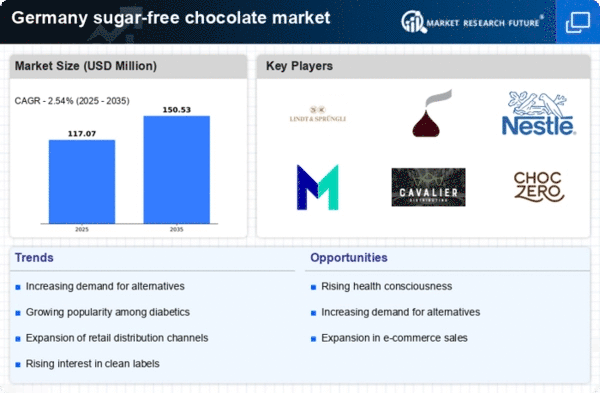
As per Market Research Future analysis, the Germany sugar-free chocolate market size was estimated at 114.17 USD Million in 2024. The Germany sugar free-chocolate market is projected to grow from 117.07 USD Million in 2025 to 150.53 USD Million by 2035, exhibiting a compound annual growth rate (CAGR) of 2.5% during the forecast period 2025 - 2035

Key Market Trends & Highlights

The Germany sugar-free chocolate market is experiencing robust growth driven by health trends and innovative offerings.

  • Health consciousness is significantly driving demand for sugar free-chocolate products in Germany.
  • The largest segment in this market is the premium sugar free-chocolate, while the fastest-growing segment is the organic sugar free-chocolate.
  • Retail channels are expanding, with e-commerce playing a crucial role in increasing product availability.
  • Rising health awareness and regulatory support for healthier options are key drivers propelling market growth.

Market Size & Forecast

2024 Market Size 114.17 (USD Million)
2035 Market Size 150.53 (USD Million)
CAGR (2025 - 2035) 2.54%

Major Players

Lindt & Sprüngli (CH), Hershey's (US), Nestlé (CH), Mars (US), Cavalier (BE), ChocZero (US), Alter Eco (US), Ghirardelli (US)

Our Impact
Enabled $4.3B Revenue Impact for Fortune 500 and Leading Multinationals
Partnering with 2000+ Global Organizations Each Year
30K+ Citations by Top-Tier Firms in the Industry

Germany Sugar Free Chocolate Market Trends

The sugar-free chocolate market is experiencing notable growth, driven by increasing health consciousness among consumers. In Germany, a shift towards healthier lifestyles has led to a rising demand for products that cater to dietary restrictions, such as sugar-free options. This trend is further supported by a growing awareness of the health risks associated with excessive sugar consumption, prompting consumers to seek alternatives that align with their wellness goals. As a result, manufacturers are innovating to create a diverse range of sugar-free chocolates that appeal to various taste preferences and dietary needs. Moreover, the sugar free-chocolate market is witnessing a surge in product availability across retail channels. Supermarkets, health food stores, and online platforms are expanding their offerings to include a wider selection of sugar-free chocolates. This increased accessibility is likely to attract a broader consumer base, including those who may not have previously considered sugar-free options. Additionally, marketing strategies emphasizing the health benefits of sugar-free chocolates are becoming more prevalent, further enhancing consumer interest and engagement. Overall, the landscape of the sugar free-chocolate market in Germany appears to be evolving rapidly, reflecting changing consumer preferences and a commitment to healthier choices.

Health Consciousness Driving Demand

The rising awareness of health issues related to sugar consumption is significantly influencing consumer choices. Many individuals are actively seeking sugar-free alternatives to satisfy their sweet cravings without compromising their health. This trend is particularly pronounced among those with dietary restrictions, such as diabetics and individuals following low-carb diets.

Innovative Product Development

Manufacturers are increasingly focusing on innovation to create appealing sugar-free chocolate products. This includes the use of natural sweeteners and unique flavor combinations that enhance the overall taste experience. Such developments are essential for attracting health-conscious consumers who desire indulgent treats without the associated guilt.

Expansion of Retail Channels

The availability of sugar-free chocolates is expanding across various retail platforms. Supermarkets, specialty health stores, and e-commerce sites are enhancing their selections, making it easier for consumers to access these products. This trend is likely to increase market penetration and encourage more consumers to explore sugar-free options.

Germany Sugar Free Chocolate Market Drivers

Rising Health Awareness

The increasing awareness of health issues among consumers in Germany appears to be a primary driver for the sugar free-chocolate market. As individuals become more conscious of their dietary choices, the demand for healthier alternatives, such as sugar free chocolates, is likely to rise. Reports indicate that approximately 30% of German consumers actively seek out sugar free products, reflecting a shift towards healthier lifestyles. This trend is further supported by the growing prevalence of diabetes and obesity, which has prompted many to reduce sugar intake. Consequently, manufacturers are responding by innovating and expanding their sugar free offerings, thereby enhancing the overall appeal of the sugar free-chocolate market.

Diverse Consumer Preferences

The sugar free-chocolate market is experiencing growth due to the diverse preferences of consumers in Germany. With a rising number of individuals following specific dietary regimes, such as ketogenic or low-carb diets, the demand for sugar free options is likely to increase. Market data suggests that around 25% of German consumers are currently following a low-sugar diet, which directly influences their purchasing decisions. This trend indicates a shift towards products that align with personal health goals, thereby driving innovation and variety within the sugar free-chocolate market. Manufacturers are thus motivated to cater to these preferences by offering a wider range of flavors and formulations.

Increased Availability in E-commerce

The expansion of e-commerce platforms in Germany is likely to enhance the accessibility of sugar free chocolates. As online shopping continues to gain traction, consumers are increasingly turning to digital channels for their grocery needs. Data indicates that online grocery sales in Germany have surged by over 15% in recent years, suggesting a shift in consumer behavior. This trend is particularly beneficial for niche markets, such as sugar free chocolates, which may not be as readily available in traditional retail settings. The convenience of online shopping, coupled with targeted marketing strategies, appears to be driving growth in the sugar free-chocolate market.

Growing Interest in Clean Label Products

The trend towards clean label products is becoming increasingly prominent in Germany, influencing the sugar free-chocolate market. Consumers are showing a preference for products with transparent ingredient lists and minimal processing. This shift is likely driven by a desire for healthier, more natural options. Approximately 40% of German consumers express a preference for clean label products, which may include sugar free chocolates made with natural sweeteners. As a result, manufacturers are adapting their formulations to meet these expectations, thereby enhancing the appeal of the sugar free-chocolate market. This focus on clean labels not only aligns with consumer preferences but also supports the overall health trend.

Regulatory Support for Healthier Options

Government initiatives aimed at promoting healthier eating habits are likely to bolster the sugar free-chocolate market in Germany. Regulatory bodies have introduced guidelines that encourage food manufacturers to reduce sugar content in their products. This regulatory environment appears to create a favorable landscape for sugar free alternatives, as companies are incentivized to develop and market these products. For instance, the German government has set targets to reduce sugar consumption by 20% by 2025, which may lead to increased availability and visibility of sugar free chocolates in retail outlets. Such measures not only support public health but also stimulate growth within the sugar free-chocolate market.


Market Segment Insights

By Main Ingredients: Cocoa Beans (Largest) vs. Sugar Substitute (Fastest-Growing)

In the Germany sugar free-chocolate market, Cocoa Beans hold a significant portion of the market share due to their essential role in providing the rich taste and texture associated with chocolate. The presence of traditional cocoa flavors alongside the rising interest in health-conscious alternatives helps to maintain Cocoa Beans as a dominant ingredient. In contrast, the Sugar Substitute segment has emerged as a vital player, rapidly gaining a share as consumers increasingly seek products that offer lower sugar levels without sacrificing sweetness. Growth trends in this market are driven by a rising consumer demand for healthier snacking options, particularly those that align with low-sugar and keto diets. As innovation in artificial and natural sweeteners continues, Sugar Substitutes are finding broader applications in various chocolate formulations. Brands focusing on clean labels and transparency are also aiding the growth of Sugar Substitutes, appealing to a more health-conscious demographic that prioritizes nutrition alongside indulgence.

Cocoa Beans (Dominant) vs. Sugar Substitute (Emerging)

Cocoa Beans serve as the backbone of the chocolate-making process, ensuring that products maintain a rich chocolate flavor that consumers expect. Their established position in the market makes them a dominant choice for manufacturers who aim for authenticity in taste while still catering to health trends by minimizing sugar content. On the other hand, the Sugar Substitute segment represents the emerging trend within the Germany sugar free-chocolate market, characterized by innovation and a variety of options ranging from stevia to erythritol. This segment appeals to consumers looking for guilt-free indulgence, driving the growth of sugar-free chocolates and enabling brands to formulate products that meet advanced health guidelines while satisfying diverse taste preferences.

By Category: No Added Sugar (Largest) vs. 100% Sugar Free (Fastest-Growing)

In the Germany sugar free-chocolate market, the distribution of market share among the primary segment values shows that 'No Added Sugar' holds a significant portion, catering to consumers who are looking for healthier indulgences without compromising on taste. This segment has established strong brand loyalty and recognition, making it a preferred choice among health-conscious consumers. Conversely, the '100% Sugar Free' segment is attracting a growing segment of consumers who are increasingly concerned about calories and overall sugar intake, driving its rapid expansion in the market. Recent trends indicate a growing preference for '100% Sugar Free' options, as consumers become more aware of dietary choices and their implications on health. This shift is propelled by lifestyle changes, with more individuals opting for products that align with their health goals. Innovative product formulations and effective marketing strategies emphasizing the benefits of sugar-free diets are further enhancing consumer awareness and contributing to the segment's robust growth trajectory.

No Added Sugar: Dominant vs. 100% Sugar Free: Emerging

The 'No Added Sugar' segment in the Germany sugar free-chocolate market is recognized as the dominant player, appealing to consumers who desire traditional chocolate taste without the guilt of added sugars. This category often features products that use natural sweeteners or sugar alternatives, making it attractive to a wide demographic. On the other hand, the '100% Sugar Free' segment is emerging as a key player in the market, targeting a niche of health-focused consumers. Products in this segment are formulated without any sugars, catering to strict dietary restrictions, such as those for diabetics or individuals on ketogenic diets. Both segments are crucial as they reflect a significant shift towards healthier desserts and snacks, driven by increasing health consciousness.

By Type: Dark (Largest) vs. Milk (Fastest-Growing)

In the Germany sugar free-chocolate market, the segment distribution reveals that Dark chocolate holds the largest share, due to its rich flavor and appeal in health-conscious demographics. Meanwhile, Milk chocolate also plays a significant role, driving an emerging segment that attracts consumers seeking a balance between sweetness and reduced sugar content. White chocolate, on the other hand, still finds its niche but remains less prominent compared to the other two types. The growth trends in this segment indicate that Milk chocolate is the fastest-growing, propelled by shifts in consumer preferences towards healthier options without compromising on taste. Rising awareness about health and wellness, combined with a growing inclination towards indulgent yet guilt-free treats, further enhances the attractiveness of these products, especially among younger demographics increasingly demanding more variety and flavor options.

Dark: Dominant vs. Milk: Emerging

Dark chocolate has emerged as the dominant player in the Germany sugar free-chocolate market due to its intense flavor profile, higher cocoa content, and perceived health benefits. Consumers associate dark chocolate with antioxidants and other health advantages, making it a favored option among those seeking indulgence with minimal guilt. On the other hand, Milk chocolate is classified as an emerging segment, appealing to a demographic that desires sweetness while still reducing sugar intake. This segment is gaining strength through innovative formulations that enhance taste and texture without compromising on the sugar-free aspect, ultimately catering to a broader audience.

By Distribution Channel: Store Based (Largest) vs. Non-Store Based (Fastest-Growing)

The Germany sugar free-chocolate market sees a significant preference for store-based distribution channels, which dominate the market share due to the convenience and immediacy they offer consumers. These channels provide a wide array of options as well as the sensory experience of product selection, establishing a strong foothold among traditional retail customers. In contrast, non-store based channels are rapidly gaining popularity, driven by the shift toward online shopping and the growing trend of health-consciousness among consumers seeking sugar-free alternatives. Emerging trends indicate that non-store based channels are evolving as the fastest-growing segment, fueled by advancements in e-commerce and direct-to-consumer models. The convenience offered by online shopping, especially post-pandemic, makes it an attractive option for consumers. Additionally, targeted digital marketing contributes to increasing brand visibility and accessibility of sugar-free chocolates through these platforms, allowing brands to cater to specific consumer segments effectively.

Store Based: Dominant vs. Non-Store Based: Emerging

Store-based distribution channels exemplify the dominant force in the market, providing a physical shopping experience where consumers can browse and select from a plethora of sugar-free chocolate products. Their established networks and customer loyalty play a crucial role in maintaining market share. Conversely, non-store based channels are identified as the emerging force, capitalizing on technological advancements and changing consumer behaviors. These channels offer unparalleled convenience, customized marketing, and a wider reach, allowing innovative brands to resonate with health-conscious shoppers looking for sugar-free options. The dynamic between the two segments showcases a competitive landscape that is continuously evolving.

Get more detailed insights about Germany Sugar Free Chocolate Market

Key Players and Competitive Insights

The sugar free-chocolate market exhibits a dynamic competitive landscape, characterized by a growing consumer preference for healthier alternatives and an increasing awareness of dietary restrictions. Key players such as Lindt & Sprüngli (CH), Hershey's (US), and Nestlé (CH) are strategically positioned to leverage these trends. Lindt & Sprüngli (CH) focuses on premium product offerings, emphasizing quality and taste, while Hershey's (US) has been expanding its portfolio through innovative flavor combinations and healthier formulations. Nestlé (CH) is actively pursuing sustainability initiatives, which resonate with health-conscious consumers. Collectively, these strategies contribute to a competitive environment that prioritizes quality, innovation, and sustainability.In terms of business tactics, companies are increasingly localizing manufacturing to reduce supply chain complexities and enhance responsiveness to market demands. The market structure appears moderately fragmented, with several players vying for market share. However, the influence of major companies is substantial, as they set trends and establish benchmarks for quality and innovation. This competitive structure fosters an environment where smaller brands can thrive by offering niche products that cater to specific consumer needs.

In October Lindt & Sprüngli (CH) announced the launch of a new line of sugar free chocolates that utilize a proprietary blend of natural sweeteners. This strategic move is significant as it not only expands their product range but also reinforces their commitment to quality and innovation. By introducing a product that aligns with health trends, Lindt & Sprüngli (CH) positions itself to capture a larger share of the health-conscious consumer segment.

In September Hershey's (US) unveiled a partnership with a leading health food retailer to create exclusive sugar free chocolate products. This collaboration is noteworthy as it allows Hershey's (US) to tap into a dedicated consumer base that prioritizes health and wellness. Such partnerships are likely to enhance brand visibility and drive sales, reflecting a strategic approach to market penetration.

In August Nestlé (CH) launched a sustainability initiative aimed at reducing the carbon footprint of its sugar free chocolate production. This initiative is crucial as it aligns with the growing consumer demand for environmentally responsible products. By focusing on sustainability, Nestlé (CH) not only enhances its brand image but also appeals to a demographic that values ethical consumption.

As of November current trends in the sugar free-chocolate market indicate a shift towards digitalization, with companies increasingly utilizing e-commerce platforms to reach consumers directly. Additionally, the integration of AI in product development and marketing strategies is becoming more prevalent. Strategic alliances are shaping the competitive landscape, enabling companies to pool resources and expertise. Looking ahead, competitive differentiation is likely to evolve, with a greater emphasis on innovation and technology rather than price-based competition. Companies that can effectively leverage these trends will likely secure a competitive advantage in the market.

Key Companies in the Germany Sugar Free Chocolate Market include

Industry Developments

In recent months, the Germany Sugar-Free Chocolate Market has seen significant developments, with increasing consumer demand for healthier alternatives driving innovations among brands such as Lindt, Russell Stover, and Mars. March 2023 noted a surge in the sales of products from companies such as Nutriburst and Atkins Nutritionals, with Bournville also reporting enhanced market performance due to rising health awareness.

The product offerings have expanded, particularly with the integration of sweeteners like Erythritol into various chocolate products, catering to the rising number of health-conscious consumers.Furthermore, in April 2023, Nestle and Kraft Foods announced a collaboration focused on developing sugar-free variants, leveraging their combined resources and market reach. Meanwhile, Mondelēz International has been actively investing in research to formulate better sugar-free options, aiming to capture a larger market share. The overall market valuation for sugar-free chocolates in Germany is also projected to grow, reflecting the shifting preferences of consumers towards healthier dietary options.

Major happenings from previous years, such as product launches and partnerships, have contributed positively to this trend, further solidifying the competitive landscape within the German Sugar-Free Chocolate Market.

Future Outlook

Germany Sugar Free Chocolate Market Future Outlook

The Sugar Free Chocolate Market in Germany is projected to grow at a 2.54% CAGR from 2025 to 2035, driven by health trends and increasing consumer demand.

New opportunities lie in:

  • Expansion of online sales platforms for direct-to-consumer access.
  • Development of innovative flavor profiles to attract diverse consumer segments.
  • Partnerships with health-focused retailers to enhance market visibility.

By 2035, the market is expected to achieve robust growth, reflecting evolving consumer preferences.

Market Segmentation

Germany Sugar Free Chocolate Market Type Outlook

  • Dark
  • Milk
  • White

Germany Sugar Free Chocolate Market Category Outlook

  • 100% Sugar Free
  • No Added Sugar

Germany Sugar Free Chocolate Market Main Ingredients Outlook

  • Cocoa Beans
  • Sugar Substitute
  • Cocoa Butter
  • Fat & Oil
  • Cocoa Liquor
  • Others

Germany Sugar Free Chocolate Market Distribution Channel Outlook

  • Store Based
  • Non-Store Based

Report Scope

MARKET SIZE 2024 114.17(USD Million)
MARKET SIZE 2025 117.07(USD Million)
MARKET SIZE 2035 150.53(USD Million)
COMPOUND ANNUAL GROWTH RATE (CAGR) 2.54% (2025 - 2035)
REPORT COVERAGE Revenue Forecast, Competitive Landscape, Growth Factors, and Trends
BASE YEAR 2024
Market Forecast Period 2025 - 2035
Historical Data 2019 - 2024
Market Forecast Units USD Million
Key Companies Profiled Lindt & Sprüngli (CH), Hershey's (US), Nestlé (CH), Mars (US), Cavalier (BE), ChocZero (US), Alter Eco (US), Ghirardelli (US)
Segments Covered Main Ingredients, Category, Type, Distribution Channel
Key Market Opportunities Growing consumer demand for healthier alternatives drives innovation in the sugar free-chocolate market.
Key Market Dynamics Rising consumer demand for healthier options drives innovation in the sugar free-chocolate market.
Countries Covered Germany
Leave a Comment

FAQs

What is the expected market size of the Germany Sugar-Free Chocolate Market in 2024?

The Germany Sugar-Free Chocolate Market is expected to be valued at 114.0 million USD in 2024.

How much is the Germany Sugar-Free Chocolate Market projected to grow by 2035?

By 2035, the market is projected to reach a value of 204.0 million USD.

What is the expected compound annual growth rate (CAGR) for the Germany Sugar-Free Chocolate Market from 2025 to 2035?

The expected CAGR for the market from 2025 to 2035 is 5.433 percent.

What are the major ingredients contributing to the Germany Sugar-Free Chocolate Market and their estimated values in 2024?

Significant ingredients include Cocoa Beans at 22.0 million USD, Sugar Substitute at 30.0 million USD, Cocoa Butter at 18.0 million USD, Fat & Oil at 18.0 million USD, and Cocoa Liquor at 26.0 million USD.

Which companies are considered key players in the Germany Sugar-Free Chocolate Market?

Key players include Cavalier, SugarFree Snacks, Russell Stover, Lindt, and Nestle among others.

What is the estimated market value of sugar substitutes in the Germany Sugar-Free Chocolate Market for the year 2035?

The estimated market value for sugar substitutes in 2035 is projected to be 54.5 million USD.

How is the market for Cocoa Beans expected to perform from 2024 to 2035?

The market for Cocoa Beans is expected to grow from 22.0 million USD in 2024 to 39.0 million USD by 2035.

What is the expected value for Cocoa Butter in the Germany Sugar-Free Chocolate Market in 2035?

Cocoa Butter is expected to reach a value of 32.5 million USD in 2035.

What trends are impacting the growth of the Germany Sugar-Free Chocolate Market?

Emerging consumer preferences for healthier options and rising awareness of sugar-related health issues are generating growth opportunities in the market.

What challenges does the Germany Sugar-Free Chocolate Market currently face?

Challenges include competition from traditional chocolates and fluctuating prices of raw ingredients.

Download Free Sample

Kindly complete the form below to receive a free sample of this Report

Compare Licence

×
Features License Type
Single User Multiuser License Enterprise User
Price $4,950 $5,950 $7,250
Maximum User Access Limit 1 User Upto 10 Users Unrestricted Access Throughout the Organization
Free Customization
Direct Access to Analyst
Deliverable Format
Platform Access
Discount on Next Purchase 10% 15% 15%
Printable Versions