×
Request Free Sample ×

Kindly complete the form below to receive a free sample of this Report

* Please use a valid business email

Leading companies partner with us for data-driven Insights

clients tt-cursor
Hero Background

Germany Sterilization Equipment Market

ID: MRFR/MED/48581-HCR
200 Pages
Rahul Gotadki
February 2026

Germany Sterilization Equipment Market Research Report By Technology (Steam Sterilization, Ethylene Oxide Sterilization, Radiation Sterilization, Plasma Sterilization, Dry Heat Sterilization), By Product Type (Sterilizers, Endoscope Reprocessors, Sterilization Containers, Disinfectants, Biological Indicators), By End User (Hospitals, Pharmaceutical Companies, Medical Device Companies, Research Laboratories, Academic Institutions) and By Application (Surgical Instruments, Pharmaceuticals, Laboratory Equipment, Veterinary Applications, Food Industry) - Growth & Industry Forecast 2025 To 2035

Share:
Download PDF ×

We do not share your information with anyone. However, we may send you emails based on your report interest from time to time. You may contact us at any time to opt-out.

Germany Sterilization Equipment Market Infographic
Purchase Options

Germany Sterilization Equipment Market Summary

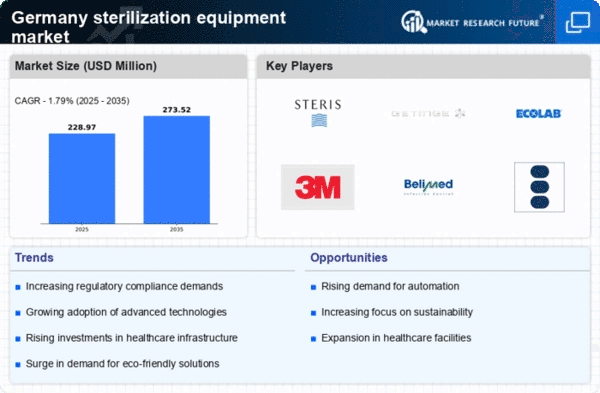
As per Market Research Future analysis, the Germany sterilization equipment market size was estimated at 224.94 USD Million in 2024. The Germany sterilization equipment market is projected to grow from 228.97 USD Million in 2025 to 273.52 USD Million by 2035, exhibiting a compound annual growth rate (CAGR) of 1.7% during the forecast period 2025 - 2035

Key Market Trends & Highlights

The Germany sterilization equipment market is poised for growth driven by technological advancements and regulatory compliance.

  • Technological advancements in sterilization equipment are enhancing efficiency and effectiveness across healthcare settings.
  • The largest segment in the market is the healthcare sector, while the pharmaceutical sector is the fastest-growing segment.
  • Regulatory compliance remains a critical factor influencing market dynamics, ensuring safety and efficacy in sterilization processes.
  • Rising healthcare expenditure and increased awareness of infection control are key drivers propelling market growth.

Market Size & Forecast

2024 Market Size 224.94 (USD Million)
2035 Market Size 273.52 (USD Million)
CAGR (2025 - 2035) 1.79%

Major Players

Steris (US), Getinge (SE), Ecolab (US), 3M (US), Belimed (CH), Matachana (ES), Tuttnauer (IL), Sakura (JP)

Our Impact
Enabled $4.3B Revenue Impact for Fortune 500 and Leading Multinationals
Partnering with 2000+ Global Organizations Each Year
30K+ Citations by Top-Tier Firms in the Industry

Germany Sterilization Equipment Market Trends

The sterilization equipment market is currently experiencing notable growth. This growth is driven by increasing awareness regarding infection control and the necessity for maintaining hygiene standards across various sectors. In Germany, stringent regulations and guidelines from health authorities are propelling the demand for advanced sterilization technologies. This trend is particularly evident in healthcare facilities, where the need for effective sterilization processes is paramount to ensure patient safety and prevent healthcare-associated infections. Furthermore, the rise in surgical procedures and the expansion of healthcare infrastructure contribute to the market's expansion, as hospitals and clinics seek reliable sterilization solutions to meet regulatory compliance and enhance operational efficiency. In addition to healthcare, the sterilization equipment market is witnessing interest from industries such as pharmaceuticals and food processing. These sectors are increasingly adopting sterilization technologies to ensure product safety and extend shelf life. The growing emphasis on quality assurance and safety standards is likely to drive innovation in sterilization methods, including the adoption of automated systems and eco-friendly solutions. As the market evolves, stakeholders are expected to focus on developing advanced sterilization equipment that meets the diverse needs of various industries while adhering to environmental regulations. This dynamic landscape suggests a promising future for the sterilization equipment market in Germany, characterized by technological advancements and a commitment to safety and efficiency.

Technological Advancements

The sterilization equipment market is witnessing rapid technological advancements, with innovations aimed at improving efficiency and effectiveness. Automated systems and smart technologies are being integrated into sterilization processes, enhancing precision and reducing human error. This trend is particularly relevant in healthcare settings, where the need for reliable sterilization is critical.

Regulatory Compliance

Stringent regulations imposed by health authorities are driving the demand for advanced sterilization solutions. Facilities are increasingly required to adhere to strict guidelines, prompting investments in state-of-the-art equipment. This trend underscores the importance of compliance in maintaining safety standards across various sectors.

Sustainability Initiatives

There is a growing focus on sustainability within the sterilization equipment market, with manufacturers exploring eco-friendly solutions. The shift towards greener technologies reflects a broader commitment to environmental responsibility, as industries seek to minimize their ecological footprint while ensuring effective sterilization.

Germany Sterilization Equipment Market Drivers

Rising Healthcare Expenditure

The increasing healthcare expenditure in Germany is a pivotal driver for the sterilization equipment market. As healthcare budgets expand, hospitals and clinics are investing more in advanced sterilization technologies to ensure patient safety and compliance with health regulations. In 2023, healthcare spending in Germany reached approximately €450 billion, reflecting a growth of around 5% from the previous year. This trend indicates a strong commitment to improving healthcare infrastructure, which directly influences the demand for sterilization equipment. Enhanced sterilization processes are essential for preventing hospital-acquired infections, thereby driving the market further. The sterilization equipment market is likely to benefit from this upward trajectory in healthcare investment, as facilities seek to upgrade their sterilization capabilities to meet rising standards and expectations.

Regulatory Standards and Compliance

Regulatory standards and compliance requirements are critical drivers of the sterilization equipment market in Germany. The stringent regulations set forth by health authorities necessitate that healthcare facilities adhere to specific sterilization protocols to ensure patient safety. Compliance with these regulations often requires the adoption of advanced sterilization equipment that meets the latest safety and efficacy standards. As regulatory bodies continue to update and enforce these standards, healthcare providers are compelled to invest in new sterilization technologies. This trend is expected to drive the sterilization equipment market as facilities strive to maintain compliance and avoid penalties. The ongoing evolution of regulatory frameworks indicates a sustained demand for high-quality sterilization solutions in the healthcare sector.

Increased Awareness of Infection Control

There is a growing awareness of infection control practices among healthcare professionals and the general public in Germany, which significantly impacts the sterilization equipment market. This heightened awareness is driven by educational campaigns and the dissemination of information regarding the importance of sterilization in preventing infections. As a result, healthcare facilities are prioritizing the acquisition of advanced sterilization equipment to enhance their infection control protocols. The sterilization equipment market is projected to grow as hospitals and clinics recognize the necessity of maintaining high standards of cleanliness and safety. This trend is further supported by the increasing incidence of healthcare-associated infections, which has prompted a more proactive approach to sterilization practices across the healthcare sector.

Technological Innovations in Sterilization

Technological innovations are transforming the sterilization equipment market, particularly in Germany. The introduction of advanced sterilization methods, such as low-temperature plasma and vaporized hydrogen peroxide, is enhancing the efficiency and effectiveness of sterilization processes. These innovations not only improve sterilization outcomes but also reduce the time and resources required for sterilization. In 2025, the market for advanced sterilization technologies is expected to grow by approximately 8%, driven by the demand for more efficient and reliable sterilization solutions. As healthcare facilities seek to adopt these cutting-edge technologies, the sterilization equipment market is likely to experience significant growth. The integration of automation and digital monitoring systems further enhances the appeal of modern sterilization equipment, making it a key driver in the market.

Growth of the Pharmaceutical and Biotechnology Sectors

The growth of the pharmaceutical and biotechnology sectors in Germany is a significant driver for the sterilization equipment market. As these industries expand, the need for effective sterilization processes becomes increasingly critical to ensure product safety and efficacy. The pharmaceutical sector alone is projected to reach €50 billion by 2025, necessitating robust sterilization solutions to meet production demands. This growth is likely to stimulate investments in sterilization equipment, as manufacturers seek to comply with stringent quality standards. The sterilization equipment market is expected to benefit from this trend, as both pharmaceutical and biotechnology companies prioritize the implementation of advanced sterilization technologies to safeguard their products and maintain regulatory compliance.


Market Segment Insights

By Application: Medical Equipment Sterilization (Largest) vs. Pharmaceutical Sterilization (Fastest-Growing)

In the Germany sterilization equipment market, the dominant application segment is medical equipment sterilization, commanding the largest share due to the high volume of surgical procedures and the critical need for effective infection control in healthcare settings. This segment is driven by the stringent regulations and increasing standards for sterilization to ensure patient safety, leading to significant investments in advanced sterilization technologies. On the other hand, pharmaceutical sterilization is rapidly emerging as the fastest-growing segment. The expansion in biopharmaceutical products and the rising demand for aseptic manufacturing processes are key drivers. Additionally, innovations in sterilization technology that meet the specific requirements of pharmaceuticals are contributing to market growth, making it a vital area for future development within the industry.

Medical Equipment Sterilization (Dominant) vs. Pharmaceutical Sterilization (Emerging)

Medical equipment sterilization plays a crucial role in maintaining compliance with health regulations, ensuring that surgical instruments, implants, and medical devices are free from contamination. This segment benefits from established market presence and a vast customer base, comprising hospitals and clinics that prioritize hygiene and safety. In contrast, pharmaceutical sterilization is gaining momentum, particularly for the production of sterile drugs and vaccines. The growth in this segment is characterized by advancements in technology that enhance sterilization precision and efficacy, catering to the increasing complexities of modern pharmaceuticals. Together, these segments shape the landscape of the Germany sterilization equipment market, highlighting the importance of innovation and regulatory compliance in driving future growth.

By Product Type: Steam Sterilizers (Largest) vs. Ethylene Oxide Sterilizers (Fastest-Growing)

Steam sterilizers dominate the market due to their efficiency and effectiveness in sterilizing medical equipment. Representing a significant portion of the overall product type segment, they are widely utilized across hospitals and clinics in Germany. Ethylene oxide sterilizers, while smaller in market share, are experiencing rapid adoption, particularly for heat-sensitive materials, highlighting a shift towards diverse sterilization methods. Growth in the steam sterilizers segment is driven by advancements in technology and increasing demand from healthcare facilities. Conversely, the rise of ethylene oxide sterilizers is fueled by innovations catering to niche applications, ensuring they remain relevant amid evolving sterilization protocols. As healthcare practices modernize, the steady adoption of these technologies is expected to continue, supporting robust growth in the overall segment.

Steam Sterilizers (Dominant) vs. Ethylene Oxide Sterilizers (Emerging)

Steam sterilizers are characterized by their wide usage and proven reliability, making them the dominant choice for most medical facilities. They work by utilizing high-pressure steam to eliminate microorganisms, providing a fast and effective solution for sterilization needs. On the other hand, ethylene oxide sterilizers present an emerging alternative, particularly favored for sterilizing sensitive medical devices that cannot withstand high temperatures. Their ability to operate at lower temperatures expands their applicability in various medical and laboratory contexts. As healthcare facilities strive for enhanced patient safety and operational efficiency, both product types are carving out significant niches within the Germany sterilization equipment market.

By End Use: Hospitals (Largest) vs. Pharmaceutical Companies (Fastest-Growing)

The Germany sterilization equipment market sees hospitals commanding the largest share among end users, reflecting the critical role they play in maintaining hygiene and safety. This dominance is supported by increasing patient counts and the expanding healthcare infrastructure, resulting in heightened demand for efficient sterilization solutions. Conversely, pharmaceutical companies are emerging as the fastest-growing segment, driven by the need for stringent sterilization processes to ensure product safety and compliance with regulatory standards. Growth trends within the end-use segment are primarily influenced by advancements in sterilization technology and heightened awareness of infection control. The increasing emphasis on sanitation in healthcare settings coupled with the rapid expansion of the pharmaceutical sector contributes significantly to the evolving landscape. Furthermore, clinical laboratories and the food industry are also pivotal, affecting overall market dynamics with their specific sterilization requirements as they become increasingly aware of the importance of effective sterilization methods.

Hospitals: Dominant vs. Pharmaceutical Companies: Emerging

Hospitals remain the dominant end user in the Germany sterilization equipment market, integral to ensuring patient safety through effective infection control measures. Their purchasing decisions are often driven by the necessity for high-volume sterilization processes, particularly in surgical and intensive care units. On the other hand, pharmaceutical companies represent an emerging segment, characterized by rapid growth due to escalating regulatory pressures and the need for enhanced product safety. This sector requires advanced sterilization technologies to comply with strict guidelines, leading to increased investments in state-of-the-art equipment. While hospitals focus on reliability and cost-efficiency, pharmaceutical companies prioritize innovation and adaptability to meet evolving market demands.

By Technique: Thermal Sterilization (Largest) vs. Chemical Sterilization (Fastest-Growing)

In the Germany sterilization equipment market, Thermal Sterilization stands out as the largest segment, capturing a significant share of the market. It is preferred in various industries due to its effectiveness in eliminating microorganisms, making it a go-to choice for many applications including healthcare and food safety. On the other hand, Chemical Sterilization is recognized as the fastest-growing segment, driven by the increasing demand for sterilization methods that are effective on heat-sensitive materials. Innovations in chemical agents and procedures are also enhancing the appeal of this segment, catering to diverse sectors such as pharmaceuticals and medical devices.

Sterilization Technique: Thermal Sterilization (Dominant) vs. Chemical Sterilization (Emerging)

Thermal Sterilization, characterized by its use of high temperatures to kill bacteria and spores, dominates the Germany sterilization equipment market. Its reliability and efficiency make it indispensable in hospitals and laboratories. Moreover, the segment boasts a well-established infrastructure and regulatory support. Conversely, Chemical Sterilization is emerging significantly, often utilized for items that cannot withstand heat. This technique is gaining traction due to advancements in sterilant formulations and a growing focus on safety and effectiveness in sterilization procedures. Both segments are crucial for maintaining hygiene standards across various industries.

Get more detailed insights about Germany Sterilization Equipment Market

Key Players and Competitive Insights

The sterilization equipment market in Germany is characterized by a competitive landscape that is both dynamic and multifaceted. Key growth drivers include the increasing demand for infection control in healthcare settings, advancements in sterilization technologies, and a heightened focus on regulatory compliance. Major players such as Steris (US), Getinge (SE), and Ecolab (US) are strategically positioned to leverage these trends. Steris (US) emphasizes innovation in its product offerings, particularly in the development of advanced sterilization systems that enhance efficiency and safety. Getinge (SE) focuses on regional expansion and partnerships, aiming to strengthen its market presence through collaborations with healthcare institutions. Ecolab (US) is actively pursuing digital transformation initiatives, integrating smart technologies into its sterilization solutions, which collectively shape a competitive environment that prioritizes technological advancement and customer-centric solutions.Key business tactics within this market include localizing manufacturing to reduce costs and optimize supply chains, which is particularly relevant given the current economic climate. The competitive structure appears moderately fragmented, with several key players exerting influence over market dynamics. This fragmentation allows for a diverse range of products and services, catering to various customer needs while fostering innovation through competition among established and emerging companies.

In October Steris (US) announced the launch of a new line of sterilization equipment designed specifically for the European market, which is expected to enhance its competitive edge by addressing local regulatory requirements and customer preferences. This strategic move not only reinforces Steris's commitment to innovation but also positions the company to capture a larger market share in a region that is increasingly prioritizing advanced sterilization solutions. This product line is likely to resonate with healthcare providers seeking reliable and efficient sterilization methods.

In September Getinge (SE) entered into a strategic partnership with a leading hospital network in Germany to implement its latest sterilization technologies across multiple facilities. This collaboration is indicative of Getinge's strategy to enhance its service offerings and strengthen its foothold in the German market. By aligning with a prominent healthcare provider, Getinge is poised to gain valuable insights into customer needs while simultaneously showcasing the effectiveness of its sterilization solutions in real-world applications.

In August Ecolab (US) unveiled a new digital platform aimed at optimizing sterilization processes for healthcare facilities. This platform integrates AI-driven analytics to monitor and improve sterilization efficacy, thereby enhancing operational efficiency. The introduction of such technology reflects Ecolab's commitment to digitalization and positions the company as a leader in providing innovative solutions that address the evolving needs of the healthcare sector.

As of November current competitive trends in the sterilization equipment market are increasingly defined by digitalization, sustainability, and the integration of AI technologies. Strategic alliances among key players are shaping the landscape, fostering collaboration that enhances product offerings and market reach. Looking ahead, competitive differentiation is likely to evolve from traditional price-based competition to a focus on innovation, technological advancements, and supply chain reliability. Companies that can effectively leverage these trends will be better positioned to meet the demands of a rapidly changing market.

Key Companies in the Germany Sterilization Equipment Market include

Industry Developments

In recent developments, the Germany Sterilization Equipment Market has gained traction due to increasing regulatory demands in healthcare settings, pushing companies like Astell Scientific, Getinge, and Steris to innovate and enhance their sterilization technologies. In October 2023, Ecolab announced advances in its automated sterilization solutions aimed at improving safety protocols in hospitals, which reflects a significant trend toward improving patient care. 

Recent mergers in the sector have included Cantel Medical acquiring a smaller firm to bolster its presence in the European market, which was reported in September 2023. The market valuation for several prominent companies, including 3M and Thermo Fisher Scientific, has seen growth attributed to rising healthcare expenditures and advancements in sterilization techniques. 

Moreover, governmental efforts to enhance infection control measures due to ongoing global health challenges have further stimulated the market, encouraging investment and Research and Development across many firms. Major happenings in the last couple of years included Metall Zug's expansion plans in Germany in August 2022 to build new manufacturing facilities that cater to increasing domestic demand for sterilization solutions. This aligns with the country's commitment to maintaining stringent health standards in medical environments.

Future Outlook

Germany Sterilization Equipment Market Future Outlook

The Sterilization Equipment Market is projected to grow at 1.79% CAGR from 2025 to 2035, driven by technological advancements, regulatory changes, and increasing healthcare demands.

New opportunities lie in:

  • Development of advanced sterilization technologies for medical devices
  • Expansion of sterilization services in emerging healthcare facilities
  • Integration of IoT for real-time monitoring of sterilization processes

By 2035, the market is expected to achieve robust growth, driven by innovation and increased healthcare investments.

Market Segmentation

Germany Sterilization Equipment Market End Use Outlook

  • Hospitals
  • Pharmaceutical Companies
  • Clinical Laboratories
  • Food Industry

Germany Sterilization Equipment Market Technique Outlook

  • Thermal Sterilization
  • Chemical Sterilization
  • Radiation Sterilization

Germany Sterilization Equipment Market Application Outlook

  • Medical Equipment Sterilization
  • Pharmaceutical Sterilization
  • Laboratory Sterilization
  • Food Sterilization

Germany Sterilization Equipment Market Product Type Outlook

  • Steam Sterilizers
  • Ethylene Oxide Sterilizers
  • Radiation Sterilizers
  • Plasma Sterilizers

Report Scope

MARKET SIZE 2024 224.94(USD Million)
MARKET SIZE 2025 228.97(USD Million)
MARKET SIZE 2035 273.52(USD Million)
COMPOUND ANNUAL GROWTH RATE (CAGR) 1.79% (2025 - 2035)
REPORT COVERAGE Revenue Forecast, Competitive Landscape, Growth Factors, and Trends
BASE YEAR 2024
Market Forecast Period 2025 - 2035
Historical Data 2019 - 2024
Market Forecast Units USD Million
Key Companies Profiled Steris (US), Getinge (SE), Ecolab (US), 3M (US), Belimed (CH), Matachana (ES), Tuttnauer (IL), Sakura (JP)
Segments Covered Application, Product Type, End Use, Technique
Key Market Opportunities Adoption of advanced sterilization technologies driven by stringent regulatory standards and increasing healthcare demands.
Key Market Dynamics Rising regulatory standards drive innovation and competition in the sterilization equipment market.
Countries Covered Germany
Leave a Comment

FAQs

What is the projected market size of the Germany Sterilization Equipment Market by 2035?

The Germany Sterilization Equipment Market is expected to reach a value of 688.61 USD Million by 2035.

What was the estimated market value of the Germany Sterilization Equipment Market in 2024?

In 2024, the Germany Sterilization Equipment Market is expected to be valued at approximately 462.3 USD Million.

What is the expected CAGR for the Germany Sterilization Equipment Market from 2025 to 2035?

The market is anticipated to grow at a CAGR of 3.689% from 2025 to 2035.

Which technology segment dominates the Germany Sterilization Equipment Market?

Steam Sterilization is the dominant segment, projected to reach 276.53 USD Million by 2035.

What market size is expected for the Ethylene Oxide Sterilization segment by 2035?

The Ethylene Oxide Sterilization segment is expected to reach a market value of 204.15 USD Million by 2035.

Who are some key players in the Germany Sterilization Equipment Market?

Major players include Astell Scientific, Fedegari, Ecolab, Getinge, and 3M among others.

What is the expected market value of Radiation Sterilization in 2024?

The Radiation Sterilization market is projected to be valued at 69.3 USD Million in 2024.

What opportunities exist in the Germany Sterilization Equipment Market?

There are growth opportunities in technological advancements and increasing demand in healthcare applications.

What is the expected market size for Plasma Sterilization by 2035?

Plasma Sterilization is expected to reach a market size of 68.07 USD Million by 2035.

How does the Dry Heat Sterilization segment project to grow by 2035?

The Dry Heat Sterilization segment is anticipated to grow to 37.46 USD Million by 2035.

Download Free Sample

Kindly complete the form below to receive a free sample of this Report

Compare Licence

×
Features License Type
Single User Multiuser License Enterprise User
Price $4,950 $5,950 $7,250
Maximum User Access Limit 1 User Upto 10 Users Unrestricted Access Throughout the Organization
Free Customization
Direct Access to Analyst
Deliverable Format
Platform Access
Discount on Next Purchase 10% 15% 15%
Printable Versions